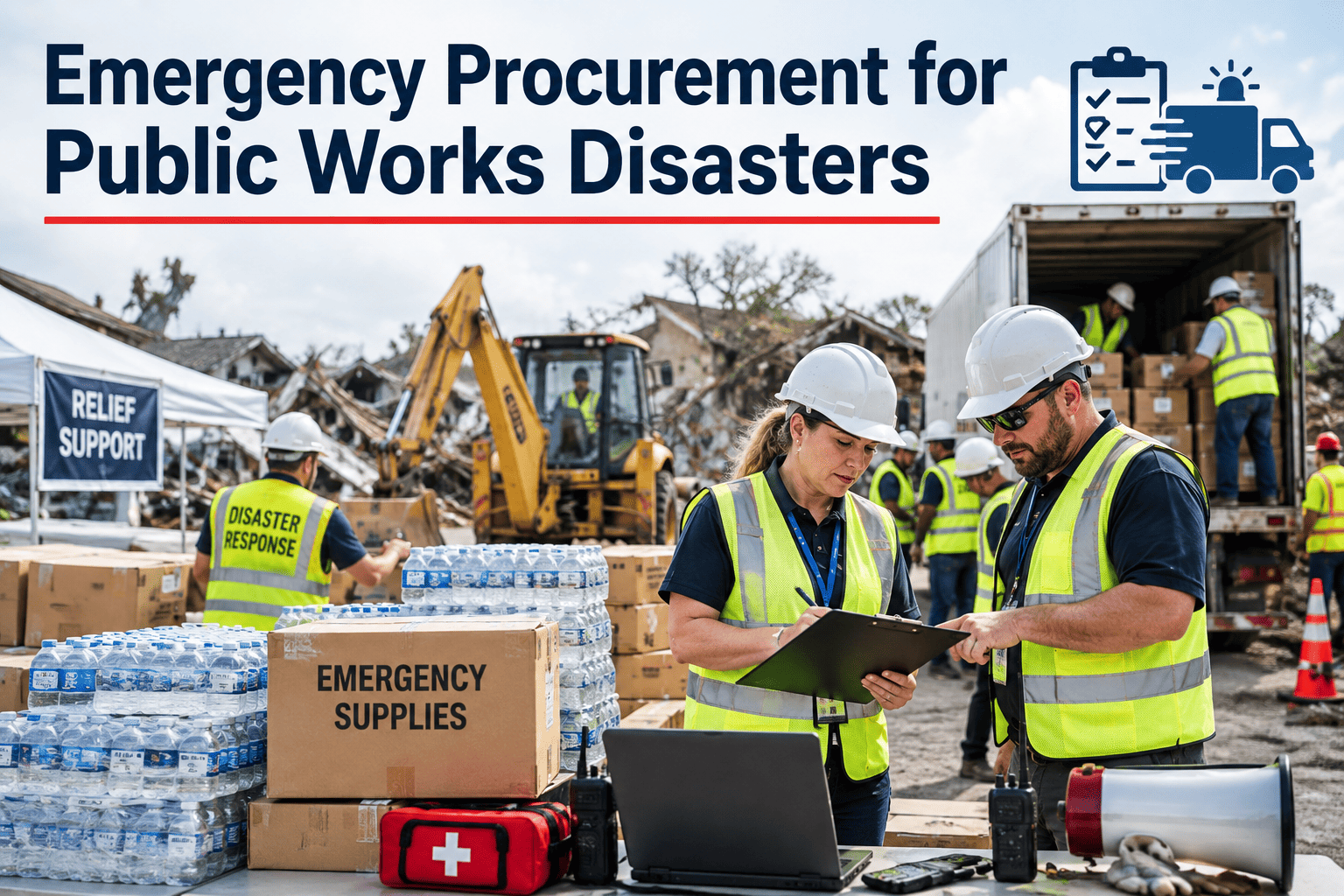
Emergency procurement for public works disasters is the critical window where agencies either mobilize contractors, materials, and equipment within hours — or stall while standard bidding procedures catch up. When hurricanes, floods, or infrastructure failures strike, municipal teams must use emergency procurement provisions to bypass routine solicitation timelines without sacrificing the audit-defensibility required for FEMA reimbursement. By pre-establishing contracts, defining emergency purchase authorities, and maintaining a rigorous disaster procurement framework, public works departments can respond rapidly while staying fully compliant with federal, state, and local regulations. Tying this rapid-response capability into an AI-powered CMMS like OxMaint ensures your maintenance teams can instantly generate emergency work orders, track contractor costs, and capture documentation in real time. Explore how to modernize your disaster response and Start Free Trial to test the workflow today.
Public Works Disaster Procurement
Can your agency mobilize emergency contractors in under 24 hours — and still pass a federal audit?
Disaster procurement government rules require speed, but FEMA reimbursement demands flawless documentation. OxMaint bridges the gap — triggering pre-approved emergency work orders, tracking spare-parts inventory, and capturing contractor costs in real time so your public works team responds fast without breaking the rules.
72hrs
Maximum window for FEMA-reimbursable emergency procurement documentation after disaster declaration
Emergency Procurement Framework
How emergency procurement works for public works disasters
Government emergency purchasing during disasters relies on four foundational pillars. When a municipal emergency is declared, standard competitive bidding thresholds — often requiring 3 bids for purchases over $50,000 — are temporarily suspended. However, disaster purchasing government regulations still require justification, cost reasonableness, and complete audit trails. Public works agencies that fail to document these elements risk losing millions in FEMA Public Assistance reimbursement.
Establish Pre-Approved Contracts
Negotiate Indefinite Delivery/Indefinite Quantity (IDIQ) agreements with debris removal, heavy equipment, and utility repair vendors before disaster strikes. Pre-vetted contractors reduce mobilization from 5 days to under 12 hours.
Declare & Activate Emergency Authority
Issue a formal emergency declaration activating emergency contracting government provisions. This unlocks sole-source purchasing, raises approval thresholds from $5K to $250K, and bypasses standard solicitation timelines.
Execute Emergency Purchasing
Deploy emergency purchase orders against pre-established contracts or use emergency sole-source authority. Track every transaction, contractor hour, and equipment rental in a centralized CMMS for audit defense.
Document for FEMA Reimbursement
Capture force account labor, materials, equipment usage, and contractor invoices with project worksheets (PWs). Missing or incomplete documentation is the #1 reason FEMA denies public works disaster claims.
Compliance Checklists
Municipal emergency procurement checklist for disaster response
A 2023 study found that 35% of FEMA project worksheets are initially denied due to incomplete procurement documentation. Use this emergency contracting public works checklist to ensure every purchase is defensible.
Pre-Established Contracts
- Debris removal IDIQ contracts with unit pricing
- Water and wastewater emergency repair agreements
- Heavy equipment rental stand-by contracts
- Pre-vetted electrical and generator suppliers
Documentation & Audit Trail
- Emergency declaration recorded with timestamp
- Justification memo for sole-source selections
- Force account labor logs with regular + overtime rates
- Equipment usage logs with FEMA rate codes
Cost Reasonableness
- Historical pricing comparison for all purchases over $5K
- Contractor invoice reconciliation against scope of work
- Material quantity tickets with load verification
- Spare-parts inventory consumption reports
FEMA Reimbursement
Disaster procurement documentation that survives FEMA audits
FEMA Public Assistance reimbursement can cover 75–90% of eligible emergency procurement costs — but only if documentation is bulletproof. For a mid-sized municipality spending $2.5M on hurricane debris removal, a failed audit means absorbing $1.8M+ in unreimbursed costs. The formula below shows how centralized tracking directly impacts recoverable funds.
FEMA Reimbursement Recovery Formula
Recoverable Funds = (Eligible Costs × Federal Share %) − Documentation Deficiency Penalty
Example: $2.5M eligible debris removal × 85% federal share = $2.125M recoverable. With 30% incomplete documentation, recovery drops to $1.48M — a $645K loss.
| Documentation Element | FEMA Requirement | Risk Without CMMS | With OxMaint Tracking |
|---|---|---|---|
| Force Account Labor | Name, role, regular/OT hours, benefits rate | Manual timesheets lost or incomplete | Auto-captured from emergency work orders |
| Equipment Usage | FEMA rate code, hours operated, mileage | Rental invoices without hour logs | Asset meter readings attached to work orders |
| Materials & Supplies | Quantity, unit cost, inventory drawdown | No linkage between spare parts and disaster site | Inventory consumption tied to asset and location |
| Contractor Invoices | Scope alignment, unit pricing, completion verification | Lump-sum invoices without detail | Line-item approval workflow with photo evidence |
| Project Worksheets | Cost summary per disaster site and category | Compiled manually 60–90 days post-disaster | One-click export of all disaster-tagged work orders |
Real-World Scenario
A coastal municipality's $4.2M disaster procurement response
Consider a coastal public works department with 180 critical assets — pumps, generators, flood gates, and lift stations — facing a Category 3 hurricane. Before implementing a CMMS, their 2019 disaster response relied on paper work orders and spreadsheet purchasing. They spent $4.2M on emergency procurement but could only document $2.8M adequately, losing $1.05M in FEMA reimbursement.
$1.05M lost
Paper work orders damaged by floodwater. Contractor hours logged on clipboards. Spare parts pulled from inventory without requisition records. 38% of project worksheets denied by FEMA.
$3.57M recovered
Mobile work orders captured contractor hours with GPS timestamps. Inventory drawdown auto-tracked against disaster-tagged assets. Photo evidence attached to every emergency PO. 96% FEMA approval rate.
The difference wasn't spending more — it was documenting everything in real time through a centralized platform that connected emergency purchasing, work order execution, and asset tracking from day one.
How OxMaint Helps
How OxMaint streamlines emergency procurement for public works
OxMaint's AI-powered CMMS and EAM platform turns chaotic disaster procurement into a controlled, auditable process. Every emergency work order, contractor hour, and spare part is captured against the specific asset and disaster event — creating the documentation chain FEMA requires.
Instant Emergency Work Orders
Generate and dispatch emergency work orders to contractors in under 5 minutes. Mobile-first capture ensures every action — labor hours, materials used, task completion — is timestamped and GPS-tagged for FEMA documentation.
Real-Time Spare-Parts Tracking
Every emergency parts drawdown is automatically linked to the asset and work order. Inventory levels update in real time, preventing stockouts of critical components like pump impellers and generator filters during peak disaster response.
Audit-Ready Documentation Export
Tag work orders, purchases, and assets by disaster event code. Export complete FEMA project worksheet packets — including force account labor, equipment usage, and material costs — in one click instead of 60 days of manual compilation.
Predictive Asset Risk Scoring
AI-driven analytics identify which of your critical assets — pumps, flood gates, lift stations — are most likely to fail during a disaster event, enabling pre-emptive emergency procurement of spare parts before the storm hits.
Be Ready Before the Next Disaster
See OxMaint on your assets — book a 30-min demo
Discover how public works teams use OxMaint to cut emergency work order creation from hours to minutes, achieve 96% FEMA documentation compliance, and eliminate the spreadsheet chaos that costs agencies millions in unreimbursed disaster spending.
Frequently Asked Questions
Emergency procurement government: top questions answered
What is emergency procurement in government and public works?
Emergency procurement is a specialized purchasing authority that allows government agencies to bypass standard competitive bidding timelines during declared disasters. In public works, it enables rapid contracting for debris removal, infrastructure repair, and emergency equipment rental. The key requirement is that the emergency must be formally declared, and all purchases must still be documented with cost reasonableness justification for post-disaster audits.
How does FEMA reimbursement work for emergency procurement public works?
FEMA Public Assistance typically reimburses 75–90% of eligible emergency procurement costs, including force account labor, equipment usage, materials, and contractor services. To qualify, agencies must maintain detailed documentation including work orders, timesheets, equipment logs, and invoices. Using a CMMS like OxMaint ensures this documentation is captured in real time — you can Start Free Trial to see how automatic work order tracking builds your audit trail from day one.
Can government agencies use sole-source contracting during a disaster?
Yes, emergency procurement provisions allow sole-source contracting when the urgency of the disaster makes competitive bidding impractical. However, agencies must document a written justification explaining why sole-source was necessary, confirm the pricing is reasonable, and ensure the contractor is not debarred or suspended. Failure to document sole-source justification is a top reason for FEMA claim denials.
What should be in a municipal emergency procurement plan?
A complete municipal emergency procurement plan includes pre-established IDIQ contracts for debris removal and equipment rental, emergency purchase order thresholds and approval authorities, a vendor pre-qualification list, documentation templates for FEMA project worksheets, and integration with the agency's CMMS for real-time work order and cost tracking. Plans should be reviewed annually and tested through tabletop exercises.
How can a CMMS improve disaster procurement compliance?
A CMMS like OxMaint improves compliance by automatically capturing every emergency work order, contractor hour, spare part, and equipment usage entry with timestamps and GPS data. This creates an unbroken audit trail that maps directly to FEMA project worksheet requirements. Instead of spending 60–90 days manually compiling post-disaster documentation, public works teams can export complete cost summaries in minutes. Book a Book a Demo to see the FEMA-ready export in action.
Get Disaster-Ready Today
Don't let missing documentation cost your agency millions
Join the public works teams using OxMaint to mobilize emergency procurement in hours, document every cost in real time, and recover up to 90% more in FEMA reimbursement. Your disaster response framework — built in a single platform.
Free 14-day trial · No credit card