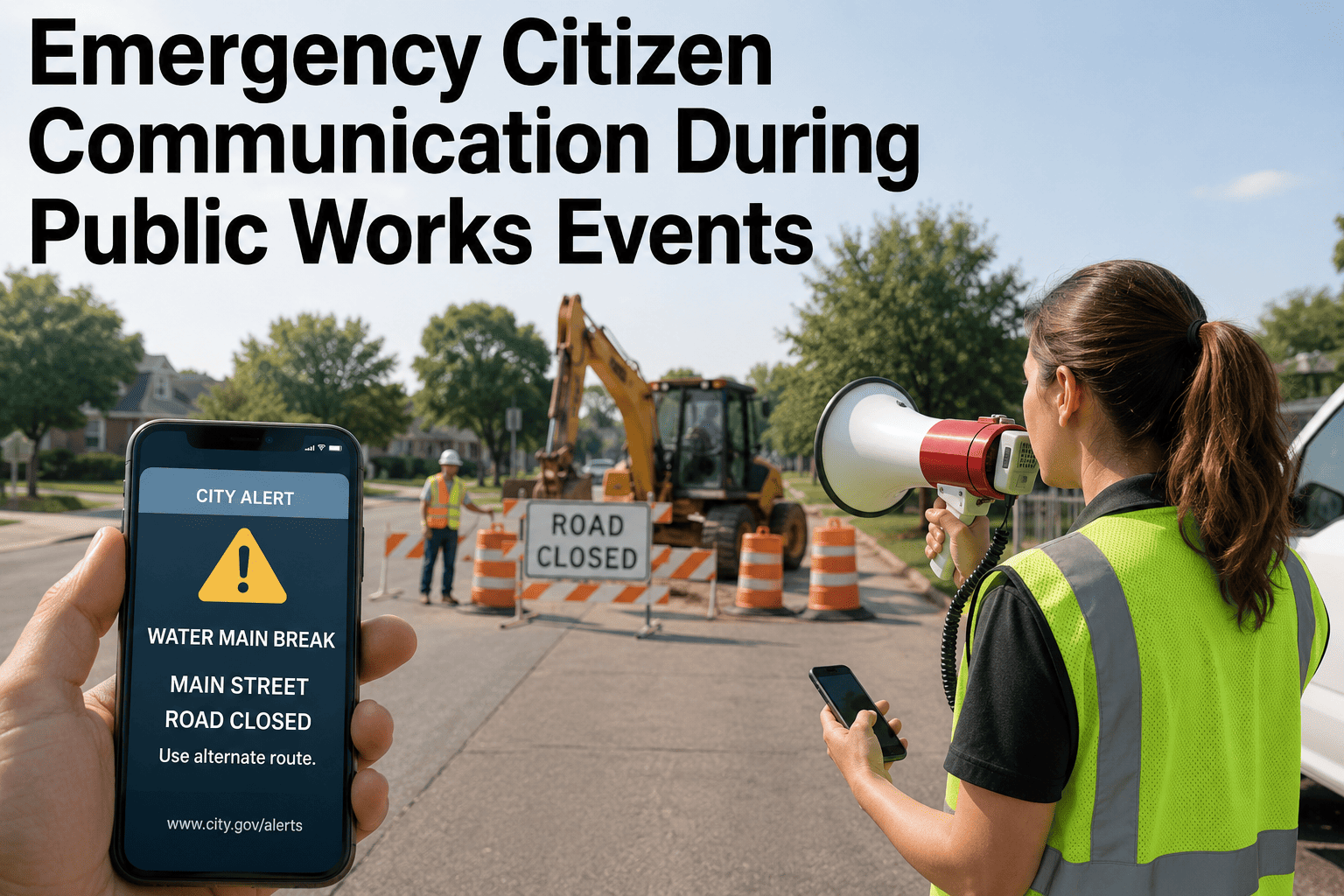
Effective emergency citizen communication during public works events — water main breaks, power outages, road closures, and sewer backups — is the difference between a manageable disruption and a public trust crisis. Municipalities that deploy a modern citizen notification system can reduce complaint call volume by up to 60% within the first hour of an infrastructure failure. When emergency notification municipal protocols are integrated directly into asset management workflows, crews respond faster, residents stay informed, and cities avoid the political fallout of silence. By connecting work order triggers to automated public works alerts, platforms like OxMaint close the gap between operational disruption and citizen communication. Explore how to modernize your approach or Start Free Trial to see the workflow in action.
Public Works Emergency Communication
Are your residents informed within 15 minutes of a water main break?
When infrastructure fails, silence breeds outrage. A structured municipal emergency communication plan delivers targeted government emergency alerts the moment a work order is triggered — protecting public safety, reducing call center overload, and preserving community trust.
The True Cost of Delayed Public Works Outage Communication
Why municipal emergency communication breaks down during infrastructure failures
A mid-sized city managing 12,000 water assets typically experiences 40–60 unplanned public works events per year — from main breaks to lift station failures. When emergency citizen notification relies on dispatchers manually emailing neighborhood lists or posting to social media, the lag between asset failure and citizen communication averages 94 minutes. During that window, 311 call volumes spike by 300%, emergency lines get congested, and residents turn to local news with complaints. The cost isn't just operational — it's reputational. Cities that implement automated public works alerts tied to maintenance triggers cut that notification delay to under 5 minutes and reduce complaint calls by up to 60%.
Step-by-Step Playbook
How to build an emergency citizen communication plan for public works
A defensible citizen notification system doesn't start when a pipe bursts — it starts with preventive maintenance data, asset criticality mapping, and pre-approved message templates. Here is the 5-phase timeline that high-performing municipal maintenance and reliability teams follow.
Map Assets to Affected Zones
Tag every critical asset — water mains, traffic signals, sewer lift stations — to a geographic service zone inside your CMMS. When a failure is logged, the system instantly knows which neighborhoods to alert. This asset-to-zone mapping is the foundation of targeted government emergency alerts.
Pre-Authorize Message Templates
Draft and legally review templates for the top 10 public works disruption scenarios before they happen. A water main break template, a boil-water advisory template, a road closure template. When a work order triggers an emergency notification, the municipal PIO approves — not drafts — saving 30–45 minutes.
Trigger Alerts From the Work Order
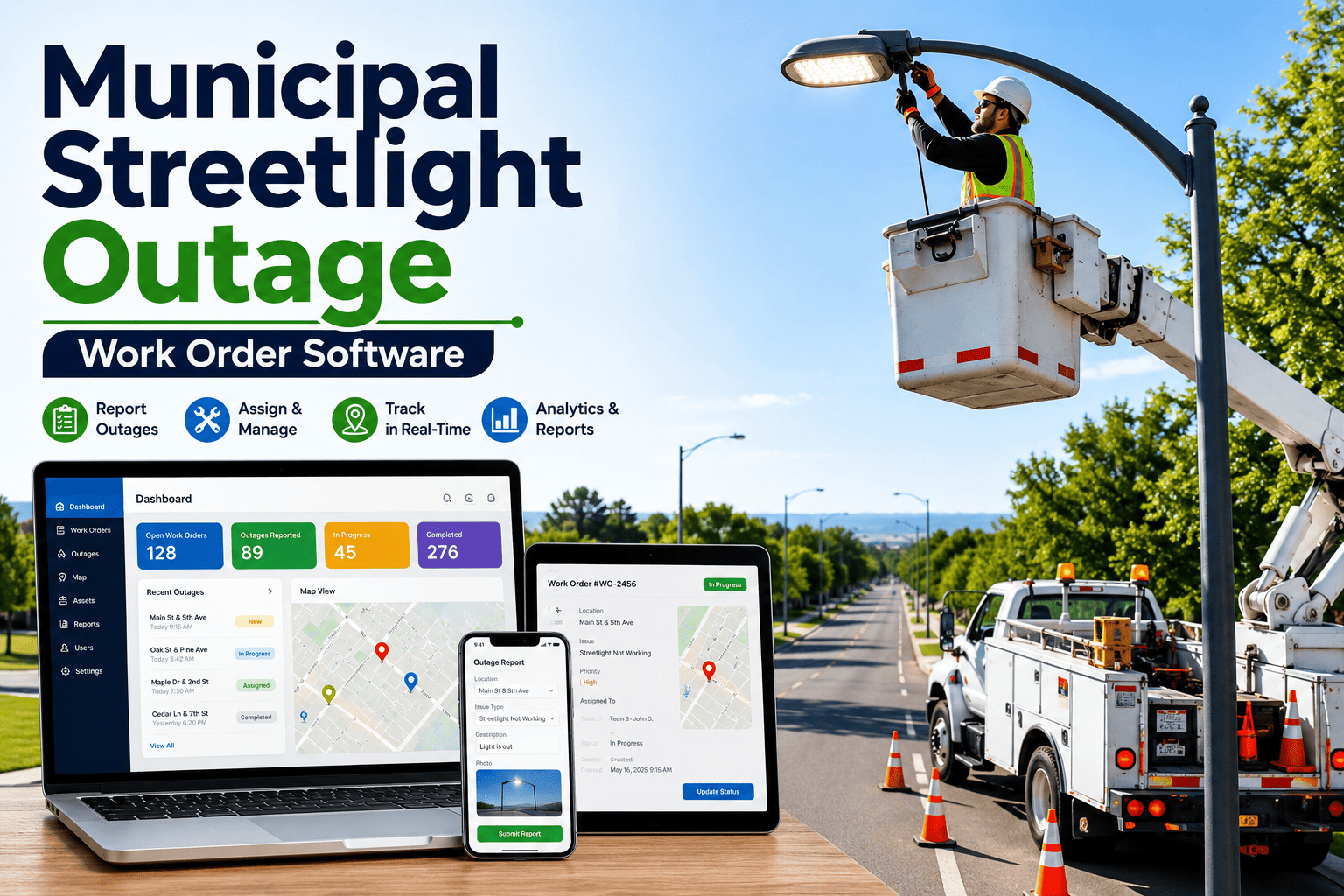
When a crew creates an emergency work order in the field, a rule-based citizen notification system should automatically push the approved template to SMS, email, and voice channels for the affected zone. No dispatcher intervention required. This is where public works outage communication shifts from reactive to automated.
Update Residents at Defined Intervals
Trust erodes during information blackouts. Schedule automated update alerts at 2-hour intervals until the asset is restored. Link each update to the work order status so messaging is accurate. Municipalities that send staged updates see a 45% drop in repeat 311 calls.
Post-Event Reconciliation and Analytics
After restoration, generate a communication audit from your maintenance analytics dashboard. Track alert delivery rate, time-to-first-notice, and citizen engagement. Use this data to refine the next cycle of emergency communication public works protocols.
Worked Example
A 180-asset public works department cut complaint calls by 58%
Consider a municipal water department in the Midwest managing 180 critical assets across 14 service zones. Before modernizing, they spent roughly $42,000 annually on overtime, call-center overflow, and manual door-to-door notification during outages. Their average time-to-citizen-alert was 82 minutes. After integrating work-order-triggered public works alerts through OxMaint, the department reduced time-to-alert to 6 minutes, cut complaint calls by 58%, and recovered $24,500 in overtime costs in the first year. The payback period for the software investment was under 4 months.
How OxMaint Helps
OxMaint capabilities that transform citizen communication during outages
OxMaint is an AI-powered CMMS and Enterprise Asset Management platform built for maintenance and reliability teams. It connects the operational reality of asset failure to the public-facing response — so municipal leaders can issue accurate, timely citizen alerts without relying on manual processes.
Asset-to-Zone Geographic Targeting
Every asset in OxMaint is mapped to a service zone. When a work order is created, the system instantly identifies the affected geographic area for precise citizen notification — no manual lookup required.
Work-Order-Triggered Alert Rules
Configure rules so that any emergency-class work order automatically generates a public works outage communication draft. The PIO reviews and approves in one click — shaving 30–45 minutes off manual drafting.
Predictive Maintenance Analytics
OxMaint AI analyzes vibration, pressure, and inspection history to predict asset failure before it happens — giving public works teams the chance to issue pre-emptive citizen alerts and schedule planned outages instead of emergency ones.
Full Audit Trail for Compliance
Every alert, work order, and asset event is time-stamped and logged. Generate a communication audit in seconds for city council inquiries, FEMA reporting, or ISO 55000 asset management compliance reviews.
Capability Comparison
Manual citizen alerts vs. OxMaint-integrated emergency notification
Most municipal maintenance teams still rely on a patchwork of phone trees, social media posts, and standalone email tools. Here is how that approach compares to a CMMS-integrated citizen notification system.
| Capability | Manual / Spreadsheet Process | OxMaint CMMS-Integrated |
|---|---|---|
| Time to first citizen alert | 60–120 minutes (manual drafting + approval) | Under 10 minutes (auto-generated from work order) |
| Geographic targeting | City-wide blast or manual list filtering | Automatic zone-based targeting from asset location |
| Message accuracy | Depends on dispatcher interpreting field report | Pulled directly from live work order data |
| Staged update automation | Manual — often forgotten during crisis | Scheduled and linked to work order status |
| Post-event audit readiness | Hours of manual log reconstruction | One-click report with full timestamp history |
| Predictive pre-alerts | Not possible — purely reactive | AI predicts failure; pre-emptive alerts issued |
Stop apologizing for slow public works alerts. Start automating.
See how OxMaint links work orders to citizen communication — so your next outage notification goes out in minutes, not hours.
Frequently Asked Questions
Emergency citizen communication for public works: top questions
What is emergency citizen communication in public works?
Emergency citizen communication is the process of notifying residents about infrastructure disruptions — water main breaks, road closures, power outages — in real time. A strong system uses automated citizen alerts triggered by maintenance work orders to deliver accurate, location-targeted messages across SMS, email, and voice channels within minutes of a failure.
How fast should municipal emergency communication reach residents?
Best practice for emergency notification municipal protocols is to deliver the first citizen alert within 15 minutes of confirming an asset failure. Cities using OxMaint's work-order-triggered alerts typically achieve first-notice delivery in under 10 minutes, compared to the 60–120 minute average for manual processes. Book a Demo to see the workflow live.
What channels should a citizen notification system use?
A redundant multi-channel approach is critical. Government emergency alerts should be pushed simultaneously via SMS text, email, automated voice calls, and social media integration. Relying on a single channel — like social media alone — misses residents without internet access and violates ADA and emergency management accessibility best practices.
How does a CMMS improve public works outage communication?
A CMMS like OxMaint connects the source of the disruption — the failed asset and its work order — directly to the communication system. This eliminates manual data entry, ensures message accuracy by pulling real-time repair status, and enables geographic targeting based on asset location data already stored in the system.
Can predictive maintenance reduce the need for emergency citizen alerts?
Yes. OxMaint's AI-powered predictive analytics identify asset degradation before catastrophic failure, allowing teams to schedule planned maintenance and issue pre-emptive citizen notifications. Municipalities using predictive maintenance typically shift 30–50% of emergency disruptions into planned, pre-communicated events — dramatically reducing citizen frustration. Start Free Trial to test predictive workflows on your assets.
Ready to modernize your municipal emergency communication?
Join public works teams using OxMaint to link asset management, work orders, and citizen alerts into one AI-powered platform. Reduce complaint calls, prove compliance, and restore trust — starting today.
Free 14-day trial · No credit card