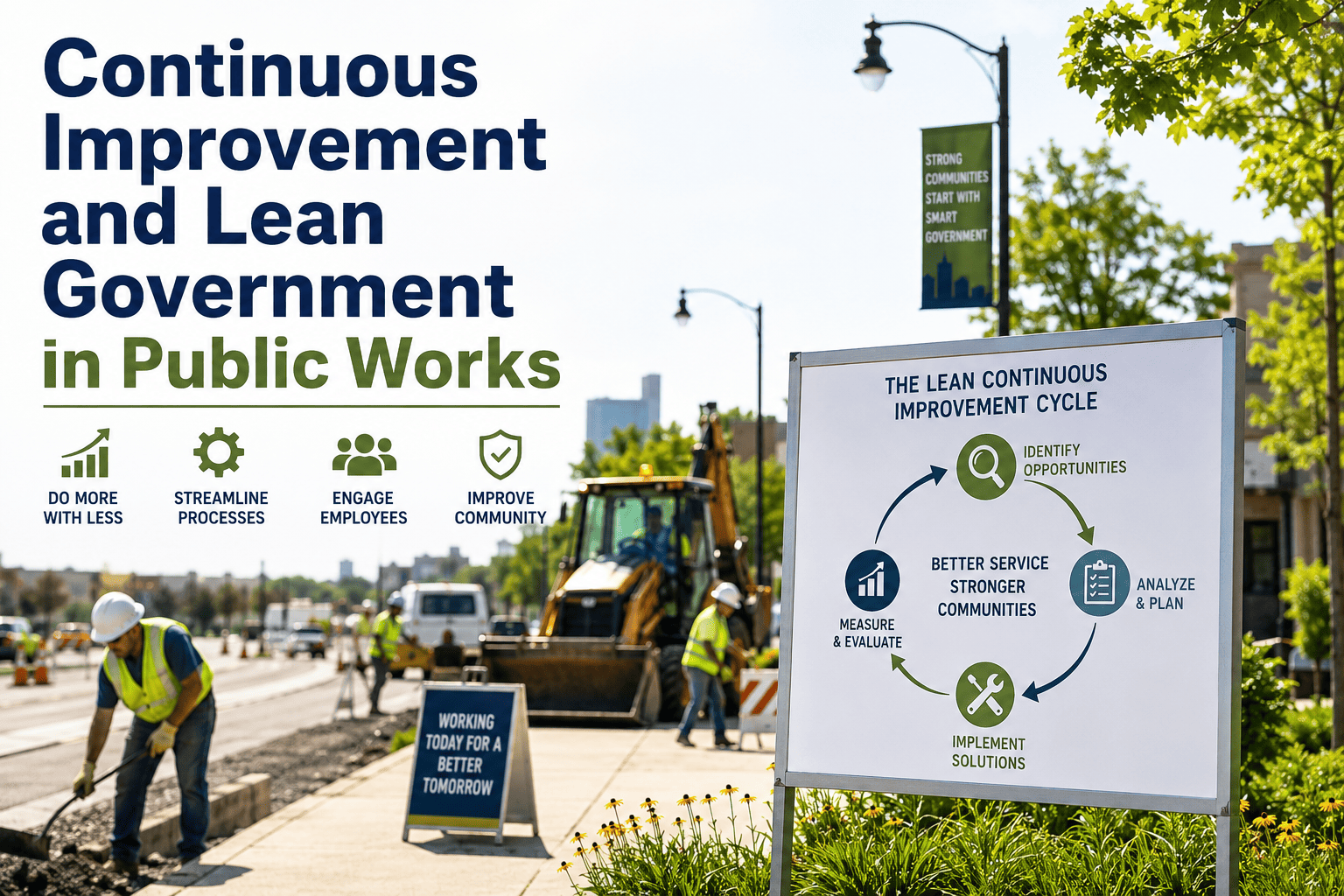
Continuous improvement and lean government in public works turn small, steady operational fixes into compounding gains in service quality, cost control, and crew productivity — without waiting for a big budget cycle or a new facility. The core idea is simple: map how work actually flows, remove the waste that slows crews down, and standardize the better way so it sticks. Municipalities that apply lean public works methods routinely cut work-order backlogs 20–40%, reduce repeat trips, and stretch limited staff further. This guide shows how to adapt lean and Kaizen to the realities of streets, water, fleet, and facilities — and how a platform like OxMaint makes continuous improvement measurable instead of aspirational. If you want to see the impact on your own operation, Start Free Trial and baseline your first value stream this week.
What if your public works department improved 1% every week — and could prove it?
Lean government is not about doing more with less until people burn out. It is about removing the wasted motion, waiting, and rework that already consume 25–35% of a typical crew's day — then locking in the better process. Continuous improvement in public works compounds: a 1% weekly gain becomes roughly 68% better performance in a year.
Why continuous improvement in government is no longer optional
Public works departments face a structural squeeze: infrastructure backlogs measured in the billions, flat or shrinking headcounts, and citizens who expect Amazon-level responsiveness from a pothole report. The U.S. alone carries an estimated $2.6 trillion infrastructure investment gap, and most municipal fleets and crews are already at capacity. You cannot hire your way out — you have to improve your way out.
The cost of the status quo is concrete. Consider a mid-size city running 12 field crews on paper work orders: if each two-person crew loses 90 minutes a day to windshield time, duplicate trips, and waiting on parts or approvals, that is 18 crew-hours daily — roughly 4,500 hours a year, or more than two full-time positions spent producing nothing. At a loaded labor rate of $55/hour, that is nearly $250,000 annually in pure waste, before counting overtime, contractor call-backs, or the citizen complaints that erode political support for your budget.
How to adapt lean methodology for the public sector
Lean was born in manufacturing, but its five principles translate cleanly to municipal operations — with a few important adaptations for public accountability, union agreements, and statutory requirements.
In lean government, the "customer" is the resident, business, or internal department you serve. Value is a safe road, clean water, a mowed park, a fast permit. Anything that does not move toward that outcome — duplicate data entry, approval layers that add no scrutiny, trips back to the yard — is a candidate for elimination.
Follow one work order from citizen call to close-out. Most departments discover the wrench time is under 40% of total elapsed time; the rest is handoffs, queues, and information gaps. Value stream mapping makes the invisible visible — and gives you the baseline every improvement is measured against.
Batch work by geography and asset class so crews stop zig-zagging across town. Move from "push" scheduling (whatever lands on the supervisor's desk) to "pull" (the next right job based on priority, location, and parts availability). Route optimization alone typically reclaims 30–60 minutes per crew per day.
An improvement that lives in one supervisor's head dies when they retire. Document standard work — the current best known method — for your highest-frequency tasks: pothole repair, sign replacement, hydrant flushing, PM inspections. Standards are not bureaucracy; they are the floor you improve from.
Continuous improvement in municipal government works best as many small experiments, not one grand reorganization. Run short Kaizen events (3–5 days) on a single painful process, measure before and after, keep what works. Twelve small wins a year beat one stalled transformation project every time.
Value stream mapping in action: a pothole work order
Here is what a value stream map typically reveals when a public works team traces one citizen-reported pothole from call to completion — and where the improvement opportunities hide.
| Step | Elapsed Time | Value-Added? | Typical Waste Found |
|---|---|---|---|
| Citizen call logged & entered | 0.5 day | No | Duplicate entry into 2–3 systems; mis-keyed location |
| Supervisor review & prioritization | 1–3 days | No | Queue waiting; unclear priority criteria |
| Crew dispatch & travel | 0.5 day | Partially | Cross-town trips; single-pothole runs |
| Repair (actual wrench time) | 45–90 min | Yes | Missing material; return trip for cold patch |
| Paperwork & close-out | 0.5–1 day | No | Handwritten forms re-typed at the office |
| Citizen notification | often never | Yes (perceived) | Repeat calls asking "did you forget me?" |
In this typical map, value-added work is under 15% of total elapsed time. A Kaizen team that batches repairs by zone, pre-stages materials, and closes work orders digitally from the field routinely cuts cycle time from 5+ days to under 48 hours — with the same crew and the same budget. That is lean public works in practice.
A 6-month roadmap to launch continuous improvement in your department
CI programs fail when they launch as a slogan. They succeed when they launch as a sequence. Here is a proven rollout for a municipal public works operation of any size.
Choose one high-volume, high-pain process — pothole response, fleet PMs, building work orders. Measure current cycle time, backlog, and rework rate. You cannot improve what you have not measured.
Bring the people who do the work into a 3–5 day event. Map the current state, design the future state, implement the top fixes immediately. Quick wins build the credibility the program needs.
Document standard work and move the improved workflow into your CMMS so it is enforced by the system, not by memory. Digital work orders eliminate the re-entry waste your map exposed.
Repeat the cycle on fleet maintenance and facilities. Stand up a simple dashboard — backlog, cycle time, PM compliance, first-time-fix rate — reviewed in a 15-minute weekly huddle.
Publish before/after numbers to leadership and council: hours reclaimed, backlog reduced, response time improved. Departments that document gains are the ones that win next year's budget conversation.
The system of record your lean program runs on
Every lean principle above depends on data: a baseline, a measure of change, and proof the gain held. Spreadsheets and paper cannot deliver that. OxMaint's AI-powered CMMS and EAM platform gives public works teams the measurement backbone continuous improvement requires.
Capture requests once, dispatch by zone and priority, and close from the field with photos and labor hours. Eliminates duplicate entry and cuts work-order cycle time 30–50% — the exact waste your value stream map targets.
Automate PMs for fleet, facilities, and infrastructure so planned work displaces reactive firefighting. Departments moving from reactive to 60%+ planned work typically cut emergency repair costs 20–30% within the first year.
Track backlog, cycle time, PM compliance, and first-time-fix rate automatically — your Kaizen baseline and your proof of results, always current. Walk into budget hearings with documented gains, not anecdotes.
Full asset history and parts inventory in one place, so crews arrive with the right material the first time. Killing return trips and parts-hunting recovers hours of wrench time every single week.
See your first value stream mapped in OxMaint — in 30 minutes
Book a live demo and we will walk through your highest-pain process — work orders, fleet PMs, or backlog — and show you exactly where the measurable gains are.
Lean government & public works CI: your questions answered
Lean government applies lean principles — value definition, waste elimination, flow, standard work, and continuous improvement — to public services. In public works it means delivering roads, water, fleet, and facility services with less waiting, less rework, and fewer wasted trips, so the same crew produces measurably more citizen value.
Start small and measurable: pick one painful, high-volume process, baseline its cycle time and backlog, run a 3–5 day Kaizen event with the people who do the work, then standardize and digitize the improved workflow. A CMMS like OxMaint gives you the baseline data and dashboards to prove the gain — Start Free Trial to baseline your first process.
A Kaizen event is a focused, time-boxed improvement workshop — typically 3 to 5 days — where a cross-functional team maps one process, identifies waste, and implements fixes on the spot. Municipalities use Kaizen to cut permitting cycle times, streamline work-order flow, and redesign crew routing, often achieving 30–50% cycle-time reductions in a single week.
Track a small set of operational KPIs before and after each change: work-order cycle time, backlog size, PM compliance rate, first-time-fix rate, overtime hours, and cost per work order. The key is a system that captures this automatically — manual tallying collapses within months. Book a Demo to see how OxMaint dashboards report these metrics live.
Yes — and it works better with them involved. Lean is not headcount reduction; it is removing the frustrations (missing parts, unclear priorities, duplicate paperwork) that make crews' days harder. The most successful municipal CI programs charter improvement teams with frontline and union representation from day one, so changes are co-designed and stick.
Make next quarter's improvement measurable — starting today
OxMaint gives your public works team digital work orders, automated PMs, asset tracking, and the analytics to prove every gain. Small improvements compound — start compounding now.