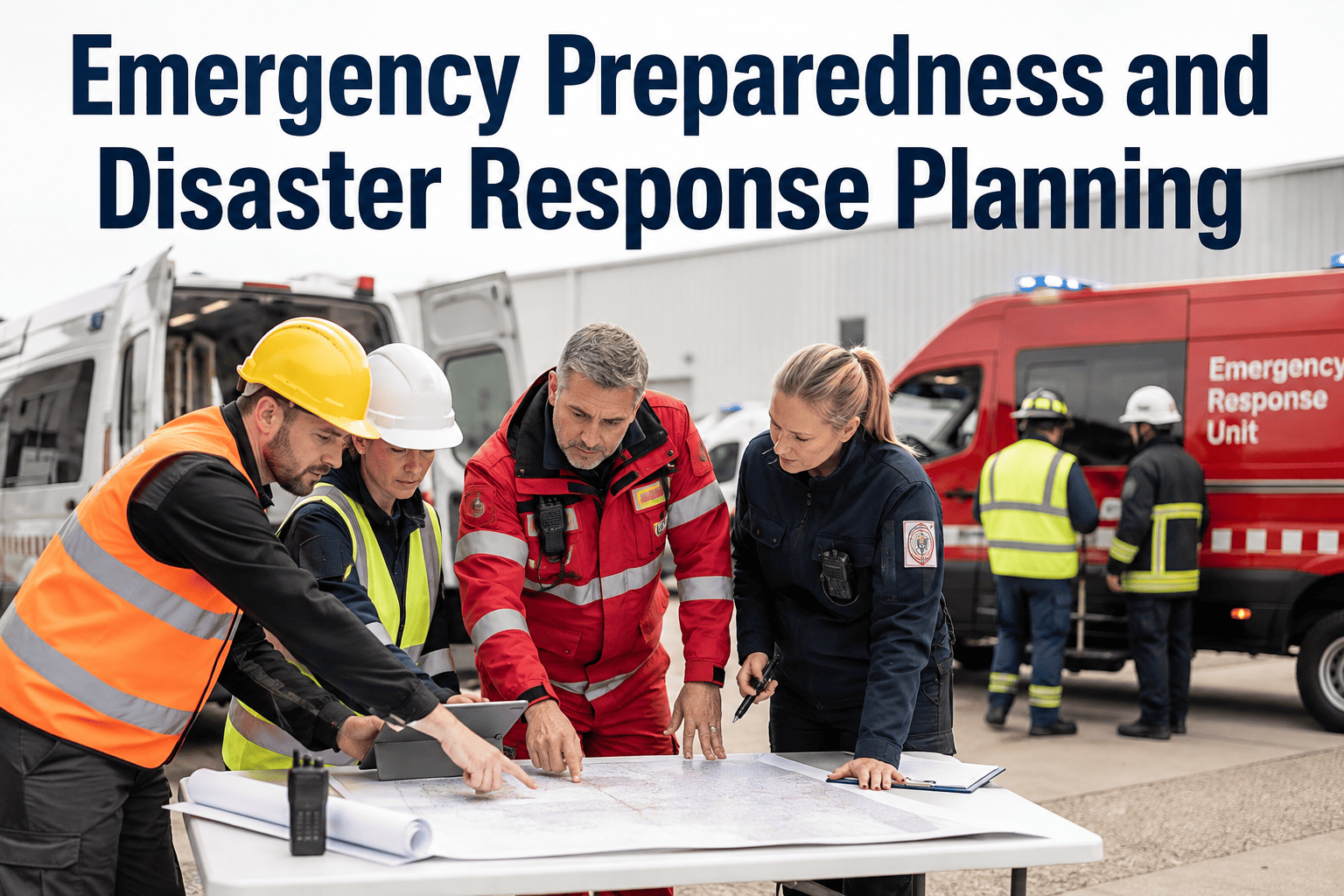
Public works emergency preparedness is the operational backbone of any community's disaster response — the crews, equipment, and plans that restore critical infrastructure when hurricanes, floods, or winter storms hit. Municipal agencies that invest in disaster preparedness for public works recover faster, reduce overtime costs by up to 30%, and keep water, sewer, and transportation systems running when residents need them most. A modern CMMS like OxMaint ties your emergency action plan to real-time asset data, work-order routing, and equipment staging so your teams mobilize in hours instead of days. You can Start Free Trial today or book a demo to see the platform configured for your agency.
Is your public works agency ready to deploy crews, equipment, and mutual aid within 12 hours of disaster striking?
Over 60% of municipalities rely on outdated paper logs and siloed spreadsheets to manage emergency response. OxMaint digitizes your disaster preparedness plan — so every work order, staged asset, and crew assignment is tracked, timestamped, and audit-ready before the next storm arrives.
The 5 phases of public works emergency response planning
Effective disaster response for public works follows a structured cycle recognized by FEMA and state emergency management agencies. Each phase demands documented procedures, tracked assets, and rapid crew mobilization — capabilities that spreadsheet-based systems fundamentally cannot scale.
Prevention & Mitigation
Identify vulnerabilities in water treatment plants, pump stations, and bridge infrastructure. OxMaint's asset registry tracks condition assessments and replacement priorities so mitigation projects get funded before failure occurs.
Preparedness & Staging
Pre-position generators, barricades, and debris-hauling equipment at strategic staging areas. OxMaint tags staging locations and links them to preventive maintenance schedules so equipment is mission-ready.
Response & Mobilization
Activate the Emergency Operations Center (EOC) and deploy crews within hours. Digital work orders route to the closest available team while real-time dashboards give EOC commanders a live view of every active task.
Mutual Aid Coordination
Manage incoming crews from neighboring jurisdictions. OxMaint tracks shared equipment hours, labor costs, and reimbursement-eligible expenses — essential for FEMA Public Assistance grant reporting.
Recovery & Documentation
Rebuild damaged infrastructure and document every dollar spent. A CMMS automatically captures labor, materials, and equipment logs — cutting FEMA reimbursement paperwork from weeks to days.
Public works EOC integration: the operational readiness checklist
When disaster strikes, the Emergency Operations Center becomes the nerve center. Public works agencies must integrate seamlessly — providing live asset status, crew availability, and equipment inventories to EOC commanders without phone calls or radio chatter.
- Up-to-date contact list for all public works staff, including NIMS/ICS certifications
- 24/7 on-call rotation schedule digitized and accessible from mobile devices
- Designated EOC liaison with backup, trained in incident command system protocols
- Mutual aid agreements signed with at least 3 neighboring jurisdictions
- Pre-identified staging areas for generators, barricades, and heavy equipment
- Preventive maintenance completed on all emergency response vehicles and pumps
- Fuel contracts activated with guaranteed delivery within 24 hours of deployment
- Spare-parts inventory for critical assets (pumps, valves, traffic signals) verified
- Debris management plan with pre-mapped haul routes and temporary storage sites
- GIS overlays of critical infrastructure (water mains, lift stations, bridges) in CMMS
- FEMA Public Assistance documentation templates ready for labor and equipment logs
- Redundant communication: cellular, radio, and satellite fallback for field crews
What disaster preparedness costs — and what it costs when you skip it
A mid-sized municipality managing 2,500 assets typically spends $35,000–$60,000 annually on emergency preparedness program development, training, and CMMS software. The cost of NOT being prepared? A single major storm can generate $500,000+ in unbudgeted overtime, emergency contractor rates, and delayed FEMA reimbursements due to poor documentation.
Worked example: A public works department spending $42K/yr on OxMaint avoids $180K in unbudgeted overtime, recovers $95K faster in FEMA reimbursements, and cuts emergency contractor spend by $60K. Net first-year ROI = $293,000 — a 7x return on the software investment.
How OxMaint powers public works disaster response
OxMaint is an AI-powered CMMS and EAM platform built for maintenance and reliability teams who cannot afford downtime — especially during emergencies. Here is how four core capabilities map directly to public works disaster preparedness and response.
Emergency Work Order Routing
Create, assign, and track disaster-response work orders from any mobile device. OxMaint routes tasks to the nearest qualified crew and provides live status updates to the EOC — cutting mobilization time by up to 50%.
Outcome: Mobilize crews in under 2 hoursAsset & Equipment Tracking
Tag every generator, pump, barricade, and vehicle with GPS-linked asset records. Know exactly where critical equipment is staged and whether it has been serviced — so nothing fails mid-deployment.
Outcome: 99% asset visibility during deploymentPredictive Maintenance Analytics
AI-driven failure prediction identifies which critical assets — lift stations, traffic signals, water mains — are most likely to fail during a storm. Pre-deploy crews and parts before the disaster hits.
Outcome: Cut unplanned downtime 30–50%FEMA-Ready Documentation
Every labor hour, equipment rental, and material charge is automatically captured and categorized against FEMA Public Assistance codes. Generate reimbursement reports in minutes — not the weeks that paper logs require.
Outcome: 90% faster FEMA reimbursementA 180-asset public works department faces a Category 2 hurricane
Consider a coastal municipality with 180 tracked assets — 12 lift stations, 8 water mains, 45 traffic signal cabinets, and a fleet of 115 vehicles. Without a CMMS, their hurricane response relies on clipboards, radio calls, and three-ring binders. Here is what changes with OxMaint.
| Response Activity | Without CMMS (Paper) | With OxMaint |
|---|---|---|
| Crew mobilization time | 6–8 hours via phone tree | Under 2 hours via mobile work orders |
| Equipment staging verification | Visual inspection at each site | Live asset dashboard from EOC |
| FEMA documentation | 3–4 weeks of manual data entry | Auto-generated reports in 1 day |
| Mutual aid crew coordination | Whiteboard and spreadsheets | Shared digital work-order portal |
| Post-disaster audit readiness | 40% of costs undocumented | 100% of costs timestamped and coded |
| Total storm response cost | $420,000 (unbudgeted) | $265,000 (within contingency) |
See OxMaint on your assets — book a 30-minute demo
Walk through a live disaster-response scenario on your own asset data. See how fast your crews could mobilize, how equipment staging becomes visible from the EOC, and how FEMA documentation builds itself.
Public works emergency preparedness: what teams ask most
What is public works emergency preparedness?
Public works emergency preparedness is the process of planning, training, and equipping municipal infrastructure teams to respond to disasters — hurricanes, floods, wildfires, and winter storms. It covers mutual aid agreements, equipment staging, EOC integration, crew mobilization protocols, and FEMA documentation. A CMMS like OxMaint digitizes these plans so they are executable in real time, not sitting in a binder on a shelf.
How does public works integrate with the Emergency Operations Center?
Public works integrates with the EOC by providing a liaison officer, live asset and crew status feeds, and real-time work-order visibility. OxMaint supports this by pushing dashboard data to EOC displays — showing active work orders, deployed crews, staged equipment, and completed tasks without phone calls or manual updates. You can see it live by booking a demo at calendly.com/oxmaintapp/30min.
What should be in a public works disaster response plan?
A complete plan includes a hazard vulnerability assessment, mutual aid agreements, equipment staging locations, crew call-down rosters, debris management routes, critical infrastructure priorities, communication protocols, and FEMA Public Assistance documentation procedures. OxMaint stores all of this in a searchable, mobile-accessible platform tied to your actual asset registry.
How long does it take to implement a CMMS for disaster preparedness?
A focused implementation for public works emergency preparedness typically takes 4–8 weeks. OxMaint onboarding includes asset data migration, work-order template configuration, user training, and emergency-response dashboard setup. Agencies can start with a free trial at app.oxmaint.ai and have core workflows running within the first week.
How does OxMaint help with FEMA reimbursement after a disaster?
OxMaint automatically captures every labor hour, equipment hour, and material charge against each work order during a disaster response. These records are tagged with FEMA Public Assistance project categories and exported as reimbursement-ready reports. This eliminates the 3–4 weeks of manual data entry that paper-based systems require after every major event, and improves reimbursement recovery rates to near 100%.
Don't wait for the next disaster to find the gaps in your plan
Digitize your public works emergency preparedness program today. Your crews, your EOC, and your community deserve a system that works when everything else is on the line.
Free 14-day trial · No credit card