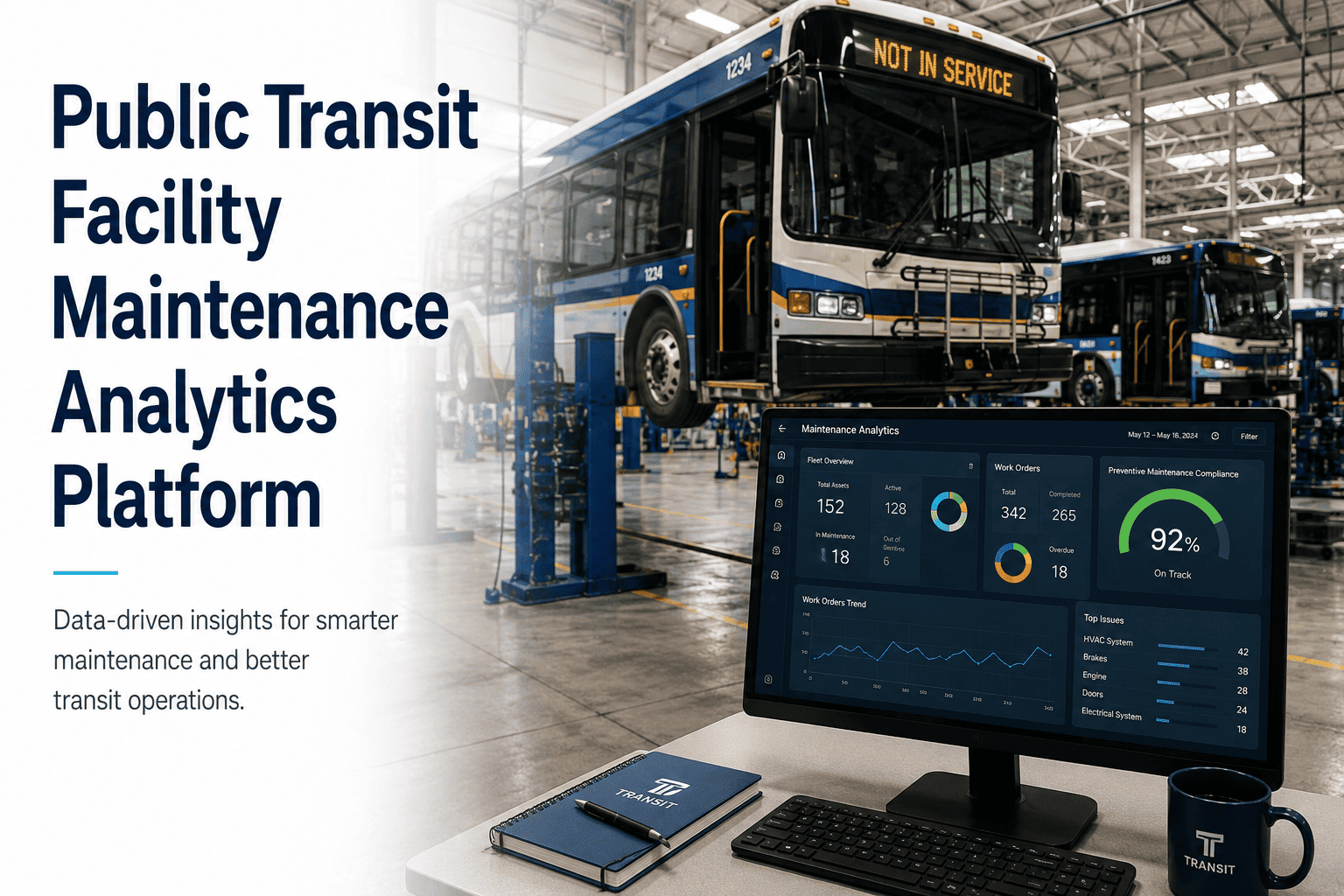
Public transit infrastructure — bus depots, rail maintenance facilities, station assets, fare systems, and supporting utilities — is among the most complex maintenance portfolios any government agency manages. Ridership disruptions caused by infrastructure failures cost transit authorities an average of $4,200 per incident in direct operational costs alone, before factoring in the public trust damage that follows service failures on a system thousands of people depend on daily. The gap between transit agencies managing this complexity well and those constantly reacting to failures is almost never a staffing gap — it is a data visibility gap. OxMaint's Analytics and Reporting platform turns the work order, asset, and compliance data your transit maintenance teams already generate into a live intelligence layer that surfaces problems before they become service disruptions.
Transit Infrastructure Maintenance — Key Performance Benchmarks
What Transit Analytics Should Show — And Mostly Don't
Most transit agencies have CMMS data. Few have analytics that turn that data into operational decisions. These are the five analytics views that separate high-performing transit maintenance programmes from reactive ones.
Regulatory and Grant Compliance Analytics OxMaint Tracks
| Requirement | Governing Body | OxMaint Analytics Support | Report Format |
|---|---|---|---|
| State of Good Repair (SGR) Reporting | FTA (49 CFR Part 625) | Asset condition scores, maintenance history, lifecycle cost data | PDF + structured data export |
| Transit Asset Management Plan | FTA (49 CFR Part 625) | Asset register, condition assessments, investment prioritization | Structured export, TAM-format |
| Title VI Equity Reporting | FTA / DOT | Service reliability data by route — PM compliance correlation to service equity | Custom date-range report |
| Drug and Alcohol Program (DAMIS) | FTA (49 CFR Part 655) | Technician certification tracking, training record management | Personnel compliance export |
| ADA Accessibility Equipment | DOT ADA Regulations | Lift and ramp inspection compliance, defect-to-repair tracking | Compliance timeline report |
See Transit Maintenance Analytics Built for Your Agency
OxMaint connects your work order data to live KPI dashboards, FTA compliance reports, and predictive fleet analytics — without replacing your existing systems. Book a demo with our transit solutions team.
Expert Review
The transit agencies that perform best on FTA oversight reviews are not necessarily the ones with the most modern fleets — they are the ones with the best data. When an FTA auditor asks for evidence that your preventive maintenance program is achieving the intervals required by your TAM plan, the answer cannot be "we think we are" or "our records are mostly complete." It must be a timestamped, technician-attributed, asset-specific record that shows exactly when each PM was performed, whether it was within the compliance window, and what was found. The agencies I have seen fail oversight reviews almost always had the maintenance work done — they just could not prove it because their records were in three different systems, two paper binders, and a shared drive folder nobody could find. A CMMS that captures every work event with full audit trail, and exports it in a format your oversight body recognizes, is not optional for a grant-receiving transit agency in 2026. It is the cost of operating with federal funding.
Turn Your Maintenance Data Into Audit-Ready Transit Analytics
OxMaint builds the analytics layer your transit agency needs for FTA compliance, capital planning, and daily fleet operations — from the work order data your team already generates. Start free today.
Frequently Asked Questions
Can OxMaint generate FTA Transit Asset Management Plan (TAM) reports?
Yes. OxMaint's asset register and condition assessment data exports in formats compatible with FTA TAM plan requirements under 49 CFR Part 625. The platform tracks asset condition scores, maintenance investment history, and projected replacement timelines — the three data sets required for a compliant TAM plan submission. For agencies required to submit to the National Transit Database, OxMaint's structured data exports eliminate the manual reconciliation step that currently takes most agency TAM coordinators 3–5 days per submission cycle. OxMaint's compliance module maintains continuous readiness for TAM reporting, not just point-in-time preparation.
How does OxMaint calculate mean distance between failures for transit vehicles?
OxMaint calculates Mean Distance Between Failures (MDBF) by correlating failure work orders with odometer readings captured at work order creation and closure. The platform accepts odometer data from direct vehicle telematics integration, from driver defect reports submitted via mobile app, or from manual entry by maintenance technicians at service completion. MDBF is calculated per vehicle, per fleet type, and at the depot level — updated in real time as work orders close. Trend lines show whether reliability is improving or declining over rolling 30, 90, and 365-day windows. Book a demo to see MDBF configuration for your fleet types.
Does OxMaint integrate with existing transit CMMS or CAD systems?
OxMaint integrates with major transit CMMS platforms via REST API and structured data import, and connects to CAD/AVL systems for vehicle location and odometer data feeds. Agencies currently using older CMMS platforms can migrate historical work order data into OxMaint to preserve the maintenance history needed for MDBF calculation and TAM reporting. OxMaint also supports parallel operation during transition periods — the existing system continues while OxMaint builds its data foundation — so there is no forced cut-over that creates compliance gaps. The integration timeline for a standard transit agency deployment is typically 4–8 weeks from contract to first production work order.
How does OxMaint help transit agencies prioritize capital replacement requests?
OxMaint's asset lifecycle analytics calculate the total maintenance cost per vehicle over its service history, plot the trend against the vehicle's current book value, and compare it against the agency's defined economic replacement threshold — typically when annual maintenance cost exceeds 30% of replacement value. Vehicles crossing this threshold are flagged in the capital planning dashboard with a full cost-basis report that quantifies the continued ownership cost versus replacement cost over a 5-year horizon. This analysis, generated directly from CMMS work order data, provides the evidence base for capital grant applications and council budget presentations that previously relied on age and mileage alone.