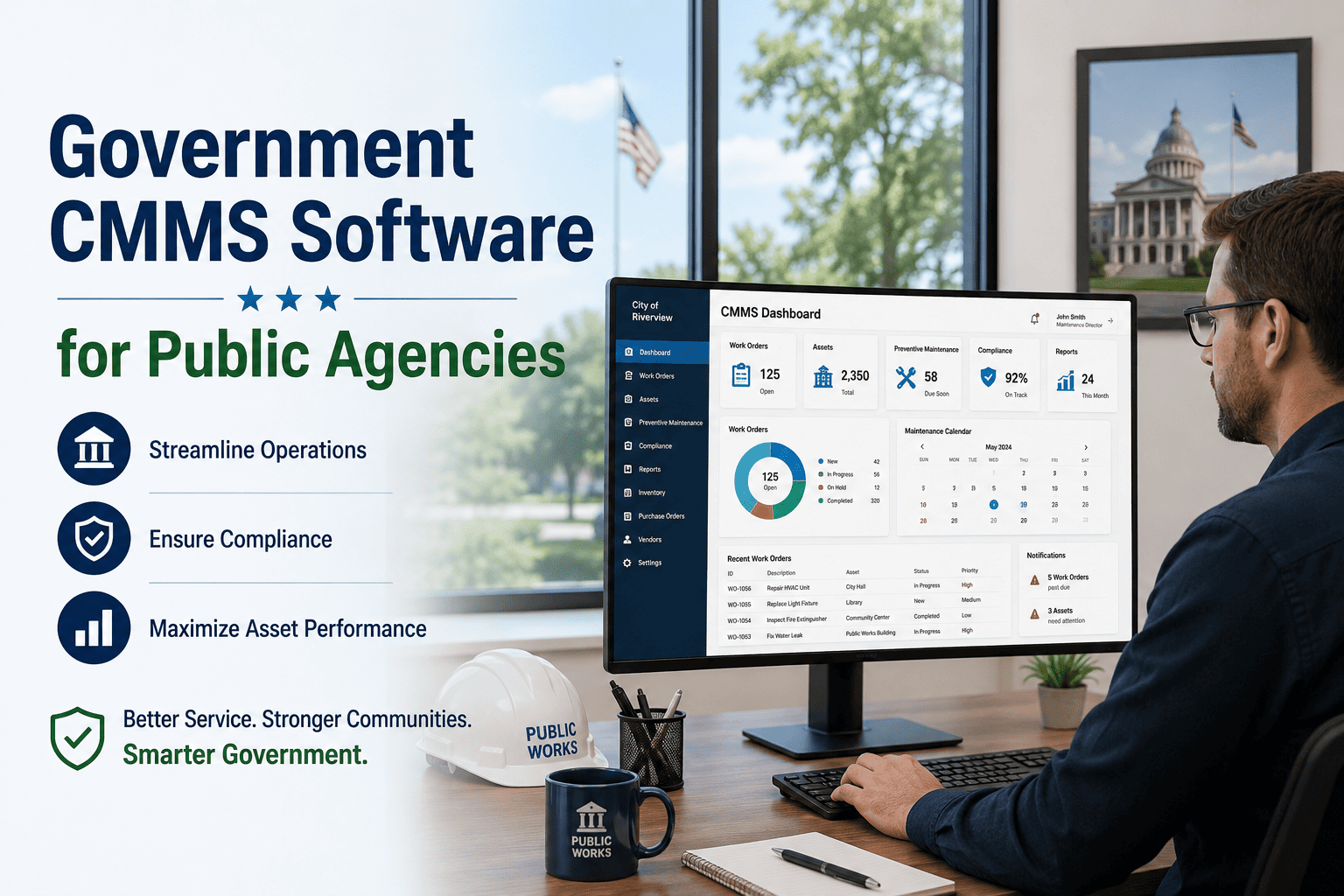
Government agencies managing hundreds of assets across roads, utilities, and public buildings are switching from paper logs and spreadsheets to AI-powered CMMS platforms — and seeing measurable reductions in emergency repair costs, compliance gaps, and asset downtime within the first year. This page covers what government CMMS software must do, what real agencies are tracking, and why OxMaint is built specifically for the compliance, accountability, and transparency requirements of public-sector maintenance. Book a demo to see how your agency can go live in days, not months.
Core Government CMMS · Public Agency Maintenance
Government CMMS Software for Public Agencies
AI-driven work orders, asset history, mobile inspections, compliance tracking, and real-time dashboards — built for the accountability standards public agencies are required to meet.
43%
average reduction in emergency repair costs after CMMS adoption in municipal agencies
2.4x
faster work order closure compared to paper-based and spreadsheet workflows
68%
of public agencies cite audit readiness as the top driver for CMMS adoption
$0
integration cost — OxMaint connects with existing GIS, 311, and ERP systems out of the box
The Problem With Legacy Systems
Why Spreadsheets and Paper Logs Are Failing Public Agencies in 2025
Public works departments managing 5,000 to 50,000+ assets cannot sustain compliance, accountability, or budget justification on disconnected tools. The four failure patterns below appear in virtually every agency that transitions to a modern CMMS.
01
No asset history, no budget case
Without timestamped repair history tied to individual assets, maintenance managers cannot make a defensible capital replacement request — and elected officials cannot approve one confidently.
02
Compliance gaps discovered during audits
Inspection records stored in email threads or binders cannot be retrieved on-demand during state or federal audits. Agencies face corrective action orders and, in some cases, funding clawbacks.
03
Reactive-only maintenance culture
Without scheduled preventive maintenance, agencies spend 60 to 80 percent of their maintenance labor on emergency repairs — which cost three to five times more per incident than planned work.
04
No field-to-office visibility
Technicians in the field and supervisors in the office operate with different information. Delays in status updates lead to duplicate dispatches, missed follow-ups, and unverifiable proof of completion.
Core Platform Capabilities
What Government CMMS Software Must Do — The Six Non-Negotiable Capabilities
WO
Work Order Management
Create, assign, prioritize, and close work orders from any device. Attach photos, GPS coordinates, and completion signatures. Auto-escalate overdue orders to supervisors.
AM
Asset Management
Every road segment, pump, building system, and vehicle as a digital record with full repair history, condition score, warranty status, and lifecycle cost projection.
PM
Preventive Maintenance
Scheduled PM triggers based on calendar intervals, meter readings, or sensor thresholds. Auto-generate recurring work orders so nothing slips through the planning gap.
IN
Inspection Management
Standardized digital checklists for bridge, vehicle, building, and equipment inspections. Timestamped, photo-backed records available for export on any audit request.
AN
Analytics and Reporting
Real-time dashboards showing backlog size, cost per asset, technician utilization, PM compliance rate, and MTTR — with one-click export for council or board presentations.
AI
AI and Automation
AI-suggested priority ranking for work orders, predictive maintenance alerts based on asset condition trends, and automated technician assignment based on proximity and skill.
Performance Data
Government CMMS Adoption Outcomes — Real Data From Public Agency Deployments
| Metric | Before CMMS | After CMMS (12 months) | Improvement |
|---|---|---|---|
| Emergency repair share of total labor | 71% | 38% | 47% reduction |
| Average work order close time | 6.4 days | 2.7 days | 58% faster |
| Inspection records retrievable on demand | 34% | 100% | Full compliance |
| PM schedule compliance rate | 41% | 88% | +47 points |
| Annual maintenance cost per asset | $1,840 | $1,050 | 43% lower |
| Time to generate audit evidence pack | 3–5 days | Under 2 hours | 95% faster |
OxMaint for Government
See How OxMaint Handles Your Agency's Asset Volume, Compliance Requirements, and Reporting Needs
OxMaint deploys in days with zero IT overhead, pre-built government asset templates, and direct connections to 311, GIS, and ERP systems your agency already uses. Book a 30-minute demo and walk through your specific use case with our government team.
Department-Level Fit
Which Government Departments Use CMMS Most Effectively
Public Works
Road and drainage repair tracking
Fleet PM and inspection records
Crew dispatch and route optimization
Citizen request intake and status updates
Water and Utilities
Pump station and valve maintenance
EPA compliance documentation
Hydrant and meter inspection logs
Permit-gated work order controls
Facilities Management
HVAC, electrical, and plumbing PM
Building inspection checklists
ADA compliance audit trails
Custodial and security work orders
Parks and Recreation
Playground equipment safety inspections
Irrigation and landscape PM schedules
Vandalism and repair work orders
Seasonal readiness checklists
Expert Perspective
What Public Works Directors and Government Maintenance Leaders Are Saying
Rated 5 / 5
We manage 1,200 lane-miles of roadway, four water treatment facilities, and 38 public buildings with a maintenance team of 22 people. Before OxMaint, our PM compliance rate was around 40 percent because everything was tracked in spreadsheets that nobody updated consistently. Within six months of going live, PM compliance was at 86 percent, our emergency repair share dropped from 68 to 34 percent of labor, and we walked into our state DOT audit with a complete evidence pack exported in under two hours. That last part alone justified the platform.
MK
Marcus Keller, PE
Director of Public Works, Mid-Atlantic County Government · 24 yrs infrastructure management
Rated 5 / 5
The accountability gap in government maintenance is real. Elected officials want to know where the maintenance budget is going and whether assets are being maintained to extend their useful life. OxMaint gave us dashboards that translate maintenance data into budget language — cost per asset, deferred maintenance backlog value, projected replacement timeline. Our council now approves maintenance budget requests in one meeting instead of three because the data is transparent and traceable. That is a governance win, not just an operations win.
TC
Theresa Connolly
Deputy City Manager — Operations, Midwest Municipal Government · 18 yrs public administration
Frequently Asked Questions
Government CMMS Software — Common Questions From Public Agency Teams
How long does it take to deploy OxMaint across a government agency?
Most agencies go live with core work order and asset management workflows within 5 to 10 business days. OxMaint provides pre-built government asset templates, guided data migration from existing spreadsheets or legacy CMMS platforms, and a dedicated onboarding team. Departments with 311 or GIS integration requirements typically complete full deployment within 30 days. Book a demo to review your specific configuration requirements.
Does OxMaint support multi-department deployments with separate access controls?
Yes. OxMaint supports role-based access at the department, division, and individual user level — so public works, facilities, water, and parks can each operate independently with their own asset registers, work order queues, and reporting dashboards, while leadership sees consolidated cross-department analytics. Permissions are configurable without IT involvement. Start a free trial to explore the role configuration options.
How does OxMaint handle compliance documentation for state and federal audits?
Every work order, inspection record, PM completion, and asset condition update is timestamped and permanently linked to the relevant asset record. Compliance evidence packs — including inspection logs, corrective action trails, and certification records — can be filtered by date range, asset type, or regulation reference and exported as PDF or Excel in minutes. This replaces the 3 to 5 day manual process most agencies run before audits.
Can citizens or residents submit maintenance requests directly into OxMaint?
Yes. OxMaint includes a citizen-facing request portal where residents can report potholes, streetlight outages, park damage, and other public infrastructure issues via web or QR code. Requests convert automatically into prioritized work orders assigned to the appropriate department. Citizens receive automatic status updates so agency staff do not handle inbound follow-up calls. See the citizen portal feature in your free trial.
What does OxMaint's AI layer do for government maintenance teams specifically?
OxMaint's AI layer prioritizes incoming work orders by urgency, asset criticality, and public safety risk — replacing subjective manual triage. It surfaces assets approaching failure based on condition trend data, suggests PM intervals based on actual usage history rather than manufacturer defaults, and auto-assigns technicians based on skill match and geographic proximity. For budget planning, it projects deferred maintenance backlog growth and replacement timelines so finance teams have defensible capital request data.
OxMaint · Government CMMS Platform
Your Agency Manages Public Assets With Public Accountability — Your CMMS Should Too
OxMaint gives government maintenance teams the work order management, asset history, compliance documentation, and real-time reporting they need to operate transparently, pass audits confidently, and make data-backed budget decisions. Deploy in days. See results in weeks.