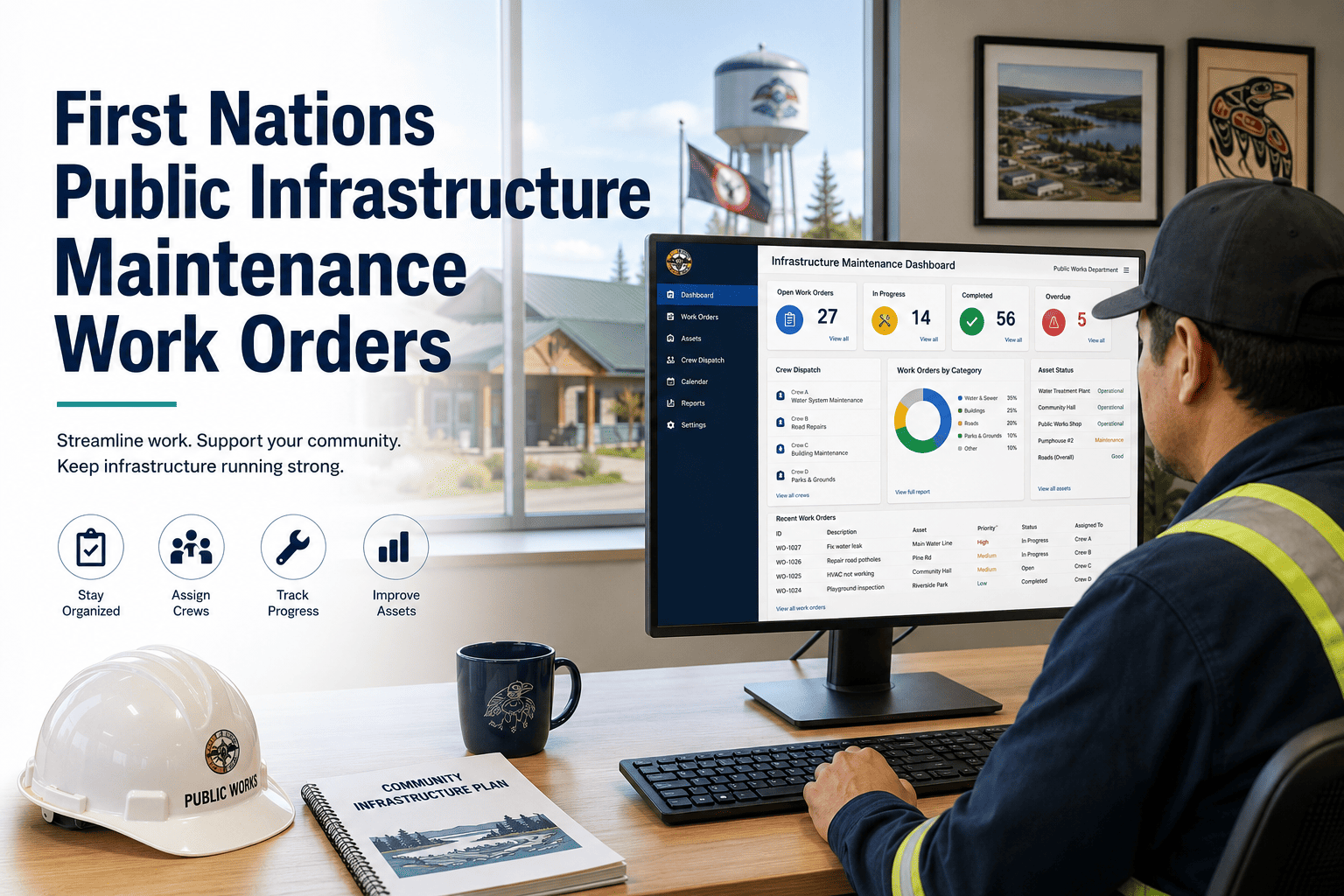
First Nations communities across Canada manage complex, often aging public infrastructure — water treatment systems, band offices, community halls, schools, roads, utility networks, and housing stock — with limited in-house maintenance capacity and significant accountability obligations to Indigenous Services Canada and community members alike. Without a centralized work order and asset management system, maintenance requests get lost, inspection records disappear, capital equipment deteriorates faster than it should, and emergency repairs consume budgets that should be funding planned maintenance. This article explains why a mobile-first, cloud-based CMMS built for community-scale public works changes that equation — and what First Nations public works teams are achieving when they centralize their maintenance records in a single platform. Start a free OxMaint trial and see how it works for your community.
Community Infrastructure · Work Order Management · Mobile CMMS
First Nations Public Infrastructure Maintenance Work Orders
How First Nations public works teams are centralizing facility repairs, asset inspections, utility maintenance, and capital planning records — with mobile-first work orders that work on and off reserve.
58%
of First Nations communities report infrastructure maintenance backlogs as a top operational challenge
3.4x
longer average asset lifespan when preventive maintenance is tracked and executed on schedule
72%
reduction in emergency repair costs reported by communities using structured work order workflows
1 platform
for work requests, inspections, asset history, and ISC compliance reporting
The Challenge
Why Traditional Infrastructure Management Fails First Nations Communities
Most First Nations public works operations have evolved from informal systems — phone calls, paper job cards, email chains — that made sense for small teams managing a handful of assets. As community infrastructure has grown, those informal systems have not scaled. The result is a maintenance environment where work gets done but is not documented, assets fail before their time because preventive maintenance is not tracked, and accountability reports to funders require weeks of manual effort to compile.
No Centralized Request System
Work requests arrive via text, walk-in, or informal conversation. There is no queue, no priority ranking, no assignment record, and no completion tracking. High-priority items compete with low-priority ones with no visibility into the backlog.
Asset History Gaps
When a pump fails or a boiler goes down, there is no documented service history to determine root cause. Technicians troubleshoot blind. Warranty claims are lost because service records were never captured. Capital replacement decisions lack supporting data.
ISC Reporting Burden
Indigenous Services Canada funding agreements require documented evidence of infrastructure maintenance activity. Without a CMMS, program coordinators spend significant time each reporting cycle compiling records manually — time that should be spent on actual maintenance work.
Reactive-Only Maintenance
With no preventive maintenance schedule, every maintenance event is a reactive emergency. Emergency repairs cost more, take longer, and disrupt community services. A water system that fails mid-winter is not a maintenance problem — it is a community health crisis.
Infrastructure Categories
The 6 Public Infrastructure Categories Every First Nations CMMS Must Cover
First Nations public works programs manage a broader asset portfolio per capita than most municipal works departments. The six categories below represent the full scope of community infrastructure that requires structured, documented maintenance management.
01
Water & Wastewater Systems
Treatment plant equipment — pumps, membranes, chemical dosing
Distribution network — valves, hydrants, pressure monitoring
Lift stations — wet wells, float switches, force mains
Regulatory sampling and testing records
MOECC and Health Canada compliance documentation
02
Community Buildings
Band office, community hall, gym, arena
HVAC systems — filters, coils, belts, refrigerant
Electrical panels, lighting, emergency power
Roofing, envelope, and seasonal building inspections
Fire suppression and safety system checks
03
Roads & Transportation
Road surface condition inspections and grading schedules
Culverts, drainage, and erosion management
Bridge and structure load rating and inspection records
Winter road maintenance — plowing, sanding, ice control
Community fleet vehicles — preventive maintenance by mileage
04
Housing Stock
Tenant repair request intake and tracking
Annual housing inspections with condition scoring
Heating system preventive maintenance — furnaces, boilers
Mould and moisture inspection protocols
Capital improvement planning based on asset condition data
05
Energy & Utilities
Generator inspection and load testing
Solar or wind system monitoring and maintenance records
Electrical distribution infrastructure
Fuel storage tanks — inspection, leak detection, spill records
Energy consumption tracking per building and asset
06
Schools & Health Facilities
HVAC and air quality systems — IAQ monitoring
Potable water quality testing and plumbing maintenance
Medical equipment maintenance at health stations
Safety equipment inspections — fire extinguishers, AEDs
FNHA and ISC inspection compliance documentation
Mobile CMMS for Remote Communities
OxMaint Works On-Reserve and Off-Network
Many First Nations communities have limited or intermittent internet connectivity. OxMaint's mobile app captures work orders, photos, and inspection data offline — syncing automatically when connectivity is restored. Your technicians work the same way whether they are in the band office or at a remote lift station 40 km out. No paper forms, no data loss, no rekeying.
Work Order Workflow
How a First Nations Work Order Moves From Request to Closed Record
1
Request Submitted
Community member, staff, or technician submits a work request via mobile app, web portal, or QR code scan at the asset location. Request is timestamped and assigned a priority level.
2
Work Order Created
Public works supervisor reviews the request, assigns a technician, attaches relevant asset history, links any required materials, and sets a due date. Technician receives a notification on their mobile device.
3
Work Performed
Technician completes the work, captures photos, logs time and materials, and records any observations about asset condition. All data is captured offline if needed and synced when connected.
4
Closed and Reported
Supervisor reviews and closes the work order. Asset history is automatically updated. Maintenance data rolls into ISC reporting dashboards, capital planning summaries, and compliance exports on demand.
Reporting and Compliance
ISC Funding Compliance — Maintenance Records That Satisfy Program Requirements
Indigenous Services Canada's First Nations Infrastructure Fund and other capital program agreements require documented evidence of ongoing maintenance activity as a condition of funding eligibility. Communities that cannot produce maintenance records risk funding clawbacks, reduced future allocations, and increased ISC oversight. OxMaint's reporting dashboard produces the evidence required — work order history by asset, by date range, by technician, and by infrastructure category — in the format program officers expect.
What ISC Wants to See
Preventive maintenance schedules on file
Documented inspection completion by asset
Corrective action records for identified deficiencies
Capital replacement planning supported by condition data
What OxMaint Produces
Recurring PM work orders with completion timestamps
Inspection reports with photo evidence and technician sign-off
Corrective action work orders with open/closed status
Asset condition history exportable per program requirement
Expert Perspective
What First Nations Public Works Directors and Band Infrastructure Managers Are Saying
Rated 5 / 5
Our community manages over 200 housing units, a water treatment plant, a community hall, a school, and a health station — all with a public works team of four. Before OxMaint, work requests came in by text and we lost track of half of them. Preventive maintenance happened when someone remembered to do it. When ISC asked for our maintenance records as part of a capital funding review, we spent three weeks pulling together paper logs and spreadsheets. After six months on OxMaint, we exported a full two-year maintenance history report in twenty minutes. That alone justified the cost for the next decade.
CW
Calvin Whitehorse, CET
Director of Public Works, Anishinaabe First Nation, Ontario · 16 years community infrastructure management
Rated 5 / 5
Water system reliability is not optional when you are managing the only potable water supply for a community of 800 people 120 km from the nearest town. We had a booster pump fail twice in one year before we started tracking its service history. Once we could see that the pump had never had a scheduled oil change or bearing inspection, the fix was obvious. Preventive maintenance scheduling in OxMaint paid for itself the first time it stopped an emergency repair. The mobile offline capability is critical for us — our technicians work in areas with no cell service, and the app captures everything and syncs when they are back in range.
MR
Margaret Running Bear, P.Eng
Band Infrastructure Manager, Northern Manitoba First Nation · 12 years water and wastewater infrastructure
Frequently Asked Questions
First Nations Infrastructure CMMS — Common Questions
Does OxMaint work in communities with limited or unreliable internet connectivity?
Yes — OxMaint's mobile application is built with offline-first functionality. Technicians can create work orders, complete inspections, capture photos, and close tasks with no internet connection. All data is stored locally on the device and syncs automatically once connectivity is restored, whether that is at the end of a field shift or when returning to the band office. This makes OxMaint fully functional for remote First Nations communities where cellular coverage is intermittent. Try it free to see the offline experience.
Can OxMaint generate the maintenance documentation required for ISC capital funding compliance?
OxMaint's reporting dashboard exports maintenance history by asset, by date range, by infrastructure category, and by technician — in formats that satisfy Indigenous Services Canada documentation requirements for the First Nations Infrastructure Fund, the Disaster Mitigation and Adaptation Fund, and most other federal capital funding programs. Work order completion records, inspection reports with photo evidence, and corrective action status reports can all be exported on demand. Book a demo to walk through the compliance reporting workflow specific to your funding agreements.
How does OxMaint support capital planning for aging First Nations infrastructure?
As assets are inspected and maintained in OxMaint, their condition history builds automatically. Asset condition scores, repair frequency, and cumulative maintenance cost data give public works directors the evidence base needed to support capital replacement requests and infrastructure investment prioritization. Communities using OxMaint for 12 or more months consistently report stronger, data-backed conversations with capital funders because their replacement recommendations are supported by documented asset performance data rather than subjective estimates.
Is OxMaint suitable for small First Nations communities with one or two public works staff?
OxMaint is designed to scale from single-technician operations to large multi-site public works departments. For small communities, the value is particularly high because one person managing all maintenance work — water, buildings, housing, roads — benefits most from a system that automatically schedules PMs, tracks open work, and generates reports without additional administrative effort. The mobile-first interface means a technician in the field is also the data entry operator, with no separate administrative step required. Start free and see setup complete in under a day.
First Nations Infrastructure · OxMaint Mobile CMMS
Your Community Infrastructure Deserves the Same Maintenance Discipline as Any Major Municipal System
First Nations communities manage critical infrastructure under resource constraints that demand exceptional efficiency from every maintenance dollar. OxMaint gives public works teams the tools to work smarter — centralized work orders, mobile-first inspections, structured asset history, and ISC-aligned reporting — so maintenance gets done, gets documented, and gets the community the funding it needs to keep investing in its infrastructure.