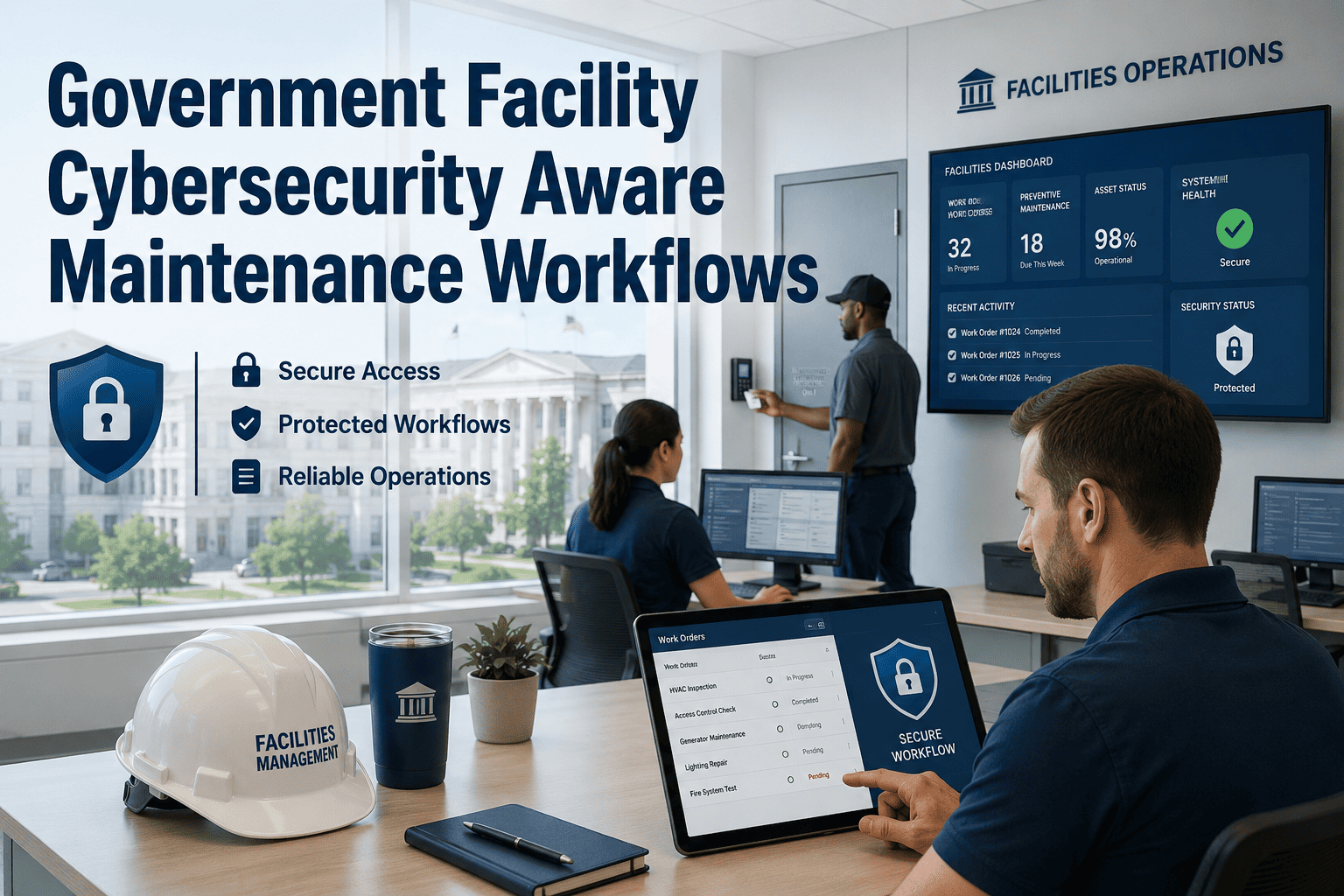
When a federal agency's IT director asks "How did ransomware encrypt our classified servers?" and the incident response team answers "The attackers breached an internet-connected smart thermostat in the lobby, bypassed the HVAC controller, and moved laterally into the main IT network because the building management system hadn't received a firmware patch in three years," the maintenance gap becomes a national security crisis. Deploying smart building technologies in government facilities is not the hard part—securing their Operational Technology (OT) networks against escalating cyber threats is. An unpatched air quality sensor that crashes is a nuisance; a compromised access control system or SCADA network that opens doors or shuts down power is a severe liability. Yet, many government facility programmes have zero scheduled maintenance for OT cybersecurity, firmware updates, network segmentation audits, or vendor access reviews. The security posture degrades continuously—new vulnerabilities are discovered, vendor passwords remain unchanged, configurations drift—but without a CMMS tracking these cyber maintenance intervals, nobody notices until an agency is breached. Talk to our team about integrating critical infrastructure cybersecurity diagnostics into your government building maintenance programme.
Government OT Security Guide
Government Cybersecurity for Building Management and OT Systems
Secure your government BMS, HVAC controls, access systems, and SCADA networks. Schedule firmware updates, enforce network segmentation audits, and conduct access reviews through automated CMMS workflows.
0 Trust
Architecture target for secure government building networks and connected assets
400%
Increase in cyberattacks targeting critical infrastructure and OT systems
30 Day
Maximum recommended interval for critical OT patch management and firmware updates
100%
Asset visibility required for comprehensive government system security
Why Government Building Networks Degrade Without Cyber Maintenance
Government facilities operating complex HVAC systems, automated lighting, and physical access controls face a fundamentally different security challenge than traditional IT environments. Operational Technology (OT) prioritises availability over confidentiality. BMS controllers run legacy protocols. SCADA networks interact directly with physical infrastructure. Vendor remote access credentials grow stale. Equipment firmware accumulates critical vulnerabilities discovered by CISA and ICS-CERT. And the facility ecosystem itself changes—new IoT sensors are added, contractors cycle out, and network configurations drift. Without scheduled cyber maintenance of every device in the government building network, security posture erodes invisibly until an adversary finds the open door. Start your free trial to schedule OT security maintenance automatically.
The Six Cybersecurity Failure Modes of Unmaintained Facilities
Unpatched Firmware
Critical
BMS and HVAC controllers are left running factory firmware for years, leaving publicly known vulnerabilities (CVEs) exposed to automated exploitation tools.
Flat Networks
High Risk
Failure to conduct network segmentation audits results in building IoT devices sharing the same network as sensitive government IT databases, allowing lateral movement.
Stale Credentials
Silent
Former mechanical contractors and integrators retain active VPN access to the government SCADA security environment because routine access reviews are ignored.
Default Passwords
100%
New IP cameras and access systems are installed with hardcoded, default factory passwords that attackers can brute-force in seconds without detection.
Shadow IoT
Unknown
Unauthorised smart devices (coffee makers, unvetted sensors) are plugged into government building networks, bypassing enterprise security controls entirely.
Ignored Advisories
Days
Critical alerts from CISA regarding government system security go unaddressed because there is no automated workflow to turn threat intel into maintenance tasks.
The OT Security Maintenance Lifecycle
A resilient government facility programme requires a structured maintenance lifecycle for the entire OT network—from baseline asset discovery through firmware updates to network segmentation audits. Each phase feeds compliance telemetry into the CMMS, creating a closed loop where cyber health is continuously monitored, vulnerabilities are patched before exploitation, and security work orders are auto-generated on schedule.
CMMS-Scheduled OT Cybersecurity Maintenance Workflow
From vulnerability scanning to mission-critical facility protection
Scan building networks to index all connected OT/IoT devices. Record MAC addresses, firmware versions, and open ports into the CMMS registry.
Quarterly
›
Cross-reference asset inventory against CISA advisories and CVE databases to flag critical infrastructure systems requiring immediate updates.
Monthly
›
Verify firewalls and VLAN configurations. Ensure BMS and SCADA traffic remains strictly isolated from standard government IT networks.
Bi-Annual
›
Audit all remote vendor connections and user privileges for HVAC controls and access systems. Revoke stale accounts and enforce MFA.
Monthly
›
Execute scheduled OT patch management. Apply secure government firmware updates to controllers during planned maintenance windows.
Scheduled
›
Pull and securely store the latest known-good configurations for all building automation systems to enable rapid recovery from potential ransomware.
Post-Update
›
Continuous network monitoring for unauthorised lateral movement. CMMS auto-triggers emergency isolation protocols if threat thresholds are met.
Continuous
Automate Your Government Cyber Maintenance
Oxmaint integrates with network scanning tools to ingest OT telemetry, detect outdated firmware, and auto-generate cybersecurity work orders—bringing IT-level rigour to physical facility management.
OT Security Subsystems: The Facility Cyber Stack
Government operational technology relies on four tightly coupled subsystems—each with distinct cyber risks, patch cadences, and compliance requirements. SCADA networks control critical utilities. BMS provides climate and lighting automation. Access Control manages physical entry. And the Network Edge defends the perimeter. Failure to maintain any single layer compromises the overarching Zero Trust architecture that modern government directives demand. Book a demo to see subsystem-level vulnerability tracking.
OT Security Subsystem Maintenance Profiles
Focus: Critical Infrastructure & Utility Control
PLC firmware patching Protocol encryption (DNP3/Modbus) Air-gap validation Historian backup verification Disaster recovery testing
Maintenance: Bi-annual deep audit + emergency patch cycles. Target: 100% resilience against state-sponsored disruption.
Focus: Environmental Control & System Integrity
BACnet security routing Controller credential rotation Setpoint lock validation Vendor VPN pruning Network traffic baseline
Maintenance: Monthly access review + quarterly firmware updates. Target: Prevent environmental sabotage or lateral pivoting.
Focus: Physical Security & Surveillance Integration
Camera firmware updates Card reader encryption checks Database synchronization Default password sweeps Biometric data hygiene
Maintenance: Monthly password audits + immediate de-provisioning checks. Target: Zero unauthorised physical bypasses.
Focus: Perimeter Defense & Shadow IT Prevention
Firewall rule pruning VLAN isolation tests Rogue device sweeps IoT certificate renewal Traffic anomaly detection
Maintenance: Weekly automated scans + daily log review. Target: Strict micro-segmentation between IT and OT layers.
Before & After: Scheduled vs. Neglected Cyber Maintenance
The difference between a government facility that safely controls its environment and one that inadvertently hosts a ransomware cell is entirely explained by whether the OT network receives structured, scheduled cyber maintenance. The HVAC chillers and card readers are identical—the maintenance discipline is not.
Harden Your Building Control Systems
Oxmaint's security integration layer monitors firmware versions, access control policies, and compliance drift across your entire government building network—auto-generating cyber work orders before vulnerabilities are exploited.
CMMS Capabilities for Government OT Security
A security-aware CMMS does not just schedule filter changes for air handlers—it monitors the cyber hygiene of the controllers commanding those units. From tracking vendor credentials to flagging critical CVEs mapping to your specific assets, the CMMS transforms raw security advisories into actionable maintenance intelligence that keeps critical infrastructure impenetrable. Start your free trial to see cybersecurity-specific CMMS features.
Security-Aware CMMS Intelligence Outputs
01
Patch Management Dashboard
Firmware version tracking per device
End-of-life (EOL) hardware alerts
Scheduled downtime deployment planning
02
Access Control Tracker
Active vendor VPN sessions logging
Automated 90-day credential pruning
Default password sweeps & alerts
03
Automated Security Work Orders
Threshold-triggered firewall audits
Scheduled configuration backups
Preventive rogue-device physical sweeps
04
Network Segmentation Maps
VLAN vs. Physical Asset mapping
IT/OT boundary exception logging
Port closure verification routines
05
Threat Advisory Correlation
CISA alert matching to asset inventory
Automated risk prioritisation scores
Mitigation tracking (Patch vs. Isolate)
06
NIST Compliance Benchmarks
Audit-ready maintenance histories
Framework scoring (Identify, Protect, Detect...)
System security plan (SSP) evidence
Expert Perspective: Cybersecurity Is Maintenance, Not Just IT
"
Everyone assumes cybersecurity is an IT problem. But when you manage a federal facility, an attack on your HVAC system or power grid isn't just data loss—it's a physical crisis. Two years ago, we had an HVAC contractor leave a cellular modem plugged into a core BMS controller for remote troubleshooting. They forgot about it. Six months later, a foreign actor found it, bypassed our perimeter firewalls entirely, and gained control over the building's climate zones. When we investigated, we realised we had zero processes for auditing physical OT networks. Now, we treat cybersecurity as a core maintenance function. Using Oxmaint, our facility engineers receive automated work orders to audit vendor access, perform network segmentation checks, and apply firmware updates alongside their mechanical PMs. We haven't had a single shadow IT incident or outdated firmware vulnerability since. Treating cyber-hygiene as routine maintenance is the only way to protect critical infrastructure.
— Chief Facilities Security Officer, Federal Agency
100%
Controllers patched on schedule via CMMS
Zero
Lateral breaches from OT to IT networks
99.9%
Uptime across critical facility control systems
Government agencies that succeed with facility security share a common discipline: they treat OT cybersecurity with the same rigour as mechanical maintenance. Network segmentation, firmware patches, access logs, and vulnerability audits are not "set and forget" configurations—they are perishable postures that degrade continuously. By integrating OT security diagnostics into CMMS-scheduled maintenance workflows, these programmes achieve the resilience and compliance that justifies public trust. Start building your cyber maintenance programme with CMMS-integrated OT diagnostics.
Secure Every Government Facility and OT System
Oxmaint's OT maintenance platform tracks BMS firmware versions, SCADA network segmentation, access control drift, and IoT vulnerabilities across your entire government portfolio—auto-scheduling cyber maintenance before exploits occur.
Frequently Asked Questions
Why are government HVAC and BMS systems specifically targeted by cyberattacks?
Attackers target government building management systems (BMS) and HVAC controls for two primary reasons. First, these systems are often the weakest link; they run on outdated, proprietary protocols (like unencrypted BACnet) and are rarely updated compared to IT networks. Second, compromising an HVAC system can be weaponised. Attackers can physically damage equipment (e.g., rapidly cycling chillers to destruction), create unsafe environments in data centres by disabling cooling, or use the BMS network as a pivot point to move laterally into the secure IT networks where classified data resides.
How often should OT firmware updates be performed in government facilities?
For critical infrastructure and government OT systems, a 30-day patch management cycle is the standard for critical vulnerabilities (CVSS 8.0+). However, OT patching is complex because devices cannot simply be rebooted during operational hours. The CMMS schedules these updates by cross-referencing vulnerability alerts with planned facility downtime or maintenance windows. Routine, non-critical updates should be audited and applied at least quarterly, accompanied by strict configuration backups prior to deployment.
What is network segmentation, and why does it need routine auditing?
Network segmentation is the practice of splitting a larger network into smaller, isolated sub-networks (VLANs). In government facilities, it ensures that internet-connected IoT devices (like smart TVs or lobby kiosks) cannot communicate with the BMS, and the BMS cannot communicate with the secure IT network. This prevents lateral movement. It requires routine auditing via the CMMS because configuration drift happens constantly—technicians temporarily open firewall ports for troubleshooting and forget to close them, or new devices are plugged into the wrong switch port. Scheduled audits catch these errors before attackers do.
How does a CMMS help with government cybersecurity and CISA compliance?
A modern CMMS bridges the gap between IT security policy and physical maintenance execution. When CISA or ICS-CERT releases a vulnerability advisory, the CMMS cross-references the impacted hardware against the facility's asset inventory. If a match is found (e.g., a vulnerable SCADA controller), it automatically generates a high-priority work order for the OT technician to apply the patch or isolate the device. Furthermore, the CMMS maintains the immutable audit logs required by NIST frameworks, proving to compliance officers that security maintenance was performed on schedule.
What is the ROI of an OT cybersecurity maintenance programme?
The ROI of OT cybersecurity is measured in risk avoidance and operational continuity. A single successful ransomware attack that encrypts a government facility's control systems can cost millions in emergency remediation, system replacement, and operational downtime—not to mention the political fallout and national security implications. A CMMS-driven cyber maintenance programme typically costs a fraction of a percent of the facility's operating budget. By automating patch management, preventing lateral network breaches, and eliminating stale vendor access, agencies ensure 99.9% uptime and avoid catastrophic incident response expenditures.