Physical maintenance operations inside government facilities now carry cybersecurity risk that most facility managers were never trained to evaluate. When a contractor plugs a laptop into a building automation system to service an HVAC controller, that connection is a potential network ingress point. When a maintenance technician uses a USB drive to upload firmware to an access control panel, that device could introduce malware into a facility's operational technology network. The convergence of cyber and physical infrastructure — known as cyber-physical systems — has turned routine maintenance workflows into compliance and security checkpoints that demand documented procedures, vetted personnel, and auditable records. This article explains how government facility managers can build cybersecurity-aware maintenance workflows that satisfy NIST, FISMA, and Executive Order 14028 requirements without slowing down operational efficiency.
Cyber-Physical Maintenance · Compliance Tracking
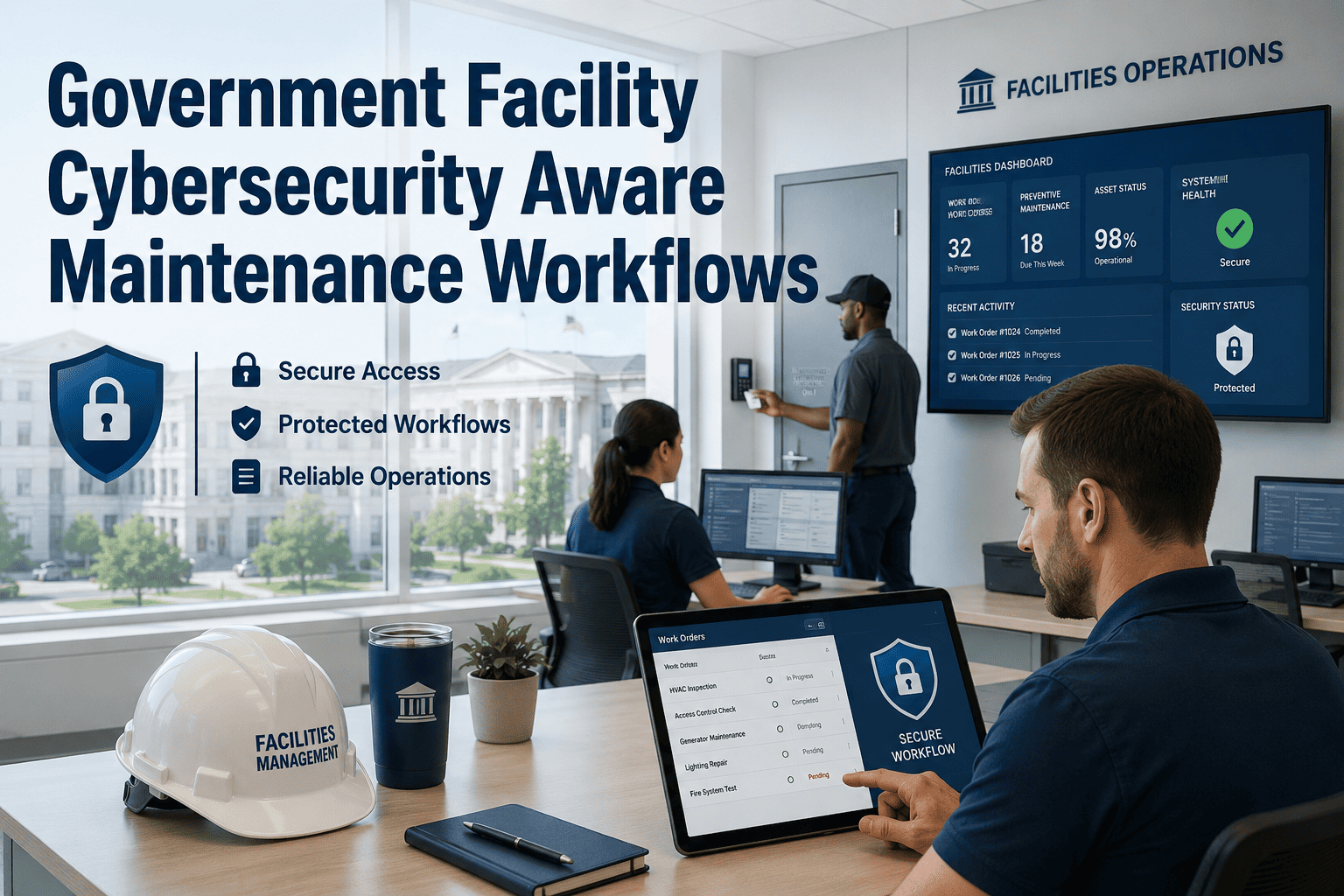
Government Facility Cybersecurity Aware Maintenance Workflows
Structured maintenance procedures that protect operational technology networks, satisfy federal cybersecurity compliance requirements, and keep facility operations moving safely.
54%
Of OT/ICS cyber incidents originate from maintenance access points
EO 14028
Federal mandate requiring cyber-physical security integration
NIST 800-82
Guide to ICS security — directly governs BAS maintenance access
72hrs
CISA required cyber incident reporting window for critical infrastructure
What Cyber-Physical Risk Means for Facility Maintenance Teams
Most government facility maintenance teams are focused on preventing equipment failures — not on evaluating the cybersecurity risk profile of each maintenance action. But when physical maintenance requires connecting to operational technology systems — building automation, access control, HVAC controllers, fire systems, or utility SCADA networks — the maintenance team becomes a potential attack vector. Understanding which maintenance actions carry OT cybersecurity risk is the first step in building compliant workflows.
High Risk
BAS / HVAC Controller Access
Direct connection to building automation system controllers for configuration or firmware updates creates a network pathway into the OT environment. Requires device vetting, documented session logging, and post-maintenance network scan.
High Risk
Access Control Panel Maintenance
Physical security systems share OT network segments in most government facilities. Maintenance on panels, door controllers, or credential databases requires the same cybersecurity controls as IT system maintenance.
Medium Risk
Third-Party Contractor Facility Access
Unvetted contractors with physical access to facility OT equipment pose an insider threat risk. Contractor identity verification, escorted access requirements, and device inspection protocols must be documented in each work order.
Medium Risk
IoT Sensor Network Configuration
Adding, replacing, or reconfiguring IoT sensors in building networks can introduce unauthorized devices onto OT network segments. Device enrollment procedures and network segment documentation must accompany each IoT maintenance work order.
Lower Risk
Mechanical Equipment Maintenance
Physical maintenance of mechanical systems not connected to network-accessible controllers carries lower OT risk but still requires documented access authorization and visitor/contractor logging to satisfy physical security compliance requirements.
Lower Risk
Grounds and Perimeter Maintenance
Perimeter maintenance is lowest on the cyber-physical risk scale but must still include documented personnel access logs, cleared contractor verification, and physical security checkpoint compliance — especially for cleared government facilities.
The Five Compliance Checkpoints in Every Cybersecurity-Aware Work Order
A cybersecurity-aware maintenance work order is not a different format — it is a standard work order with five additional data fields that satisfy federal cyber-physical compliance requirements. OxMaint's compliance tracking captures all five checkpoints automatically, embedding them into the work order workflow so that compliance documentation is a byproduct of completing the work, not a separate administrative task.
| # |
Checkpoint |
What It Documents |
Compliance Framework |
| 1 |
Personnel Authorization |
Technician identity, clearance level, and authorization to access OT systems or controlled areas |
NIST 800-53 MA-5, FISMA |
| 2 |
Device and Tool Inspection |
Approved device list verification, USB device check, laptop security posture review before OT connection |
NIST 800-82, CISA ICS guidelines |
| 3 |
Network Access Session Log |
Start/end timestamp of any OT system connection, systems accessed, and changes made during the session |
NIST 800-53 AU (Audit), FedRAMP |
| 4 |
Maintenance Action Record |
Specific actions taken, firmware or configuration changes applied, and systems affected |
FISMA MA-2, NIST 800-53 |
| 5 |
Post-Maintenance Verification |
System functional test results, network scan outcome (where required), and supervisor sign-off |
NIST 800-53 MA-3, FedRAMP |
Build Cybersecurity Compliance Into Every Maintenance Work Order
OxMaint's compliance tracking captures all five cyber-physical checkpoints automatically during work order execution — no separate documentation step required. See how it works for government facility maintenance teams in a 30-minute walkthrough.
How OxMaint Compliance Tracking Handles Cyber-Physical Maintenance
OxMaint structures maintenance work orders to capture cyber-physical compliance data at each step of the workflow — from work order creation through field execution to supervisor sign-off. The platform maintains a persistent compliance record for every maintenance action that touches OT-connected assets, generating the audit trail documentation that FISMA auditors, IG offices, and FedRAMP assessors require.
01
Work Order Creation with OT Asset Classification
Every asset in OxMaint carries a cyber-physical risk classification. When a work order is created for a high-risk OT-connected asset, the platform automatically applies the appropriate compliance checklist — contractor vetting, device approval, session logging — based on the asset class and compliance tier.
02
Contractor and Personnel Verification Workflow
Before work on high-risk assets is authorized, OxMaint prompts the supervisor to verify and document personnel authorization status. Contractors must be listed as approved in the platform's vendor management module before they can be assigned to OT-class work orders.
03
Field Execution with Timestamped Compliance Capture
Field technicians complete compliance checkpoints in the OxMaint mobile app — device inspection confirmation, OT connection start/end timestamps, and post-maintenance verification steps — all captured with GPS location and technician identity before the work order can be marked complete.
04
Automated Compliance Report Generation
OxMaint generates compliance documentation reports by asset, time period, contractor, or compliance framework — exportable in formats structured for FISMA audit packages, IG reviews, and FedRAMP assessment documentation. No manual report assembly from multiple logs.
Expert Review
The cyber-physical gap in government facility maintenance is not a technology problem — it is a workflow and documentation problem. Most facility managers understand that contractor access to a building automation system carries cybersecurity risk. What they lack is a structured process that captures the compliance evidence at the moment the work is performed, rather than reconstructing it after the fact from access logs, paper sign-in sheets, and email chains. Every IG audit I have participated in revealed the same finding: the maintenance was performed correctly, but the documentation to prove it was either missing, inconsistent, or spread across five different systems. A CMMS that builds compliance documentation into the work order execution workflow solves that problem structurally — not through better record-keeping habits, but through process design that makes compliance evidence the output of doing the work.
Frequently Asked Questions
Which government facilities must comply with cyber-physical maintenance documentation requirements?
Any federal or federally-funded facility that operates OT systems — building automation, access control, HVAC controllers, utility SCADA, or fire and suppression systems — is subject to FISMA's maintenance control family (MA-1 through MA-6), which specifically addresses maintenance of information systems and the security controls applied during maintenance activities. Executive Order 14028 (Improving the Nation's Cybersecurity) extended these requirements to critical infrastructure operators and contractors working within federal environments. State and local government facilities operating under federal funding programs or housing federally-designated critical infrastructure are also subject to CISA's cyber-physical security guidance for operational technology environments.
OxMaint's compliance tracking is configured to the specific frameworks applicable to each facility type.
Book a demo to discuss your facility's compliance obligations.
How does OxMaint handle maintenance contractor cybersecurity vetting within the platform?
OxMaint's vendor management module maintains a contractor and third-party service provider registry with clearance level, authorized access scope, and approved work categories documented for each vendor. When a work order is assigned to an external contractor, the platform verifies that the contractor record is current and that their authorization scope covers the asset and access type required. If a contractor's record is expired or their authorization does not cover the required access tier, the work order is flagged for supervisor review before assignment is permitted. This workflow satisfies the NIST 800-53 MA-5 control requirement for maintenance personnel authorization and creates the audit trail documentation that proves each maintenance event was performed by an authorized party.
Explore the platform or speak with our team during a
live demo.
Can OxMaint be deployed in an air-gapped or restricted network environment for classified facility use?
OxMaint offers deployment configurations suitable for government network environments with restricted internet access requirements. The platform supports on-premises deployment and restricted cloud configurations for facilities operating under network access limitations. Mobile work order access for field technicians can operate in offline mode, capturing compliance data locally and syncing to the platform when connectivity is restored — relevant for facilities with restricted mobile device policies or limited network coverage in mechanical spaces. Our government implementation team has experience supporting facilities with specific network segmentation and data residency requirements.
Book a demo to discuss your facility's network environment and security requirements with our team.
What is the difference between OT maintenance compliance and standard facility maintenance compliance?
Standard facility maintenance compliance focuses on documenting that maintenance was performed on schedule, by qualified personnel, and with the correct procedures — satisfying safety codes, warranty requirements, and general operational standards. OT maintenance compliance adds a cybersecurity layer: it must also document that personnel were authorized to access OT-connected systems, that devices connected to OT networks were vetted and approved, that network sessions were logged with timestamps, and that post-maintenance verification included checking that no unauthorized changes were made to system configurations. The NIST 800-53 MA control family and NIST 800-82 ICS security guide together define these additional requirements.
OxMaint's compliance tracking handles both standard and OT-specific requirements within a single work order workflow, eliminating the need for separate physical and cyber compliance processes.
Cyber-Physical Compliance Starts at the Work Order Level
OxMaint builds the documentation trail that government facility cyber-physical compliance requires directly into your maintenance workflows. Stop reconstructing evidence after audits — let your maintenance program generate it automatically. Talk to our government team about your facility's specific compliance obligations.