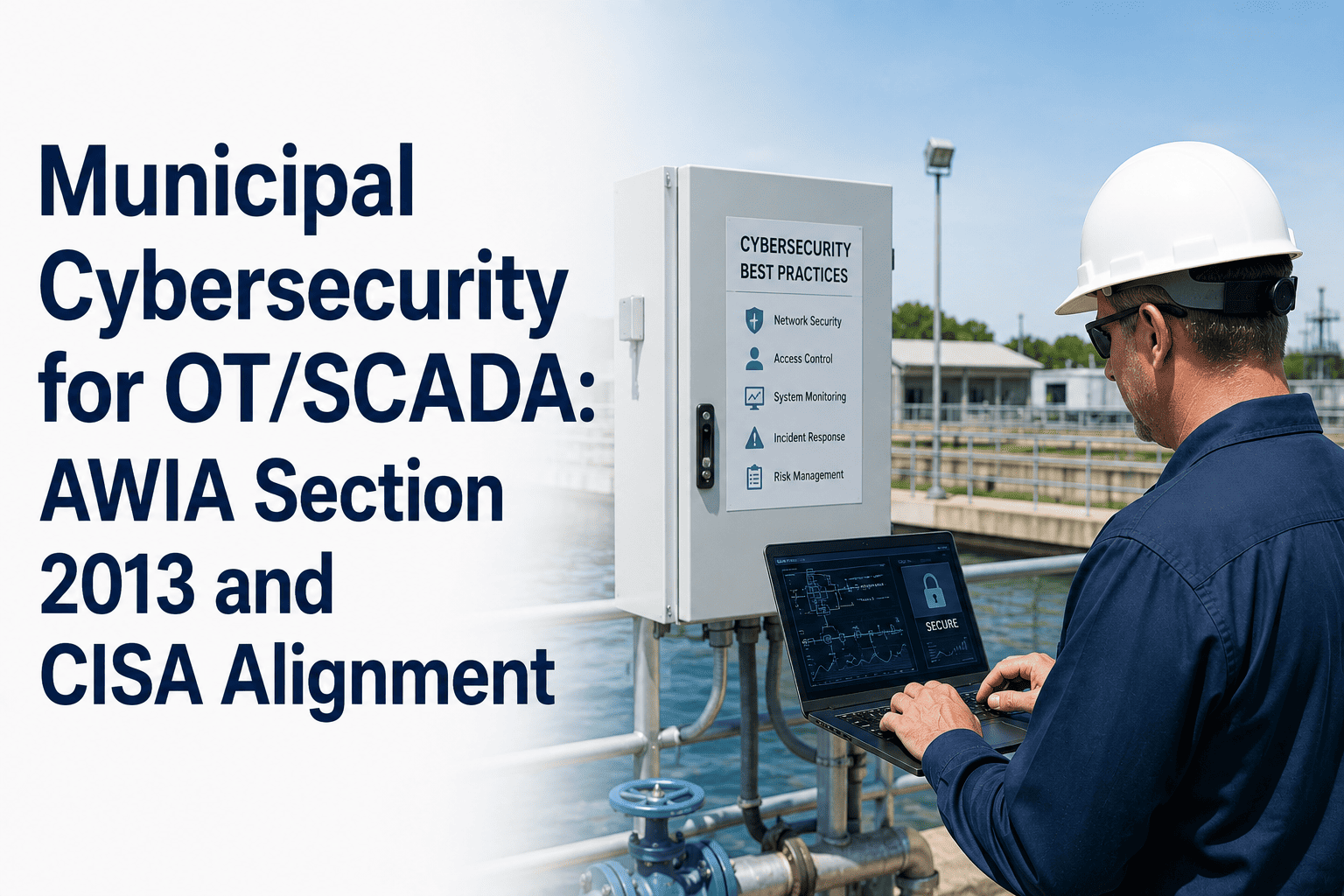
Public infrastructure cybersecurity has become a frontline public safety concern as municipalities connect SCADA networks, building management systems, and IoT sensors to the internet without proportional defenses. Every connected water treatment plant, traffic signal controller, and power substation expands the attack surface that threat actors can exploit to disrupt essential services. Government infrastructure cybersecurity now demands IT/OT segmentation, continuous device monitoring, and tested incident response plans — not after an attack, but before the next one. This guide walks through the critical infrastructure cybersecurity controls that every municipal public works and utility team should implement today, and shows how OxMaint's asset intelligence platform helps you Start Free Trial to secure and maintain connected infrastructure from a single system of record.
Smart Infrastructure Risk
Every connected sensor is a doorway. Is yours locked?
A single compromised PLC in a water SCADA network can shut down service to 50,000 residents. Municipal cybersecurity infrastructure fails not because teams lack dedication — but because asset inventories, patch cycles, and access controls live across five disconnected spreadsheets. OxMaint unifies asset tracking, work orders, and security-driven maintenance so you can see and defend every connected device before attackers do.
The Threat Landscape
Why public works cybersecurity is now a public safety emergency
Critical infrastructure security for government agencies has shifted from an IT concern to an operational imperative. Water utilities, traffic management centers, wastewater plants, and public transit systems increasingly rely on internet-connected operational technology (OT) — programmable logic controllers (PLCs), remote terminal units (RTUs), supervisory control and data acquisition (SCADA) systems, and building management systems (BMS). Each connection point is a potential entry for ransomware groups and nation-state actors seeking to disrupt services or extort municipalities.
The stakes are uniquely high for municipal SCADA security. When a manufacturing plant suffers a ransomware incident, the financial loss is measured in downtime hours. When a municipal water treatment facility is compromised, the risk extends to public health — attackers could alter chemical dosing, shut down pumps, or contaminate supply. The 2021 Oldsmar, Florida incident, where an attacker remotely increased sodium hydroxide levels to dangerous concentrations, demonstrated that these are not theoretical risks. They are present, documented, and escalating.
Core Controls
The 5 pillars of municipal cybersecurity infrastructure
Securing connected public infrastructure requires defense-in-depth across the full IT/OT stack. These five pillars — aligned to NIST Cybersecurity Framework and CISA guidance for critical infrastructure — form the operational backbone that every municipal public works department should implement.
Complete OT asset inventory & classification
You cannot protect what you cannot see. Maintain a real-time inventory of every PLC, RTU, HMI, sensor, and network switch — including firmware version, IP address, physical location, responsible technician, and criticality tier. Municipal teams relying on static spreadsheets typically miss 30–40% of connected devices after network changes.
IT/OT network segmentation & access control
Isolate SCADA and control networks from corporate IT and public internet using VLANs, firewalls, and unidirectional data diodes where appropriate. Enforce role-based access with multi-factor authentication for every remote connection to municipal OT systems.
Continuous monitoring of OT & IT environments
Deploy passive network monitoring across industrial segments to detect anomalous traffic, unauthorized configuration changes, and indicator-of-compromise signatures — without disrupting control system availability.
Tested incident response & recovery plans
Maintain and exercise OT-specific incident response playbooks covering isolation, safe shutdown, manual operations, and stakeholder communication. A plan that has never been tested is a plan that will fail under pressure.
Patch management & secure configuration
Track firmware versions, security patches, and configuration baselines for every connected device. Schedule patch windows during planned maintenance to avoid unplanned downtime — and document every change in a centralized work order system for audit readiness.
Vulnerability Assessment
Where smart infrastructure security breaks down
Most municipal cyber security failures trace back to the same root causes — not sophisticated zero-day exploits, but operational gaps in asset visibility, maintenance discipline, and change management. The table below maps the most common vulnerabilities in public sector infrastructure security to their operational impact and the control that closes each gap.
| Vulnerability | Operational Impact | Security Control |
|---|---|---|
| Unpatched PLCs & RTUs running end-of-life firmware | Known CVEs exploitable for remote code execution or denial of service | Centralized firmware tracking + scheduled patch work orders |
| Flat network — no IT/OT segmentation | Lateral movement from compromised email to SCADA control layer | VLAN isolation, firewall policies, data diodes |
| Shared credentials for vendor remote access | Single credential compromise grants access to all municipal systems | Individual accounts, MFA, time-bound access, audit logging |
| No inventory of connected IoT sensors | Shadow devices with default credentials accessible on public networks | Automated asset discovery + classification in CMMS |
| Manual paper-based maintenance logs | No audit trail for who changed what configuration and when | Digital work orders with timestamps, photos, and e-signatures |
| Unplanned reactive maintenance cycles | Security patches deferred indefinitely; emergency overrides bypass controls | Preventive maintenance scheduling with security-task integration |
"A mid-sized municipality managing 12,000 connected assets across water, traffic, and buildings typically loses 60–90 hours per quarter searching for asset data spread across spreadsheets, filing cabinets, and individual technician laptops — hours that should be spent on preventive security work."
Implementation Roadmap
A 6-month timeline for municipal SCADA security
Public sector infrastructure security cannot be achieved overnight, but it can be systematically built. Below is a phased roadmap that a municipal public works department with 500–5,000 connected assets can follow to move from reactive vulnerability to defensible posture within two budget cycles.
Asset discovery & baseline inventory
Passively scan all network segments to discover every connected device. Import existing spreadsheets into OxMaint, reconcile discrepancies, and establish a single source of truth. Target: 100% of IP-addressable devices catalogued with location, owner, and criticality tier.
Risk classification & gap assessment
Score each asset by criticality (life safety, service continuity, regulatory) and vulnerability exposure. Identify devices running end-of-life firmware, default credentials, or exposed to public networks. Prioritize remediation by composite risk score.
IT/OT segmentation & access hardening
Implement VLAN separation between corporate IT and operational SCADA networks. Deploy firewall rules restricting east-west traffic. Enforce MFA on all remote vendor access. Decommission unused accounts and shared credentials.
Patch management & preventive maintenance integration
Schedule firmware updates and security patches as preventive maintenance work orders in OxMaint. Link each patch to its CVE, risk score, and affected asset. Target: 95% of critical assets patched within 30 days of vendor release.
Continuous monitoring & alerting
Deploy OT-aware monitoring across industrial segments. Configure alerts for configuration drift, unauthorized access attempts, and anomalous traffic patterns. Integrate alerts into OxMaint work order triggers for automatic response assignment.
Tabletop exercise & plan refinement
Conduct a full-scale incident response tabletop exercise simulating a SCADA ransomware event. Test isolation procedures, manual operations fallback, communication protocols, and recovery time objectives. Document gaps and refine the playbook.
See OxMaint on Your Infrastructure
Book a 30-minute demo and see how OxMaint secures your connected assets
Walk through a live environment where asset inventory, security-driven work orders, and audit-ready maintenance logs are unified in one AI-powered platform. Bring your toughest OT security question.
How OxMaint Helps
How OxMaint strengthens public infrastructure security
OxMaint is an AI-powered CMMS and EAM platform built for maintenance and reliability teams — and increasingly, that mission includes cybersecurity-driven maintenance for connected infrastructure. By unifying asset tracking, work order management, and maintenance analytics, OxMaint gives municipal teams the visibility, control, and audit trail they need to defend OT environments without abandoning their existing operational workflows.
Unified OT asset register
Replace fragmented spreadsheets with a single live inventory of every PLC, sensor, pump, and controller — including firmware version, IP address, criticality tier, and maintenance history. Eliminate the 30–40% asset blind spot that plagues most municipal teams.
Outcome: 100% asset visibility within 30 days of onboardingSecurity-driven work orders
Convert every vulnerability finding, patch notice, or access-review task into a tracked work order with assigned technician, deadline, and priority. Automatically generate preventive maintenance schedules for firmware updates and configuration audits — no more deferred patches.
Outcome: 95% of critical patches completed within SLAPredictive maintenance analytics
AI-driven anomaly detection flags unusual asset behavior — temperature spikes, vibration changes, or communication anomalies — that may indicate both mechanical failure and cyber compromise. Catch issues weeks before they become incidents.
Outcome: 30–50% reduction in unplanned downtimeAudit-ready compliance logs
Every work order, configuration change, and maintenance action is timestamped, attributed, and searchable. Generate compliance reports for NIST, CISA, and state regulatory audits in minutes — not the weeks it takes when records live across paper and email.
Outcome: 80% faster audit preparation and reportingFrequently Asked Questions
Public infrastructure cybersecurity: what teams ask most
What is the difference between IT and OT cybersecurity for municipal infrastructure?
IT cybersecurity protects data confidentiality across corporate networks — email, databases, financial systems. OT cybersecurity protects the availability and safety of physical control systems — SCADA networks, PLCs, and industrial sensors that operate water plants, traffic signals, and power distribution. Municipal teams need both, but OT security requires specialized controls like network segmentation, deterministic monitoring, and safe-shutdown procedures because an OT breach can directly endanger public health. OxMaint bridges the gap by treating every connected asset as both a maintenance object and a security boundary.
How can municipalities improve SCADA security without replacing existing infrastructure?
Most SCADA security improvements are operational, not capital. Start with asset inventory, enforce network segmentation between IT and OT, apply available firmware patches, restrict remote vendor access with MFA, and implement continuous monitoring. A centralized CMMS like OxMaint lets you track all of this without ripping out legacy PLCs — you can Book a Demo to see exactly how your existing assets map into the platform.
What regulations apply to government infrastructure cybersecurity?
Depending on your sector and jurisdiction, applicable frameworks include NIST Cybersecurity Framework 2.0, CISA Critical Infrastructure guidance, EPA cybersecurity requirements for public water systems (America's Water Infrastructure Act), TSA security directives for pipeline and transit, and state-level mandates. Most require documented asset inventories, risk assessments, incident response plans, and maintenance audit trails — all of which OxMaint generates automatically through normal maintenance workflows.
How does a CMMS support public works cyber security?
A CMMS provides the asset visibility, work order discipline, and audit trail that cybersecurity programs require but struggle to maintain manually. It tracks which devices exist, what firmware they run, when patches were last applied, who performed the work, and whether preventive maintenance is on schedule. Without a CMMS, these records live in spreadsheets that are incomplete within months. OxMaint automates this so security-driven maintenance becomes a byproduct of normal operations.
What is the average cost of a cyberattack on municipal critical infrastructure?
Ransomware attacks on municipalities average $1.2M in direct recovery costs, but the full impact — including service disruption, emergency response, regulatory fines, and reputational damage — often exceeds $3–5M for mid-sized cities. Downtime for a water utility can cost $50,000–$100,000 per day in emergency operations alone. Investing in preventive controls through a platform like OxMaint typically pays for itself by preventing a single moderate incident.
Start Securing Your Infrastructure
Your connected assets need more than a spreadsheet to stay secure
Join the municipal teams using OxMaint to unify asset tracking, security-driven maintenance, and compliance reporting — all in one AI-powered platform. Set up in days, not months.
Free 14-day trial · No credit card