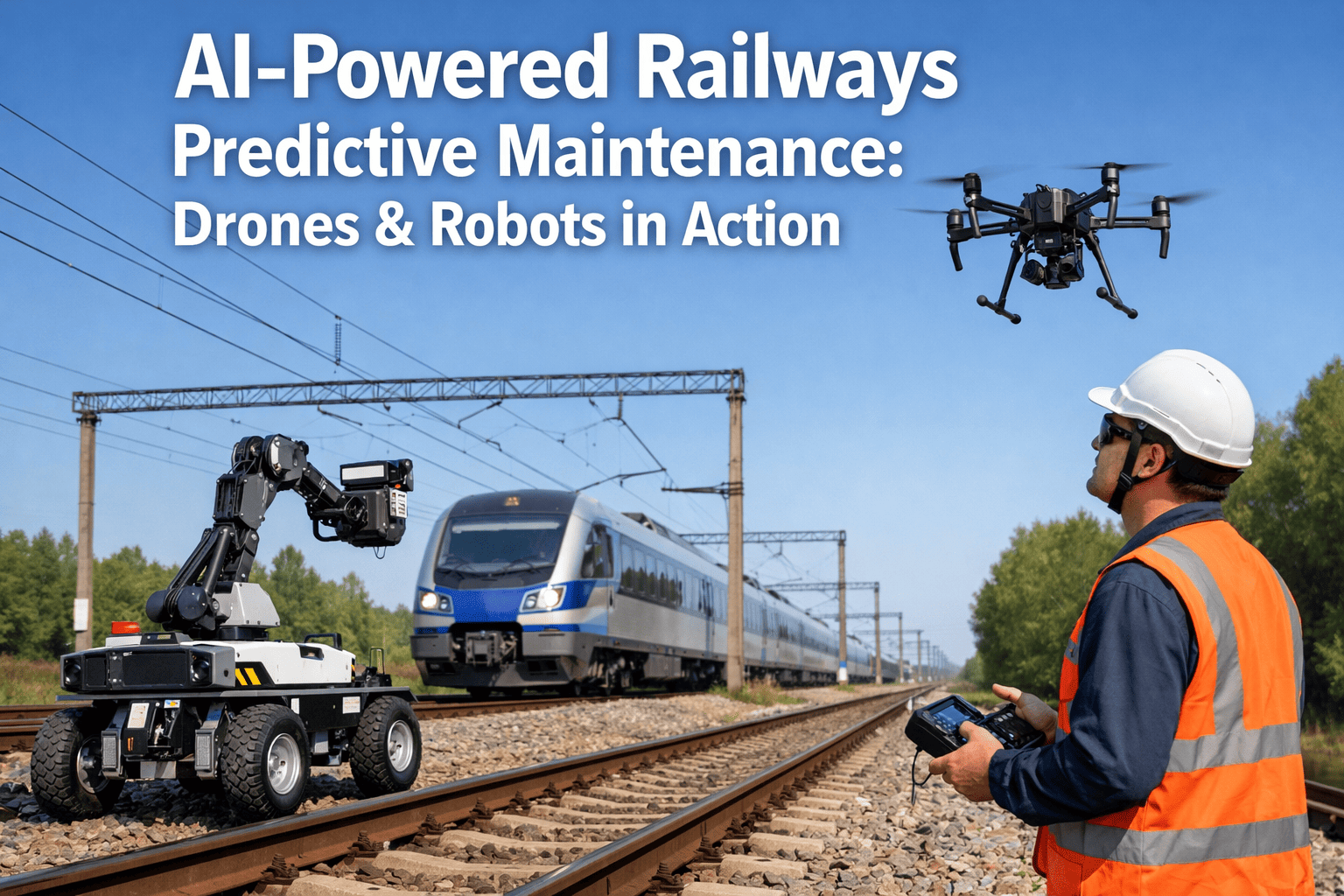
For decades, railway infrastructure inspections have relied on manual track walks, high-rail vehicles, and visual spotting—a process that is slow, hazardous, and often misses the early signs of fatigue in remote sections. A public transport agency deployed an OxMaint-integrated platform of drones, robots, and AI across its rail network — surveying 340 miles of track and bridges, identifying 2,847 critical defects, and prioritizing $12M in capital improvements. integrated platform drones robots and ai in railways maintenance, railways maintenance, public works, government infrastructure, asset health dashboard, predictive maintenance, asset management, public infrastructure, CMMS integration, digital twin, IoT monitoring, AI analytics, drone inspection, robot inspection, work order automation. By connecting autonomous telemetry directly into their maintenance software, the agency transformed reactive railway repairs into a proactive, data-driven operation. Book a demo to see how railway operators are replacing dangerous manual track inspections with automated CMMS workflows.
The Future of Railway Infrastructure Management
As railway networks face increased load and aging components, traditional visual inspections are no longer sufficient to ensure public safety. Drones and autonomous track robots offer unprecedented access to high-span bridges and remote corridors, but capturing high-definition imagery is only the first step. Without a system to process, classify, and trigger repairs, this data remains an untapped resource. OxMaint bridges this gap by integrating robotic systems with a robust CMMS.
Aerial Track & Bridge Drones
High-Altitude Mission Logs
UAVs equipped with thermal and AI vision survey bridge trusses, catenary lines, and steep embankments without requiring track shutdowns or specialized climbing teams.
Autonomous Track Patrols
Robotic Rail Diagnostics
Autonomous ground robots navigate rail corridors, using LiDAR and ultrasonic sensors to detect rail fractures, fastener issues, and ballast degradation in real-time.
AI Vision Analytics
Automated Defect Detection
Advanced AI models process thousands of inspection images per hour, automatically identifying rust, cracks, and missing components with higher precision than the human eye.
340
miles
Railway corridor surveyed safely with zero track downtime
2,847
Structural and track defects identified by AI vision
$12M
allocated
Maintenance budget prioritized via asset health data
Case Study: Integrated Railway Intelligence
A regional public works department managing a complex commuter rail network faced a critical backlog of federally mandated inspections. Using traditional methods, the backlog was estimated to take years to clear. By deploying an integrated platform of drones and robotics powered by OxMaint, the agency completed a comprehensive 340-mile network assessment in record time. The platform automatically ingested mission logs, generated work orders for defects, and provided a digital twin dashboard for long-term planning.
Phase 1: Pre-Automation
Manual Operations
Reliance on manual track walks, paper-based reporting, and reactive emergency repairs.
High inspection costs
Safety risks for staff
Service disruptions
→
Phase 2: Platform Integration
Deployment
OxMaint integration with drone workflows and robotic teleoperation systems.
AI model training
Route planning
IoT connectivity
→
Phase 3: Data-Driven Rail
Present
Fully automated defect logging, geofenced safety alerts, and predictive maintenance scheduling.
85% faster cycles
Zero safety incidents
100% Audit Readiness
Measurable Impact on Railway Maintenance
$3.1M
Operational Savings
Reduced the need for specialized rail-bound inspection vehicles and night-shift manual labor.
90%
Reduction in Manual Risks
Robots and drones now handle high-risk inspections on bridges and high-voltage areas.
Real-Time
Defect Resolution
AI Vision flags defects instantly, allowing crews to respond to critical issues before they cause failures.
Zero
Missed Compliance
Automated mission logs ensure every foot of track meets government safety standards.
How Integrated AI & Robotics Drive Rail Results
The core value of an integrated platform lies in the seamless flow of data. When a drone detects a hairline fracture on a bridge piling or a robot identifies a loose rail fastener, the OxMaint engine translates that visual signal into an immediate maintenance task. This removes human error and ensures that no defect is overlooked.
01
AI Vision Defect Detection
Sophisticated AI vision algorithms analyze robotic imagery to find cracks, corrosion, and missing bolts. These findings are automatically ranked by severity and logged as work orders within the CMMS.
02
Safety Geofencing & Alerts
Integrated platforms use geofencing to ensure robots stay within safe zones during operations. If a robot detects an obstacle or enters an unauthorized area, the system triggers instant safety alerts.
03
Autonomous Mission Logs
Every flight and robot patrol is meticulously logged. These logs provide a historical audit trail, showing the exact condition of an asset over time to create a "Digital Twin" of the railway network.
04
Route Planning & Teleoperation
Managers can remotely operate assets or set pre-planned routes. This allow for the inspection of hundreds of miles of infrastructure from a centralized command center.
340
Miles Inspected
+10x coverage
2,847
Defects Found
0 backlog
$12M
Prioritized Spend
ROI-optimized
100%
Safety Rating
No staff injuries
Identified Risks by Asset Category
Ready to modernize your railway maintenance? OxMaint integrates drones and robots directly into your workflow—transforming raw data into operational excellence.
Start Free TrialMaximizing Infrastructure Longevity
The financial burden of manual inspection extends beyond labor; it includes the cost of service delays and the exponential price of emergency repairs. By moving to an integrated platform, agencies can spot issues when they are inexpensive to fix, rather than waiting for a failure that stops the network.
Emergency Track Shutdowns
Cost: $50K+ per hour of delay
Unexpected failures cause massive commuter disruption. Predictive robotics identify these risks weeks in advance.
Hazardous Access Costs
Cost: Significant scaffolding expense
Inspecting bridge undersides often requires specialized equipment. Drones perform these tasks in minutes without extra gear.
Manual Data Entry Errors
Risk: Lost inspection reports
Paper reports are easily lost or misfiled. AI integration ensures every defect is digitally tracked until resolution.
Asset Life Reduction
Risk: Shortened infrastructure lifespan
Ignoring minor rust or small cracks leads to premature asset replacement. Automated monitoring extends asset life.
Methodology Comparison: Manual vs. Integrated Platform
Inspection Speed
2 miles / day
25+ miles / day
Data Accuracy
Subjective human notes
Precise AI Vision metrics
Personnel Safety
High (Working on live tracks)
Zero (Remote operations)
Cost Efficiency
High per-mile cost
Low cost via automation
Maintenance Strategy
Reactive / Calendar-based
Predictive / Condition-based
Strategic Implementation Path
Implementing an integrated platform requires a phased approach to ensure the technology aligns with public works objectives. OxMaint provides the framework to scale from a single pilot to a network-wide deployment.
Phase 1
Asset Mapping & Connectivity
Upload railway asset hierarchy and geospatial data into OxMaint.
Establish communication protocols between drones, robots, and the CMMS.
Phase 2
AI Calibration & Training
Train AI models on railway-specific defects (corrosion, fastener wear).
Set up automated work order triggers for critical severity levels.
Phase 3
Full Network Deployment
Execute autonomous patrols and drone missions across the network.
Monitor real-time health dashboards to manage the $12M capital budget effectively.
70%
Faster identification of rail flaws
100%
Digital audit trail for regulators
30%
Increase in asset useful life
Frequently Asked Questions
Can drones inspect railway catenary lines and power infrastructure?
Yes. OxMaint-integrated drones use high-resolution thermal and optical sensors to inspect overhead wires and insulators for hotspots or physical damage, keeping personnel away from high-voltage environments.
How does AI vision handle different weather conditions on the tracks?
Our AI models are trained on diverse datasets, including rain, snow, and low-light conditions. The system filters out noise to ensure that critical defects like rail cracks are identified regardless of the environment.
Does the system require a constant internet connection for robots?
While real-time teleoperation benefits from connectivity, our robots can perform autonomous missions in offline mode, syncing all data and mission logs to OxMaint once they return to a dock or network-enabled area.
Schedule a demo to learn more.
Build a Resilient Railway with Integrated Intelligence
Join the agencies using OxMaint to lead the world in railway safety. Connect your drones, robots, and AI to one powerful maintenance platform today.