When a water main breaks beneath a city street, it doesn't just affect the water department. Public works needs to barricade and repair the road surface. Parks discovers the runoff has eroded a section of the adjacent trail. Fleet management pulls a backhoe from a scheduled parks project to support the emergency dig. Facilities gets a call because the break reduced water pressure to City Hall, triggering a fire suppression system alarm. Five departments. One incident. And in most municipalities, five separate work order systems — or no system at all — each logging their piece of the response in isolation, with no shared timeline, no coordinated resource allocation, and no unified after-action record. This is what departmental silos look like in practice: not an organizational chart problem, but an operational failure that costs taxpayer dollars, delays repairs, and leaves elected officials unable to answer basic questions about how their government responded to a single infrastructure event.
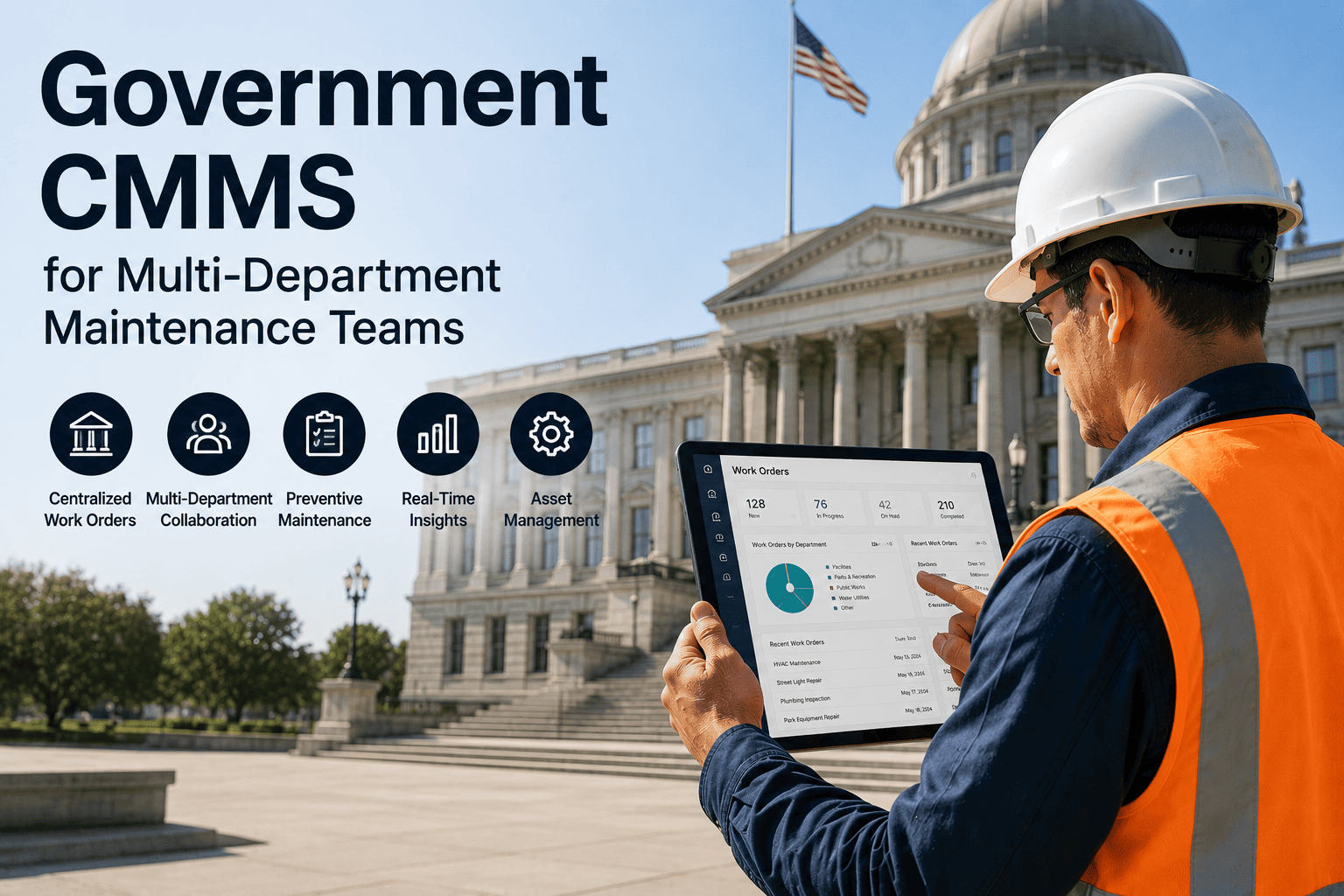
Forward-thinking municipalities in 2026 are dismantling these silos — not by reorganizing departments, but by deploying a centralized CMMS platform that connects every department's maintenance operations while preserving the role-based access, separate budgets, and department-specific reporting that each director needs. When public works, parks, fleet, facilities, water, and sewer all operate on the same digital platform, cross-department coordination becomes automatic, shared resources become visible, and elected officials get the unified operational picture they need to govern effectively.
This guide provides actionable strategies for government operations directors to unify maintenance across every department while preserving the autonomy each department requires. Agencies ready to break down silos can start their unified maintenance journey today.
Departmental silos aren't just an inconvenience — they are a structural inefficiency that compounds across every maintenance operation in government. When public works tracks assets in one spreadsheet, parks uses a different work order system, fleet manages vehicles on paper, and facilities relies on email requests, the municipality loses visibility into its own operations. Duplicate equipment purchases go undetected. Shared contractors are managed without coordinated scheduling. Emergency responses lack a unified command picture. And when council members ask for a total maintenance cost across all departments, the answer takes weeks to compile — if it can be compiled at all.
35%
Of maintenance spending is duplicated across siloed departments
6+
Departments managing assets in disconnected systems per municipality
3 Weeks
Average time to compile a cross-department maintenance report manually
Zero
Real-time cross-department visibility in paper-based operations
Every municipality has the same core departments generating maintenance work orders, tracking assets, and consuming budget — but almost none coordinate these activities across departmental boundaries. Unifying these departments on a single CMMS platform creates the operational visibility that enables resource sharing, coordinated scheduling, and consolidated reporting.
Government Departments on One CMMS Platform
Public Works
Assets:Roads, bridges, drainage, signals
Challenge:Highest emergency volume
CMMS Gain:Coordinated response with utilities
Parks & Recreation
Assets:Playgrounds, trails, fields, pools
Challenge:Seasonal demand spikes
CMMS Gain:Shared fleet & crew scheduling
Facilities Management
Assets:City Hall, libraries, fire stations
Challenge:ADA & code compliance tracking
CMMS Gain:Unified building condition data
Fleet Management
Assets:Trucks, mowers, heavy equipment
Challenge:Cross-department sharing conflicts
CMMS Gain:Visible availability across all depts
Departmental silos in government maintenance aren't caused by unwillingness to cooperate — they are caused by the absence of a shared operational platform. Each department adopted its own tracking method because no unified alternative existed. Breaking silos requires a platform that gives each department its own workspace while connecting everything underneath for cross-department visibility, resource sharing, and consolidated reporting.
| Operational Function |
Siloed Departments |
Unified CMMS |
Impact of Unification |
| Work Order Routing |
Dept-only visibility |
Cross-dept routing |
Multi-dept incidents handled as one event |
| Equipment Sharing |
Phone calls & favors |
Real-time availability |
Eliminates duplicate equipment purchases |
| Budget Reporting |
Manual compilation |
Instant roll-up |
Council-ready reports in minutes, not weeks |
| Contractor Mgmt |
Separate vendor files |
Shared vendor registry |
One performance record across all depts |
| Emergency Response |
Radio & memory |
Unified command view |
All departments see the same incident picture |
Quick-Win Unification Strategies
1
Unified Asset Registry
Catalog every asset from every department — roads, buildings, vehicles, parks, utilities — into one CMMS with department tags. Creates the foundation for cross-department visibility without changing org structure.
Result: Complete municipal asset picture for the first time
2
Cross-Department Work Orders
When a single incident affects multiple departments, one work order spawns linked tasks routed to each department — public works for road repair, utilities for pipe fix, fleet for equipment dispatch — all connected.
Result: Coordinated multi-dept response from a single trigger
3
Shared Resource Calendar
Heavy equipment, specialized vehicles, and contractor crews become visible across all departments. Parks can see when the backhoe is available. Public works knows when the tree crew is free.
Result: Fewer idle assets and eliminated rental costs
4
Role-Based Access with Unified Reporting
Each department sees only its own work orders and budget — but the city manager, finance director, and council see consolidated dashboards showing total maintenance spending, PM compliance, and backlog across all departments.
Result: Department autonomy preserved + municipal-wide visibility
Connect Every Department on One Platform
Oxmaint CMMS gives each department its own workspace — separate budgets, separate work orders, separate reporting — while connecting everything underneath for cross-department coordination, shared resource visibility, and consolidated analytics that council members and city managers need.
Trusted by municipal governments managing 3 to 30+ departments on one platform
The number one concern department directors raise about unified platforms is loss of control. They fear that a centralized system means a centralized authority dictating their priorities, budgets, and workflows. A properly configured CMMS addresses this directly: each department maintains its own work order queues, budget tracking, PM schedules, and reporting — visible only to their staff. Cross-department features are additive, not invasive.
How Unified CMMS Preserves Department Independence
✓
Separate Budget Tracking
Each department tracks its own maintenance spending against its own budget codes. Finance sees the roll-up. Departments see their own numbers. No blending, no confusion.
✓
Role-Based Access Control
Parks staff cannot see facilities work orders. Public works cannot modify fleet schedules. City manager sees everything. Each role sees exactly what they need — nothing more, nothing less.
✓
Department-Specific PM Schedules
Each department configures its own preventive maintenance calendars, frequencies, and checklists. Parks has seasonal playground inspections. Facilities has monthly fire alarm tests. Both automated, neither interfered with.
✓
Custom Reporting Dashboards
Department directors get dashboards showing their own KPIs — open work orders, PM compliance, spending trends. The city manager gets a consolidated view across all departments from the same data.
Deploying a unified CMMS across multiple departments requires a phased approach that builds momentum through early wins rather than attempting a big-bang rollout that overwhelms staff and risks resistance. Start with the department that has the most pain, prove value quickly, then expand.
120-Day Multi-Department Rollout Roadmap
Days 1-30
Pilot Department Launch
→ Select the highest-volume department (usually public works or facilities)
→ Inventory all assets, configure PM schedules, train staff on mobile work orders
→ Establish baseline KPIs: open work orders, PM completion rate, average response time
Milestone: One department fully digital with measurable improvement data
Days 31-60
Second & Third Department
→ Onboard parks & recreation and fleet management simultaneously
→ Enable shared resource visibility between pilot department and new departments
→ Configure cross-department work order linking for multi-department incidents
Milestone: Three departments sharing resources and coordinating on shared incidents
Days 61-90
Full Agency Expansion
→ Roll out to water/sewer, IT, and remaining departments
→ Activate consolidated dashboards for city manager and finance director
→ Connect vendor registry across all departments for unified contractor management
Milestone: All departments on one platform with cross-department visibility active
Days 91-120
Optimization & Reporting
→ Generate first consolidated municipal maintenance report for council presentation
→ Identify cross-department resource sharing opportunities from usage data
→ Optimize PM schedules based on first 90 days of digital data across all departments
Milestone: Data-driven municipal maintenance operations with council-ready reporting
Operations directors and city managers need clear metrics to demonstrate that unifying departments on one platform delivers measurable value — not just to justify the investment, but to sustain adoption across departments that may initially resist change.
Coordination
Multi-Dept Response Time
Target: < 4 Hours
Measures how quickly departments coordinate on incidents affecting multiple teams
Efficiency
Equipment Utilization Rate
Target: 75%+
Tracks shared equipment usage across departments to eliminate idle assets
Visibility
Report Generation Time
Target: < 5 Minutes
Time to produce consolidated cross-department maintenance reports for council
Savings
Duplicate Spend Reduction
Target: 25%+ Decrease
Eliminates redundant equipment purchases, contractor overlaps, and parts stockpiling
Municipalities that have deployed unified cross-department CMMS platforms report measurable improvements across coordination, cost savings, and operational transparency:
40%
Faster Multi-Dept Response
Coordinated incidents resolved in hours, not days
$350K
Annual Savings
From eliminated duplicate equipment and contractor overlap
100%
Council Reporting
Consolidated maintenance data available on demand
6→1
Systems Consolidated
One platform replacing spreadsheets, paper, and siloed software
See How Oxmaint Unifies Government Departments
Schedule a personalized demo showing exactly how role-based access, cross-department work orders, shared resource calendars, and consolidated dashboards work for your specific department structure and reporting requirements.
Trusted by municipalities managing 3 to 30+ departments on one unified platform
Departmental silos in government maintenance are not an inevitability — they are a symptom of outdated tools. When each department operates on paper, spreadsheets, or disconnected software, silos are the natural result. When every department operates on a shared CMMS platform with role-based access, cross-department coordination becomes the natural result instead. The technology exists today. The question is not whether your municipality can afford to unify — it is whether you can afford to continue operating in disconnected silos while taxpayers fund the inefficiency.
The municipalities making this transition now report measurable wins: 40% faster multi-department response, $350K+ in annual savings from eliminated duplication, and council-ready reporting that builds confidence in government operations. These are not aspirational targets — they are documented outcomes from operations teams that deployed unified CMMS across every department.
Your departments won't coordinate themselves. Your reporting won't consolidate itself. But the tools to make it happen are available today. For a personalized assessment of how unified CMMS would work across your specific department structure, request a government operations consultation from specialists who understand multi-department municipal operations.
How does a unified CMMS handle different department budgets and cost centers?
Each department maintains its own budget codes, cost centers, and spending accounts within the CMMS. When a public works technician creates a work order, the labor and parts costs are automatically charged to the public works budget code. When a parks crew completes a playground repair, those costs go to the parks budget. The finance director and city manager can see a consolidated roll-up of all department spending from the same data — without any manual compilation. Cross-department work orders split costs according to configurable rules, so when fleet provides a vehicle for a public works project, each department's budget is charged accurately and automatically.
Will our departments lose control of their own operations?
No. Role-based access control ensures that each department director controls their own work order queues, PM schedules, staff assignments, and reporting. Parks staff cannot see or modify facilities work orders. Public works technicians cannot access fleet budget data. Each department operates independently within their own workspace. The cross-department features — shared resource visibility, linked multi-department work orders, and consolidated reporting — are additive layers that provide coordination benefits without removing any department's operational autonomy. Department directors gain tools; they do not lose authority.
How do cross-department work orders work in practice?
When an incident affects multiple departments — like a water main break that requires road repair, utility work, and park trail restoration — the originating work order can spawn linked child tasks routed to each department. Each department sees their specific task in their own queue with their own priority, timeline, and assigned crew. But all linked tasks share the same incident reference, GPS location, photos, and timeline — so every department working the same incident has the same situational awareness. The city manager can view the entire incident across all departments from a single screen, seeing which tasks are complete, which are in progress, and which are blocking others.
What about departments that already have their own maintenance software?
This is common. Most municipalities have at least one department using a legacy system alongside departments using paper or spreadsheets. The phased rollout approach starts with departments that have the most pain (usually the ones on paper) and demonstrates value quickly. As other departments see the benefits — faster work orders, mobile access, better reporting — adoption follows naturally. For departments with existing software, Oxmaint can often import historical data to ensure continuity. The key is that the value of cross-department coordination only materializes when multiple departments are on the same platform — which creates natural momentum for full adoption.
How quickly can we see results from unifying departments?
The pilot department typically sees measurable improvement within 30 days — faster work order completion, higher PM compliance, and better visibility for the department director. Cross-department benefits begin appearing at 60 days when the second and third departments come online and shared resource visibility activates. The full municipal impact — consolidated reporting, reduced duplicate spending, coordinated multi-department response — materializes at 90-120 days when all departments are active. The most immediate win is often the simplest: the city manager can finally answer the question "what is our total maintenance backlog across all departments?" in minutes instead of weeks.
Book a demo to see how the phased rollout works for your department structure.