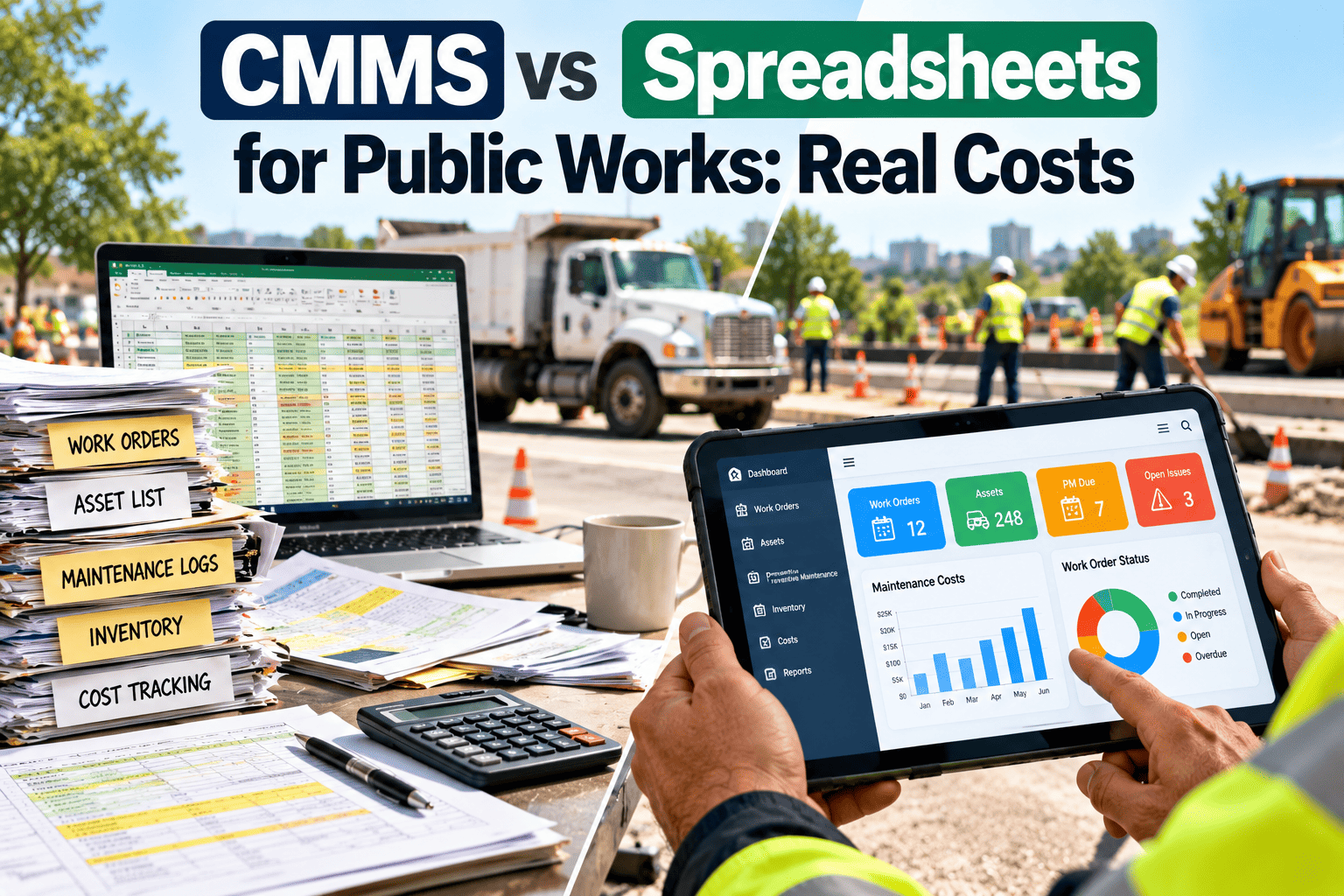
Municipalities managing parks, roads, utilities, and public buildings face a maintenance challenge that generic work order tools cannot solve — aging infrastructure, union labor rules, and procurement ceilings create compliance obligations that private-sector CMMS platforms ignore. The average municipality spends 31 cents of every maintenance dollar on reactive repairs a structured PM program would prevent at one-fifth the cost. Schedule a demo to see how Oxmaint deploys a purpose-built CMMS for municipalities and public works operations.
A municipal CMMS is a maintenance management platform configured for the asset classes, regulatory frameworks, and public accountability requirements of city and county government — covering public works, parks, buildings, fleet, and utilities under one system with audit-ready records. Unlike commercial tools, it handles procurement thresholds, union work rules, grant-eligible capital reporting, and multi-department routing across elected bodies. This guide covers every implementation phase from needs assessment through full PM deployment.
Why Municipal Maintenance Is Fundamentally Different
Public works directors operate under constraints no private facilities manager faces: procurement rules that cap emergency spending, union agreements that define task assignments, and grant reporting requirements that demand timestamped records. See how Oxmaint is purpose-built for government facility maintenance operations.
Municipal emergency repairs exceeding thresholds require competitive bidding. Without CMMS enforcement, departments inadvertently trigger violations. A purpose-built platform flags procurement ceiling breaches before work orders are issued.
FEMA, CDBG, and IIJA grants require itemized labor, material, and condition records that spreadsheets cannot produce retroactively. Missing documentation results in clawbacks averaging $180,000 per disallowed project.
A city hall HVAC failure crosses facilities, finance, and the city manager's office. Municipal work order routing requires department-specific approval chains that commercial platforms treat as expensive custom configurations.
The Four-Phase Municipal CMMS Implementation Framework
Each phase has defined deliverables and go/no-go checkpoints. Skipping Phase 1 needs assessment is the single most common cause of municipal CMMS deployments going unused within 18 months.
A municipal needs assessment documents asset inventory, work order volume by department, regulatory obligations, union labor classifications, and procurement thresholds. This baseline eliminates platforms that cannot serve your public-sector context — and prevents 12 months of post-deployment frustration. See the government facility software evaluation framework.
- Complete asset inventory across all departments — buildings, vehicles, equipment, infrastructure
- Work order volume breakdown by reactive vs. preventive maintenance type
- All regulatory reporting obligations — EPA, OSHA, state, and federal grant requirements
- Union labor classifications and work rule constraints per task type
- Procurement thresholds and IT security requirements confirmed
Procurement compliance, grant-eligible asset tracking, and multi-department routing are non-negotiable requirements most commercial platforms add as afterthoughts. Configuration covers asset hierarchy setup, PM template deployment, department permissions, and integration with existing financial systems. Download the municipal CMMS vendor evaluation scorecard.
- Vendor scored on procurement compliance, grant reporting, and union workflow requirements
- API integration confirmed with existing ERP, HR, and financial systems
- Mobile offline capability validated for field crews in parks and infrastructure sites
- Asset hierarchy configured — municipality, department, facility, system, equipment
- PM templates deployed and department approval workflows configured
The goal is not to migrate everything — it is to migrate what matters for PM scheduling, compliance reporting, and capital planning. A prioritized approach gets priority asset classes live in days, not months. See the public building maintenance guide for asset documentation standards.
- Priority assets live first — HVAC, electrical, fleet, critical infrastructure
- Manufacturer specs, installation dates, and replacement values imported
- QR asset tags printed and deployed in the field concurrent with data entry
- Historical work orders migrated for regulatory reporting continuity
- Deferred maintenance backlog documented as open corrective work orders
Deployments fail at adoption when training focuses on features instead of daily workflows. Training organized around how a technician starts and completes their day achieves 3× higher field adoption within 60 days. Download the government facility PM checklist for training reference.
- Role-based tracks — field technicians on mobile app, supervisors on dashboards, admins on reporting
- Supervisors trained on PM compliance dashboards and escalation alerts
- Department heads trained on compliance exports and FCI capital reporting
- CMMS champion designated per department for first-line troubleshooting
- 30/60/90-day adoption checkpoints set — PM compliance rate as primary KPI
Deploy Oxmaint Across Your Municipality in 14 Days
Pre-built workflows for procurement compliance, grant documentation, and multi-department routing — live in two weeks with no IT project and no consultant fees.
Platform Capabilities by Municipal Department
Each department manages distinct asset classes and regulatory requirements. Oxmaint configures department-specific workflows rather than applying a single template across the city portfolio. See the complete government facility maintenance software guide.
HVAC, elevator, fire suppression, and electrical PM scheduling with ADA compliance records and digital sign-off. Capital replacement forecasting per building system produces FCI-backed council budget submissions. See the complete public building facility maintenance guide for 2026.
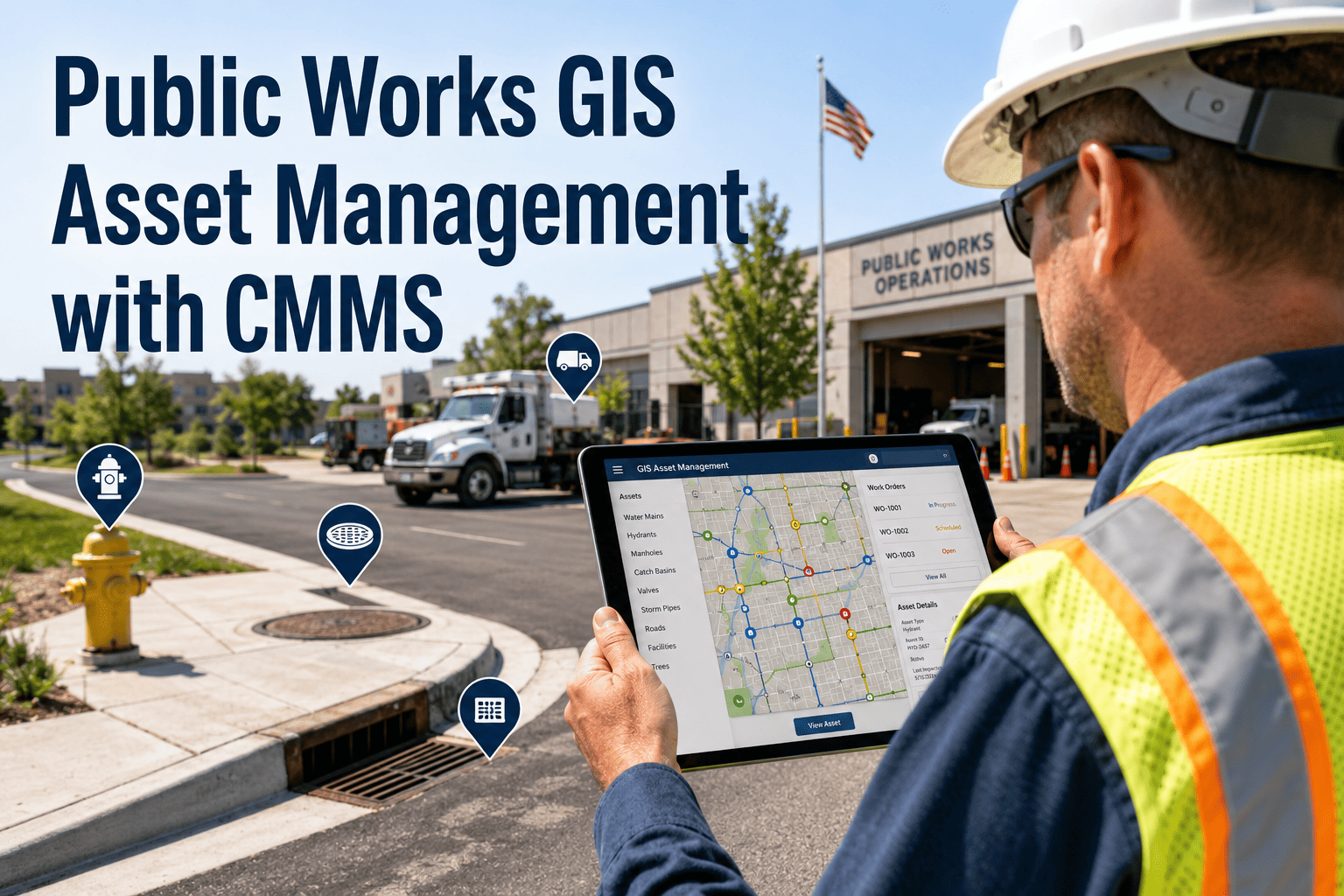
GIS-linked road segment inspection records with FHWA bridge compliance documentation. Grant-eligible capital project costs tagged with federal project codes from work order creation through closeout. See how deferred road maintenance compounds infrastructure costs.
Playground safety inspection scheduling with CPSC and ASTM F1487 compliance records. Irrigation PM, athletic field calendars, and pool water chemistry logs all stored and exportable per agency requirements. See the government facility PM checklist for parks equipment intervals.
PM scheduled by mileage, engine hours, and calendar intervals. DOT inspection compliance documentation per vehicle with mechanic certification tracking and lifecycle cost analysis for council replacement submissions. See the PM checklist for fleet maintenance intervals.
Platform Comparison: Key Municipal Evaluation Criteria
This comparison covers the government-specific requirements that determine whether a platform will serve a municipality's regulatory, procurement, and accountability obligations. See how deferred maintenance compounds when the wrong CMMS is selected.
| Criterion | Oxmaint Municipal | Generic CMMS | Enterprise EAM | Spreadsheet |
|---|---|---|---|---|
| Procurement compliance | Built-in Threshold flags pre-configured | No Custom build required | Partial 6+ month project | None No enforcement |
| Grant documentation | Built-in Federal project code tagging | No Not standard | Partial Needs integration project | None High clawback risk |
| Multi-dept approval routing | Built-in Separate chains per department | Basic Single-level only | Yes Long to configure | None Email only |
| EPA / OSHA compliance export | Built-in Pre-configured templates | No Custom reports required | Partial Report builder only | None Manual, frequent gaps |
| Mobile offline capability | Full Offline Auto-sync on reconnect | Limited View-only offline | Varies Platform-dependent | None Paper forms only |
| Time to live PM schedules | 14 Days | 30–60 Days | 6–18 Months | N/A |
Before and After: Municipal Maintenance Transformation
Benchmark outcomes comparing reactive-maintenance municipalities against Oxmaint-deployed operations across all major department asset classes.
See Oxmaint Across a Full Municipal Operations Portfolio
30-minute demo configured for municipal operations — department workflow, procurement compliance, grant documentation export, and EPA compliance reporting included. Schedule your municipal demo today.
30-Day Municipal CMMS Go-Live Timeline
For a mid-size municipality with 3 to 5 departments and 200 to 800 tracked assets. Larger portfolios extend data migration by 1 to 2 weeks while maintaining the same go-live structure for priority assets. See the public building guide for facility-specific asset documentation requirements.
Department permissions and asset hierarchy configured. Critical assets — HVAC, electrical, fleet — entered first with QR tags deployed in the field. Historical work orders imported for regulatory continuity.
Pre-built PM templates deployed per equipment class. OSHA and manufacturer-interval schedules activated. First automated PM work orders generated with escalation alerts at 30, 7, and 1 day before each deadline.
Field technicians trained on mobile app workflow. Supervisors trained on compliance dashboards. EPA and grant reporting templates configured and validated. CMMS champions designated per department.
Full audit: open work orders, PM compliance rate, and incomplete records reviewed. Field adoption confirmed via mobile completion rate. All departments operational on live PM schedules with 60/90-day checkpoints set.
Frequently Asked Questions: Municipal CMMS Implementation
Continue Reading: Government & Municipal Maintenance Guides
Stop Managing Public Works Maintenance on Spreadsheets — Go Live in 14 Days
Municipalities on Oxmaint reach 87% PM compliance, cut reactive spend by 31%, and produce audit-ready documentation in under 4 hours — deployed across all departments in 14 days, no IT project, no consultant fees.