Municipal Fleet Electrification: Complete Transition Guide
By Taylor on February 6, 2026
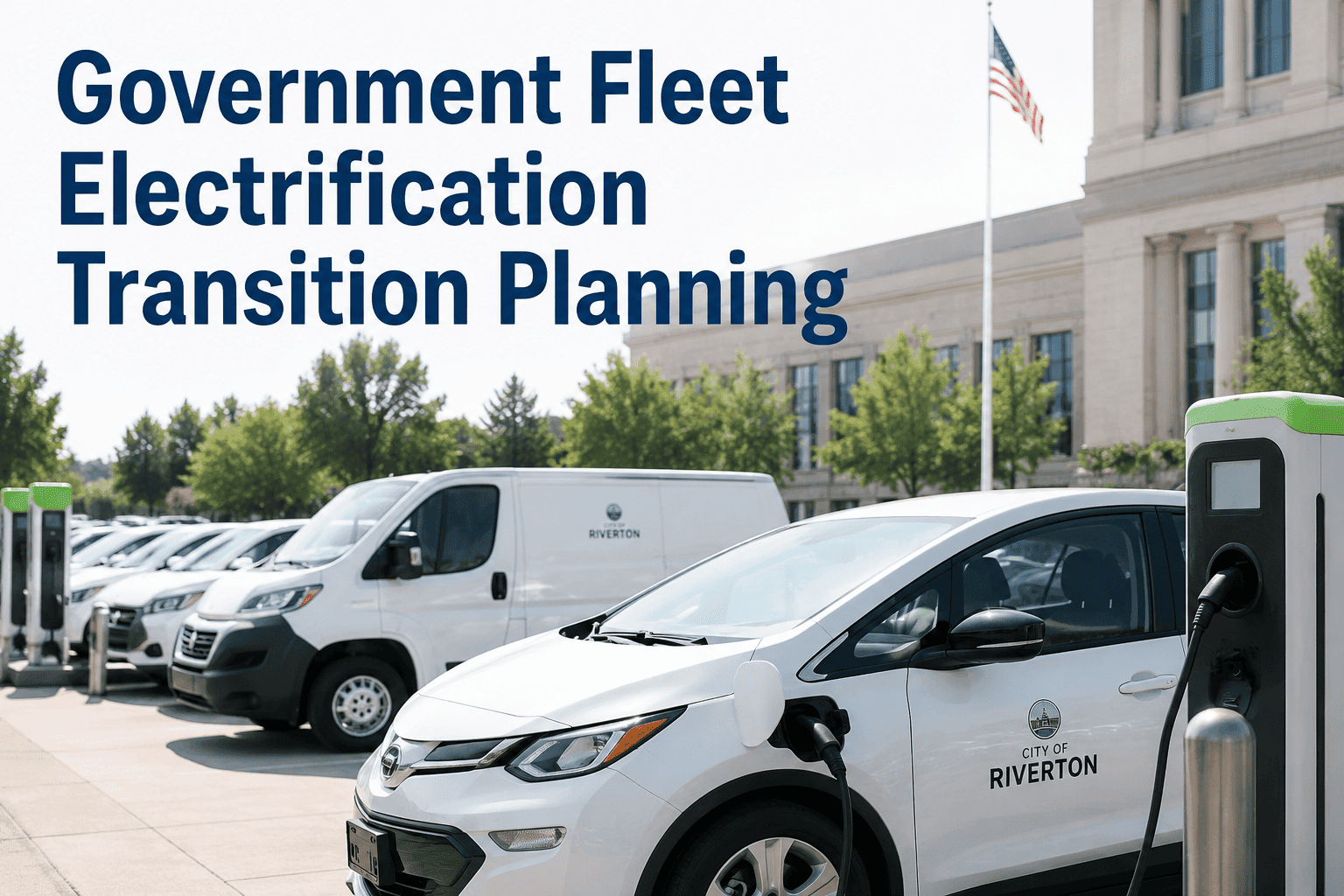
Municipal fleet electrification is no longer a future aspiration—it's a present-day imperative reshaping how cities operate their vehicles. From police cruisers and transit buses to public works trucks and administrative sedans, local governments are under mounting pressure from executive orders, state mandates, and citizen expectations to transition away from internal combustion engines. A single mid-sized municipal fleet burning 500,000 gallons of diesel annually generates over 5,000 metric tons of CO2 while spending $2M+ on fuel that could be redirected to community services.
This guide provides city managers, fleet directors, and sustainability coordinators with a comprehensive framework for planning and executing fleet electrification. We cover the full lifecycle from vehicle assessment and charging infrastructure planning to Total Cost of Ownership (TCO) analysis and federal grant capture, providing actionable steps to build a fiscally responsible EV transition. Municipalities ready to begin their electrification journey can start their fleet assessment today. Start Free Trial.
Fleet Transition Landscape
The Accelerating Case for Municipal Fleet Electrification
70%
lower fuel costs per mile for EVs vs. diesel/gasoline equivalents
50%
reduction in maintenance costs over EV lifecycle vs. ICE vehicles
$7.5B
in federal funding available for government fleet electrification through 2026
Source: DOE, EPA, IIJA/IRA Federal Programs 2023-2026
The transition window is narrowing. Federal incentives from the Inflation Reduction Act and Infrastructure Investment and Jobs Act have created an unprecedented funding environment, but grant deadlines are approaching. Meanwhile, EV manufacturers are rapidly expanding their commercial vehicle lineups, making viable electric alternatives available for nearly every municipal application. The cities that plan now will lock in the lowest TCO; those that wait will face higher vehicle costs, grid upgrade backlogs, and missed grant cycles.
Assessing Your Fleet: Where Electrification Makes Sense First
Not every vehicle in a municipal fleet should be electrified simultaneously. Strategic assessment identifies the "low-hanging fruit"—vehicles with predictable routes, return-to-base duty cycles, and high fuel consumption—that deliver the fastest ROI. Understanding these operational profiles ensures that electrification starts where it saves the most money and builds organizational confidence.
Fleet Electrification Assessment Framework
From fleet analysis to phased deployment
01
Fleet Telematics Audit
Collect 90 days of GPS/fuel data to map daily mileage, idle time, and return-to-base patterns
02
EV Suitability Scoring
Rank each vehicle by EV readiness: daily range needs, duty cycle, dwell time, and replacement schedule
03
TCO Modeling
Calculate total lifecycle costs: acquisition, energy, maintenance, and residual value vs. ICE baseline
04
Phased Deployment
Deploy highest-ROI vehicles first, align with grant cycles, and scale charging infrastructure
Implementing a data-driven fleet assessment eliminates guesswork from the electrification decision. Telematics data reveals that most municipal sedans and light-duty trucks travel under 80 miles daily—well within EV range—while spending 12+ hours parked at base, providing ample overnight charging windows. This operational reality makes 40-60% of most municipal fleets immediately EV-eligible.
ICE vs. EV: The Real Cost Comparison
The sticker price of an EV is higher, but sticker price is not total cost. When fuel savings, reduced maintenance (no oil changes, brake regeneration, fewer drivetrain components), and available federal/state incentives are factored in, EVs achieve TCO parity within 3-5 years for most municipal applications—and significant savings over the vehicle's full lifecycle.
Total Cost of Ownership: ICE vs. Electric Fleet
✗
ICE Fleet (Gasoline/Diesel)
Fuel: $0.15-$0.25 per mile
Oil changes every 5,000 miles
Transmission, exhaust, coolant repairs
Volatile fuel price exposure
Emissions compliance costs rising
Declining residual values
No federal purchase incentives
Higher Lifecycle Cost & Rising Risk
✓
Electric Fleet (BEV)
Energy: $0.04-$0.08 per mile
No oil changes, minimal brake wear
Fewer moving parts, lower failure rate
Stable electricity pricing
Zero tailpipe emissions
Strong residual value trajectory
Up to $40K federal incentives per vehicle
Lower TCO & Fiscal Stability
The maintenance savings alone are transformative. Municipal fleets report 40-60% reductions in per-vehicle maintenance costs after EV conversion, freeing shop technician hours for other priorities while eliminating costly engine, transmission, and exhaust system repairs entirely.
Fleet Electrification Performance Metrics
Documented results from municipal EV transition programs
70%
Fuel Cost Savings
Electricity vs. Gasoline/Diesel
50%
Maintenance Reduction
Over Vehicle Lifecycle
3-5yr
TCO Payback
Including Federal Incentives
100%
Emissions Cut
Tailpipe Emissions Eliminated
Charging Infrastructure: The Foundation of Fleet Success
The most common cause of fleet electrification failure isn't the vehicles—it's inadequate charging infrastructure planning. Municipal fleet depots need sufficient Level 2 and DC Fast Charger capacity to ensure every vehicle starts each shift fully charged, without overloading the electrical grid or requiring prohibitively expensive utility upgrades.
Charging Infrastructure Planning: The Four Pillars
Electrical Capacity
Audit existing panel capacity; plan transformer upgrades for phased charger deployment without grid stress.
Smart Scheduling
Deploy managed charging software to stagger loads during off-peak hours, reducing demand charges 40-60%.
Charger Mix Strategy
Level 2 for overnight depot charging; DCFC for midday top-ups and vehicles with extended duty cycles.
Future-Proofing
Install conduit and panel capacity for 2x current needs; avoid costly retrofit when fleet scales beyond Phase 1.
The Financial Equation: Grant Funding vs. Capital Outlay
The federal funding landscape for municipal fleet electrification is the most favorable in history. However, grant applications require detailed fleet data, TCO projections, and emissions reduction calculations that most municipalities struggle to produce from spreadsheet-based systems. Digital fleet management platforms automate grant documentation, dramatically increasing award rates.
Funding Calculator: Grants + Savings vs. ICE Baseline
Based on a 50-vehicle municipal fleet transition over 5 years
ICE Baseline (Status Quo)
Annual Fuel Cost$450K - $650K
Annual Maintenance$200K - $350K
Federal Incentives$0
Emissions LiabilityRising / Uncertain
5-Year Cost: $3.2M - $5M+
VS
EV Transition Plan
Annual Energy Cost$90K - $195K
Annual Maintenance$100K - $175K
Federal/State Grants$500K - $2M captured
EmissionsZero Tailpipe
5-Year Net Savings: $1M - $3M+
Municipalities that implement digital fleet management platforms can also generate the data documentation required for EPA Clean School Bus, FHWA CMAQ, DOE Clean Cities, and state-level EV grant programs. The data argument for fleet digitization before electrification is clear: you can't win grants you can't document.
Electrify Your Fleet with Confidence
Don't leave grant dollars on the table. Oxmaint provides integrated fleet assessment, TCO modeling, and charging infrastructure tracking to ensure your electrification program delivers maximum ROI.
Implementation: Building an Electrification Roadmap
Fleet electrification is a multi-year journey that requires coordination across fleet operations, facilities, finance, and sustainability departments. A structured maturity model ensures that each phase builds on the last, preventing the costly mistakes that occur when municipalities rush vehicle purchases before infrastructure is ready.
Fleet Electrification Maturity Model
Phase 1 — Year 1
Assessment & Planning
Telematics Data CollectionEV Suitability ScoringElectrical Capacity AuditGrant Application Prep
Phase 2 — Year 2-3
Pilot Deployment
10-15% Fleet EV ConversionDepot Charger InstallationTechnician EV TrainingEnergy Cost Monitoring
Phase 3 — Year 4-6
Scaled Transition
40-60% Fleet ElectrifiedSmart Charging OptimizationV2G Revenue ExplorationLifecycle Data Reporting
Start with data. Install telematics on your current fleet to understand real-world duty cycles before purchasing any EVs. Then, align vehicle replacements with natural lifecycle turnover to avoid premature asset disposal costs. Finally, scale charging infrastructure ahead of vehicle deliveries to prevent deployment bottlenecks.
EV-Ready Workforce: Training for the Transition
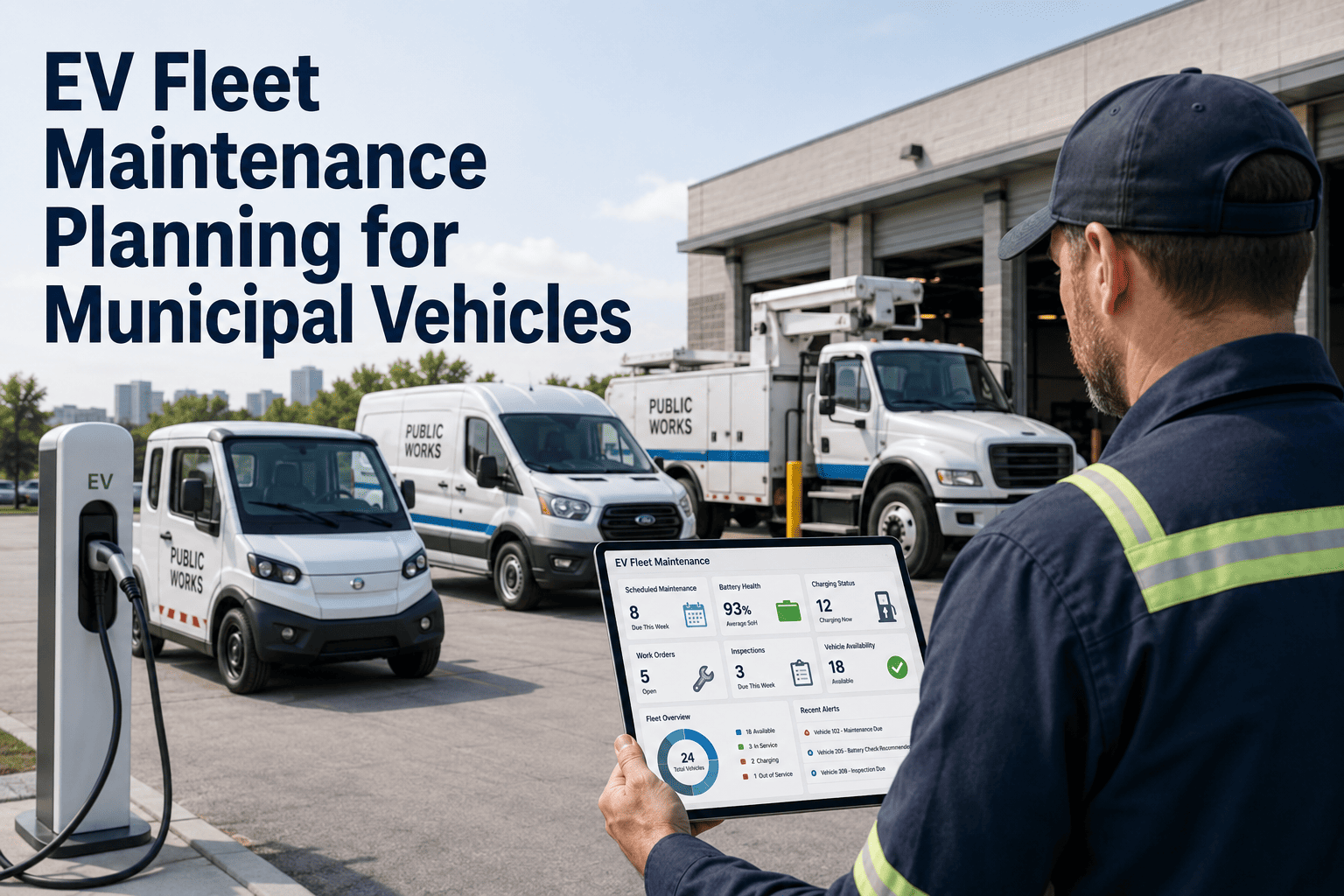
Municipal fleet shops built around diesel engines and hydraulic transmissions need new skills for high-voltage battery systems, regenerative braking, and charging network management. Investing in technician training before vehicles arrive ensures safe, efficient maintenance and prevents costly dealer-dependency for routine service.
EV Workforce Development Program
Building competency across every level of fleet operations
HV Safety (NFPA 70E)
Battery Diagnostics
EVSE Installation
Charging Mgmt Software
Regen Brake Systems
Thermal Management
TCO Data Analysis
Grant Documentation
Technician Certification
ASE-aligned EV training ensuring shop staff can safely service high-voltage systems in-house.
Operator Education
Driver training on regen braking, range optimization, and proper charging procedures for maximum efficiency.
Leadership Fluency
Council-ready briefings on TCO, emissions reduction, and grant ROI to build political support for phased investment.
Effective fleet electrification is a team effort spanning mechanics, drivers, facility managers, and elected officials. By investing in workforce development alongside vehicle procurement, municipalities ensure smooth adoption and avoid the operational disruptions that derail transition programs. See how our platform supports fleet transition planning. Book a Demo.
Future-Proof Your Municipal Fleet
Take the first step towards a cleaner, more cost-effective fleet. Oxmaint provides the data platform to assess, plan, and manage your electrification transition—from telematics audit to grant documentation.
Which municipal vehicles should be electrified first?
Start with vehicles that have predictable, return-to-base duty cycles and travel under 100 miles daily. Administrative sedans, building inspection vehicles, parking enforcement, and light-duty pickup trucks are typically the best candidates. Transit buses and refuse trucks are increasingly viable but require more infrastructure investment. Police patrol vehicles are now available as EVs but require range validation for specific jurisdictional needs.
How much does it cost to install charging infrastructure at a fleet depot?
Costs vary widely based on existing electrical capacity. Level 2 chargers cost $3,000-$7,000 installed per port, while DC Fast Chargers range from $50,000-$150,000. However, the largest variable is electrical panel and transformer upgrades, which can add $50,000-$500,000 depending on the site. Smart planning—phased installation, managed charging software, and utility partnership programs—can reduce these costs by 30-50%.
What federal grants are available for municipal fleet electrification?
Key programs include the EPA Clean Heavy-Duty Vehicle Program (up to 100% funding for qualifying vehicles), FHWA CMAQ funds (for emissions reduction projects), DOE Clean Cities grants, and IRA Section 30C tax credits for charging infrastructure (30% up to $100,000 per station). Many states offer additional rebates and incentive programs. A CMMS with fleet data can auto-generate the documentation these applications require.
How do EVs perform in extreme weather conditions?
EV range decreases 20-40% in extreme cold (below 20°F) due to battery chemistry and cabin heating demands. Municipalities in cold climates should oversize vehicle range requirements by 30%, invest in depot pre-conditioning (warming batteries while plugged in before shifts), and consider heat pump-equipped models. Hot climates have less impact (10-15% range reduction) and benefit from lower cooling energy vs. ICE engine heat management.
How does a CMMS help manage a mixed ICE/EV fleet during transition?
During the multi-year transition period, a CMMS tracks both ICE and EV assets in a single platform—managing different maintenance schedules (oil changes vs. battery health checks), tracking fuel costs vs. electricity costs separately, monitoring charger utilization, and generating comparative TCO reports that prove EV savings to council. It also tracks warranty compliance for new EVs and schedules the specialized HV-certified technicians required for EV maintenance.