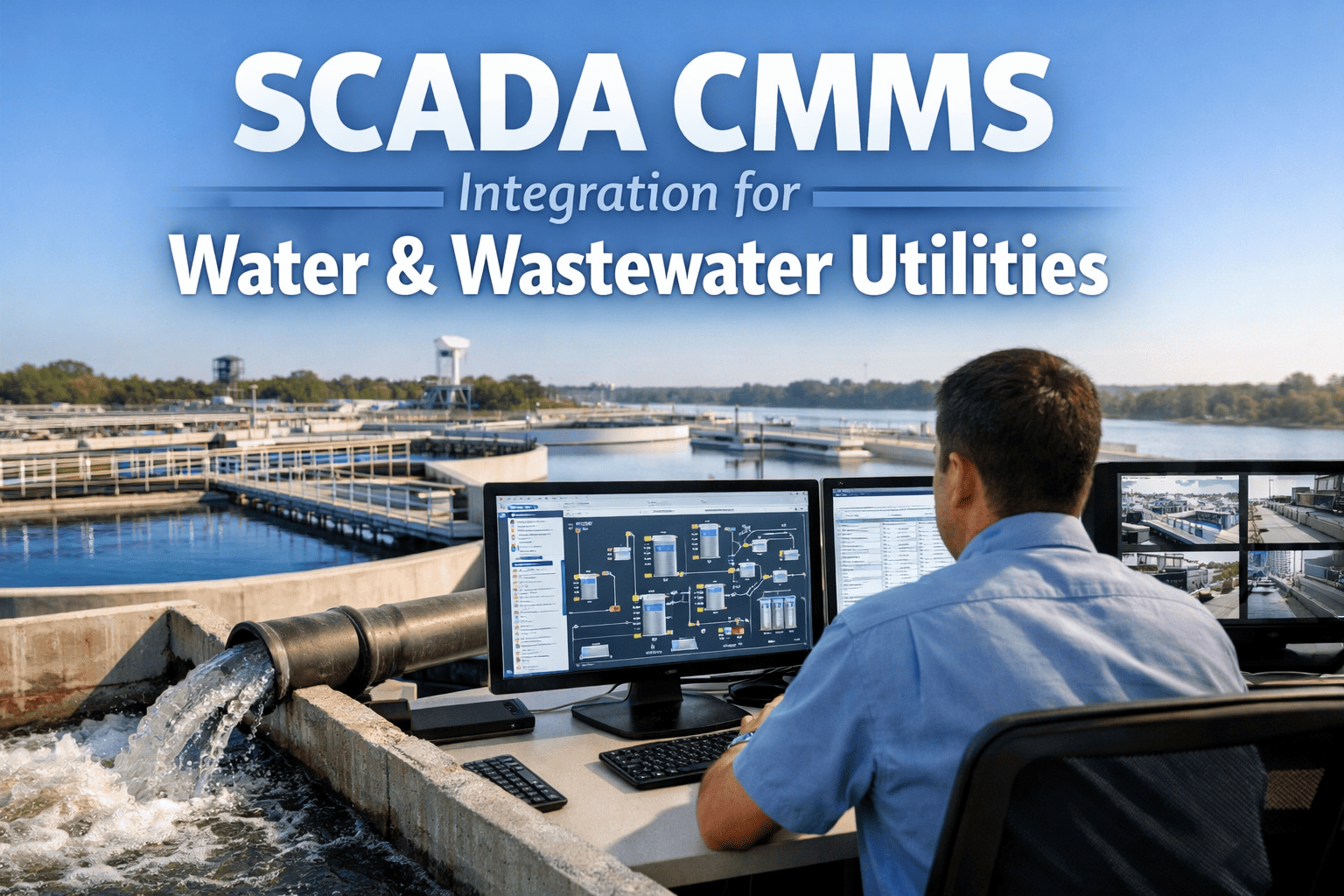
SCADA Integration with CMMS for Water and Wastewater Utilities
By Taylor on February 25, 2026
When a utility director asks "Why did the lift station overflow at 3 AM?" and the maintenance lead responds "The SCADA alarm went to a generic email inbox that nobody checked until the morning shift," the integration gap is critical. Monitoring water quality and flow is not enough; having a connected utility where every pump failure, pressure spike, and chlorine analyzer deviation feeds real-time data into a single CMMS platform is the standard. If your plant operations rely on disconnected SCADA screens, clipboard rounds, and manual work order creation, budget is bleeding through invisible cracks in the treatment process. The difference between utilities drowning in reactive repairs and those achieving regulatory peace of mind is the depth of their SCADA-CMMS Integration Strategy. Talk to our team about closing the gap between your sensors and your maintenance workforce.
Water & Wastewater Utility Guide — 2026 Edition
SCADA Integration with CMMS for Water and Wastewater Utilities
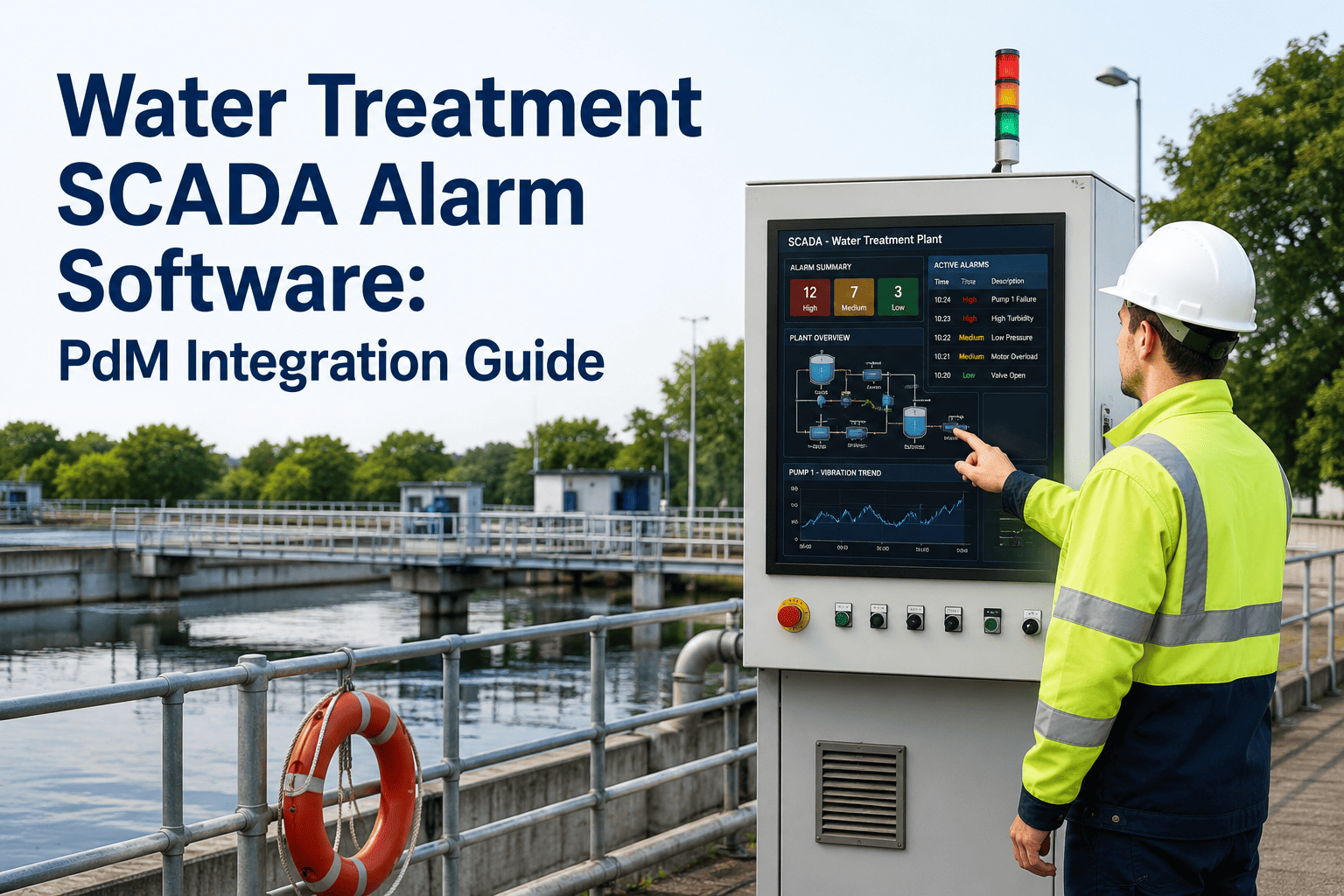
Connect SCADA monitoring directly to CMMS for automated maintenance workflows. When SCADA detects pump failures, pressure anomalies, or process upsets, work orders generate automatically for rapid response.
Every utility department—from distribution and collection to treatment plants—generates massive amounts of data. But when SCADA screens operate in a control room isolated from the maintenance team's daily workflow, the utility loses operational intelligence. A vibration spike on a lift station pump, a turbidity violation at the filter, or a low chlorine residual are data points in isolation—but when fed into a unified CMMS, they become actionable maintenance tasks that prevent violations. Integration builds the infrastructure health picture that drives smart CIP planning.
What SCADA-CMMS Integration Enables
Predictive Maintenance
Monitor runtime hours and amperage draw trends to predict pump bearing failures before they cause catastrophic station outages.
Automated Work Orders
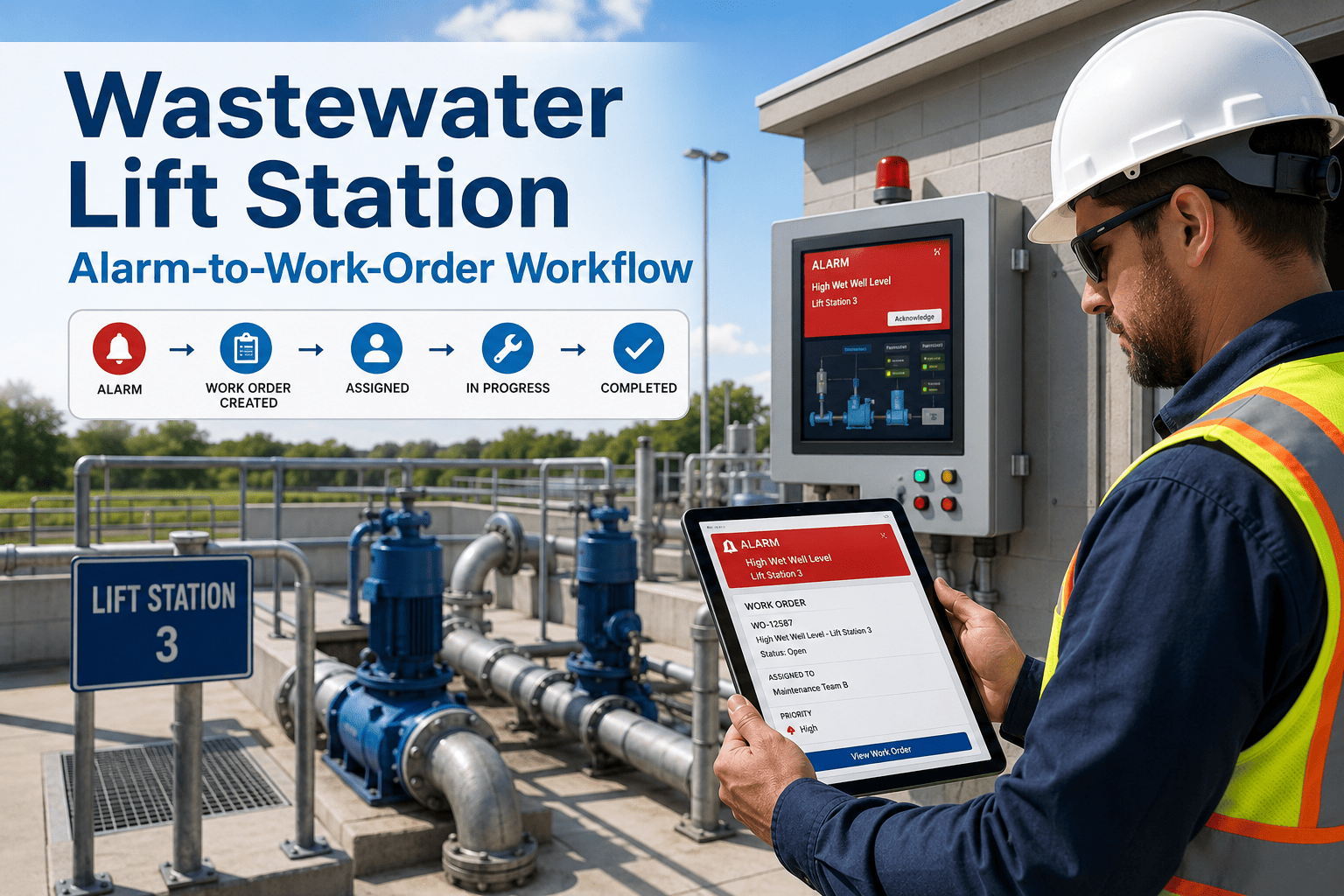
SCADA alarms auto-generate prioritised CMMS work orders with SOPs, location data, and lockout/tagout procedures attached.
Rapid Response
Bypass the "phone tree" delay. Critical process upsets notify the right on-call technician immediately via the mobile CMMS app.
Data Accuracy
Eliminate manual runtime readings. SCADA feeds exact pump hours directly to the CMMS to trigger PMs based on actual usage, not calendar estimates.
Regulatory Compliance
Digital audit trails link specific SCADA alarm events to the completed repair work order, satisfying EPA and state DNR documentation needs.
Asset Lifecycle Planning
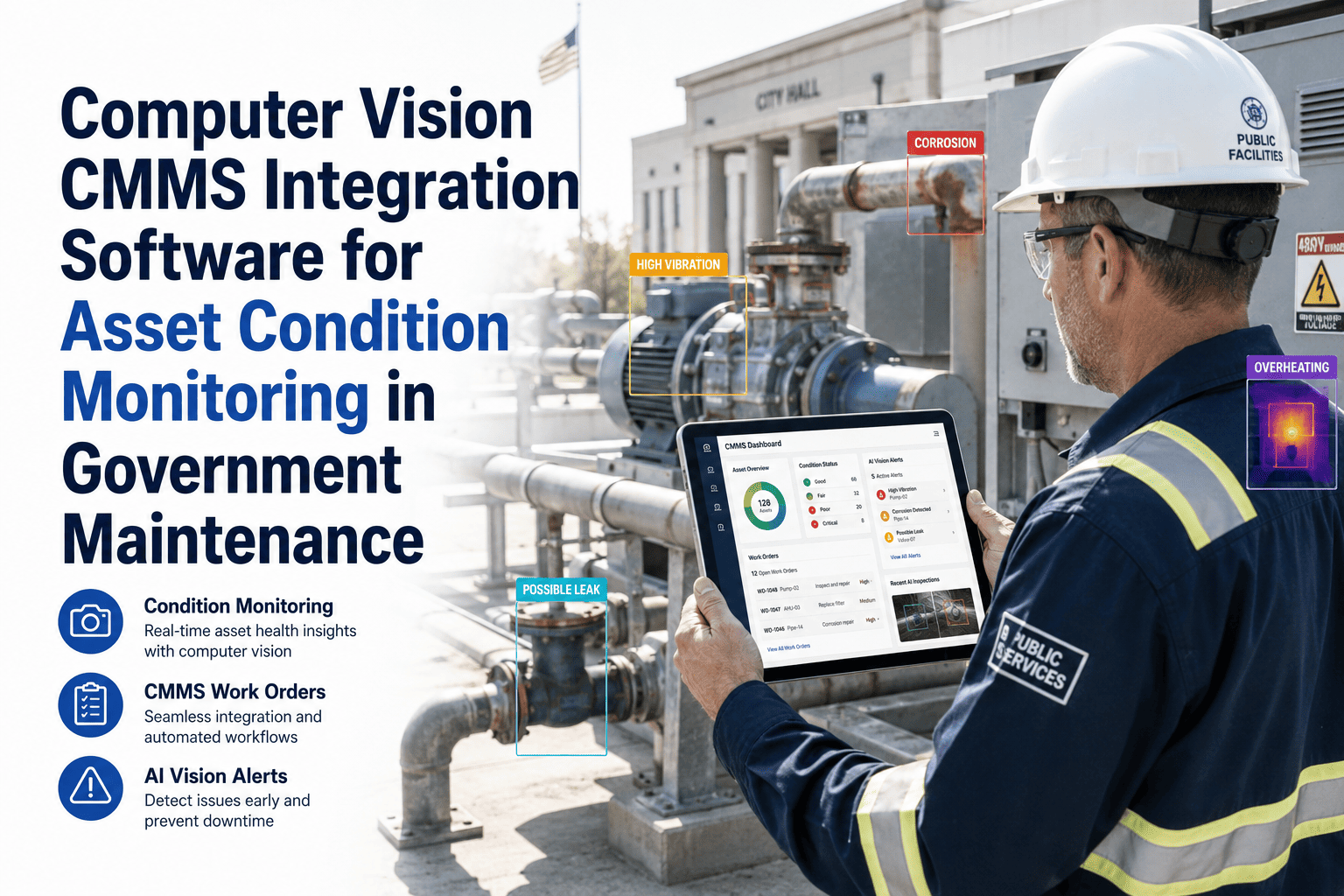
Condition data from SCADA sensors builds quantified evidence for Capital Improvement Plans (CIP) to justify equipment replacement.
Critical Control Points: SCADA Assets by Domain
Water and wastewater utilities manage diverse assets—each producing unique data signatures that signal impending failure. No single alarm covers every scenario, which is why unified integration through a central CMMS is essential for converting PLC data into coordinated maintenance tasks. Book a demo to see real-time SCADA workflow automation.
Key Integrated Assets & Signals
Lift Stations & Pumps
High Amperage DrawImmediate
Vibration MonitoringTrend
Seal Fail AlarmsCritical
Assets: Submersible pumps, motors, VFDs
Output: Auto-WO for unclogging/repair
Water Treatment Plant
Turbidity Spikes< 0.3 NTU
Chemical Feed FailureFlow Loss
Filter Head LossBackwash
Assets: Clarifiers, filters, chemical skids
Output: Calibration & process check tasks
Distribution System
Tank Level AnomaliesHigh/Low
Pressure TransientsHammer
Chlorine ResidualGrab Sample
Assets: Water towers, booster stations, PRVs
Output: Leak investigation orders
Headworks & Screening
Differential LevelHigh
Conveyor TorqueOverload
Flow Meter DriftVar %
Assets: Bar screens, grit removal, compactors
Output: Preventive cleaning schedules
Aeration & Biological
Dissolved Oxygen (DO)Setpt Dev
Blower TemperatureHigh
RAS/WAS Flow RatesPacing
Assets: Blowers, diffusers, mixers
Output: Blower PMs & sensor cleaning
Unify Operations and Maintenance
Oxmaint connects your SCADA/PLC data directly to your maintenance workflows. Turn every alarm into an accountable action item, automate runtime-based PMs, and ensure no critical failure goes unnoticed by the maintenance team.
To prioritise digital transformation, water utilities must assess their integration maturity. A standardised 1-5 scale translates complex technical architecture into a roadmap that superintendents and city managers can act on—moving from "Reactive Chaos" (Level 1) to "Predictive Reliability" (Level 5). Most utilities today sit at Level 2, with expensive SCADA systems that don't talk to their maintenance software. Start your free trial to reach Level 4.
Utility Automation Maturity Scale
5
Predictive — AI-Driven Reliability
Systems analyze trends (vibration, heat, amps) to forecast failure weeks in advance. Maintenance is scheduled just-in-time, maximizing asset life.
Action: Refine AI models & optimize inventory
Goal State
4
Automated — SCADA-Triggered Work
SCADA alarms automatically create CMMS work orders. Runtime hours push directly to PM schedules. No manual data entry required.
Action: Expand integration to all asset classes
High Efficiency
3
Connected — Manual Generation
Maintenance team can see SCADA data, but must manually type work orders. Response relies on human vigilance.
Action: Implement API for auto-creation
Standard
2
Siloed — Disconnected Alarms
SCADA signals ring in the control room only. Maintenance team is notified by phone or radio. High risk of miscommunication.
Action: Map SCADA tags to CMMS assets
Inefficient
1
Reactive — Paper Based
No SCADA or limited local alarms. Maintenance is purely reactive (break-fix) or based on paper calendar rounds.
Action: Digitize assets and install basic monitoring
High Risk
The Cost of Disconnected SCADA: Compounding Risks
Operating SCADA without CMMS integration is a financial drain on ratepayers. A high-level alarm triggered by a pump failure but trapped in a control room log compounds into missed response windows, sewer overflows (SSOs), and environmental fines. The cost of acting on SCADA data immediately through automated work orders is minimal compared to the cost of a consent decree or major equipment burnout.
Cost of Alarm Response Latency
Cost multiplier when SCADA alarms don't generate immediate CMMS work orders
5 Auto Work Order
$300 (Seal Replacement)
1x
4 Manual Entry
$1,200 (Bearing Fail)
4x
3 Shift Delay
$15,000 (Pump Rebuild)
50x
2 Alarm Missed
$45,000 (Overflow Cleanup)
150x
1 Catastrophic
$500K+ (EPA Fines)
1600x
Investing in SCADA-CMMS integration (Level 4-5) prevents the exponential costs that occur when alarms are not immediately converted into maintenance tasks.
Turn Sensor Data Into Infrastructure Protection
Oxmaint helps utility teams convert SCADA warnings into prioritised work orders, track runtime hours for accurate PM scheduling, and generate the compliance documentation that state agencies require—all from one dashboard.
A successful SCADA-CMMS integration follows a disciplined lifecycle—from mapping tags to automating workflows. This cycle ensures that your technology investment delivers measurable operational uptime, not just more data on a screen. Systematic execution builds operator trust and ensures long-term compliance value.
Utility Integration Lifecycle
1
Tag & Asset Mapping
Audit existing SCADA tags (OPC/API). Map specific tags (e.g., "Lift_Station_5_Pump_1_Run_Hours") to the corresponding asset ID in the CMMS. Establish naming conventions for clean data transfer.
Months 1–2
2
Runtime Automation Config
Configure the API to push runtime hours and cycle counts from SCADA to CMMS daily. Switch PM triggers from "Calendar Days" to "Runtime Hours" for pumps and motors to optimize labor.
Months 2–3
3
Alarm-to-Work Order Logic
Define logic rules. Triggers: "If Tank Level > 90% AND Pump Status = OFF, create Emergency WO." Validate these rules to prevent "alarm fatigue" in the work order system.
Months 4–5
4
Mobile Deployment & Training
Deploy mobile tablets to field crews. Train operators to receive SCADA-triggered jobs, view real-time tank levels on the tablet, and close work orders with photos for compliance.
Months 6–8
5
Predictive Analytics & CIP
Activate predictive models. Use historical amperage and vibration data collected in CMMS to forecast remaining useful life (RUL) and justify budget for capital replacement projects.
Year 2+ (Continuous)
Expert Perspective: From Control Room to Field
"
We have over 40 lift stations spread across the county. Before integration, operators would drive by stations just to check if the red light was flashing. We had SCADA, but it was stuck in the office. If a pump clogged on Friday night, we wouldn't know until the Monday morning meeting or a citizen complaint. Connecting SCADA to our CMMS changed everything. Now, a 'High Amperage' alarm instantly creates a work order on the on-call technician's phone. They know exactly which pump it is and what tools to bring before they even leave the house. We've reduced overtime callouts by 30% because we catch issues during regular hours based on predictive trends, rather than responding to emergency alarms at midnight.
— Utilities Superintendent, Service Area of 85,000
$180k
Annual savings in overtime and emergency repairs
Zero
Reportable overflow events since full integration
15%
Extension in average pump lifecycle via runtime PMs
The utilities achieving true operational excellence share a common trait: they treat SCADA not just as a monitoring tool, but as the trigger for maintenance action. By leveraging CMMS integration, automated work orders, and predictive analytics, these organizations transform raw data into a unified command center for water quality and asset protection. When sensor data drives work orders, citizens get reliable service, and elected officials get the evidence-based capital plans they need. Start building your unified maintenance program with the platform that connects every sensor to every work order.
Build a Smarter, Safer Utility Infrastructure
Oxmaint centralises SCADA monitoring, automated maintenance workflows, and regulatory compliance reporting into one utility CMMS—ensuring every alarm delivers measurable outcomes, not just noise.
What types of SCADA data can trigger CMMS work orders?
Virtually any tag monitored by your SCADA system can trigger a workflow. Common triggers include: (1) Runtime Hours—triggering Preventive Maintenance (PM) based on actual usage rather than calendar days; (2) Limit Alarms—High/Low tank levels, high pressure, or high turbidity triggering inspection orders; (3) State Changes—Pump failure signals or "Fail to Start" alarms triggering corrective maintenance; (4) Analog Trends—Rising vibration or temperature readings triggering predictive analysis tasks. The key is to filter these to avoid creating a work order for every minor flutter, focusing only on actionable events.
How does integration improve regulatory compliance (EPA/DNR)?
Compliance requires proving that you responded to issues and performed required maintenance. Without integration, matching a SCADA alarm log to a paper work order is a manual, error-prone process. Integration creates a digital thread: The SCADA alarm creates the Work Order -> The Technician completes the Work Order (timestamped) -> The Record is closed. When an auditor asks about a specific excursion or overflow event, you can instantly produce a report showing exactly when the alarm occurred, who responded, what they did, and when the system returned to compliance.
Can the CMMS handle predictive maintenance for pumps?
Yes. By ingesting continuous data points like amperage draw, vibration, and temperature, the CMMS can track degradation curves. Instead of waiting for a hard failure alarm, the system can flag a "Check Pump" work order when amperage usage increases by 10% over a baseline average, indicating seal wear or impeller issues. This allows for planned repairs during normal business hours, which are significantly cheaper and safer than emergency midnight replacements.
Does this work with legacy SCADA systems?
Generally, yes. Most modern CMMS platforms use standard protocols like OPC-UA, REST APIs, or SQL database connectors to bridge the gap. Even older SCADA systems usually write data to a historian or database that the CMMS can read. You do not typically need to replace your entire SCADA infrastructure to achieve integration; you simply need a middleware connector or API integration that allows the CMMS to "listen" to the relevant tags in your existing system.
What is the ROI timeline for SCADA-CMMS integration?
Most utilities see ROI within 6-12 months. Savings come from three main buckets: (1) Labor Optimization—switching from calendar-based PMs to runtime-based PMs often eliminates 20-30% of unnecessary maintenance trips; (2) Overtime Reduction—catching issues early via trends reduces after-hours emergency callouts; (3) Asset Life Extension—identifying and fixing minor issues (like vibration) before they destroy the asset can extend pump life by years. For a medium-sized utility, avoiding just one or two major pump replacements or regulatory fines can pay for the entire integration effort.