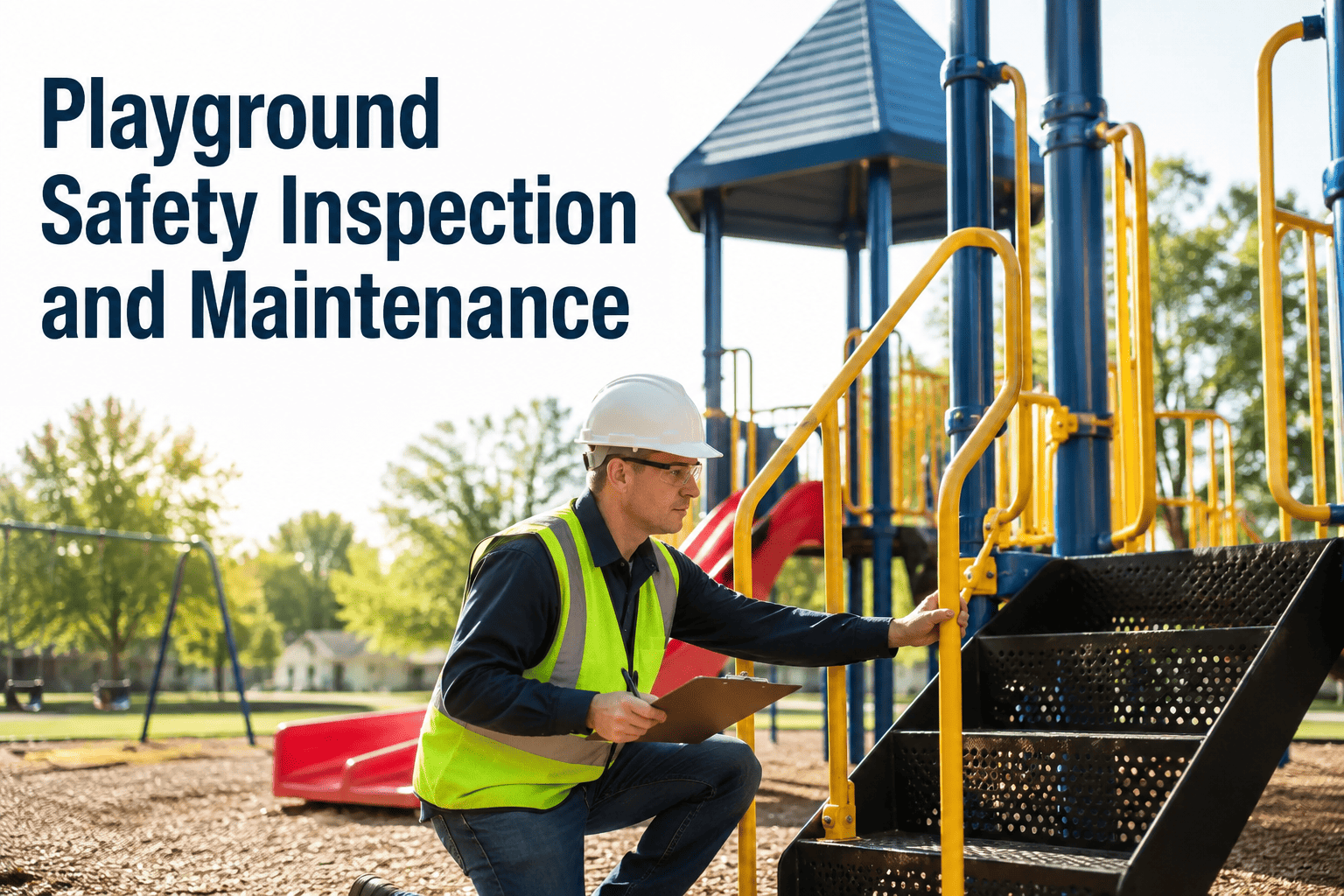
Every year, more than 200,000 children under 14 arrive at emergency rooms with playground injuries — and 75% of them happened on public playgrounds owned by parks departments, schools, and municipalities. For a Parks and Recreation Director, a neglected swing bearing or a fall zone missing three inches of surfacing is not a maintenance issue — it is a $500,000 to $2 million liability event waiting for the day it happens. The gap between a compliant playground and a legally indefensible one is a documented, timestamped inspection program that follows CPSC and ASTM F1487 protocols on every asset. Start a free trial and build your first CPSI-ready inspection schedule today.
Parks · Recreation · Playground Safety Compliance
A Documented Playground Safety Program — Before the Next Incident Report
OxMaint gives Parks and Recreation Directors a CPSC-aligned inspection cadence, ASTM F1487 hazard checklists, entrapment probe logs, and an audit-defensible record on every playground asset — replacing the paper binders that fail the "standard of care" test in court.
The Liability Reality
What Uninspected Playgrounds Cost Municipalities Every Year
200,000+
Children under 14 treated in ERs annually for playground injuries — CDC data
75%
Of non-fatal playground injuries occur on public playgrounds — parks, schools, daycares
63%
Of municipal playgrounds fail current safety surfacing depth standards under ASTM F1292
$2M
Typical exposure ceiling per serious injury claim against a municipal playground
The legal defense in every one of these claims comes down to a single question — can the municipality prove it exercised "standard of care" through documented, systematic inspections. Missing or sporadic paper logs are the leading reason claims are settled instead of defended.
Inspection Cadence
The Four-Tier Inspection Program Required by CPSC Guidelines
Daily
High-Use Visual Sweep
Trash, broken glass, needles, animal waste, vandalism, standing water, missing surfacing, obvious equipment damage. High-use urban parks require this every morning before opening.
Owned by — Parks crew on opening rounds
Monthly
Operational Inspection
Hardware condition, moving parts, chain wear, S-hook closure, bolt tightness, surfacing depth at high-use zones, rust and structural condition on load-bearing components.
Owned by — Trained maintenance technician
Quarterly
Comprehensive Audit
Full ASTM F1487 hardware assessment, entrapment probe testing, fall zone measurement, surfacing displacement mapping, hardware fatigue signs, age-appropriate signage verification.
Owned by — Senior parks maintenance lead
Annual
CPSI Compliance Inspection
Full inspection by NRPA-certified CPSI. Legally defensible documentation of compliance with CPSC Handbook and ASTM F1487, F1292, F2373, F1951. Required by most insurance policies.
Owned by — Certified Playground Safety Inspector
Hazard Classification
The Eight Hazard Categories Every Playground Inspection Must Cover
| Hazard Category |
What Inspectors Check |
Governing Standard |
Severity |
| Fall Zone Surfacing |
Depth of loose-fill under swings, slide exits, climbers — measured at all high-use points |
ASTM F1292 / F2075 |
Critical |
| Head Entrapment |
Openings between 3.5 and 9 inches — tested with CPSC entrapment probes |
ASTM F1487 §6 |
Critical |
| Protrusions and Sharp Edges |
Exposed bolts, worn welds, broken slide edges, protruding hardware over threshold length |
ASTM F1487 §7 |
Critical |
| Swing and Rotating Hardware |
S-hook closure gap, chain wear, bearing binding, seat cracks, connector fatigue |
ASTM F1487 §9 |
High |
| Structural Integrity |
Post rot, weld cracks, footings exposure, foundation shift, climbing structure sway |
ASTM F1487 §8 |
High |
| Age-Appropriate Design |
Equipment matches signage age range, no under-2 access to school-age equipment |
ASTM F2373 / F1487 |
Medium-High |
| ADA Accessibility |
Accessible route, transfer stations, surfacing firmness on accessible paths |
ASTM F1951 / ADA |
Medium-High |
| Site Perimeter and Environment |
Fencing, drainage, tree branches, sight lines, distance from roads and water |
CPSC Handbook §3 |
Monitor |
OxMaint · Parks and Recreation · CPSC Compliance
See the CPSC Inspection Workflow Run on Your Playground Inventory
A 30-minute demo covers how OxMaint imports your playground asset registry, configures daily-monthly-quarterly-annual inspection frequencies per site, and generates the audit trail your insurance carrier and legal department need in the event of a claim.
Program Workflow
How OxMaint Runs a Playground Safety Inspection Program End-to-End
01
Playground Asset Registry Import
Every playground is loaded as an asset with equipment types, installation date, manufacturer, surfacing material, and use category — bringing your entire portfolio into one system.
02
Inspection Schedule Automation
Daily, monthly, quarterly, and annual inspection work orders generate automatically per CPSC-recommended cadence — routed to the right crew or the CPSI on the annual date.
03
Mobile Checklist Execution
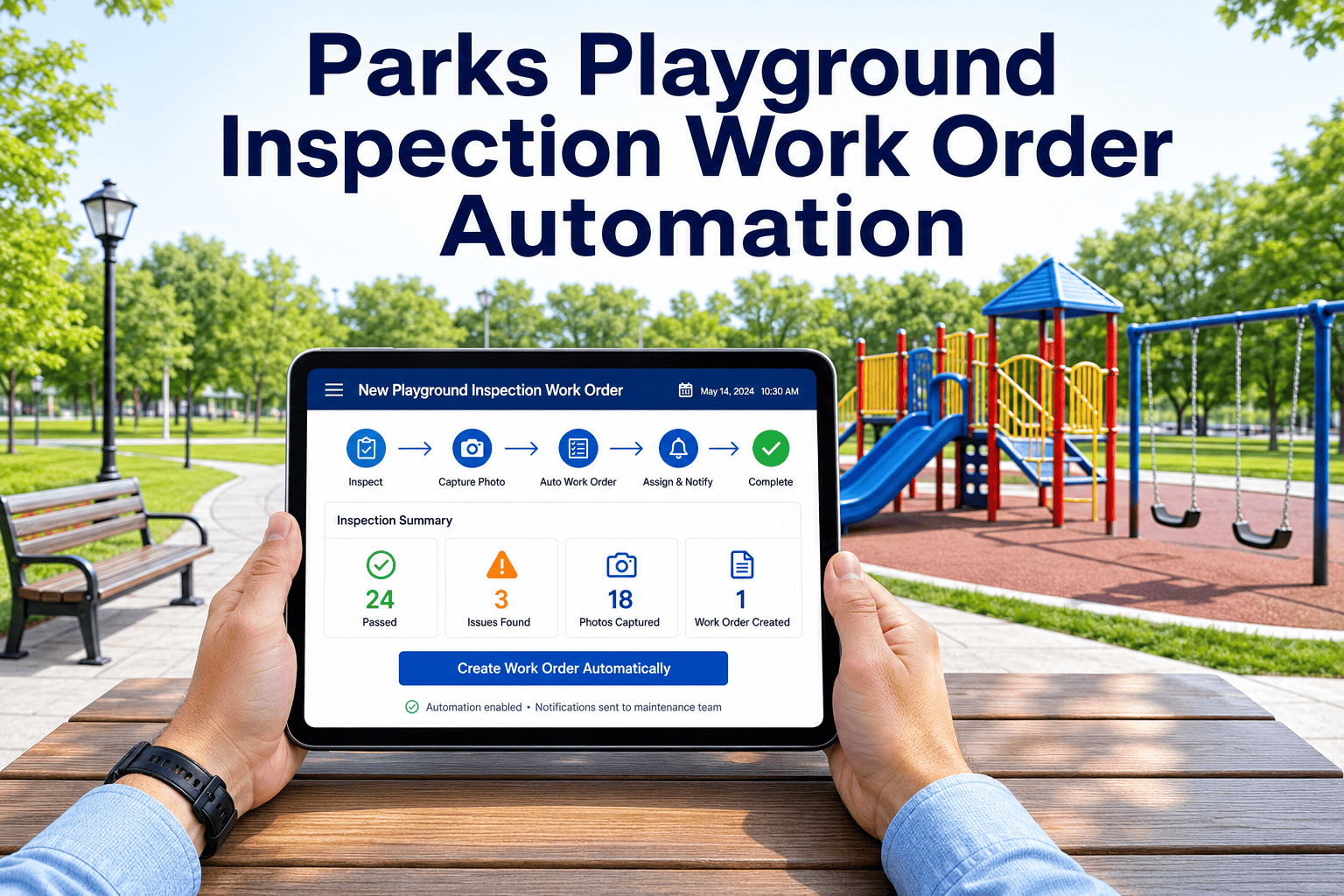
Inspectors execute ASTM F1487 checklists on a phone or tablet — with entrapment probe results, surfacing depth measurements, and hardware condition photos captured against the asset record.
04
Deficiency Work Order Generation
Any deficiency flagged during inspection creates a repair work order automatically — assigned to the maintenance crew, tracked to closure, and linked back to the original inspection.
05
Audit-Ready Compliance Export
Every inspection generates a timestamped record — who inspected, what was checked, findings, photos, and resolution. Exportable in the format your legal and insurance teams require.
Program Outcomes
What Parks Departments Achieve with a Digital Playground Inspection Program
Inspection Completion Rate — Monthly Schedule
Defensible Audit Records — After 12 Months
Time to Close Critical Deficiency Work Orders
Paper-Based Program
14 days
"
A playground injury claim is not won or lost on the day of the accident. It is won or lost by whether the department can produce a signed, dated, photographed inspection log for that specific piece of equipment covering the weeks and months before the incident. Paper binders lose that case every time. A digital record with timestamps, photos, and closed work orders wins it — because the standard of care becomes provable rather than assumed.
Diane Reyes, CPSI
Certified Playground Safety Inspector · 21 years in municipal parks risk management · Former Regional NRPA Committee Member
Frequently Asked Questions
Playground Inspection Program Questions from Parks and Recreation Directors
How often does CPSC recommend playgrounds be inspected in public parks?
CPSC guidelines recommend daily visual sweeps for high-use playgrounds, monthly operational inspections of hardware and moving parts, quarterly comprehensive audits, and an annual inspection by a Certified Playground Safety Inspector. OxMaint schedules all four tiers automatically per playground.
Book a demo to see the cadence configuration.
Does OxMaint work with our existing playground asset inventory and GIS system?
Yes. OxMaint imports playground registries from spreadsheet, CSV, and common GIS export formats — pulling equipment type, installation date, surfacing, and site coordinates. Site coordinates enable route-based inspection scheduling for crews covering multiple parks in a shift.
Start a free trial and import your first site.
What compliance records does OxMaint generate for legal and insurance review?
Every inspection produces a timestamped record — inspector name, checklist items completed, entrapment probe results, surfacing depth readings, deficiency photos, and linked repair work orders. Records export in formats accepted by municipal risk pools, insurance carriers, and legal counsel for standard of care defense.
Can OxMaint track CPSI certification renewals and inspector training records?
Yes. OxMaint stores each inspector's CPSI certification date, expiration, and training records against their user profile. The system flags expiring certifications 60 days before renewal and prevents assignment of annual inspections to any inspector whose CPSI is not current.
Ask about certification tracking during your demo.
How does OxMaint handle deficiencies that require immediate playground closure?
Critical hazards — head entrapment, exposed protrusions, structural failure, or missing surfacing at fall zones — trigger a "close asset" flag on the inspection, generate a priority repair work order, and notify the Parks Director immediately. The playground stays closed in the system until the repair is verified and signed off.
OxMaint · Parks and Recreation · CPSI-Ready · Free to Start
Every Playground in Your Portfolio Deserves a Defensible Inspection Record
Parks and Recreation Directors use OxMaint to move from paper binders and missed inspection dates to a documented, CPSC-aligned safety program that protects children and defends the department. The next incident will happen on someone's playground — make sure the paperwork is on your side.