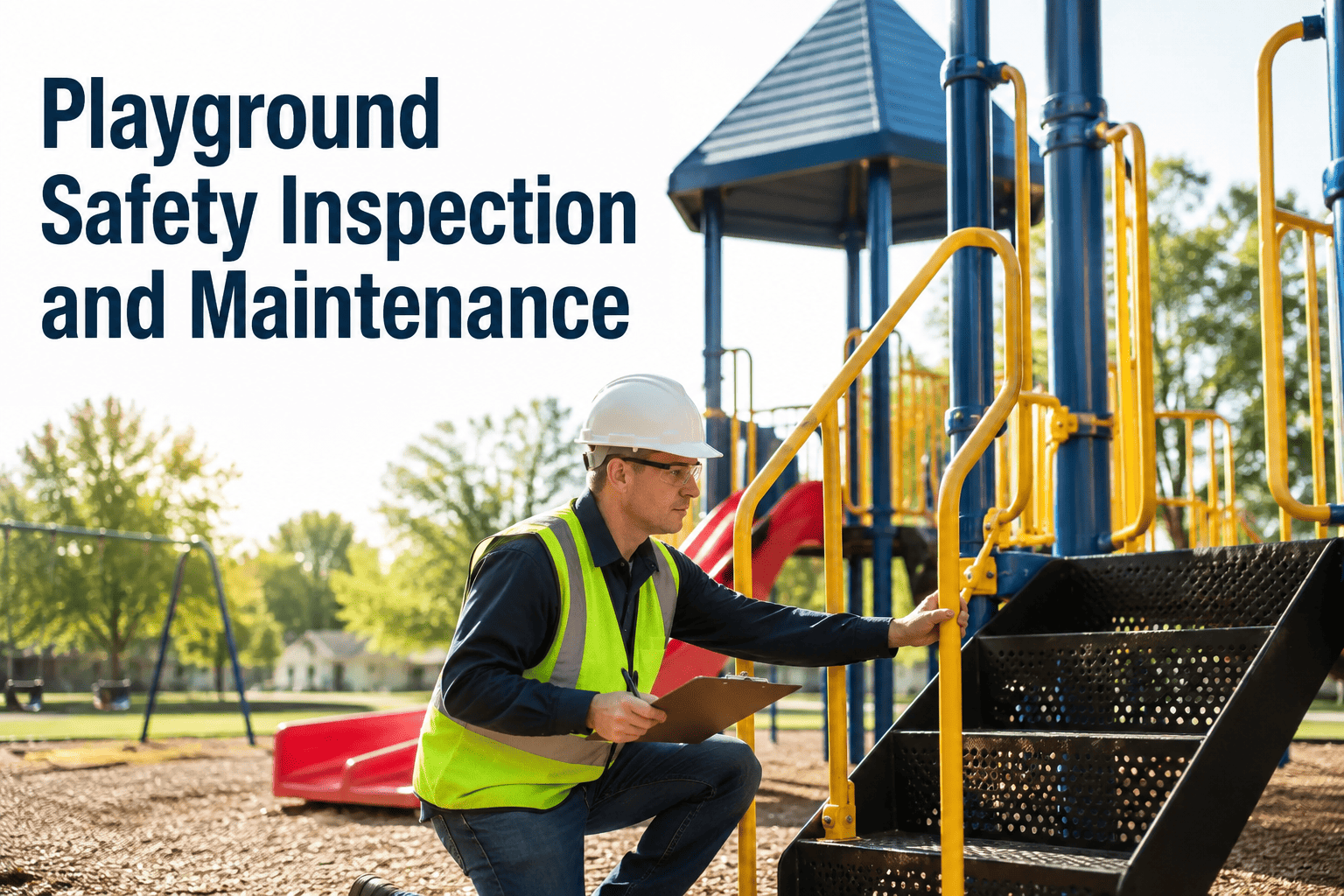
When a neighborhood playground goes uninspected, accident risks multiply for children and liability exposure skyrockets for municipalities. A loose S-hook, a worn swing bearing, or inadequate surfacing depth can turn a community asset into a public safety hazard. Yet many parks departments rely on reactive maintenance—waiting for a parent complaint before addressing dangerous conditions that could have been caught with systematic inspection.
This guide provides municipal parks crews and maintenance directors with a comprehensive safety inspection checklist for playgrounds, covering CPSC standards, component verification, and safety protocols that ensure compliance. Departments ready to modernize their playground maintenance can start building their smart park management system today.
Playgrounds are more than recreational spaces; they are developmental hubs for communities. Treating playground maintenance with the same urgency as facility repair or lighting outages is essential for modern municipal management.
Impact of Playground Maintenance Failures
Child Safety & Injury Prevention
Critical Zone: Swings, slides, climbing structures, fall zones
Risk Factor: Falls account for 79% of playground injuries
Failure Impact: Severe injuries, concussions, fractures
Urgency: Immediate repair required (Category 1 priority)
Liability Reduction
Critical Zone: Non-compliant equipment, surfacing depth, entrapment hazards
Function: Defensible documentation of standard of care
Failure Impact: Costly lawsuits, negligence claims, increased insurance premiums
Urgency: High priority mitigation (24-48 hour target)
Community Trust
Critical Zone: Neighborhood parks, school playgrounds, regional recreation areas
Function: Safe play environments, family satisfaction
Failure Impact: Parent complaints, negative press, reduced park usage
Urgency: Standard maintenance cycle (3-5 day target)
Don't gamble with child safety. Implement systematic safety tracking and predictive maintenance to resolve playground hazards before accidents occur.
Systematic troubleshooting prevents accidents by ensuring compliance with CPSC Public Playground Safety Handbook guidelines. This checklist guides crews through critical inspection points from surfacing to equipment integrity.
Modern park management systems allow municipalities to move from "fix it when they call" to "fix it before it breaks." Digital logs and data analysis provide real-time insights into equipment health.
Smart Park Safety Analytics
1
Surfacing Wear Prediction
Track top-off frequencies to predict when loose-fill surfacing will drop below compliant depths based on usage patterns, automating replenishment orders before hazards arise.
ROI: Maintains constant compliance; prevents fall injuries
2
Component Lifecycle Tracking
Monitor installation dates and usage of swing chains, hangers, and slides. Algorithms forecast end-of-life replacement needs, allowing budgeting for upgrades rather than emergency fixes.
ROI: Optimized capital budgeting; reduced liability risk
3
Digital Inspection Audits
Timestamped, GPS-verified inspection logs create an irrefutable "Standard of Care" defense. Missing an inspection triggers automatic escalations to supervisors to ensure no park is neglected.
ROI: Mitigates negligence claims; ensures inspector accountability
4
Hazard Trend Analysis
Aggregate data on recurring vandalism or breakage to identify "hot spots." Data-driven decisions on lighting improvements or equipment durability changes can reduce recurring maintenance costs.
ROI: Reduces recurring repair costs; improves park security
Automated Hazard Resolution Workflow
1
Inspector identifies loose bolt or worn S-hook during mobile route
→
2
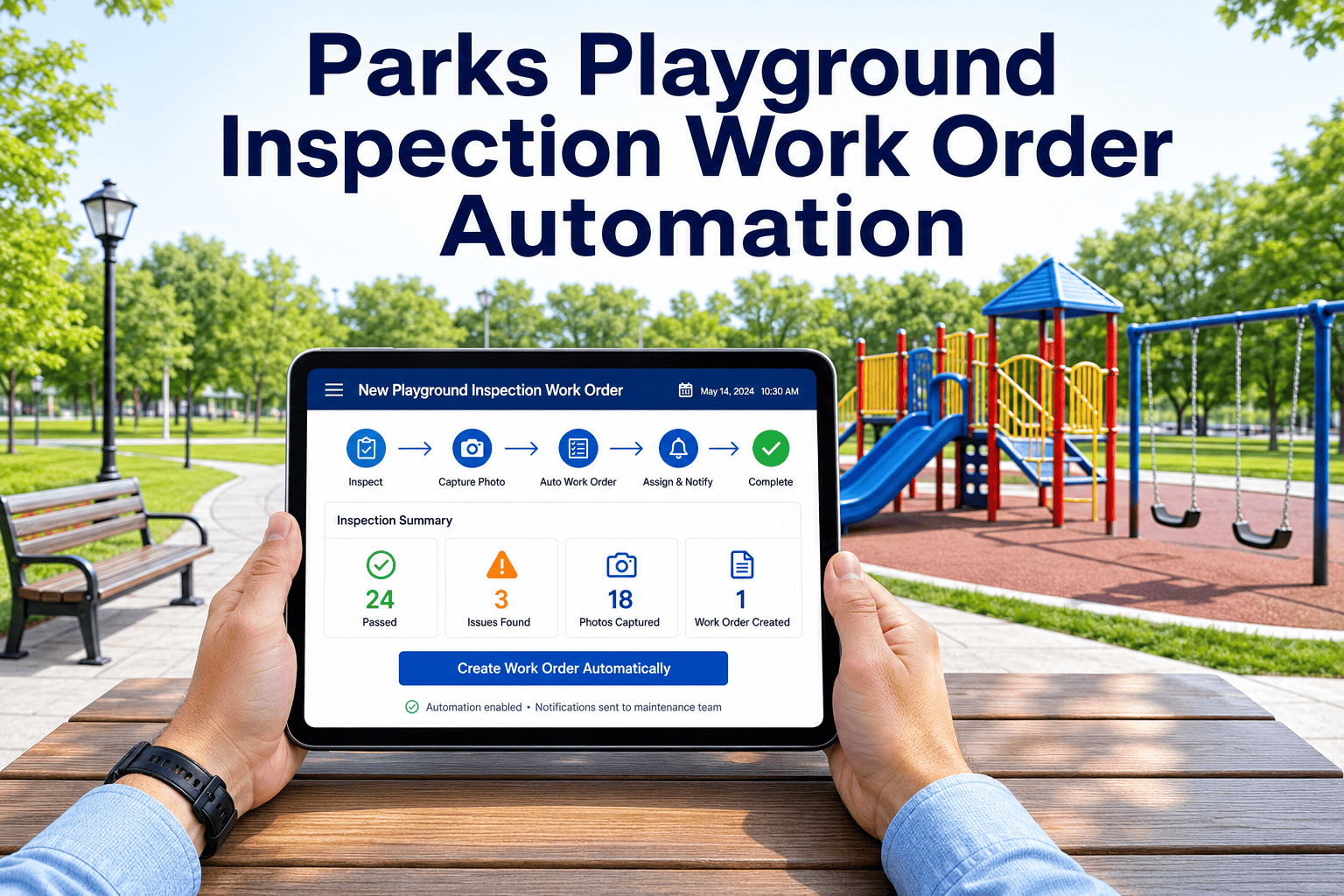
App auto-creates high-priority work order with photo evidence
→
3
Task assigned to maintenance crew with GPS location and part requirements
→
4
Crew repairs hazard, scans QR code, uploads "After" photo, closes ticket
→
5
System logs "Resolved" status and updates safety compliance report
See smart park management in action. Book a demo showing how integrating digital inspections with CMMS automates your entire playground safety workflow.
Book Custom Demo →Standardization ensures safety and efficiency. These SOPs guide crews through routine inspections, emergency repairs, and seasonal preparations to ensure consistent quality across all parks.
✓ Walk perimeter to identify broken glass, trash, or biohazards
✓ Rake loose-fill surfacing to level out displacement under swings/slides
✓ Check for vandalism, graffiti, or damage from overnight use
✓ Verify all signage (Rules, Ages) is visible and legible
✓ Test moving parts (swings, spinners) for smooth, silent operation
✓ Log "Safe/Unsafe" status in mobile app immediately
✓ Respond within 2 hours of high-priority hazard report
✓ Immediately tape off/barricade damaged equipment if repair isn't instant
✓ Remove broken pieces that pose cutting/choking risks
✓ Document damage with photos for potential restitution/insurance
✓ Post "Out of Order" signage clearly on affected unit
✓ Create follow-up work order for permanent repair parts
✓ Top off all loose-fill surfacing to original install depth
✓ Power wash structures to remove winter grime/mildew
✓ Tighten and torque all hardware to manufacturer specs
✓ Inspect footings for frost heave or erosion exposure
✓ Touch up paint/coatings to prevent rust expansion
✓ Audit full inventory against CPSC guidelines for current compliance
Elevating Safety with Smart Asset Management
Oxmaint CMMS integrates mobile inspections, work orders, and compliance reporting to streamline park operations, reducing liability and improving community safety.
Trusted by parks and recreation departments nationwide
Playground safety is heavily regulated to ensure child protection. Maintenance documentation must prove adherence to national standards and local safety ordinances.
Surfacing guidelines for fall protection
Equipment spacing and layout zones
Hardware and fastener safety standards
Entrapment and protrusion avoidance
Automated: Inspection forms map directly to CPSC guidelines
Performance specs for public playground equipment
Accessibility requirements (ADA)
Material durability and testing
Labeling and identification requirements
Automated: Asset records store compliance data for ASTM audits
Timestamped inspection logs
Repair history and work order trails
Certified inspector sign-offs
Incident report linkage
Automated: Digital paper trail creates defensible liability protection
Accessible routes to equipment
Ground level play components
Transfer stations and ramps
Appropriate surfacing for wheelchairs
Automated: Specific ADA checkpoints included in annual audits
→ Import existing park assets into CMMS
→ Conduct field audit to verify equipment types and conditions
→ Set up QR code tagging for instant field scanning
→ Create digital inspection forms based on CPSC standards
→ Define critical high-use parks for priority schedules
Milestone: 100% digital inventory of playground assets; forms ready
→ Deploy mobile app to maintenance crews
→ Train staff on identifying CPSC hazards and using the app
→ Configure automated recurring inspection schedules
→ Standardize failure codes (e.g., "Worn Bearing", "Low Surfacing")
→ Run pilot inspections in 5-10 key parks
Milestone: Crews using tablets; first digital inspections logged
→ Analyze pilot data for common hazards and "hot spots"
→ Integrate inventory for common parts (S-hooks, swing seats)
→ Establish "Rapid Response" protocols for critical failures
→ Generate "Safety Compliance" report for Parks Director
→ Full rollout to all municipal playground facilities
Milestone: Data-driven safety strategy; reduced risk; improved efficiency
A reactive approach to playground maintenance—waiting for an injury or complaint—is negligent and costly. The modern standard demands a proactive stance where hazards are identified through systematic, documented inspections before they harm a child. A well-maintained playground builds community trust and encourages healthy activity.
By implementing digital checklists, mobile workflows, and predictive asset management, municipalities can drastically improve their safety profile. Crews stop scrambling to react and start executing targeted maintenance. Documentation shifts from lost paper logs to defensible digital records that prove diligence and compliance.
The technology to safeguard your community's play spaces exists today. Whether managing 5 neighborhood lots or 50 sprawling recreation centers, the path to safety starts with better data and better processes. For a personalized assessment of your playground maintenance strategy, request a consultation with our parks safety specialists.
How often should playgrounds be inspected?
High-use playgrounds should be inspected daily for obvious hazards like trash, broken glass, or vandalism. A more detailed operational inspection (checking hardware, moving parts) should occur monthly. A comprehensive CPSC compliance audit is recommended annually by a Certified Playground Safety Inspector (CPSI).
What is the most common playground violation?
Inadequate surfacing depth is the most frequent violation. Loose-fill materials like wood chips or engineered wood fiber displace easily under swings and slides. CPSC standards typically require 9-12 inches of depth for a 7-foot fall height. Regular raking and topping off are essential maintenance tasks.
How does a CMMS help with liability defense?
In the event of an injury lawsuit, a municipality must prove it exercised "standard of care." A CMMS provides an immutable audit trail showing exactly when inspections occurred, what was checked, who checked it, and that repairs were made promptly. This digital evidence is far more defensible than sporadic or missing paper logs.
What are "entrapment hazards"?
Entrapment hazards are openings between 3.5 inches and 9 inches where a child's body could pass through, but their head could get stuck, leading to strangulation. Common areas include ladder rungs, barrier gaps, and cargo nets. These must be tested with specific CPSC probes during inspections.
Do older playgrounds need to meet current standards?
Generally, yes. While some "grandfathering" exists, safety hazards that pose a threat of serious injury (like head entrapment or hard surfaces) should be remediated regardless of the equipment's age. Retrofitting or removing non-compliant equipment is often necessary to reduce liability and ensure safety.