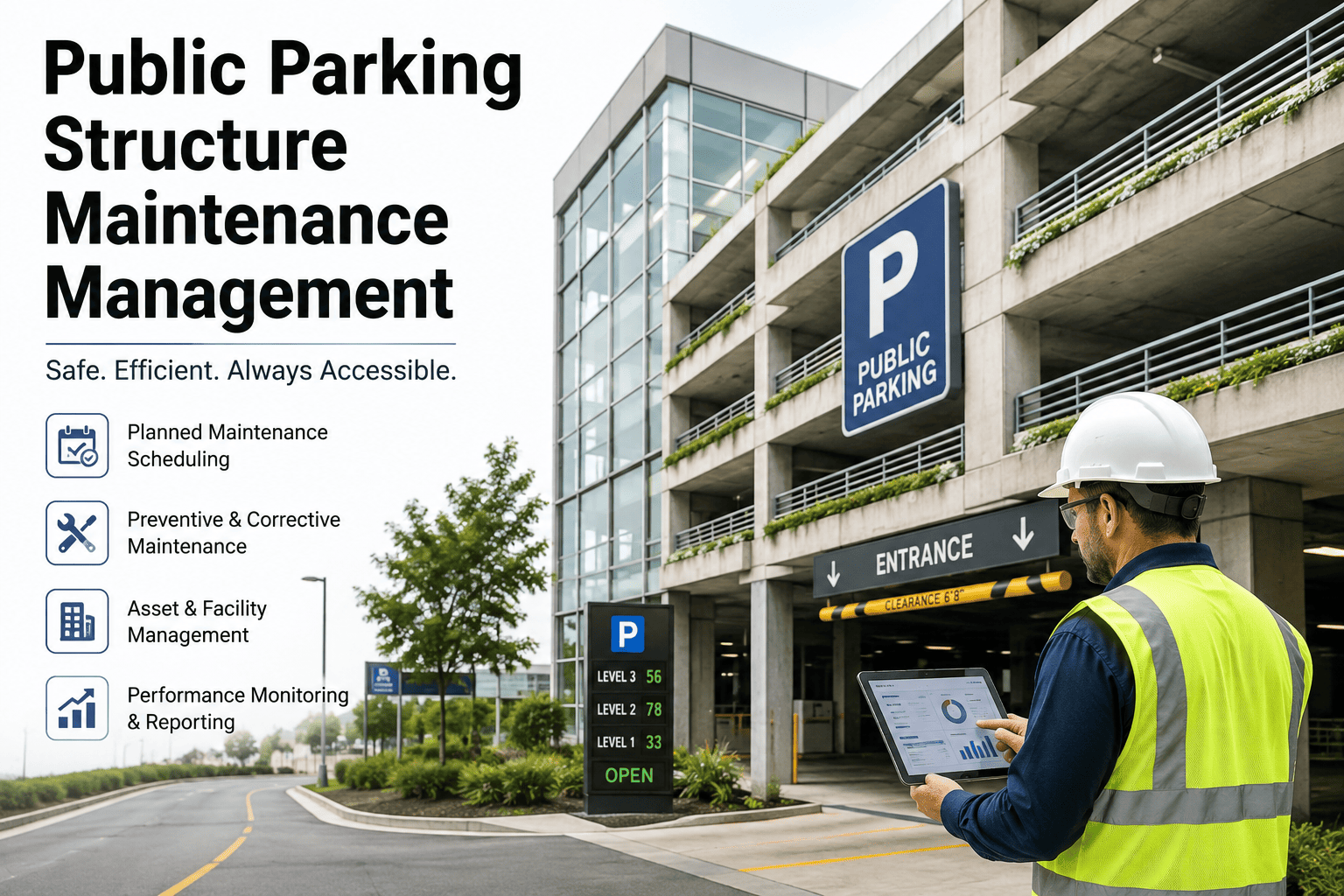
Public parking structure maintenance is the difference between a garage that safely serves a community for 40 years and one that fails at 25. Municipal parking structures face relentless traffic loads, freeze-thaw cycles, deicing salts, and carbonation that corrode embedded steel long before visible spalling appears on the surface. A well-run public parking garage maintenance program combines scheduled structural inspections, drainage cleaning, sealant replacement, lighting upkeep, and security system checks to protect both public safety and the asset's revenue stream. Transitioning these tasks from reactive spreadsheets to a centralized CMMS like OxMaint eliminates missed inspections and extends infrastructure life — you can Start Free Trial today to see the platform in action.
Is your parking structure aging faster than your capital plan can fund it?
Corrosion, joint failure, and drainage blockage silently shorten municipal parking garage lifespans by 10–15 years. A CMMS-driven parking structure management program catches deterioration early — protecting public safety, revenue, and the asset itself.
Why public parking structure maintenance fails without a system
Most municipal parking maintenance teams operate reactively — responding to complaints, broken lights, and water leaks instead of preventing them. The result is accelerated deterioration that costs 3–4x more to repair than it would have cost to prevent.
Worked example: A 320-stall municipal parking garage relying on clipboard checklists missed two consecutive expansion joint replacements. Water intrusion chlorides reached the post-tensioning tendons. The resulting structural remediation cost $1.2M — a proactive joint and coating program managed in a CMMS would have cost roughly $85K over the same period.
Public parking structure inspection checklist
A defensible parking structure inspection program for public facilities should follow a tiered schedule — daily operational walks, quarterly preventive checks, and annual structural assessments aligned with ASTM E2018 and ACI 362 guidelines.
Operational Walk-Through
- Lighting outages and dark zones
- Standing water and clogged drains
- Stairwell and elevator functionality
- Signage, striping, and barrier damage
Preventive Maintenance Cycle
- Drain line flushing and catch basin cleaning
- Expansion joint and sealant inspection
- Security camera and intercom testing
- Surface coating wear and delamination check
Structural Condition Assessment
- Concrete spalling and crack mapping
- Corrosion potential and chloride testing
- Bearing and connection inspection
- Load capacity and barrier rail verification
| System | Inspection Frequency | Key Failure Mode | Preventive Action |
|---|---|---|---|
| Structural Slab | Annual | Spalling / rebar corrosion | Sealer reapplication every 3–5 yrs |
| Expansion Joints | Quarterly | Water ingress / debris buildup | Clean + replace sealant as needed |
| Drainage System | Quarterly | Blockage / ponding water | Flush lines + vacuum catch basins |
| Lighting | Monthly | Burnout / dark zones | LED retrofit + group relamping |
| Security Systems | Quarterly | Camera / intercom failure | Functional test + firmware update |
| Traffic Coatings | Annual | Wear / delamination | Recoat high-traffic areas every 5 yrs |
How to build a parking deck maintenance program that extends asset life
A mature public parking facility maintenance program moves through five phases — from baseline assessment to predictive analytics. Each phase compounds the last, shifting the team from firefighting to lifecycle planning.
Baseline Condition Audit
Catalog every structural element, MEP system, and accessory asset into a central register. Photograph existing spalls, cracks, and joint failures. This becomes the benchmark for every future parking structure inspection.
Preventive Schedule Build-Out
Map every inspection and maintenance task to a recurring work order — drain cleaning, sealant checks, lighting audits, coating assessments. Assign owners, frequencies, and compliance documentation requirements.
Spare Parts & Inventory Setup
Stock critical spares — lamps, sealant cartridges, drain grates, barrier components — with min/max thresholds. Eliminate the 2–3 day delays that turn a minor repair into a safety hazard.
Mobile Execution & Documentation
Technicians complete inspections on mobile devices with photo capture and digital signatures. Every work order auto-archives for municipal audit readiness and liability protection.
Predictive Analytics & Capital Planning
Use accumulated condition data to predict failure trends and build 5-year capital forecasts. Shift from emergency repair budgets to planned investment that extends structure life past the 40-year mark.
ROI of CMMS-driven municipal parking maintenance
The financial case for moving public parking maintenance off spreadsheets is straightforward. Preventive care costs a fraction of reactive repair, and a CMMS ensures preventive tasks actually happen on schedule.
| Metric | Spreadsheet / Reactive | OxMaint CMMS Program | Difference |
|---|---|---|---|
| Inspection Completion Rate | ~55% | 97%+ | +42% |
| Avg. Repair Response Time | 6–8 days | 1–2 days | −75% |
| Annual Emergency Repairs | 22 events | 6 events | −73% |
| Audit Documentation Time | 4 days/quarter | 2 hours/quarter | −95% |
| Estimated Structure Lifespan | 25–28 years | 38–42 years | +13 years |
OxMaint: the CMMS built for public parking structure management
OxMaint brings AI-powered work order automation, asset tracking, and predictive analytics to municipal parking maintenance — replacing clipboards, spreadsheets, and siloed vendor reports with a single auditable system of record.
Automated PM Scheduling
Auto-generate recurring work orders for inspections, drain cleaning, sealant replacement, and lighting audits. Technicians get mobile reminders; managers get escalation alerts when tasks slip past due.
Asset & Condition Tracking
Every slab, joint, drain, luminaire, and barrier gets a digital record with condition photos, repair history, and lifecycle cost — giving you a live capital forecast instead of a vendor's best guess.
Predictive Failure Analytics
AI models analyze inspection trends, weather data, and repair frequency to flag elements approaching failure — so you can budget remediation before a chunk of spalled concrete closes a deck.
Audit-Ready Documentation
Every work order, inspection photo, and vendor invoice is timestamped and archived. Generate compliance reports for municipal councils, insurers, and DOT audits in minutes instead of days.
See OxMaint manage your parking structure — book a 30-minute demo
Walk through a live public parking maintenance workspace: scheduled inspections, asset registers, mobile work orders, and capital forecasts built for municipal teams.
Public parking structure maintenance FAQs
How often should a public parking structure be inspected?
Public parking structures should receive operational walk-throughs daily, preventive maintenance checks quarterly, and a comprehensive structural condition assessment annually. High-traffic municipal parking garages in cold climates with deicing salt exposure may require biannual structural reviews. A CMMS like OxMaint automates these schedules so no inspection window is missed. Start Free Trial to set up your recurring inspection calendar in minutes.
What is the most common cause of parking garage deterioration?
Chloride-induced corrosion of embedded steel reinforcement is the leading cause of structural deterioration in public parking decks. Deicing salts penetrate cracked concrete and compromised sealants, reaching rebar and post-tensioning tendons. Once corrosion begins, spalling accelerates rapidly — making preventive sealant replacement and drainage maintenance far cheaper than structural remediation.
How long should a municipal parking structure last?
A well-maintained public parking structure should last 40–50 years. Without a disciplined preventive maintenance program — including regular sealing, joint replacement, and drainage cleaning — that lifespan drops to 25–28 years. The 12–15 year difference represents millions in deferred replacement cost and lost revenue.
Can a CMMS help with municipal parking maintenance compliance?
Yes. A CMMS like OxMaint automatically timestamps every inspection, work order, and repair with photos and technician signatures, creating a defensible audit trail. This documentation satisfies municipal council reporting requirements, insurer due diligence, and standards like ASTM E2018 and ACI 362 — reducing audit prep time by up to 95%.
How much does parking structure maintenance software cost?
CMMS pricing for public parking maintenance typically ranges from $40–$120 per user per month, depending on features and asset volume. With average annual repair cost reductions of $42K+ per structure, most municipal teams achieve full payback within the first 2–3 months. You can Book a Demo to get a customized ROI estimate for your portfolio.
Stop repairing parking structures reactively — start managing them proactively
Join the municipal teams using OxMaint to extend parking structure life, cut emergency repairs, and pass every audit. Set up your asset register and preventive schedule in under an hour.
Free 14-day trial · No credit card