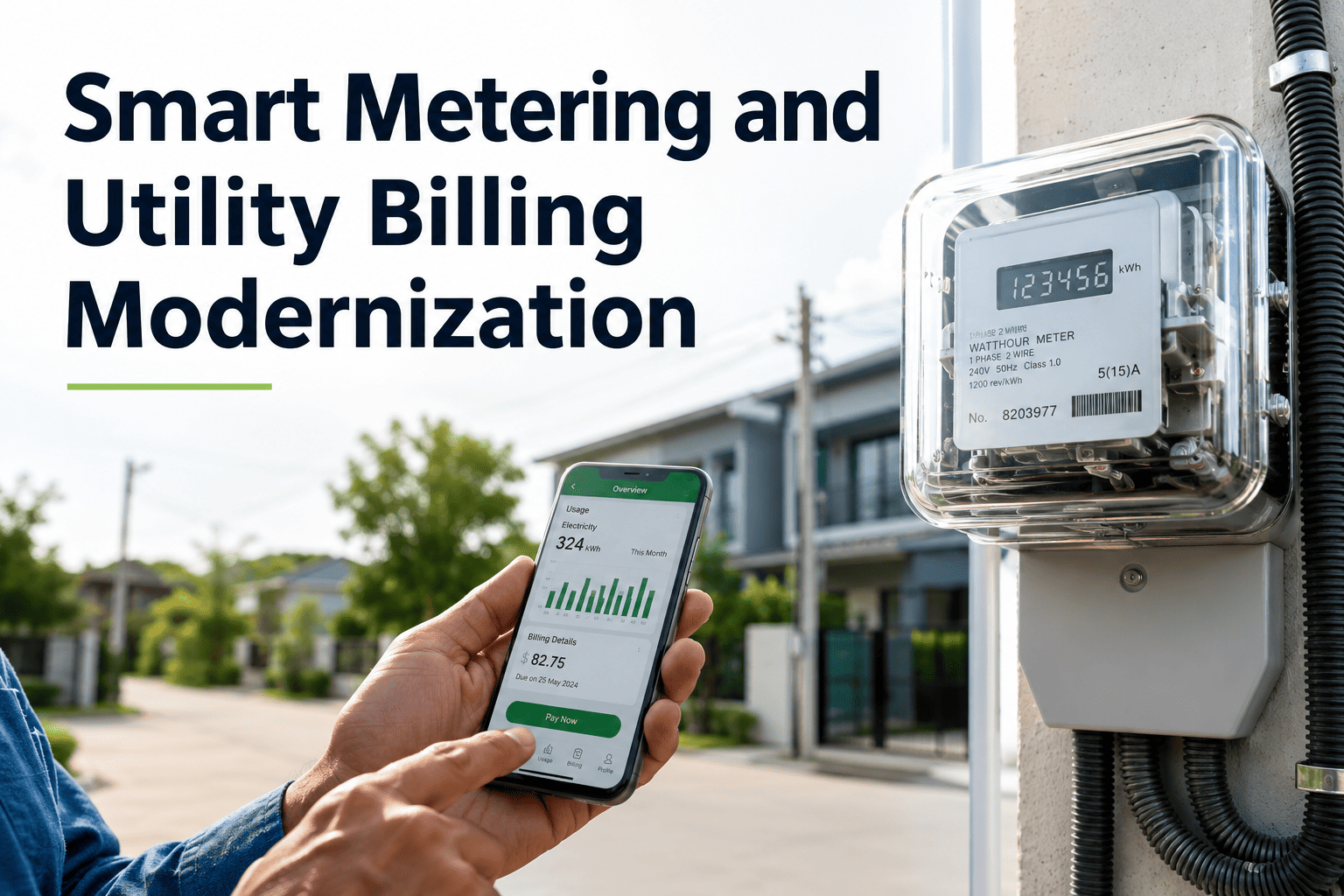
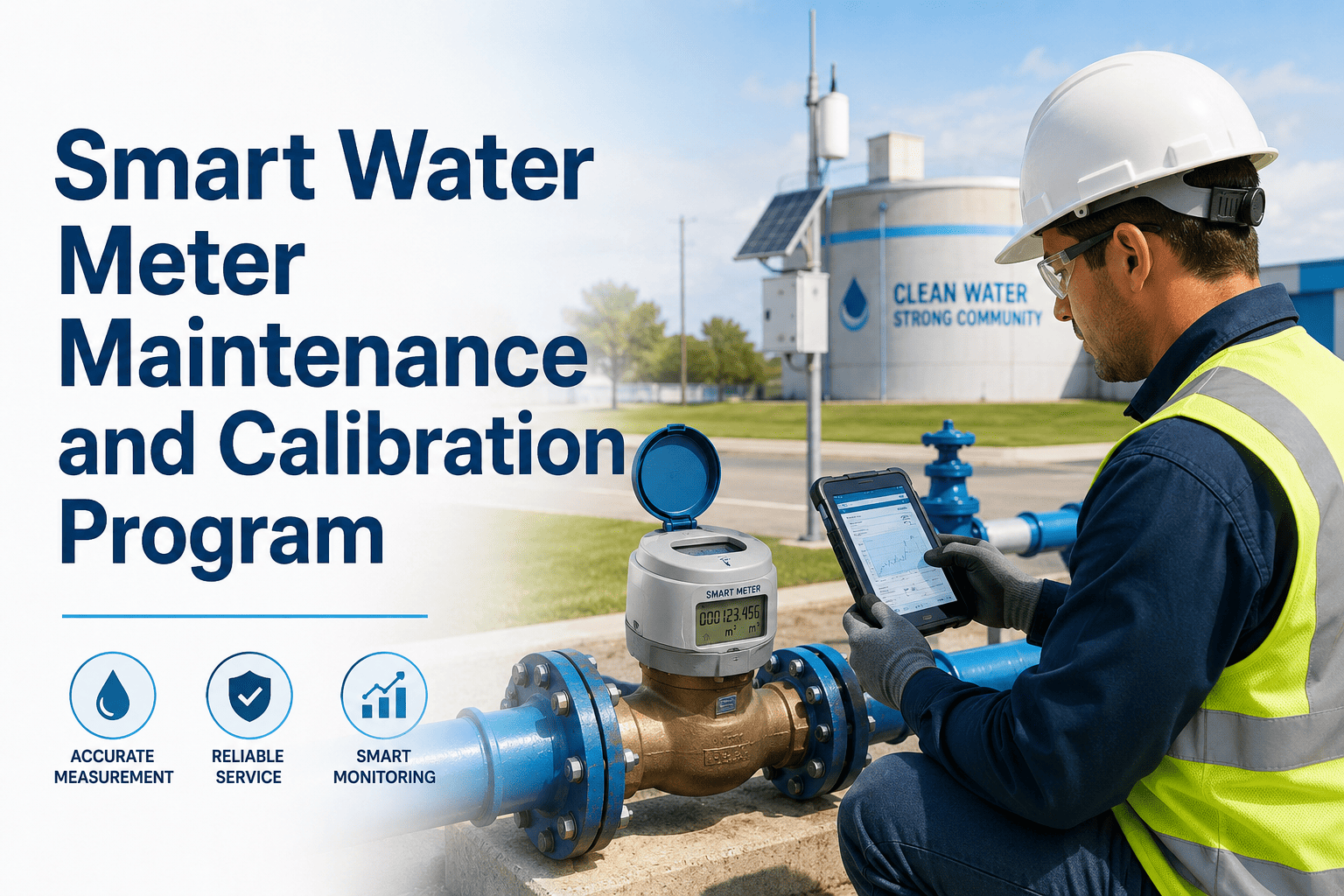
Smart metering (AMI) is one of the largest technology transitions a municipal utility undertakes — and the decisions made in the first 6 months shape water and power operations for the next 15 to 20 years. Aging mechanical meters under-register consumption as they age, mailed estimated bills invite dispute calls, and monthly reads mean a household leak is only caught after the water has already run for weeks. Modernization replaces manual truck rolls with interval data, portal-facing usage views for citizens, and near-instant leak and tamper alerts — but only when the meter shortlist, MDMS choice, CIS integration, and deployment sequence are treated as one connected program. Book a demo to see how OxMaint helps municipal utilities plan AMI rollouts end-to-end — from meter shortlist through billing go-live and non-revenue loss recovery.
Municipal Utility · AMI · Billing Modernization
Smart Metering and Utility Billing Modernization for Municipal Water and Power Utilities
A structured roadmap for AMI selection, MDMS and CIS integration, deployment sequencing, and the citizen-experience program that turns a metering rollout into a revenue and conservation win.
The Real Cost of Old Meters
Where Municipal Utilities Are Losing Revenue Today
Before scoping a smart metering program, quantify what the current infrastructure is actually costing. These are the four largest revenue and trust leaks municipal utilities discover during AMI business-case work.
3–8%
Apparent water loss
Volume delivered but not billed correctly — meter under-registration, tamper events, register drift, and unauthorized draw. Recoverable once AMI exposes it.
$60–163
Annual saving per meter
US DOE finding across 15 AMI case studies — reduced truck rolls, fewer estimated bills, eliminated re-reads, and lower disconnect field visits.
45%
Faster leak resolution
AMI-monitored networks catch continuous-flow anomalies within hours instead of the next monthly cycle — cutting both bill shock and repair scope.
22%
Billing accuracy lift
Continuous interval reads eliminate estimation, keying errors, and misread digits — the top three drivers of billing disputes at municipal utilities.
Meter Evolution
Manual Reads to AMR to AMI — What Actually Changes
1970s–1990s
Manual Reads
Reader visits every meter. Reads happen monthly or quarterly. Estimated bills fill gaps. Leaks are found when the customer sees the invoice.
1 read per 30–90 days
»
1990s–2010s
AMR — Drive-By
Truck drives past homes and collects reads by RF. Fewer visits and better accuracy, but still one-way, monthly, and blind between drive-bys.
1 read per 30 days
»
2010s–Today
AMI — Smart Meters
Two-way communication, 15-minute interval data, remote connect/disconnect, tamper and leak alerts, and citizen self-service portals.
96 reads per day per meter
System Architecture
The Five Layers of an AMI Program
A smart metering program is not a meter purchase. It is a five-layer stack, and every layer has to work together for the billing modernization to hold up. Skipping or under-scoping any layer is the single most common reason municipal AMI programs run over budget.
01
Endpoint — Smart Meter
Ultrasonic or solid-state meter with built-in radio, tamper detection, and low-flow sensitivity. 15+ year battery life is now standard on NB-IoT and LTE-M classes.
02
Network — Communication Layer
RF mesh, cellular (NB-IoT / LTE-M), or LoRaWAN. Choice is driven by service-area geography, building density, and whether the utility owns spectrum or leases carrier connectivity.
03
Head-End System (HES)
Vendor software that collects and stores raw reads from the meter fleet, manages firmware pushes, and monitors network health. Usually bundled with the meter contract.
04
Meter Data Management System (MDMS)
Validates, edits, and estimates the raw stream (VEE), applies exception handling, and hands billing-ready reads to CIS. Underscoped MDMS is the #1 cause of billing project slippage.
05
CIS, Billing & Citizen Portal
Existing customer information and billing platform, plus the citizen-facing self-service portal that turns interval data into a usage view residents actually check.
Scope the AMI Program Before You Buy the Meters
Most AMI overruns trace back to under-scoped MDMS and CIS integration. OxMaint helps municipal utilities pressure-test the full five-layer stack — meter, network, HES, MDMS, and citizen portal — before contracts are signed.
Deployment Roadmap
The Five-Phase Municipal AMI Deployment Roadmap
Business Case & Program Design
Baseline non-revenue loss, truck-roll cost per meter, dispute volume, and estimated-read percentage. Model 15-year cash flow with recovery of apparent losses and reduced O&M.
Technology Selection & Procurement
Meter, network, HES, and MDMS RFPs. Score every vendor on CIS integration path, exception queue design, and AMI-agnostic architecture so future meter swaps stay possible.
Pilot Deployment
Install 2,000 to 10,000 meters across representative geography. Stress-test network coverage, MDMS load, and the AMI-to-CIS billing handoff before scaling up.
Full-Scale Rollout
Route-based install waves, citizen communication kit per neighbourhood, parallel-run billing on old and new reads for 1–2 cycles per premise, and structured cutover with rollback windows.
Value Realization & Optimization
Move beyond billing and outage alerts into rate redesign, targeted conservation nudges, meter accuracy monitoring, and DER integration — where most utilities still leave value on the table.
Before vs After
Legacy Metering vs Modernized AMI Billing
| Operational Metric |
Legacy / AMR Utility |
Modernized AMI Utility |
| Read frequency per meter |
1 per 30–90 days |
Every 15 to 60 minutes |
| Estimated bills issued |
8–15% of monthly bills |
Under 1% of monthly bills |
| Leak detection lag |
Days to weeks — caught on the bill |
Hours — caught by continuous-flow alert |
| Cost per read |
$0.90 to $1.80 per manual read |
Marginal cost per read approaches zero |
| Move-in / move-out service call |
Truck roll — 24 to 72 hour SLA |
Remote connect / disconnect in minutes |
| Apparent water loss visibility |
Blind — discovered on audits |
Per-meter revenue-loss score |
| Citizen self-service usage view |
Last month total only |
15-minute interval history in portal |
“
The utilities that get the most out of a smart metering program are the ones that treat it as a billing and citizen-experience program, not a hardware program. The meter is 40% of the value. The other 60% comes from the MDMS validation logic, the CIS integration, and the citizen portal that turns interval data into a bill people trust. Municipal utilities that sequence those layers correctly recover apparent losses within the first 12 months of full rollout and spend the next decade compounding the return.
Director, Municipal Utility Modernization Practice
19 Years Utility Systems · Led AMI Programs for 12 Municipal Utilities · MDMS & CIS Integration Specialist
Frequently Asked Questions
What is the typical cost per meter for a municipal AMI rollout?
Full-network AMI deployments typically run $200 to $400 per meter including endpoint, network, HES, MDMS allocation, and installation labour. Municipal utilities can offset a meaningful portion through federal grid resilience grants and direct-pay tax credits.
Book a demo to model the per-meter economics for your service territory.
How long does a municipal AMI deployment realistically take?
End-to-end programs typically run 24 to 36 months from business case through full rollout, with a 4 to 8 month pilot in the middle. Smaller municipal utilities under 20,000 meters can complete integrated deployments in 8 to 12 months when meter, MDMS, and CIS integration are scoped together from day one.
Do we have to replace our existing CIS and billing platform for AMI to work?
No. A purpose-built MDMS sits between the AMI head-end and the existing CIS, validating reads and handing billing-ready data to the current billing engine. Most municipal utilities keep the legacy CIS through initial rollout and replace it later as a separate program.
Start a free trial to see the integration pattern.
How do we handle citizen concerns about smart meter accuracy and privacy?
Municipal utilities that publish meter accuracy test protocols, offer opt-out paths where regulation allows, and launch the citizen usage portal at the same time as the meter swap consistently see the fewest complaints. Transparency on what data is collected and who can see it is more important than any hardware specification.
Can OxMaint support water, electricity, and gas meters on the same program?
Yes. OxMaint supports multi-utility municipal deployments where the same MDMS and work-order workflows serve water, power, and gas meter fleets. This is common for combined municipal utilities and typically produces the strongest per-meter economics.
Book a demo to walk through the multi-commodity setup.
OxMaint · Municipal AMI · Billing Modernization
Turn Your Smart Metering Program Into a Revenue and Trust Win
OxMaint helps municipal water and power utilities plan the AMI stack, sequence the deployment, and integrate MDMS with existing CIS and billing platforms — so modernization delivers the revenue recovery, faster leak response, and citizen-experience lift it was scoped for.