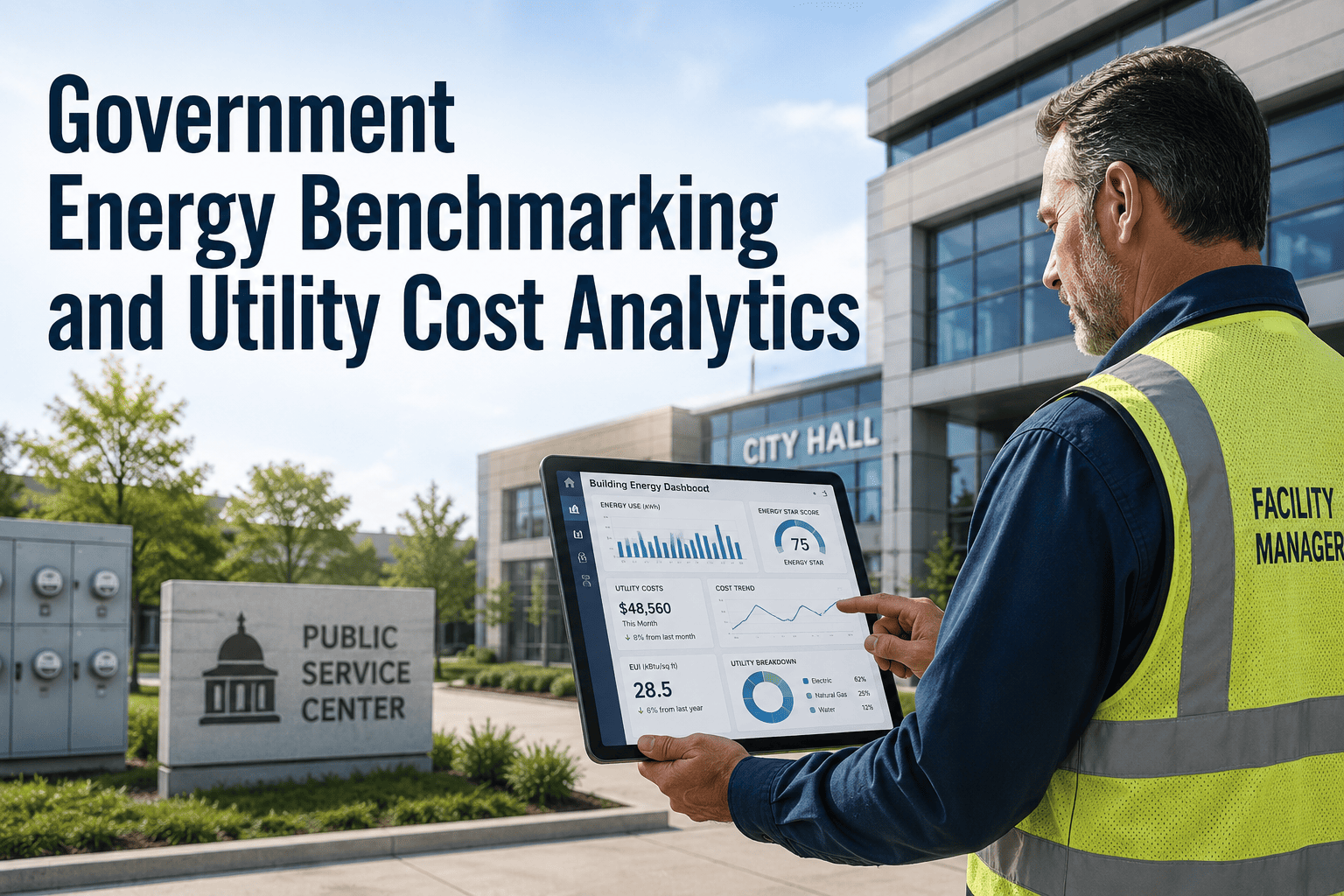
Government buildings consume $7+ billion annually in energy. Smart energy management with BMS integration, occupancy controls, and LED retrofits delivers 20-35% savings while meeting federal and state energy mandates. government energy management, public building energy, municipal energy savings, government utility costs, government BMS, government energy efficiency, public building energy audit, government LED retrofit, municipal energy management, government energy mandate, public building energy monitoring, government utility reduction, state energy code government. Without integrating these data points into a centralized CMMS, agencies cannot forecast these costs or justify efficiency upgrades. Talk to our team about intelligent energy monitoring and CMMS-integrated utility tracking.
Government Facilities 2026
Government Building Energy Management: Reducing $7B+ in Annual Public Utility Costs
Smart utility tracking, BMS integration, energy auditing, and sustainability compliance — all powered by CMMS energy data to help facility directors justify efficiency investments and reduce public utility costs.
$7.2B
Annual energy spend across US public and federal buildings
35%
of energy consumed is wasted through inefficient HVAC and lighting
2.8x
Average utility cost reduction when deploying smart occupancy controls
82%
of agencies lack real-time public building energy monitoring
Why Legacy Energy Management Fails Government Agencies
Government facility managers evaluating utility costs on monthly billing cycles alone are systematically missing the root causes of energy waste. HVAC over-runtime, uncalibrated thermostats, degrading seals, and peak demand spikes all accumulate over a building's service life. Without CMMS and BMS integration, agencies cannot pinpoint these losses, justify retrofit budgets, or demonstrate ROI to civic oversight boards. The result is bloated utility budgets, missed sustainability mandates, and facility directors who struggle to secure funding for LED retrofits. Start Free Trial.
The Six Failure Modes of Reactive Energy Management
Hidden Peak Demand
30%
of the total utility bill often comes from peak demand charges — spikes in usage that occur because high-load equipment turns on simultaneously.
HVAC Over-Runtime
24 Hr
Systems running at full capacity in empty municipal zones. Without occupancy controls, agencies heat and cool completely vacant spaces.
Audit Blind Spots
$50K
Wasted in manual auditing efforts that yield outdated data. Without automated monitoring, a public building energy audit is obsolete upon completion.
No Real-Time Data
Zero
Agencies lack integration between BMS and CMMS. Energy anomalies aren't detected until the municipal utility bill arrives 45 days later.
Mandate Penalties
$100K
Potential fines per building for failing to meet an aggressive state energy code government standard or federal decarbonization mandate.
ROI Blindness
82%
of agencies cannot demonstrate utility reduction ROI to oversight bodies — killing funding requests for deep energy retrofits and smart upgrades.
The Lifecycle-Aware Energy Optimization Pipeline
A successful government building energy management strategy follows a structured lifecycle pipeline — from baseline auditing and total utility modelling through competitive retrofitting, CMMS-tracked operations, and data-driven compliance reporting. Each phase generates data that feeds the next optimization cycle, creating a continuous improvement loop where every facility decision is backed by actual consumption and cost evidence.
CMMS-Powered Energy Optimization Pipeline
From energy auditing to data-driven municipal energy savings
Define operational baselines, assess peak demand, evaluate HVAC performance, and log current municipal energy consumption.
Planning
›
Model total cost of utilities: base loads, peak demand charges, maintenance of aging assets, and potential carbon taxes.
Analysis
›
Evaluate retrofit partners on lifecycle energy savings, not just installation price. Score projected ROI and rebate eligibility.
Procurement
›
Integrate building sensors into the CMMS with predictive maintenance schedules, automated set-points, and real-time alerts.
Integration
›
Track kWh consumption, HVAC efficiency, occupancy trends, and off-hours energy bleed throughout the entire facility.
Ongoing
›
Generate ROI dashboards showing utility cost avoidance, carbon reduction metrics, and cost-per-square-foot for city councils.
Quarterly
›
CMMS recommends optimal retrofit timing based on energy cost trends, equipment degradation, and new rebate programs.
Lifecycle
Build Your Energy Retrofit Business Case with Real Data
Oxmaint provides facility directors with energy dashboards, TCO modelling tools, consumption tracking, and ROI analytics — turning government utility reduction from guesswork into an evidence-based operational strategy.
Utility Categories: The True Cost of Public Energy Waste
Total cost of utilities for a government building spans four major categories — each with specific cost drivers that must be mapped during an audit and tracked through the BMS/CMMS throughout the facility's lifecycle. Agencies that look only at the bottom line of a utility bill are systematically blind to the nuances of municipal energy savings. Book a Demo.
Total Cost of Utilities — Consumption Categories
Focus: Core Operations & Peak Demand
Daily HVAC operationsServer & IT coolingPeak demand spikesBase lighting requirementsWater heating
Typical range: 50-60% of Utility Costs. This represents the necessary energy to keep the building functional during core hours.
Focus: Unoccupied & Inefficient Usage
Off-hours HVAC runtimeLights left on overnightUncalibrated thermostatsDegraded insulationPhantom plug loads
Typical range: 25-35% of Utility Costs. The primary target for CMMS-driven reductions and immediate ROI generation.
Focus: System Degradation Penalties
Clogged air filtersRefrigerant leaksFailing motor bearingsScale buildup in boilersSensor recalibration
Typical range: 10-15% of Utility Costs. Degraded equipment draws significantly more amperage; poor maintenance directly inflates the energy bill.
Focus: Mandates & Carbon Accounting
State energy code finesDecarbonization reportingAudit labor costsCarbon tax liabilitiesCompliance documentation
Typical range: 2-5% of Operations. Penalties for failing to meet government energy mandates are rising steeply year-over-year.
Before & After: CMMS-Driven Energy Transformation
Moving from a reactive bill-paying process to CMMS-powered public building energy monitoring yields transformative results. Facilities gain utility predictability, eliminate off-hours waste, demonstrate ROI for LED retrofits to city councils, and time HVAC replacements based on actual efficiency degradation rather than arbitrary schedules.
Stop Wasting Taxpayer Funds — Start Tracking Energy KPIs
Oxmaint's public building energy analytics dashboard tracks every kilowatt consumed — from HVAC baseloads to peak demand spikes — giving facility directors the evidence they need to justify retrofits, automate efficiency, and guarantee municipal energy savings.
CMMS Features for Municipal Energy Management
A modern CMMS doesn't just issue work orders — it provides the energy analytics that facility directors, sustainability officers, and state planners require to hit government energy efficiency goals. From BMS integration and peak load tracking to ROI dashboards and compliance reporting, the CMMS is the intelligence layer behind every public utility reduction. Start Free Trial.
CMMS Public Energy Capabilities
01
Energy Dashboard
Real-time kW and BTU monitoring
Per-building and campus-wide views
Forecast vs. actual consumption tracking
02
BMS Integration
Direct links to HVAC and lighting controls
Automated work orders triggered by energy spikes
Occupancy-based temperature setbacks
03
Peak Load Analytics
Time-of-use rate tracking and alerts
Demand spike identification and prevention
Staggered start-up sequence scheduling
04
Maintenance Correlation
Track efficiency drops caused by delayed PMs
Filter and coil cleaning ROI calculators
Asset degradation and energy bleed warnings
05
Retrofit ROI Tracking
Before/after measurement of LED upgrades
Utility rebate qualification documentation
Cost-per-square-foot reduction metrics
06
Mandate Compliance
State energy code government reporting
Carbon footprint and GHG emissions tracking
Automated public building energy audits
Facility Director Perspective: Data-Driven Utility Reduction
"
Our first attempt at a government LED retrofit was a struggle — we lacked baseline data, and the city council rejected the capital request because we couldn't guarantee the ROI. The next year, we integrated our BMS with Oxmaint to track every kilowatt across 14 municipal buildings. We discovered that 30% of our energy bill was tied to peak demand charges generated because all our rooftop units fired up simultaneously at 6:00 AM. When the new budget cycle arrived, I presented a dashboard showing $450,000 in immediate cost avoidance through staggered start-ups alone, plus a 22-month payback period for the LED upgrades. The council approved a $2.5M campus-wide energy overhaul. The CMMS didn't just measure our energy — it funded our modernization.
— Director of Facilities, State Government Complex
$450K
Documented cost avoidance presented to city council
30%
Reduction in peak demand charges tracked through CMMS
22 Mo
Payback period approved based on evidence-based ROI case
Government agencies that lead in sustainability and budget efficiency share a common thread: they treat energy consumption data as a strategic operational asset, not just a monthly invoice. By combining CMMS-tracked maintenance, BMS integration, and ROI analytics, they transform public building energy consumption from a budget drain into a documented success story that oversight bodies applaud. Start building your smart energy programme with integrated utility analytics.
Justify Your Energy Upgrades with Hard Evidence
Oxmaint's energy analytics give government facility teams the real-time monitoring, ROI dashboards, BMS integration, and audit-ready reporting needed to secure retrofit funding, slash utility costs, and guarantee mandate compliance.
Frequently Asked Questions
What constitutes public building energy monitoring?
Public building energy monitoring is the continuous tracking of a facility's electrical, gas, and water consumption using sub-meters, IoT sensors, and BMS data integrated into a CMMS. Instead of waiting 45 days for a utility bill, facility managers receive real-time visibility into baseloads, peak demand spikes, and off-hours waste, enabling immediate corrective actions to drive municipal energy savings.
Sign up for Oxmaint to begin tracking utility data.
How does Oxmaint assist with a government LED retrofit?
Oxmaint acts as the central intelligence hub for retrofit planning. Before the upgrade, it tracks baseline lighting energy consumption. During procurement, it models the total lifecycle savings and payback period to justify the capital request to city councils. Post-installation, the CMMS continuously measures the new consumption data against the historical baseline to definitively prove ROI, validate utility rebate qualifications, and track the warranty lifecycle of the new LED fixtures.
Can a government BMS directly communicate with a CMMS?
Yes. Modern Building Management Systems (BMS) monitor environmental controls, while a CMMS manages maintenance workflows. When integrated, if the BMS detects a sudden drop in HVAC efficiency or an unexpected energy spike, it automatically triggers a high-priority work order in the CMMS. This ensures technicians inspect failing components before they cause massive utility waste or catastrophic equipment failure.
Schedule a demo to see BMS and CMMS integration in action.
How do you conduct a continuous public building energy audit?
A traditional audit is a point-in-time manual inspection. A continuous public building energy audit uses connected sensors and CMMS logging to automatically evaluate facility performance 24/7. It tracks KPIs like Energy Use Intensity (EUI), cross-references energy consumption against real-time occupancy data, and continuously maps utility spend against established baselines. This ensures the facility is always optimized and data is constantly ready for compliance reporting.
Does this help agencies comply with a state energy code government mandate?
Absolutely. As states introduce stricter carbon reduction and energy efficiency mandates, agencies are required to submit highly detailed consumption and decarbonization reports. Oxmaint automatically aggregates this data, tracking greenhouse gas (GHG) footprint equivalents and providing audit-ready documentation that proves compliance with evolving federal and state energy standards, helping municipalities avoid steep penalties.