Water Meter Management and AMI Integration: Digital Utility Asset Tracking
By Taylor on March 6, 2026
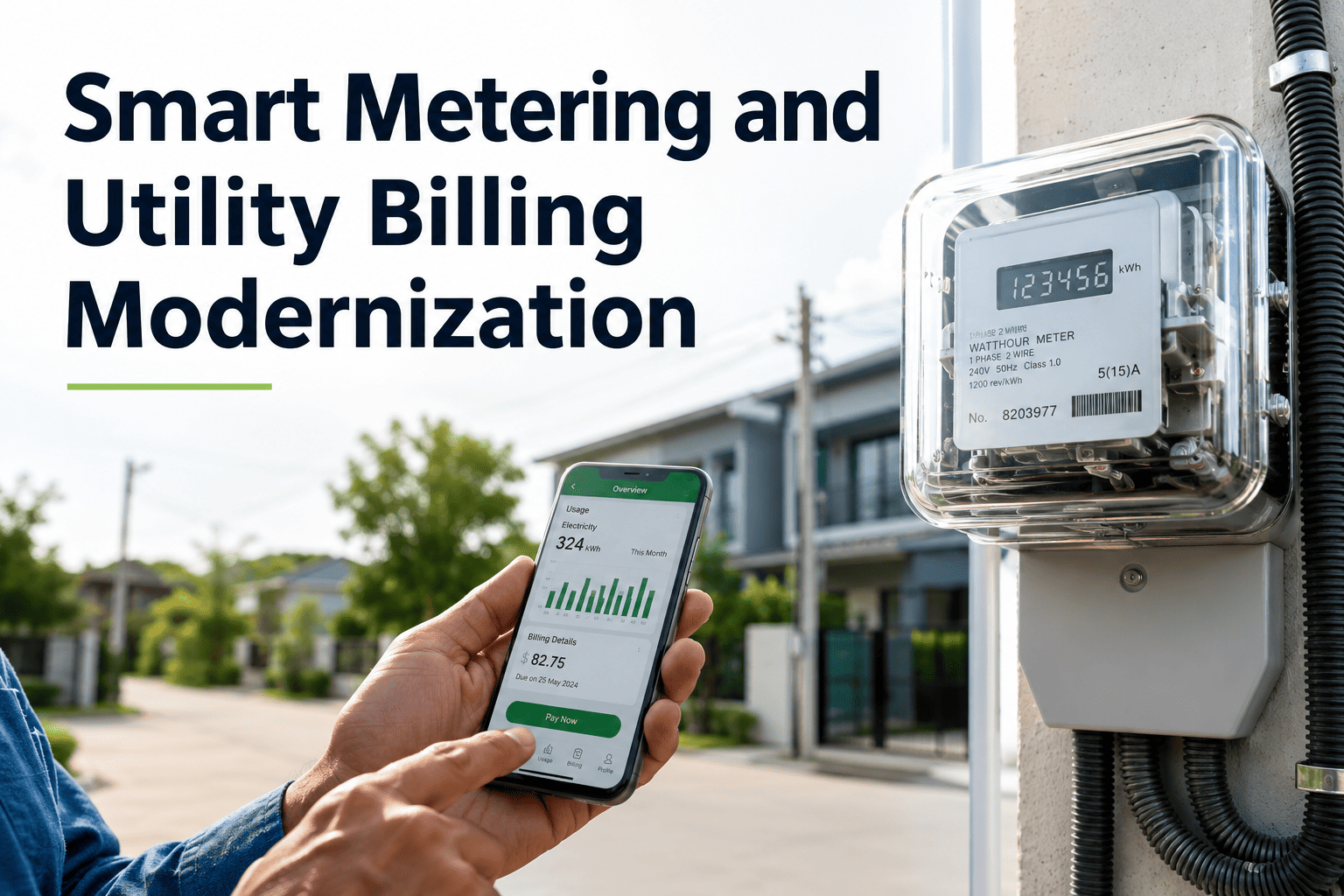
A mid-size water utility in the Southeast discovered during a revenue audit that 23% of its 84,000 residential meters were under-reading by more than 3% — silently losing $1.4 million in unbilled water every year. The oldest meters, installed between 1998 and 2005, had never been tested for accuracy since installation. The utility had no digital record of when most meters were installed, what model they were, or whether they had ever been calibrated. Replacement decisions were made by street address when a customer complained — not by meter age, accuracy data, or lifecycle cost analysis. The AMI (Advanced Metering Infrastructure) system the utility had invested $12 million to deploy was only communicating with 71% of installed endpoints because 29% of the radio modules had failed silently — and nobody knew which ones because endpoint health was tracked in the AMI head-end software but never connected to the maintenance system that dispatches field crews. The meter shop had 4,200 replacement meters in inventory — but 1,100 of them were for a discontinued model, purchased three years earlier by a supervisor who had since retired. Every one of these failures — the revenue loss, the accuracy degradation, the AMI communication gaps, the dead inventory — traces to the same root cause: no CMMS managing the meter fleet as an asset portfolio with lifecycle tracking, condition monitoring, and integrated AMI health data. OxMaint provides the digital asset registry, calibration tracking, AMI integration monitoring, replacement scheduling, and inventory management that transforms a meter fleet from an untracked liability into a revenue-protected, lifecycle-managed asset portfolio. Start your free OxMaint trial and begin building your meter asset registry today — or schedule a consultation to assess your current meter management gaps.
$1.4M
annual revenue lost
From 23% of meters under-reading by 3%+ at a single mid-size utility
29%
AMI endpoints offline
Silent radio failures undetected because AMI and CMMS don't share data
15–20 yr
typical meter lifespan
Accuracy degrades 1–3% per year after year 8 — without testing, revenue silently erodes
These are not edge cases. They represent the daily reality for utilities managing meter fleets without lifecycle tracking. The good news: utilities deploying CMMS-integrated meter management report 95%+ AMI uptime, full revenue recovery from accuracy-based replacement programs, and elimination of dead inventory through demand-driven procurement. Book a demo with OxMaint to assess your meter fleet's revenue exposure.
What Separates Managed Meter Fleets from Revenue-Leaking Ones
Most water utilities treat meters as "install and forget" infrastructure — replaced only when a customer complains about a high bill or a meter reader reports a stuck register. Without lifecycle tracking, calibration data, and AMI health integration, utilities are systematically losing revenue, misallocating replacement budgets, and operating blind to the condition of their largest distributed asset class. Six data disciplines separate managed fleets from unmanaged ones.
Foundation
Digital Asset Registry
Every meter registered with serial number, model, manufacturer, size, installation date, location (GPS), service address, and account linkage. The registry is the foundation — without it, every other management capability is impossible.
Accuracy
Calibration & Testing Records
Flow test results stored per meter with date, technician, low/mid/high flow accuracy readings, and pass/fail determination. Trending across tests reveals degradation curves per model and age cohort — driving data-based replacement decisions.
Connectivity
AMI Endpoint Health
Radio module communication status, signal strength trending, firmware version, battery life remaining, and last-read timestamp — pulled from the AMI head-end and linked to the meter asset record in the CMMS for unified fleet visibility.
Lifecycle
Age-Based Replacement Scheduling
Automated replacement scheduling based on meter age, accuracy test results, AMI health status, and manufacturer-recommended lifespan. Eliminates both premature replacement waste and overdue meter revenue loss.
Revenue
Non-Revenue Water Tracking
Links meter accuracy data to billing records — quantifying revenue loss per under-reading meter and prioritizing replacements by revenue recovery potential rather than arbitrary age cutoffs.
Supply Chain
Meter Inventory Management
Tracks new meter stock by model, size, and AMI compatibility. Min-max levels with automated reorder triggers prevent both stockouts that delay replacements and dead inventory from discontinued models.
OxMaint integrates all six meter management disciplines into one CMMS platform. See why water utilities trust us with their meter fleet data, AMI integration, and revenue protection programs.
Head-to-Head: Meter Management Approaches Compared
We evaluated common meter management approaches across the criteria that matter to utility asset managers and finance directors: lifecycle visibility, revenue protection, AMI integration, replacement optimization, and audit readiness. Here is an honest comparison to help you select the right approach for your utility's meter fleet.
Recommended
OxMaint CMMS
Integrated Meter Lifecycle Management
Full digital registry with AMI health integrationCalibration tracking with accuracy degradation curvesRevenue-ranked replacement scheduling
Tracks radio module connectivityFirmware version managementConsumption data collection
Included with AMI system
Spreadsheet Tracking
Manual meter records management
Low cost to startFamiliar to all staffNo software procurement required
Hidden cost: lost revenue + errors
GIS-Only Tracking
Location management without lifecycle data
Spatial visualization of meter locationsIntegration with mapping workflowsService area planning support
Missing: accuracy, AMI, lifecycle data
Billing System Records
Account-based meter tracking
Links meter to customer accountConsumption history per accountAlready in place at most utilities
No maintenance or lifecycle capability
Paper Meter Shop Log
Legacy test bench record-keeping
Physical test result documentationTechnician familiarityNo technology dependency
Not auditable, not trendable
Every utility's meter fleet is different — the best way to evaluate is to see your own data in a connected system. Create a free OxMaint account and have your meter team review the asset registry and AMI integration capabilities firsthand.
Why OxMaint Is Built for Meter Fleet Management
Most CMMS platforms treat meters like any other asset — a name and a location. OxMaint is built with meter-specific data structures: accuracy test results with low/mid/high flow readings, AMI endpoint health fields, age-based degradation curves, revenue impact calculations, and inventory management with model compatibility tracking. Here is how that meter-specific architecture translates into real capabilities for utility asset managers.
Meter Lifecycle Dashboard
Every meter in the fleet visualized by age cohort, model, accuracy status, and AMI health — with automated flags for meters approaching replacement thresholds. Sort by revenue impact to prioritize the replacements that recover the most unbilled water first.
Accuracy Test Tracking & Degradation Curves
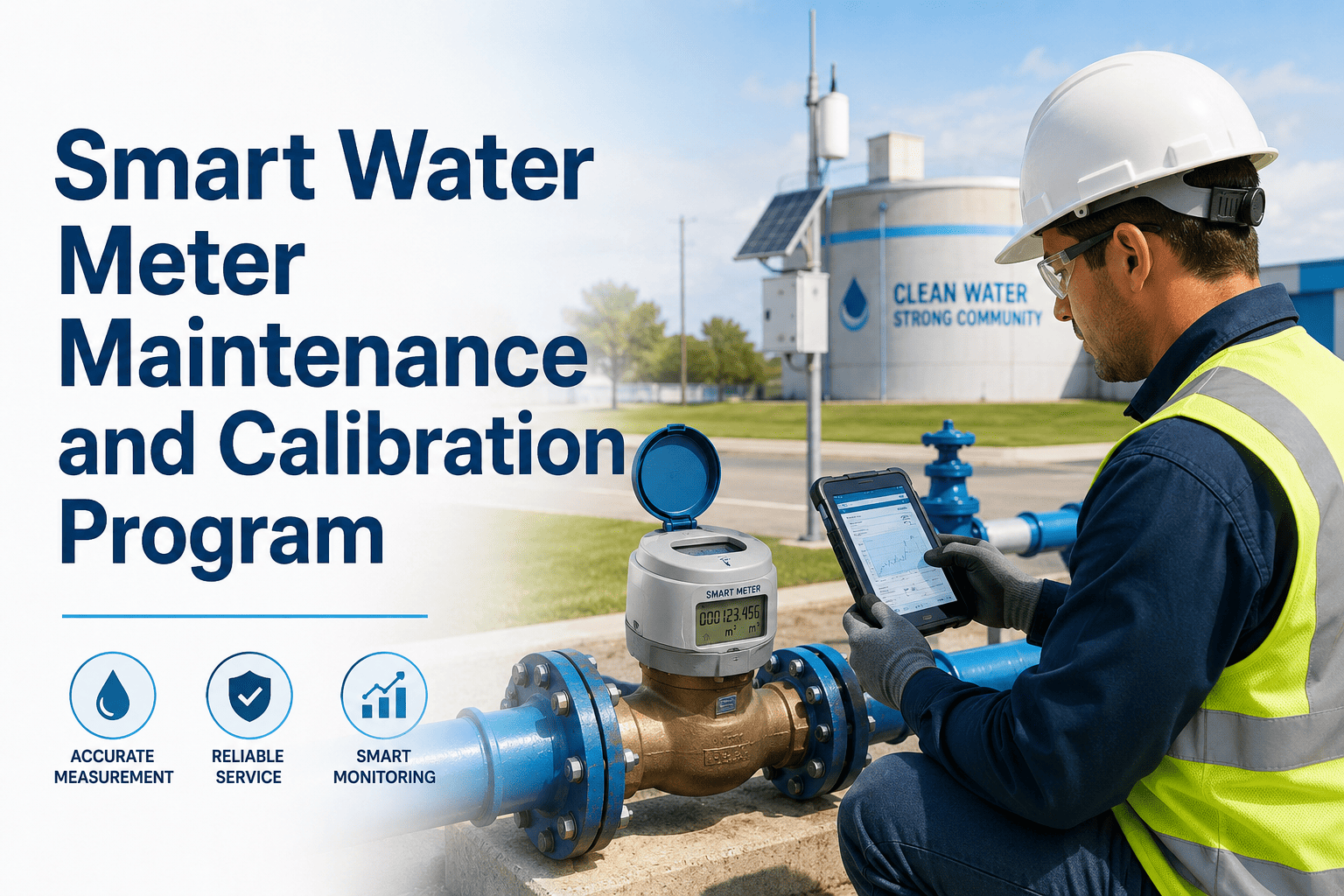
Store every flow test result — low flow (¼ GPM), mid flow (2 GPM), and high flow (15 GPM) — per meter with pass/fail determination against AWWA M6 standards. OxMaint trends accuracy across test cycles to build degradation curves per model and age, enabling data-driven replacement timing instead of arbitrary age cutoffs.
AMI Endpoint Health Integration
OxMaint pulls AMI head-end data — radio signal strength, battery voltage, firmware version, last successful read timestamp, and communication failure alerts — and links it to the meter asset record. When an endpoint goes silent, OxMaint auto-generates a field work order for the meter technician — not an IT ticket that sits in a queue.
OxMaint calculates estimated revenue loss per under-reading meter based on accuracy test results and average consumption — ranking the replacement queue by revenue recovery potential. A meter losing $280/year in unbilled water gets replaced before a meter losing $40/year, regardless of which one is older. This revenue-ranked approach typically recovers 60–80% of non-revenue water attributable to meter inaccuracy within the first 24 months. Sign up for OxMaint to start building your revenue recovery queue.
Before & After: The Transition to Managed Meter Assets
The shift from untracked meter fleets to CMMS-managed lifecycle programs is not just an operational upgrade — it is a fundamental shift from revenue erosion to revenue protection. Here is what that transition looks like in practice for a water utility.
Unmanaged Meter Fleet
No digital registry — meter age and model unknown for 40–60% of fleet
Accuracy testing only when customer complains — systematic under-reading undetected
AMI endpoint failures invisible to maintenance — 20–30% of radios offline silently
Replacement by complaint or arbitrary age — no revenue impact prioritization
Dead inventory accumulates — discontinued models purchased by former staff
$1.4M+ Lost
Annual revenue erosion from undetected meter under-reading across the fleet
OxMaint-Managed Meter Fleet
Complete digital registry — every meter with serial, model, age, GPS, and account linkage
Proactive accuracy testing by age cohort — degradation curves drive replacement timing
AMI health integrated — silent failures auto-generate field work orders within hours
Revenue-ranked replacement queue — highest revenue loss meters replaced first
Demand-driven inventory — min-max by model with auto-reorder, zero dead stock
Revenue Protected
95%+ AMI uptime, full accuracy compliance, and eliminated non-revenue water loss
Modernize your meter management without a multi-year IT project. OxMaint's free tier lets you build your meter registry, start tracking accuracy tests, and connect AMI health data — no procurement cycle required.
Utility finance directors and asset managers need hard data to justify CMMS investment for meter management. The evidence from utilities with managed meter fleets is clear — the revenue recovery alone funds the entire program within the first year.
95%+
AMI Uptime
Silent endpoint failures caught within hours — not months
80%
NRW Recovery
Non-revenue water from meter inaccuracy recovered in 24 months
100%
Fleet Visibility
Every meter tracked — age, accuracy, AMI status, and revenue impact
Zero
Dead Inventory
Demand-driven procurement eliminates obsolete meter stock entirely
Your 4-Step Path to a Managed Meter Fleet
Transitioning from untracked meters to a fully managed fleet should not require a multi-year IT project. Use this streamlined framework to go from inventory chaos to lifecycle intelligence in phases that deliver ROI at every step.
1
Build the Digital Meter Registry
Import existing meter data from billing systems, GIS, and AMI head-end into OxMaint. Clean and validate: serial numbers, models, sizes, installation dates, GPS coordinates, and account linkages. Flag meters with missing data for field verification. This registry becomes the foundation for every subsequent management capability.
2
Connect AMI Health Data
Integrate AMI head-end data feeds into OxMaint — radio signal strength, battery voltage, firmware version, communication status, and last-read timestamp per endpoint. Configure automated work order generation for endpoints that go silent or fall below signal thresholds. This immediately recovers the 20–30% of offline endpoints most utilities don't know they have.
3
Launch Accuracy Testing Program
Configure age-based testing schedules — priority testing for meters 10+ years old using AWWA M6 methodology. Store low/mid/high flow accuracy results per meter. Build degradation curves per model and age cohort. Calculate revenue impact per under-reading meter to build the revenue-ranked replacement queue.
4
Activate Lifecycle Replacement Scheduling
Deploy revenue-ranked replacement scheduling — replacing the meters that lose the most revenue first. Connect replacement schedules to inventory management with min-max levels per model and auto-reorder triggers. Report lifecycle cost and revenue recovery data to finance and management for budget justification. Schedule a walkthrough to plan your phased deployment.
We spent $12 million deploying AMI and then discovered that 29% of our endpoints were offline because nobody connected the AMI health data to the maintenance system. The AMI head-end knew which radios were dead. The meter shop had replacement parts. But the two systems didn't talk to each other, so the work orders never got created. The day we connected AMI health to our CMMS, we generated 2,400 work orders for silent failures we didn't know existed. Within six months, AMI uptime went from 71% to 96%. We didn't buy new technology. We connected what we already had.
Director of Meter Services, Regional Water Authority
Every Meter Is Either an Asset or a Liability. CMMS Makes It an Asset.
OxMaint brings together digital meter registry, accuracy test tracking, AMI endpoint health integration, revenue-ranked replacement scheduling, and demand-driven inventory management in one platform built for water utility meter operations. Manage work orders, protect revenue, and maintain your AMI investment — from one connected system.
How does OxMaint integrate with our existing AMI system?
OxMaint connects to all major AMI head-end platforms — Itron, Badger Meter BEACON, Neptune R900/E-Coder, Sensus FlexNet, and Kamstrup — via standard API and data export protocols. The integration pulls endpoint health data (signal strength, battery voltage, firmware version, communication status, last-read timestamp) into OxMaint's meter asset record on a configurable schedule — typically every 4–24 hours. When an endpoint goes silent or signal strength drops below threshold, OxMaint auto-generates a field work order dispatched to the meter technician. This eliminates the 20–30% silent AMI failure rate that most utilities discover only during manual audits. Book a demo to verify integration compatibility with your specific AMI platform.
How does accuracy degradation tracking work?
Every time a meter is tested on a flow bench, OxMaint stores the test results — low flow (typically ¼ GPM), mid flow (2 GPM), and high flow (15 GPM) accuracy percentages — linked to the specific meter serial number with date, technician, and test bench calibration certificate. AWWA M6 standards define the accuracy thresholds for pass/fail determination. When the same meter is tested again in subsequent years, OxMaint automatically calculates the accuracy change over time, building a degradation curve for that specific meter. Aggregated across meters of the same model and age, these curves reveal model-specific degradation patterns — enabling the utility to predict when each meter cohort will degrade below acceptable accuracy and schedule replacements proactively rather than waiting for individual failures.
How does revenue-ranked replacement work?
Traditional meter replacement programs use age as the primary criterion — replace all meters over 15 or 20 years old. This approach replaces meters that may still be accurate while leaving younger meters that are already under-reading in service. OxMaint calculates estimated annual revenue loss per meter based on: (1) accuracy test results showing under-reading percentage, (2) average daily consumption for the account served, and (3) current water rate. A ⅝" residential meter under-reading by 5% on an account using 8,000 gallons/month loses approximately $48/year. A 2" commercial meter under-reading by 3% on an account using 150,000 gallons/month loses approximately $540/year. Revenue-ranked replacement puts the 2" commercial meter first — regardless of which one is older. This approach typically recovers 60–80% of meter-attributable non-revenue water within 24 months. Start your free trial to build your revenue recovery queue.
Can OxMaint manage meter inventory and procurement?
Yes. OxMaint's inventory module tracks meter stock by model, size, and AMI compatibility — with min-max levels configured per meter type based on replacement program volume and lead times. When stock drops to minimum threshold, OxMaint generates a purchase order routed to the procurement manager. The system also flags inventory for discontinued models — preventing the dead stock problem that wastes $50K–$200K at typical utilities when staff purchase meters for models no longer deployed. Every meter issued from inventory to a work order auto-decrements stock and links the new meter serial number to the service address — maintaining the registry chain from warehouse to field installation.
How long does it take to implement meter fleet management with OxMaint?
A phased implementation typically runs 8–14 weeks: Phase 1 (weeks 1–3) imports existing meter data from billing systems, GIS, and AMI head-end to build the digital registry with data cleaning and validation. Phase 2 (weeks 3–6) connects AMI health data feeds and activates automated work order generation for silent endpoint failures — this phase alone typically identifies 15–30% of endpoints that need field attention. Phase 3 (weeks 6–10) configures accuracy testing workflows, launches age-cohort testing schedules, and begins building degradation curves. Phase 4 (weeks 10–14) activates revenue-ranked replacement scheduling, inventory management, and lifecycle reporting. Quick wins — the digital registry and AMI health integration — are operational within the first 3 weeks. Book a scoping call for a timeline specific to your fleet size and data readiness.