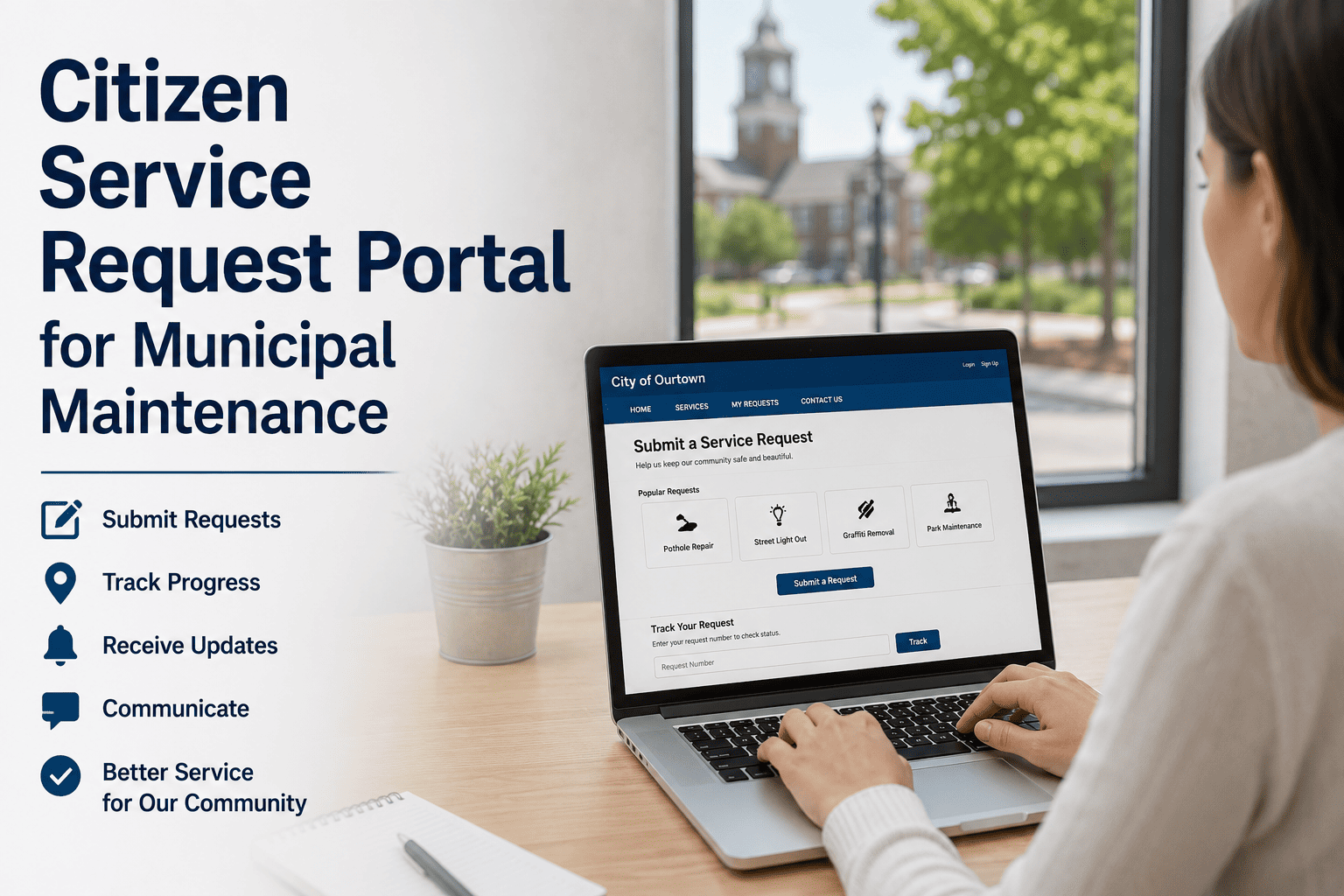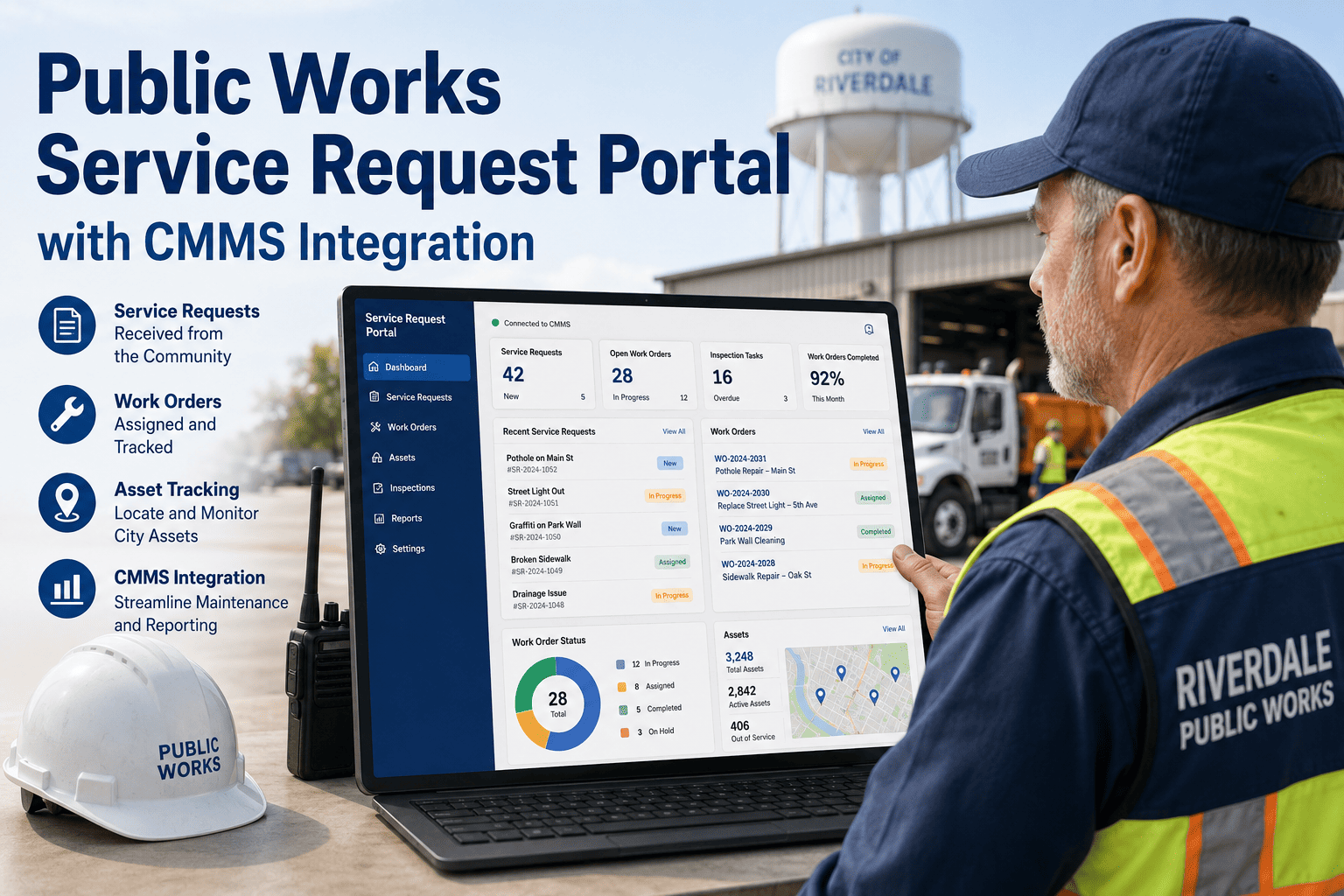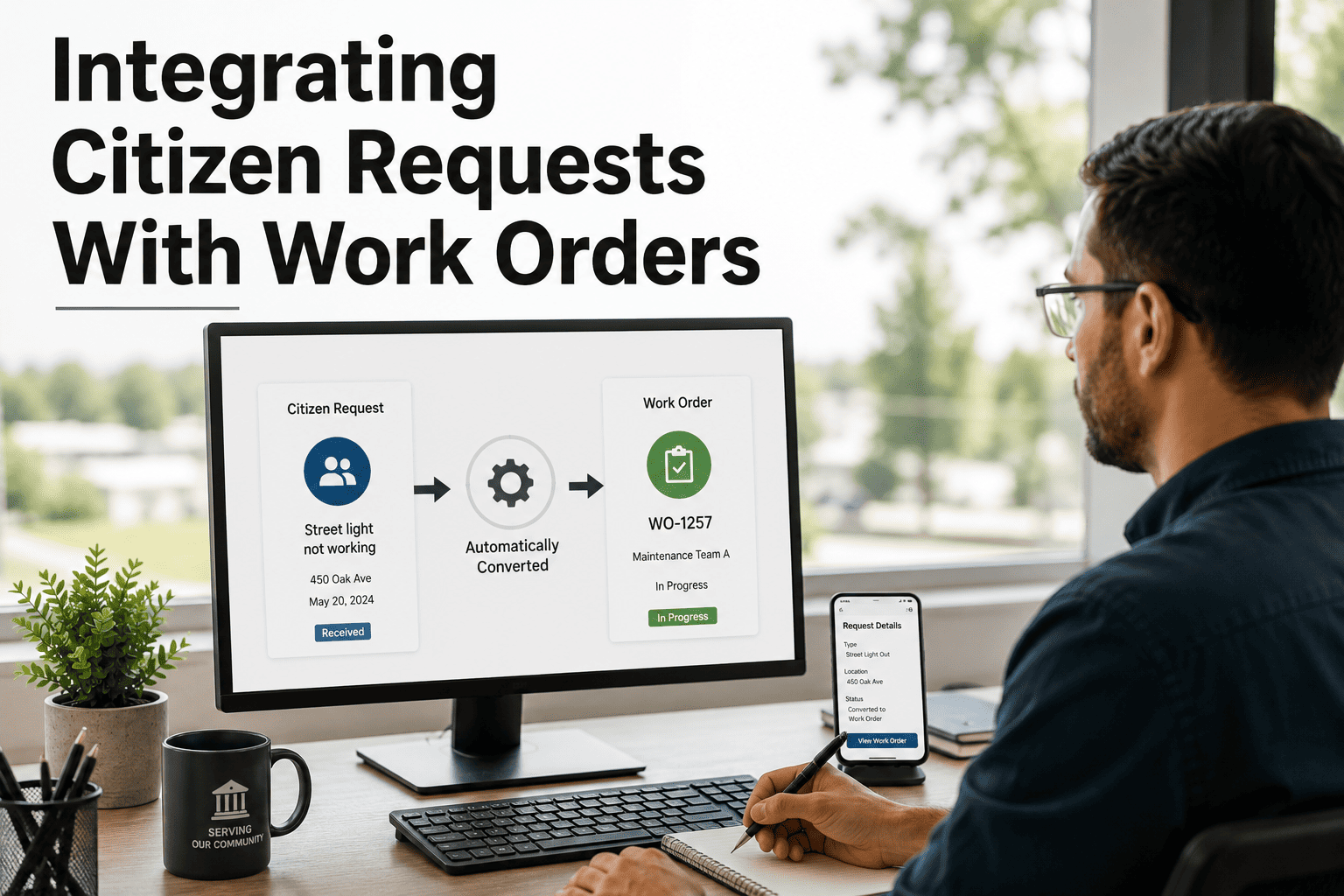
A citizen request work order should flow into operations the moment a resident hits submit — not sit in a shared inbox until someone manually re-keys it into a maintenance system. For municipalities, integrating 311 and citizen service portals directly with work order management closes the gap between reported problems and completed work, cutting response times by 30–50% and creating an auditable trail from first contact to closure. This guide walks through the architecture, routing rules, and workflow design that turn a citizen request into a tracked, closed-loop work order — the same closed-loop model that powers OxMaint's AI-driven CMMS for public works and municipal asset teams. Ready to see it on your assets? Start Free Trial and spin up your first workflow in minutes.
311 to Work Order Integration
Every citizen request becomes a tracked work order — automatically.
Stop losing service requests between departments. Connect your 311 portal, web forms, and mobile apps to a single CMMS workflow that routes, schedules, dispatches, and closes the loop — with real-time status pushed back to the citizen who reported it.
In most municipalities, a citizen service request travels through 3–5 manual handoffs before a crew is dispatched. Each handoff is a point where context is lost, priority is misjudged, or the request quietly drops.
Integrated 311-to-CMMS workflows eliminate every manual step — the moment a resident submits a request, the system categorizes it, assigns it to the right crew, generates a work order, and tracks it to closure.
The Problem
Why citizen request to work order handoffs fail
A 2024 survey of 200+ municipal public works departments found that 61% still rely on email, spreadsheets, or paper forms to bridge the gap between their 311 system and their maintenance operation — and that gap is where service quality goes to die.
Manual re-entry destroys context
A call-taker logs a pothole at Maple & 4th. A dispatcher re-types it into a work order. The crew gets an address but no photo, no GPS pin, no category. Result: wrong truck, wrong materials, repeat trip.
No priority routing — everything is "urgent"
When every citizen request lands in the same queue, a downed stop sign and a cracked sidewalk compete for the same crew. Without category-based SLAs, true emergencies get buried under noise.
Citizens never hear back
72% of residents who file a 311 report never receive a status update. When the work order lives in a separate system from the 311 ticket, there is no closed-loop notification — only silence and follow-up calls.
No audit trail for compliance
When a request becomes a complaint or a legal claim, municipalities need a defensible record: who reported it, when it was received, who dispatched it, when it was resolved. Disconnected systems make that trail impossible to reconstruct.
Integration Architecture
How 311 to work order integration actually works
A robust citizen request workflow connects five layers — intake, categorization, routing, execution, and feedback — so that a single service request flows through the entire maintenance lifecycle without a human re-keying a single field.
Intake — multi-channel citizen request capture
Residents submit requests via 311 call center, web portal, mobile app, or embedded widget. Each submission captures category, location (GPS or address), description, photo attachments, and citizen contact info — structured data, not free-text notes. Open APIs (REST/SOAP) and pre-built connectors for platforms like Open311, GovQA, and Questys pull submissions in real time.
Categorization — auto-classify by service type
AI-assisted categorization reads the request text and maps it to a standardized service type — pothole, streetlight outage, graffiti, illegal dumping, tree hazard, water leak. Each category carries a default priority level, target SLA, required skill set, and estimated labor hours. This eliminates the 40% of misrouted requests caused by manual category selection.
Routing — match to crew, zone, and availability
The work order engine evaluates the service type, location, and current crew workload to auto-assign the job. A streetlight outage in District 3 goes to the electrical crew whose zone includes that block. Priority overrides escalate downed-sign or water-main reports to the nearest available team. Routing rules are configurable per department, per zone, per season.
Execution — mobile dispatch and field closure
Crews receive the work order on a mobile app with full context: location map, citizen-reported photo, asset history, parts needed, and safety instructions. They update status, log labor and materials, capture before/after photos, and close the work order from the field — even offline. No paperwork, no end-of-day data entry.
Feedback — closed-loop citizen notification
When the work order is closed, the system automatically pushes a status update back to the citizen via SMS, email, or 311 portal — including the resolution summary and before/after photos. The 311 ticket closes simultaneously. No orphaned tickets, no "is this done yet?" calls, no double-closure work for dispatchers.
Routing Logic
Citizen request workflow routing rules that work
Routing is the brain of a citizen request to work order system. A mid-sized city handling 40,000 service requests per year needs deterministic rules — not guesswork — to make sure each request reaches the right crew within the right SLA window.
| Service Category | Priority | Target SLA | Assigned Crew Type | Auto-Upgrade Trigger |
|---|---|---|---|---|
| Downed stop sign / traffic signal | Emergency | 2 hours | Signs & Traffic crew (on-call) | Immediate dispatch — nearest unit |
| Water main break | Emergency | 1 hour | Water Utilities crew | Auto-notify supervisor + mutual aid |
| Pothole | High | 48 hours | Street Maintenance zone crew | Escalate if > 3 duplicate reports same location |
| Streetlight outage | Medium | 5 business days | Electrical crew (zone-based) | Batch with nearby outages for efficiency |
| Graffiti removal | Medium | 7 business days | Parks & Public Property crew | Escalate if on public-facing facility |
| Illegal dumping | Medium | 3 business days | Sanitation / Solid Waste crew | Auto-route to contracted hauler if > 2 cubic yards |
| Sidewalk crack / trip hazard | Low | 30 business days | Concrete crew (scheduled batch) | Escalate to High if ADA complaint filed |
SLA targets shown reflect median benchmarks from U.S. municipalities with populations of 50,000–250,000. Configure your own in OxMaint to match local ordinances and council mandates.
Before vs After
Manual citizen request handling vs integrated work orders
A public works department serving 85,000 residents was processing 12,000 citizen requests per year through a call center, email inbox, and paper work orders. After implementing an integrated 311-to-CMMS workflow, the numbers told the story within 90 days.
Spreadsheet + email + paper work orders
- 2.4 days average time from citizen report to crew dispatch
- 23% of requests required a follow-up call because status was unknown
- 14% of work orders were duplicates of already-open jobs
- 0% of citizens received automated status updates
- 6 hrs/week spent by dispatchers re-keying 311 data into work orders
- No audit trail — reconstructing a single request's history took 45+ minutes
311 portal connected to AI-powered CMMS
- 18 min average time from citizen report to crew dispatch
- 3% of requests required a follow-up call — status visible in portal
- 1.2% duplicate rate — system detects existing open work orders at intake
- 100% of citizens received automated SMS/email status updates
- 0 hrs/week on manual re-keying — work orders auto-generate from 311 feed
- Full audit trail — any request's complete history retrievable in under 10 seconds
Worked example: Maple Street water leak
A resident reports water pooling at 142 Maple Street via the city's 311 app at 8:47 AM, attaching a photo. The system auto-categorizes it as "water leak — suspected main," geocodes the location, cross-references the asset database (12-inch cast iron main, installed 1962, last inspected 2019), and flags it as Priority 1 due to infrastructure age and leak proximity to the pipe joint. By 8:52 AM, the Water Utilities crew lead has the work order on his phone — with the citizen's photo, pipe specs, valve shut-off locations, and a recommended repair kit from inventory. The crew is on-site by 9:30 AM. At 11:15 AM they close the work order with before/after photos and a parts-usage log. At 11:16 AM, the citizen who reported it gets an SMS: "Your water leak report at Maple Street has been resolved. Thank you for helping keep our city safe." Total elapsed time: 2 hours 29 minutes. Before integration, the same request took an average of 31 hours to resolve.
How OxMaint Helps
How OxMaint closes the citizen request to work order loop
OxMaint is built for the realities of municipal maintenance — multi-department routing, seasonal workload swings, aging infrastructure, and citizens who expect Amazon-level service transparency. These are the four capabilities that make the citizen request to work order handoff seamless.
Open API + Open311 connector
Pre-built integration with Open311, Salesforce 311, GovQA, Questys, and custom citizen portals. REST API supports real-time webhooks so a citizen request creates a work order in under 2 seconds — no batch imports, no overnight sync, no manual triggers.
AI-assisted categorization & routing
Natural language processing reads the citizen's description and auto-assigns a service category, priority level, SLA target, and crew type — with 94% accuracy out of the box. Configurable rules let you override or refine routing for your department structure and seasonal capacity.
Mobile field execution with offline mode
Crews get the full work order on a mobile app — citizen photo, GPS location, asset history, parts list, safety notes. They update status, log labor and materials, and capture before/after photos even without cellular coverage. Data syncs the moment connectivity returns.
Closed-loop citizen notifications
When a work order closes, OxMaint automatically sends a status update to the citizen who reported it — via SMS, email, or portal update — with resolution summary and photos. The linked 311 ticket closes simultaneously, so there are no orphaned records or double-closure workflows.
ROI Snapshot
What municipalities save with integrated citizen request work orders
For a mid-sized municipality processing 12,000 citizen service requests per year, the cost of disconnected systems is measurable — and so is the payback from integration.
See how OxMaint turns 311 requests into closed work orders
Book a 30-minute demo and we'll map your citizen request workflow end-to-end — from 311 intake to citizen notification — on your own service categories and zones.
FAQ
Citizen request work order integration: frequently asked questions
What is a citizen request work order and why does integration matter?
A citizen request work order is a maintenance work order that is automatically generated from a service request submitted by a resident through a 311 system, web portal, or mobile app. Integration matters because without it, the request must be manually re-entered into the maintenance system — a process that introduces delays (averaging 2.4 days), errors, and lost context. With integration, the same request becomes a tracked, routed work order in under 2 seconds, cutting dispatch time by up to 92% and creating a complete audit trail from first citizen contact through field closure. You can explore the workflow yourself — Start Free Trial and configure your first citizen request workflow in minutes.
How does 311 work order integration work technically?
311-to-work-order integration uses APIs (typically REST or SOAP) and standard protocols like Open311 to push citizen service requests from the 311 system directly into a CMMS or work order management platform. When a citizen submits a request, the 311 system sends a structured payload — category, location, description, attachments, contact info — to the CMMS via webhook or real-time API call. The CMMS then auto-categorizes the request, applies routing rules, generates a work order, and assigns it to the appropriate crew. When the crew closes the work order, a status update flows back to the 311 system to close the original ticket and notify the citizen.
Can OxMaint integrate with our existing 311 or citizen request system?
Yes. OxMaint supports pre-built connectors for Open311-compliant systems, Salesforce 311, GovQA, Questys, and SeeClickFix, as well as a REST API for custom citizen portals. If your 311 platform can send an HTTP request with the service request data, OxMaint can receive it, parse it, and generate a work order automatically. For systems without API capability, OxMaint also supports scheduled CSV/JSON imports as a fallback. Most integrations are live within 2–4 weeks. Book a Demo and we'll assess your specific 311 platform in the call.
How long does it take to implement citizen request integration for a municipality?
A typical mid-sized municipality (50,000–250,000 residents) can go live with citizen request to work order integration in 4–8 weeks. This includes 1–2 weeks for API configuration and connector setup, 1–2 weeks for category and routing rule configuration, 1 week for mobile app deployment to field crews, and 1–2 weeks for training and pilot testing. Cities already using a modern 311 platform with Open311 compliance can integrate in as little as 2 weeks. OxMaint provides implementation support, workflow templates based on municipal best practices, and pre-configured SLA libraries by service category to accelerate deployment.
What are the main benefits of citizen request to work order integration for public works?
The five core benefits are: (1) faster response times — dispatch drops from days to minutes; (2) reduced duplicate work orders — the system detects existing open jobs at intake, cutting duplicates by 85%; (3) automated citizen notifications — 100% of residents receive status updates, cutting follow-up calls by 80%; (4) full audit trail — every request has a defensible record from intake to closure, critical for compliance and legal protection; and (5) data-driven resource allocation — categorized, geo-tagged work order data reveals recurring problem areas, enabling proactive maintenance planning rather than reactive dispatch. Typical payback is under 11 weeks for a mid-sized municipality.
Turn every citizen request into a closed work order
Stop losing service requests between 311 and public works. OxMaint's AI-powered CMMS connects citizen intake to crew dispatch, field execution, and closed-loop notification — so nothing falls through the cracks and every resident hears back.
Free 14-day trial · No credit card