Municipal Work Order Management: From Citizen Request to Resolution
By Taylor on March 2, 2026
When a resident calls the city's 311 line to report a pothole that cracked her suspension, the operator logs it on a sticky note. When a business owner emails public works about a streetlight out for three weeks, the message sits in a shared inbox. When the parks department gets a verbal complaint about a broken playground swing at a community meeting, nobody writes it down at all. Three different citizens, three different channels, three different failure modes — and zero trackable work orders in any system. Six months later, the city council reviews a constituent satisfaction survey showing 34% approval for public works responsiveness. The public works director cannot explain the gap because there is no data — no request log, no assignment timestamps, no resolution records, no evidence that any citizen request was ever formally received, prioritised, dispatched, completed, or verified. The city spent $14.2 million on maintenance last fiscal year with no ability to show which citizen requests were addressed and which were not. The technology to track every request from intake to resolution existed; the operational framework to deploy it did not. Talk to our team about building a digital work order management system that turns every citizen request into a tracked, accountable service delivery outcome.
Municipal Operations Guide — 2026 Edition
Municipal Work Order Management: From Citizen Request to Resolution
Transform citizen service requests into tracked, prioritised work orders with digital municipal work order management. Pothole reports, streetlight outages, and facility repairs — resolved efficiently with full accountability and public transparency.
Faster average resolution time with digital work order tracking vs. paper-based systems
100%
Request accountability — every citizen report logged, timestamped, assigned, and tracked to resolution
3.2x
Improvement in citizen satisfaction scores when residents receive status updates on their requests
40%
Reduction in duplicate work orders through automated request deduplication and geo-clustering
Why Digital Work Order Management Is Non-Negotiable for Municipal Government
Every municipal service — pothole repair, streetlight replacement, park maintenance, building systems, water infrastructure, fleet operations — depends on work orders that connect citizen need to crew action. Without a digital system that captures every request, assigns it to the right crew, tracks time and materials, and closes it with verified resolution, municipalities operate blind. Council members cannot answer constituent questions, directors cannot allocate budgets by actual demand, and citizens lose trust in government responsiveness. Digital work order management transforms service delivery from invisible labour into documented, accountable public stewardship.
What Digital Work Order Management Delivers
Request Accountability
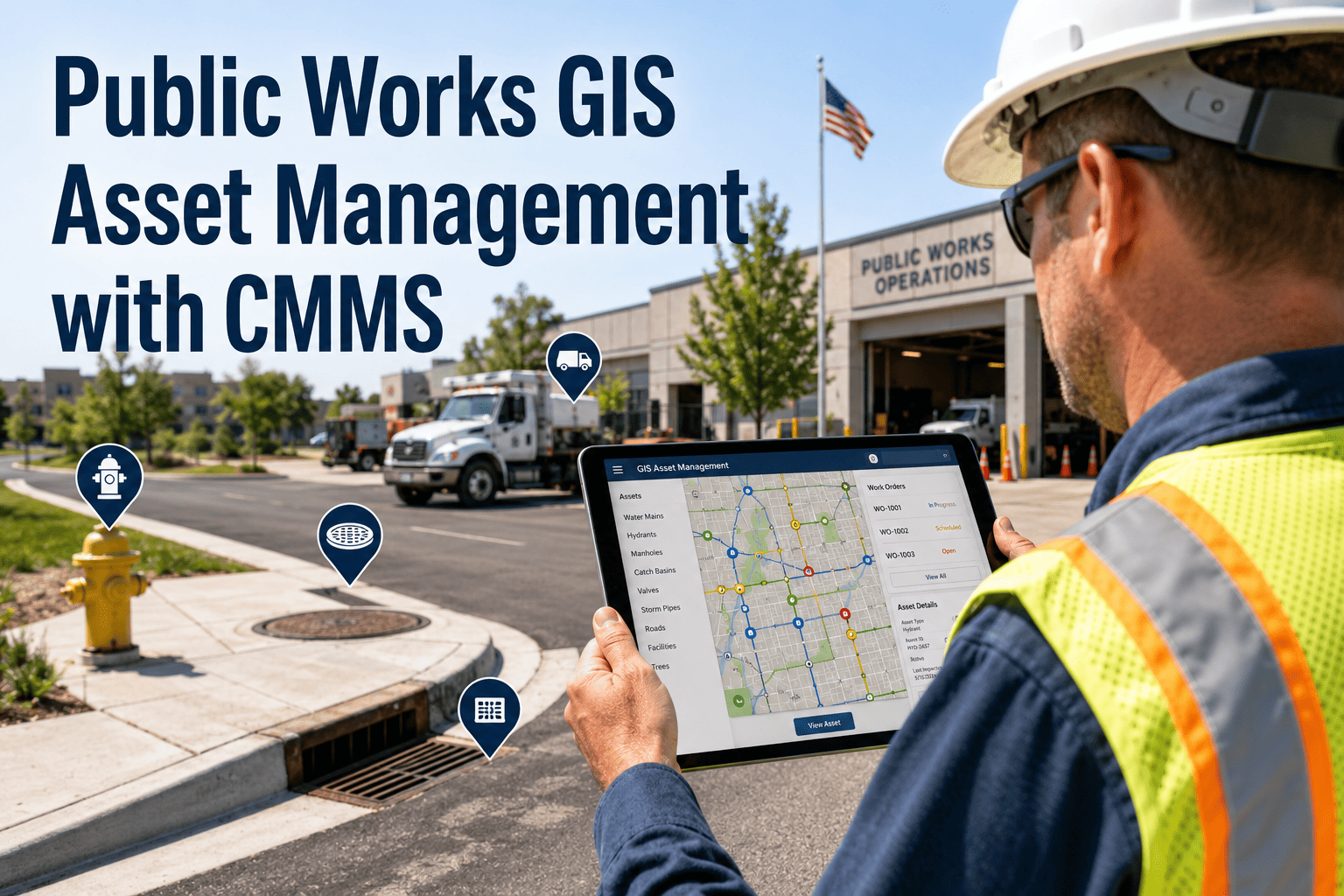
Every citizen report — phone, email, app, walk-in, 311 — logged with timestamp, geo-location, photo, and auto-assigned to the correct department.
Resolution Speed
Automated dispatching, mobile crew assignment, and real-time status updates cut average resolution time by 72% versus paper-based systems.
Public Transparency
Citizens see request status in real time. Council members get dashboards showing resolution rates by ward, department, and request type.
Budget Intelligence
Labour hours, materials, and contractor costs tracked per work order. Directors justify budgets with actual demand data, not estimates.
Crew Productivity
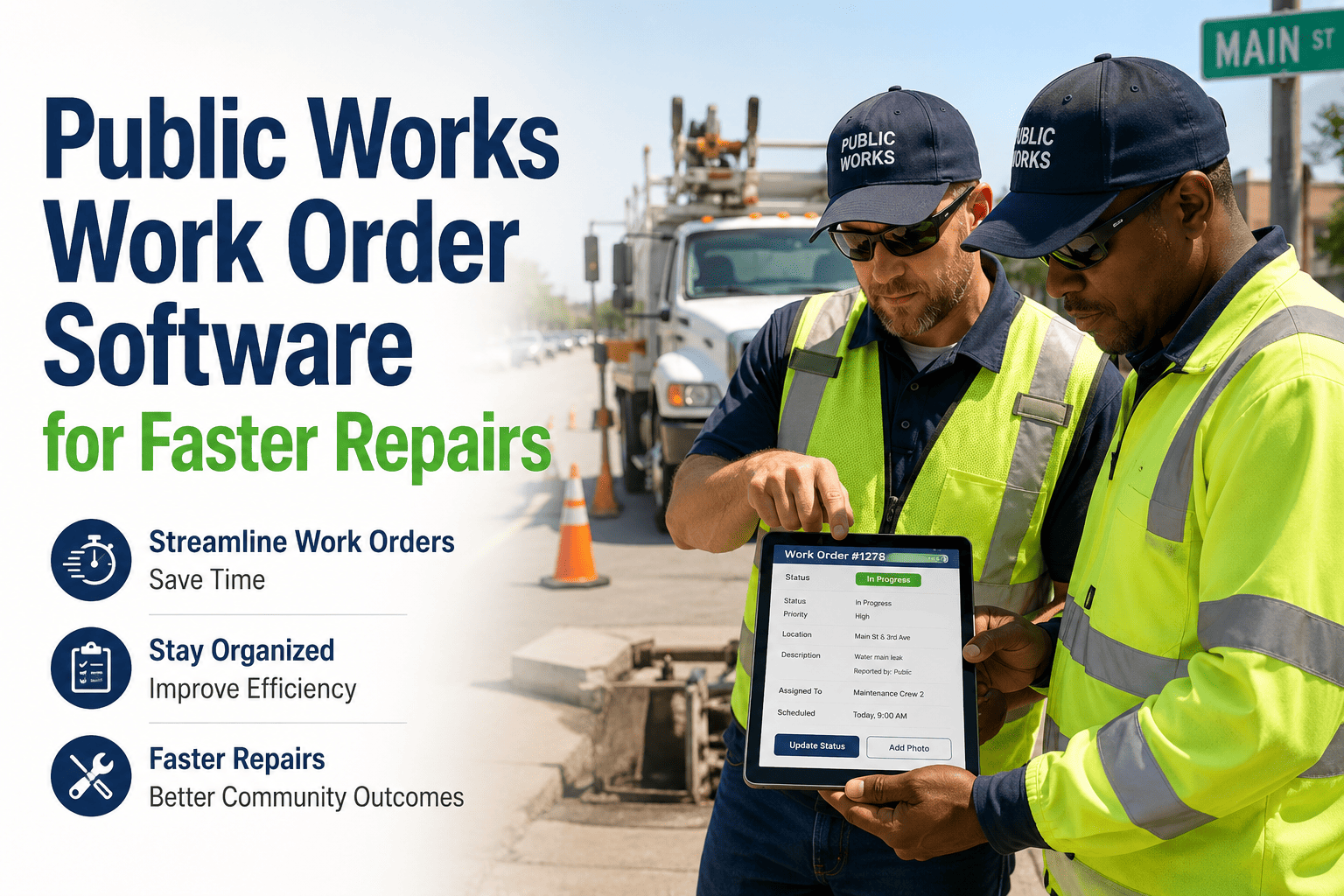
Mobile work orders eliminate paperwork, optimise routing, and give field crews everything they need on one screen — instructions, photos, parts lists, and maps.
Audit Compliance
Complete digital trail from citizen request through resolution — timestamped, geo-tagged, photo-documented, and exportable for any oversight audit.
Work Order Lifecycle Modules: The Integration Stack
No single function handles the complexity of municipal work order management. Intake captures the request, triage prioritises it, dispatch assigns crews, execution tracks the work, and verification confirms resolution. A unified CMMS integrates these distinct functions into one seamless workflow. By synchronising these modules, municipalities eliminate dropped requests and create a single source of truth for every service delivery action. Start your free trial to connect every module in your work order lifecycle.
Municipal Work Order Integration Points
Request Intake
311 / Phone IntegrationCritical
Citizen Mobile AppHigh
Email / Web PortalHigh
Channel: Multi-Source Capture
Value: Zero Dropped Requests
Triage & Prioritisation
Auto-Category AssignmentHigh
Priority Scoring EngineHigh
Duplicate DetectionHigh
Function: Intelligent Routing
Value: Right Priority First
Dispatch & Scheduling
Crew Assignment EngineCritical
Route OptimisationHigh
Calendar/Shift IntegrationMedium
Function: Resource Allocation
Value: Crew Efficiency
Field Execution
Mobile Work OrdersCritical
Photo/GPS DocumentationHigh
Time & Materials CaptureHigh
Function: Crew Operations
Value: Accountability
Verification & Reporting
Before/After Photo ProofHigh
Citizen NotificationHigh
Council DashboardsHigh
Function: Closure & Analytics
Value: Public Trust
Capture Every Citizen Request — Resolve It With Proof
Oxmaint's municipal work order platform integrates 311 systems, citizen apps, mobile crew dispatching, and council-ready dashboards into one unified workflow — ensuring no request is ever lost, ignored, or unaccounted for.
The 1–5 Work Order Maturity Scale: Where Does Your City Stand?
To prioritise digital transformation, municipal work order operations must be assessed by maturity level. A standardised 1–5 scale translates complex operational capability into a roadmap for city leadership. This allows directors to move from "Sticky Note Chaos" (Level 1) to "AI-Predictive Service Delivery" (Level 5) systematically, with clear milestones at every stage.
Municipal Work Order Maturity Scale
5
Predictive — AI-Driven Service Delivery
AI predicts service needs before citizens report them. Proactive work orders generated from sensor data, weather forecasts, and historical patterns. Public dashboards show real-time city health.
Action: Continuous AI refinement & citizen engagement
Goal State
4
Automated — Real-Time Digital Workflows
Citizen requests auto-generate CMMS work orders. Mobile crews update status in real time. Citizens receive automated notifications. Council dashboards show live resolution metrics.
Action: Expand analytics & citizen self-service
High Efficiency
3
Digital — Basic Work Order Tracking
CMMS captures work orders but intake is still manual. Supervisors assign crews via desktop. Field updates happen end-of-day. Reporting is possible but delayed.
Action: Deploy mobile & integrate 311 intake
Standard
2
Fragmented — Spreadsheets & Email
Requests tracked in Excel or shared inboxes. No priority scoring. Crews receive verbal assignments. Completion is confirmed by phone call. Data is unreliable for reporting.
Action: Implement centralised CMMS platform
Inefficient
1
Ad-hoc — Paper & Tribal Knowledge
Citizen requests received on sticky notes, voicemail, and verbal complaints. No log. No assignment tracking. No resolution verification. No data for council or auditors.
Action: Immediate digitalisation required
High Risk
The Cost of Dropped Requests: Compounding Consequences
A missed citizen request is not just a service failure — it's a compounding liability. A pothole report that goes untracked becomes a vehicle damage claim. A streetlight outage that goes unassigned becomes a pedestrian safety incident. A facility repair that goes unscheduled becomes an emergency closure. The cost of addressing a service request at intake is minimal compared to the cost of litigation, emergency repair, or public trust erosion after failure. The "Cost of Inaction" model demonstrates why real-time work order tracking is a fiduciary imperative for every municipality.
Cost of Untracked Citizen Requests Over Time
Cost multiplier relative to same-day digital work order creation
5 Same-Day WO
$120 (Routine Repair)
1x
4 1-Week Delay
$350 (Deterioration)
3x
3 1-Month Lost
$2,800 (Emergency Fix)
23x
2 Citizen Injury
$45,000 (Liability Claim)
375x
1 Litigation
$500K+ (Lawsuit/Settlement)
4000x
A $120 routine repair becomes a $500,000 lawsuit when the work order is never created. Real-time tracking (Level 4–5) prevents the exponential costs of service failure (Level 1).
Turn Every Citizen Request Into Documented Action
Oxmaint helps municipal teams capture requests from any channel, assign crews with mobile dispatch, track labour and materials per work order, and deliver council-ready dashboards that prove your department's impact — before budget season.
Building the Workflow: The 5-Phase Work Order Lifecycle
A robust municipal work order management system follows a disciplined lifecycle — from multi-channel citizen intake through intelligent triage, optimised dispatch, mobile field execution, and verified closure with citizen notification. Systematic execution of these phases ensures that every service request produces a documented outcome and that no request is ever lost between intake and resolution.
Request-to-Resolution Lifecycle
1
Multi-Channel Request Intake
Citizens submit requests via 311 phone lines, mobile apps, web portals, email, social media, walk-ins, or council referrals. Every channel feeds into a single CMMS intake queue — eliminating the sticky notes, shared inboxes, and verbal reports that cause requests to disappear.
Capture Phase
2
Intelligent Triage & Prioritisation
CMMS auto-categorises requests by type (pothole, streetlight, facility, water, sewer, parks), assigns priority scores based on safety impact, location, and citizen volume, and detects duplicate reports for the same issue via geo-clustering. Supervisors review exceptions only — routine requests flow automatically.
Classification Phase
3
Optimised Dispatch & Crew Assignment
Work orders are assigned to available crews based on skill match, location proximity, shift schedule, and current workload. Route optimisation groups nearby work orders into efficient daily sequences. Crews receive assignments on mobile devices with all context — photos, GPS coordinates, instructions, and required materials.
Scheduling Phase
4
Mobile Field Execution
Field crews execute work orders from mobile devices — logging arrival time, before/after photos, materials used, labour hours, and completion status in real time. GPS tracking confirms on-site presence. Supervisors monitor crew progress on a live dispatch dashboard without calling for verbal updates.
Execution Phase
5
Verified Closure & Citizen Notification
Work order closed with photo-documented proof of completion. Citizen automatically notified that their request has been resolved — with before/after imagery if applicable. Resolution data feeds council dashboards, budget reports, and public accountability scorecards. Sign up for Oxmaint to close the loop between citizen request and verified resolution.
Verification Phase
Director Perspective: From Invisible Labour to Public Proof
"
Our public works department handled 14,000 service requests last year — and I couldn't tell the council how many we actually completed. Requests came in through phone calls, emails, walk-ins, and council referrals. Some got written on whiteboards, some went into Excel, and most lived in people's heads. When a council member asked why a constituent's pothole hadn't been fixed after six weeks, we had no record it was ever reported. After implementing Oxmaint, every request gets a work order within minutes. Crews receive mobile assignments, log before/after photos, and close work orders from the field. Citizens get automated status updates. I now walk into council meetings with a dashboard showing 94% of requests resolved within SLA, average resolution time by category, and cost per work order by ward. The work our crews do hasn't changed — what changed is that we can finally prove it.
— Director of Public Works, Mid-Size City (Population 185,000)
94%
Requests resolved within service level agreement
72%
Faster average resolution time vs. prior year
Zero
Lost citizen requests after CMMS implementation
The municipalities achieving true service excellence share a common trait: they view work order management not as a back-office function, but as the visible link between citizen need and government action. By leveraging CMMS-integrated intake, mobile dispatch, real-time field tracking, and verified closure with citizen notification, these cities turn invisible maintenance labour into documented, accountable public service delivery. When the system proves the work, public trust follows. Start building your citizen-to-resolution workflow with the platform that makes every work order count.
Every Request Deserves a Resolution — And Proof It Happened
Oxmaint provides the digital infrastructure for modern municipal service delivery — capturing citizen requests from any channel, dispatching crews with mobile work orders, tracking every dollar and hour spent, and producing the council-ready dashboards that justify budgets, demonstrate accountability, and build public trust.
How does a CMMS integrate with existing 311 systems for citizen request intake?
Modern CMMS platforms connect to 311 systems via API integration, automatically converting citizen-reported issues into prioritised work orders. When a resident calls 311 to report a pothole, the 311 operator logs the request with location, description, and photos — and the CMMS instantly creates a categorised, geo-tagged work order assigned to the correct department queue. This eliminates the manual re-entry that causes requests to be lost between 311 intake and public works action. For cities without dedicated 311 systems, Oxmaint provides citizen-facing request portals and mobile apps that feed directly into the same work order queue, ensuring every channel produces the same tracked, accountable outcome. Sign up for Oxmaint to connect your intake channels.
How does mobile dispatch improve crew productivity in the field?
Mobile dispatch eliminates the morning briefing bottleneck where crews drive to the yard, receive paper assignments, and drive back out to job sites. With mobile work orders, crews receive assignments directly on their devices with GPS navigation, citizen-submitted photos, required materials lists, and step-by-step instructions. Route optimisation sequences nearby work orders into efficient daily itineraries, reducing windshield time by 25–35%. Real-time status updates eliminate the supervisor phone calls that interrupt productive work. Before/after photo capture at each job site creates instant documentation without separate paperwork. Municipalities implementing mobile work orders consistently report 30–40% more work orders completed per crew per day compared to paper-based systems.
What dashboards and reports does the CMMS provide for council meetings?
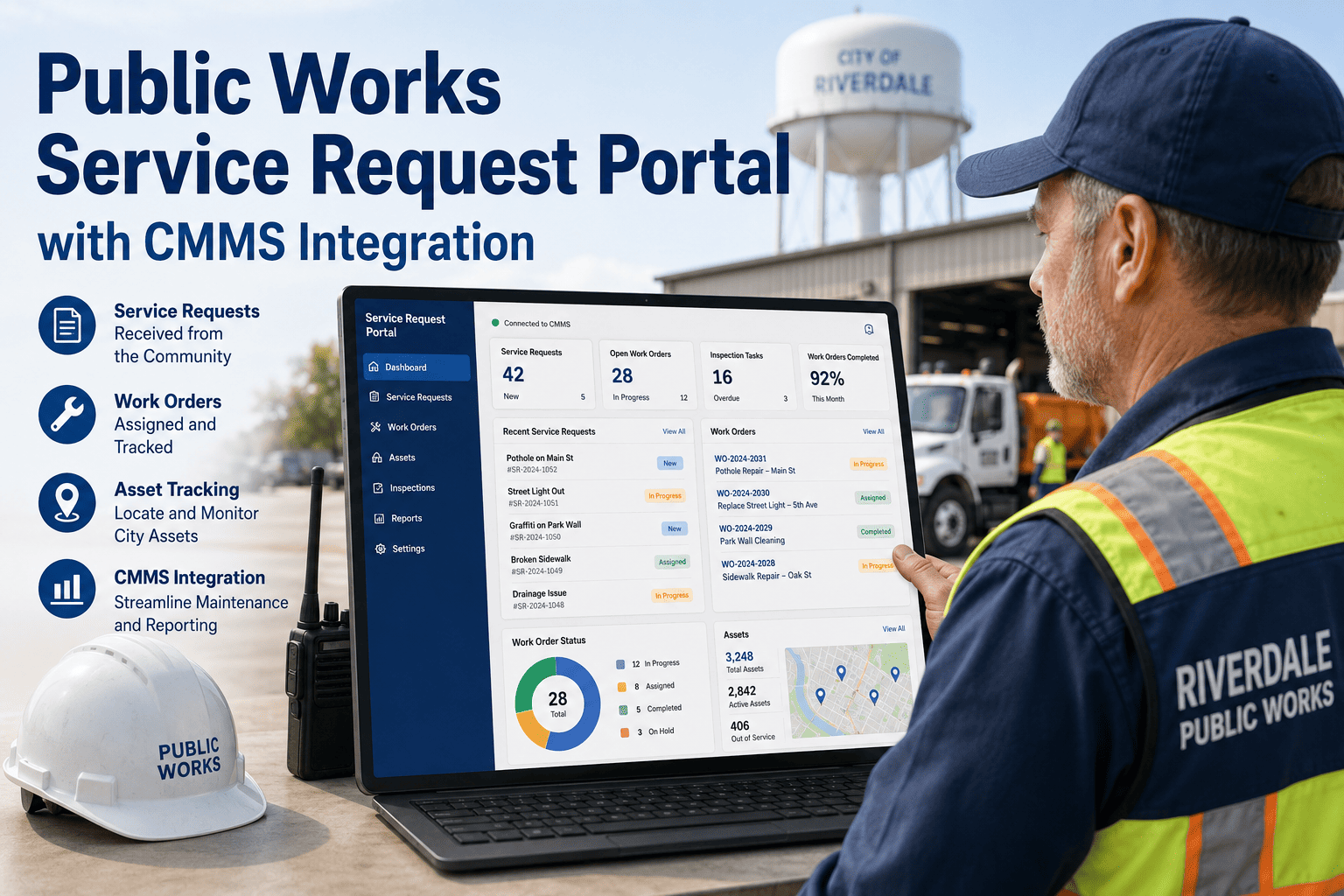
Oxmaint generates council-ready dashboards showing: total requests received and resolved by period, average resolution time by request category (potholes, streetlights, facility repairs, water, sewer, parks), SLA compliance rates by department and ward, cost per work order including labour and materials, geographic heat maps showing request volume by neighbourhood, and year-over-year trend analysis. These dashboards export as PDF reports formatted for council meeting presentations and are available in real time for directors to review before budget hearings or constituent inquiries. The data transforms public works from a department that says "we're working on it" into one that shows exactly what was accomplished, where, and at what cost. Schedule a demo to see council reporting in action.
How does automatic prioritisation work for citizen service requests?
The CMMS assigns priority scores based on configurable criteria including: safety impact (a downed traffic signal scores higher than a faded crosswalk), citizen volume (multiple reports for the same issue increase priority), location sensitivity (requests near schools, hospitals, or senior centres receive automatic boosts), asset criticality (water main issues prioritise above cosmetic concerns), and regulatory compliance deadlines (ADA-related repairs receive accelerated scheduling). Priority scoring replaces the subjective "squeaky wheel" system where the loudest complainant gets service first. Instead, the CMMS ensures that the most consequential issues receive attention first — regardless of which council member forwarded the request.
What is the ROI timeline for municipal work order management implementation?
Most municipalities see measurable ROI within the first 90 days of deployment. Primary savings include: reduced liability exposure from documented request handling (cities have avoided six-figure claims by proving a reported hazard was addressed within SLA), increased crew productivity of 30–40% through mobile dispatch and route optimisation, elimination of duplicate work orders (40% of requests in untracked systems are duplicates that waste crew time), and reduced emergency repair costs through faster response to deteriorating conditions. The political ROI is equally significant — council members who can show constituents a dashboard of completed work orders by ward gain measurable public trust advantages. Most cities report break-even on CMMS implementation within 6–9 months when both operational savings and avoided liability costs are included. Start your free trial to begin measuring ROI from day one.