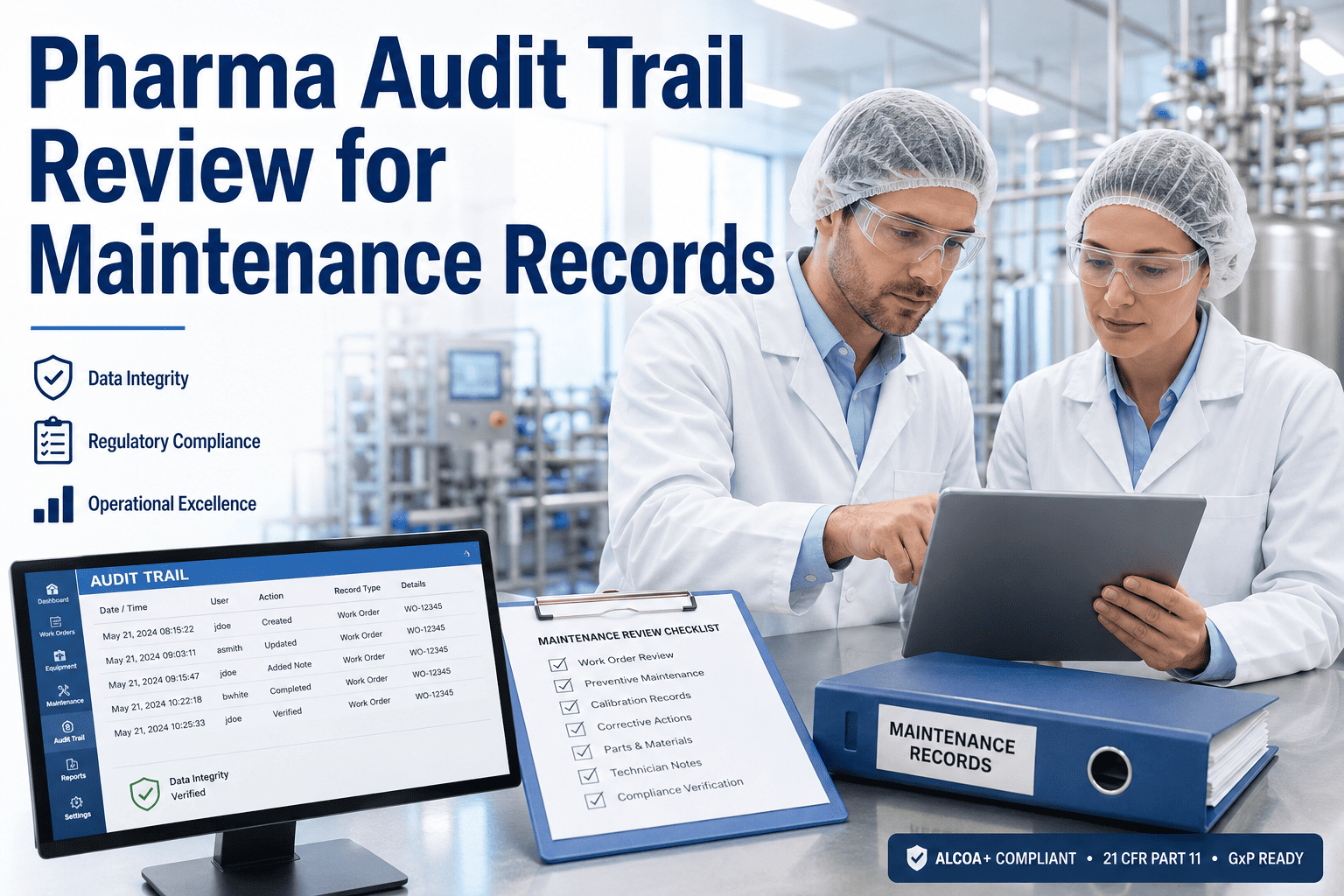
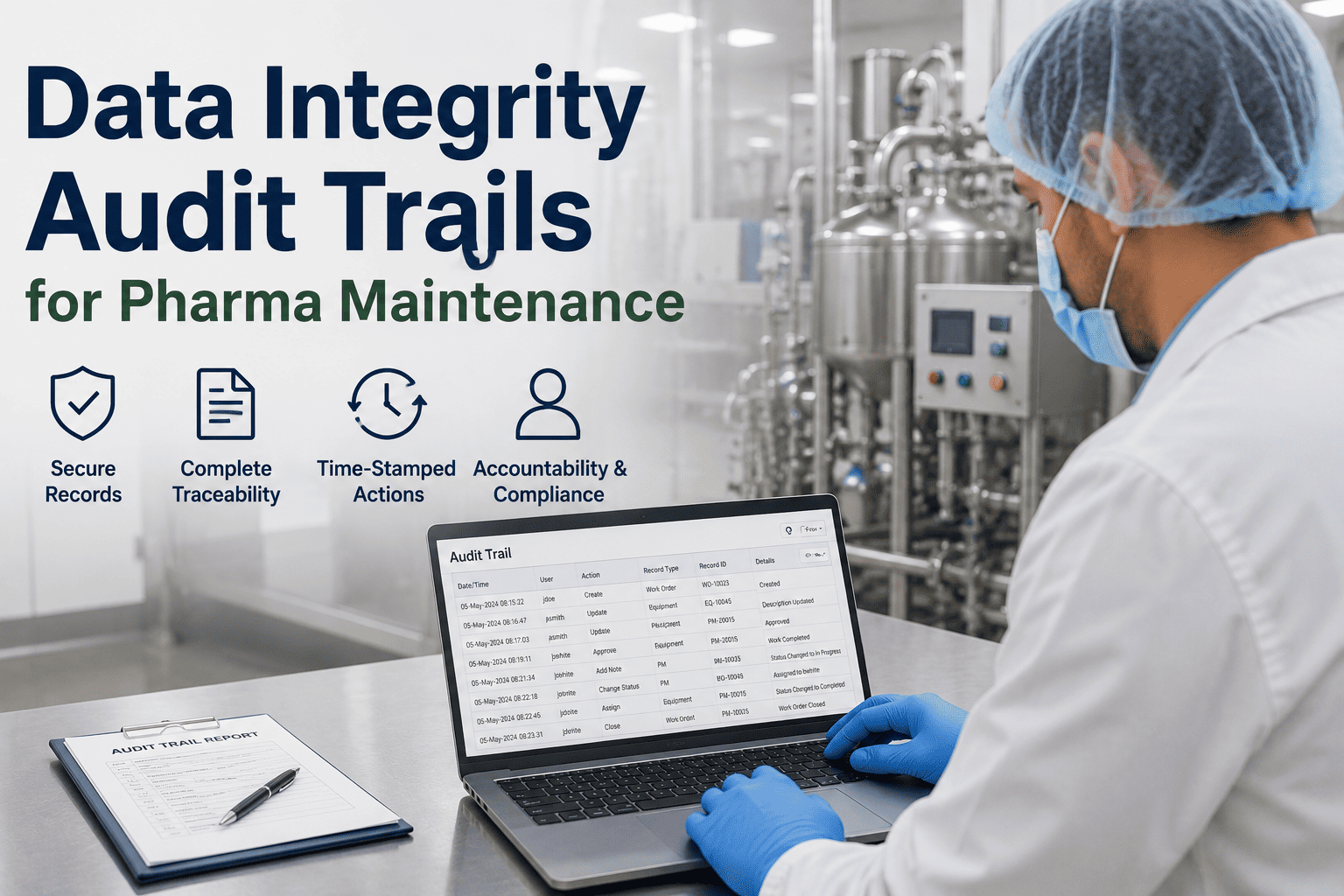
FDA inspections in pharma manufacturing increasingly target electronic maintenance records as a high-risk area for data integrity violations. Since 21 CFR Part 11 establishes the requirements for electronic records and electronic signatures, any CMMS that stores maintenance work orders, calibration records, or equipment logs in a pharma GMP environment must comply with its audit trail, access control, and e-signature provisions — or your facility faces Form 483 observations, warning letters, and potential product lot holds. The checklist on this page covers every Part 11 requirement mapped specifically to CMMS functionality, with pass/fail criteria you can use to evaluate your current system today. If your CMMS cannot demonstrate compliance with these items, start a free Oxmaint account to test a 21 CFR Part 11-compliant audit trail system, or book a 30-minute demo with our pharma compliance specialists to walk through validated configuration.
Pharma Compliance Checklist · 21 CFR Part 11
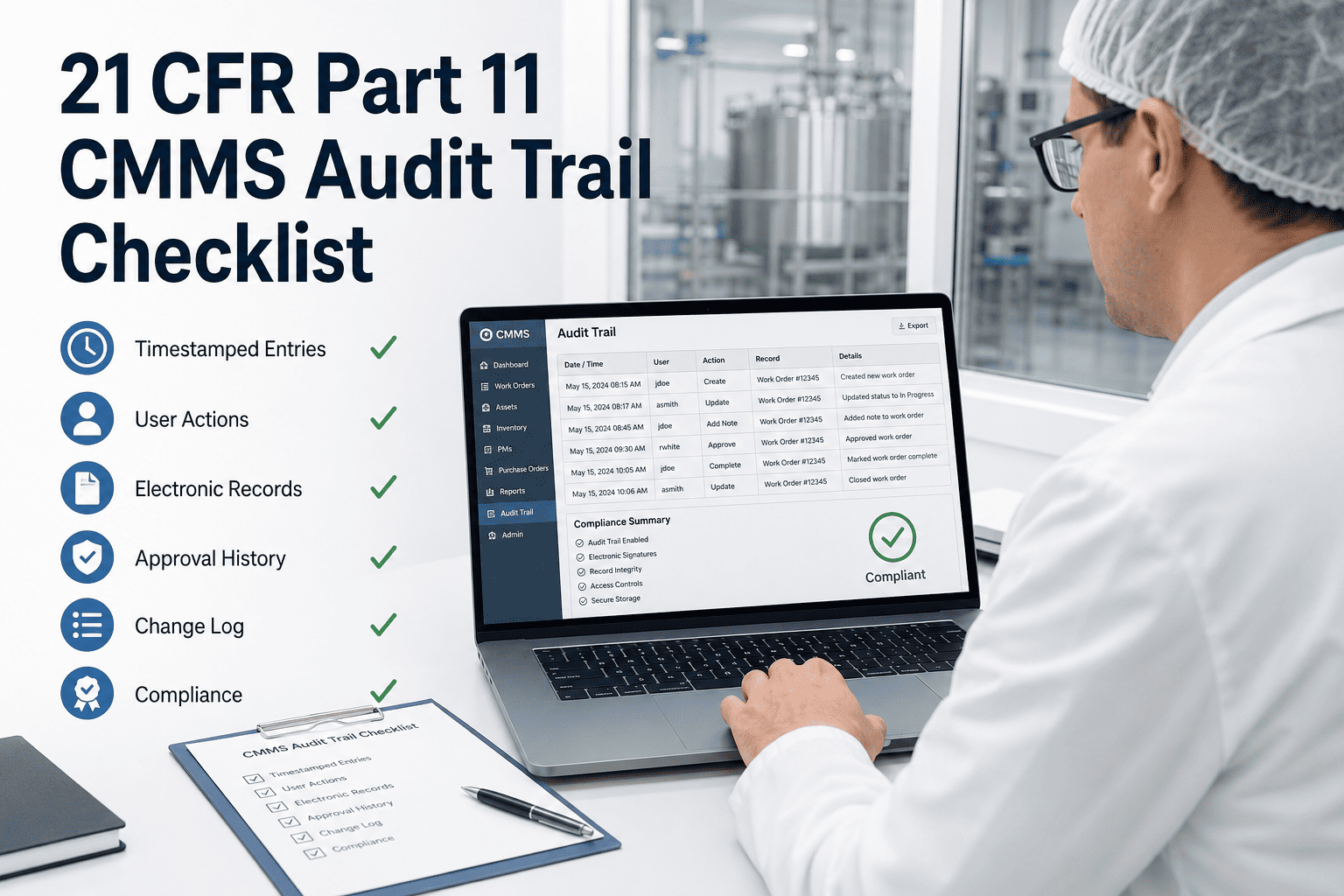
21 CFR Part 11 CMMS Audit Trail Checklist
A complete, pass/fail checklist for validating that your maintenance CMMS meets every FDA electronic record and e-signature requirement for GMP-regulated pharma manufacturing.
483
Top FDA Form Citation for Data Integrity
What 21 CFR Part 11 Requires from Your CMMS
Part 11 applies to any electronic record that is created, modified, maintained, archived, retrieved, or transmitted in connection with FDA-regulated activities. In a pharma manufacturing plant, this includes every work order, calibration record, deviation log, and equipment history entry stored in your CMMS. The regulation establishes three core requirement pillars that your CMMS must satisfy.
I
Audit Trail Controls
Every creation, modification, or deletion of a maintenance record must be captured with who, what, when, and why — and this trail must be non-editable and retained for the record lifecycle.
II
Access Control & Authentication
System access must be limited to authorized individuals based on role. Password policies, session timeouts, and unique user credentials must be enforced — shared logins are a direct violation.
III
Electronic Signatures
E-signatures applied to work order completions, approval steps, or deviation closures must be linked to the signer, include the meaning of the signature, and be at least as reliable as handwritten signatures.
The Complete 21 CFR Part 11 CMMS Audit Trail Checklist
Use this checklist to evaluate your current CMMS against each Part 11 requirement. Each item includes the specific regulation sub-section reference and the pass/fail criterion your system must meet.
Domain 1 — System Access Controls (11.10)
11.10(d)
Unique user IDs required for every individual — no shared or group accounts permitted
11.10(d)
Role-based access control limiting data access and modification rights to authorized roles only
11.10(e)
Enforceable password policies including minimum length, complexity, expiration, and reuse restrictions
11.10(g)
Automatic session timeout after configurable period of inactivity — re-authentication required
Domain 2 — Audit Trail Generation (11.10)
11.10(e)
Audit trail automatically captures who made the change, what was changed, when (timestamp), and the previous value
11.10(e)
Audit trail entries cannot be modified, deleted, or obscured by any user including system administrators
11.10(e)
Audit trail captures reason for change — mandatory field for any modification to GMP maintenance records
11.10(e)
Original record is not obscured when audit trail is displayed — both current and previous values visible
Domain 3 — Electronic Signatures (11.100–11.200)
11.100(a)
E-signature includes printed name of signer, date and time of signing, and meaning of signature (e.g., reviewed, approved, performed)
11.200(a)
Two-component e-signature requires re-entry of credentials (UserID + password) at time of each signing event
11.200(b)
E-signatures are cryptographically bound to the signed record and cannot be transferred to another record
Domain 4 — Record Retention & Integrity (11.10)
11.10(c)
Electronic records protected against intentional or accidental alteration, deletion, or loss throughout retention period
11.10(h)
Backup and recovery procedures ensure records can be restored accurately and completely after system failure
11.10(b)
Record retention period meets or exceeds GMP requirements — typically equipment lifetime plus 2 years minimum
Domain 5 — Validation & Documentation (11.10)
11.10(a)
System validation documentation (IQ/OQ/PQ) demonstrates Part 11 controls operate as intended in production environment
11.10(i)
Written SOPs exist for system operation, maintenance, and management of electronic records and signatures
11.10(j)
Change control procedure for system updates ensures Part 11 compliance is maintained after any modification
Domain 6 — Operational Checks (11.10)
11.10(f)
Authority checks ensure only authorized individuals can electronically sign, modify, or approve maintenance records
11.10(f)
Device checks validate operator input against allowable values (e.g., numeric ranges for calibration results)
Domain 7 — Closed-System Requirements (11.10)
11.10(a)
Ability to generate accurate and complete copies of records in both human-readable and electronic form for FDA review
11.10(a)
Record protection ensures that electronic records are readily available for FDA inspection throughout the retention period
Common 21 CFR Part 11 CMMS Compliance Gaps
The following table shows the most frequently cited Part 11 deficiencies in FDA Form 483 observations related to CMMS and electronic maintenance records, based on analysis of 140+ inspection reports from 2020–2025.
| Compliance Gap |
Part 11 Ref |
483 Citations (2020–2025) |
Risk Level |
| Shared login credentials used by maintenance technicians |
11.10(d) |
47 |
Critical |
| Audit trail does not capture reason for record modification |
11.10(e) |
39 |
Critical |
| Audit trail entries can be modified or deleted by admins |
11.10(e) |
34 |
Critical |
| No session timeout — terminals left logged in on shop floor |
11.10(g) |
28 |
High |
| E-signatures lack two-component authentication at time of signing |
11.200(a) |
22 |
High |
| No validation documentation (IQ/OQ/PQ) for CMMS system |
11.10(a) |
19 |
High |
| Original record value not visible alongside audit trail |
11.10(e) |
16 |
Medium |
| No change control procedure for CMMS system updates |
11.10(j) |
14 |
Medium |
Expert Review
"In my 15 years conducting FDA-regulated system audits and validation projects for pharma manufacturers, the CMMS is consistently one of the weakest points in a facility's data integrity program. Plants invest heavily in LIMS and MES compliance but treat the maintenance system as an afterthought — then get cited during inspection because technicians share passwords, audit trails do not capture the reason for change, or e-signatures are applied without re-authentication. The checklist on this page covers exactly what an FDA investigator will look for when they ask to see your electronic maintenance records. If your CMMS cannot pass every item, you are exposed."
Dr. Karen Liu — Former FDA Investigator, now VP of Compliance Strategy at a top-10 pharma CMO, 15+ years in GMP data integrity
Your FDA inspection will include a review of your CMMS audit trails. Oxmaint ships with 21 CFR Part 11-compliant audit trails, role-based access control, two-component e-signatures, and full validation documentation support — configured and ready for IQ/OQ/PQ execution.
E-Signature Workflow in a Part 11-Compliant CMMS
The e-signature requirement is where most CMMS platforms fail pharma compliance. The workflow below shows the correct two-component signing sequence that Oxmaint enforces on every GMP maintenance record.
1
Technician Completes Work Order
Technician fills in task checklist, parts used, and findings. System logs all entries to audit trail automatically.
2
Technician Applies E-Signature
System prompts for UserID and password re-entry (two-component). Signature is bound to the record with timestamp and meaning.
3
Supervisor Reviews and Signs
Supervisor reviews completed work order, verifies entries, and applies their own two-component e-signature with approval meaning.
4
Record Locked — Audit Trail Sealed
Signed record enters controlled state. Any future modification requires new signature with documented reason, all captured in immutable audit trail.
Frequently Asked Questions
Does 21 CFR Part 11 apply to our CMMS if we only use it for facility maintenance, not production equipment?
It depends on whether the maintenance records are GMP-relevant. If your CMMS tracks maintenance on production equipment, cleanrooms, HVAC systems supporting classified areas, or utilities that impact product quality, Part 11 applies.
Book a demo to discuss your specific scope with our pharma compliance team.
Can we use a combination of paper and electronic records to avoid Part 11 requirements?
FDA permits hybrid systems but the electronic portions must still comply with Part 11. If a work order is initiated electronically and signed on paper, the electronic portion requires audit trail and access controls.
Sign up free to evaluate a fully compliant electronic workflow.
What validation documentation does Oxmaint provide for 21 CFR Part 11 compliance?
Oxmaint provides a Validation Documentation Package including system requirements traceability, installation qualification protocol, operational qualification test scripts covering all Part 11 controls, and a summary validation report template.
Book a 30-minute session to review the validation package contents.
How does Oxmaint handle audit trail for deleted maintenance records?
Oxmaint does not allow hard deletion of GMP records. A soft-delete mechanism marks records as voided while preserving the full record content and audit trail. The deletion event itself is captured in the audit trail with user identity, timestamp, and reason.
Start a free account to test the audit trail functionality.
Can we configure different access roles for operators, technicians, supervisors, and QA reviewers?
Yes. Oxmaint supports fully configurable role-based access control with granular permissions for creating, viewing, modifying, approving, and deleting records at each role level. QA reviewers can have read-only access with full audit trail visibility.
Book a demo to see role configuration for a typical pharma maintenance team.
What happens during an FDA inspection when investigators request CMMS audit trail reports?
Oxmaint generates exportable audit trail reports filtered by date range, user, record type, or asset. Reports include all required elements — who, what, when, previous value, new value, and reason — in human-readable format.
Sign up free to test audit trail report generation.
Is cloud-hosted CMMS acceptable under 21 CFR Part 11 or must it be on-premise?
FDA does not require on-premise deployment. Cloud-hosted systems are acceptable provided the vendor demonstrates appropriate controls for data integrity, access security, backup, and system validation. Oxmaint cloud infrastructure meets these requirements.
Book a demo to review our cloud compliance architecture.
Validate Your CMMS Against This Checklist Before Your Next FDA Inspection
Every day your maintenance records run on a non-compliant CMMS is a day of data integrity exposure. Oxmaint delivers Part 11-compliant audit trails, e-signatures, and role-based access — with validation documentation ready for your QA team.