A pharmaceutical maintenance record missing a complete audit trail, signed by an unauthenticated user, and stored without data integrity controls — costs a US pharma manufacturer an average FDA 483 observation escalating to Warning Letter exposure of $2.4M plus regulatory hold on product shipments. In 2023, 67 percent of FDA inspections at pharmaceutical manufacturing facilities cited incomplete electronic record documentation under 21 CFR Part 11. The CMMS existed. The signatures were captured. The audit trails were generated. The failure was in the compliance gap — between what happened in maintenance and what met FDA validation standards. That gap is exactly what Oxmaint closes. Book a demo to see how Oxmaint digitizes pharma maintenance permits, 21 CFR Part 11 electronic records, and audit trail compliance across your full operation.
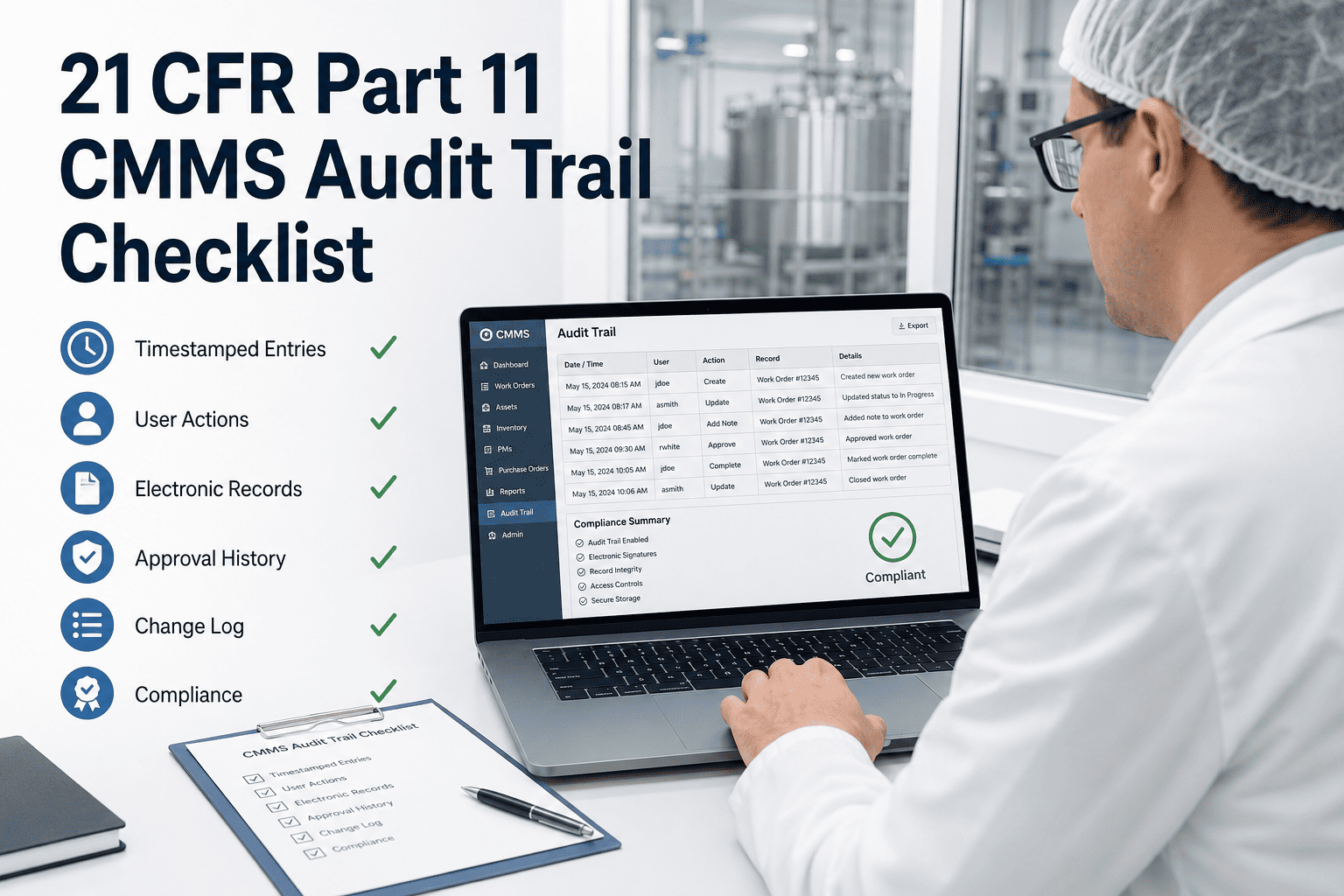
21 CFR Part 11 compliance requires documented control of four critical electronic record systems: electronic signature capture with user authentication and role-based access, complete audit trails recording all record changes with timestamp and user identity, data integrity and immutability controls preventing unauthorized modification, and system validation documentation demonstrating 21 CFR 11.10 controls are in place. Oxmaint manages every maintenance record, approval, signature, and system change automatically — generating FDA-ready audit trails and validation evidence without manual documentation.
The Four Systems Where Pharma CMMS Carries the Highest Regulatory Risk
Each system has its own 21 CFR Part 11 requirement, its own validation obligation, and its own failure mode when CMMS is not designed for FDA compliance. Book a demo to see how Oxmaint structures all four into a unified 21 CFR Part 11-compliant CMMS.
Every maintenance approval, environmental monitoring sign-off, and equipment clearance must capture an authenticated electronic signature uniquely identifying the authorized person. Unsigned records or records without documented user identity create FDA 483 observations. Oxmaint enforces multi-factor authentication, role-based access control, and signature capture linked to unique user credentials on every approval step — preventing unsigned or anonymously signed records from entering the system.
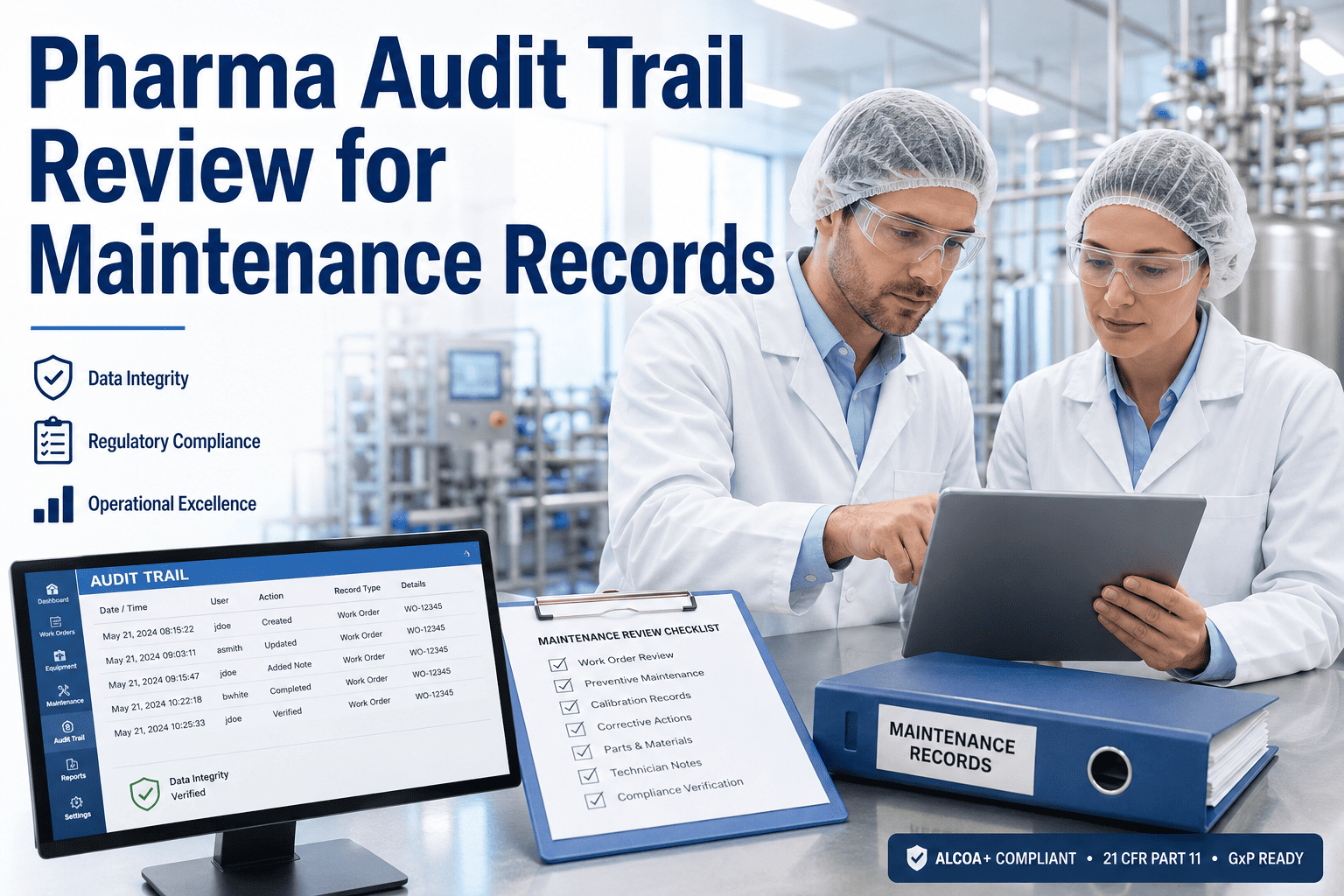
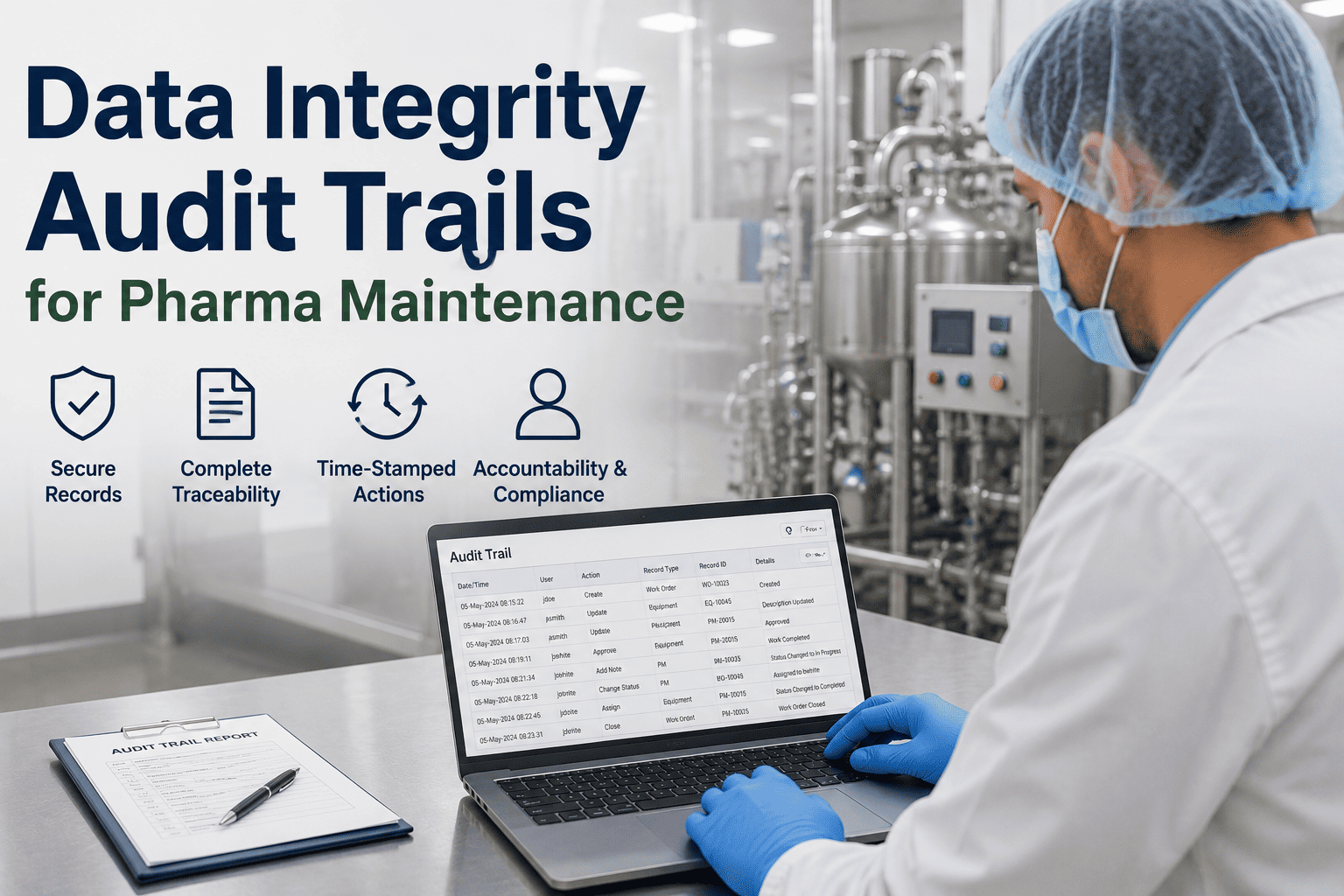
Every change to a maintenance record — field edit, status update, or approval — must generate an immutable audit trail entry capturing who made the change, when it was made, what was changed, and the original value. Paper-based or untracked digital systems create gaps that FDA inspectors identify immediately. Oxmaint generates complete audit trail records for every action, stored separately from the maintenance record itself, with no deletion or modification possible once recorded.
Electronic maintenance records must be protected from unauthorized or undetected modification. Oxmaint implements change control workflows requiring approval before modification, prevents back-dating of records, protects historical versions against alteration, and validates system integrity through checksums and access controls — ensuring FDA can verify that stored records have not been tampered with since creation.
The CMMS itself must be validated to demonstrate that 21 CFR Part 11 controls are in place and effective. Validation documentation includes IQ/OQ/PQ protocols, system security design specifications, disaster recovery procedures, and periodic revalidation. Oxmaint provides pre-built 21 CFR Part 11 validation documentation packages — reducing qualification time from months to weeks while meeting FDA expectations for system validation evidence.
Every Signature. Every Audit Trail. Every Change. Captured and Validated for FDA — Not Reconstructed After.
Oxmaint generates 21 CFR Part 11-compliant maintenance records on mobile — capturing authenticated signatures, complete audit trails, and data integrity controls at the point of work. System validation documentation is pre-configured, not manual. Book a demo to see the 21 CFR Part 11 workflow for your pharma operation.
Oxmaint 21 CFR Part 11 Implementation — Deployment Roadmap
A structured deployment moves your pharma operation from non-compliant CMMS to fully validated 21 CFR Part 11-certified system — without disrupting production scheduling or equipment maintenance cycles.
Current CMMS evaluated against 21 CFR 11.10 requirements — electronic signature controls, audit trail completeness, data integrity mechanisms, access controls, and system validation documentation reviewed. Gap assessment identifies compliance deficiencies and validation protocol requirements for Oxmaint deployment. Validation strategy document prepared outlining IQ/OQ/PQ scope per FDA and GAMP guidance.
Oxmaint configured with user roles, approval workflows, signature capture, and audit trail controls aligned to pharma maintenance processes. Pre-built 21 CFR 11.10(a) validation documentation activated — including system design specifications, security architecture, disaster recovery, and backup procedures. Oxmaint IQ/OQ/PQ protocols configured for your site and user count. Book a demo to see 21 CFR Part 11 system configuration for pharmaceutical maintenance workflows.
IQ protocol executed validating Oxmaint system hardware and software components are correctly installed. OQ protocol validates that 21 CFR 11 controls operate as designed — signature capture, audit trail generation, access control enforcement, data integrity protection all tested and documented. PQ validates maintenance workflow processes execute correctly in validated system. Test cases mapped to 21 CFR 11.10 requirements with documented pass/fail results.
Oxmaint approved for production use with validation summary report and maintenance/support plan filed in quality management system. Ongoing annual revalidation schedule established. FDA inspection readiness maintained with audit trail reports, signature logs, and system change documentation accessible in under 2 hours. System monitoring dashboard tracks audit trail volume, signature compliance rate, and access control events for continuous compliance verification.
Pharma Compliance KPI Benchmarks — 21 CFR Part 11 CMMS
Client Results — Pharma Manufacturers Using Oxmaint 21 CFR Part 11 Compliance
These outcomes are drawn from pharmaceutical manufacturing deployments where Oxmaint's 21 CFR Part 11-compliant system replaced non-validated CMMS within the first year of operation.
From 61% to 100% Audit Trail Compliance — in 12 Weeks
Pharma manufacturers that move from non-validated CMMS to Oxmaint's 21 CFR Part 11-certified system close the compliance gap before the FDA inspection — not after. Book a demo to see your 21 CFR Part 11 compliance gap identified in the first system assessment.
Oxmaint 21 CFR Part 11 Platform Features
Every maintenance approval captured with multi-factor authentication, role-based access control, and unique user identity uniquely linked to signature — eliminating unsigned or anonymously signed records from CMMS.
Every record change — field edit, status update, approval — generates immutable audit trail entry with timestamp, user identity, change description, and original value. Audit trails stored separately and protected from modification.
Change control workflows require approval before modification, prevent back-dating, protect historical versions, and enforce access controls — ensuring FDA can verify records have not been tampered with since creation.
Pre-built IQ/OQ/PQ protocols, system design specifications, security architecture, and compliance evidence — reducing validation timeline from months to weeks while meeting FDA 21 CFR 11.10(a) requirements.
User access restrictions by role and function — preventing unauthorized access, modification, or deletion of maintenance records while maintaining audit trail of all access events.
Automated backup procedures, offsite data redundancy, and disaster recovery documentation meeting FDA expectations for system resilience and business continuity.
Frequently Asked Questions
Close the 21 CFR Part 11 Compliance Gap Before the FDA Inspection
Authenticated electronic signatures, complete audit trails, data integrity controls, and system validation documentation — all live in Oxmaint within 12 to 16 weeks, no IT project required. Book a demo with your quality assurance director and see the full 21 CFR Part 11 workflow configured for your pharma operation.