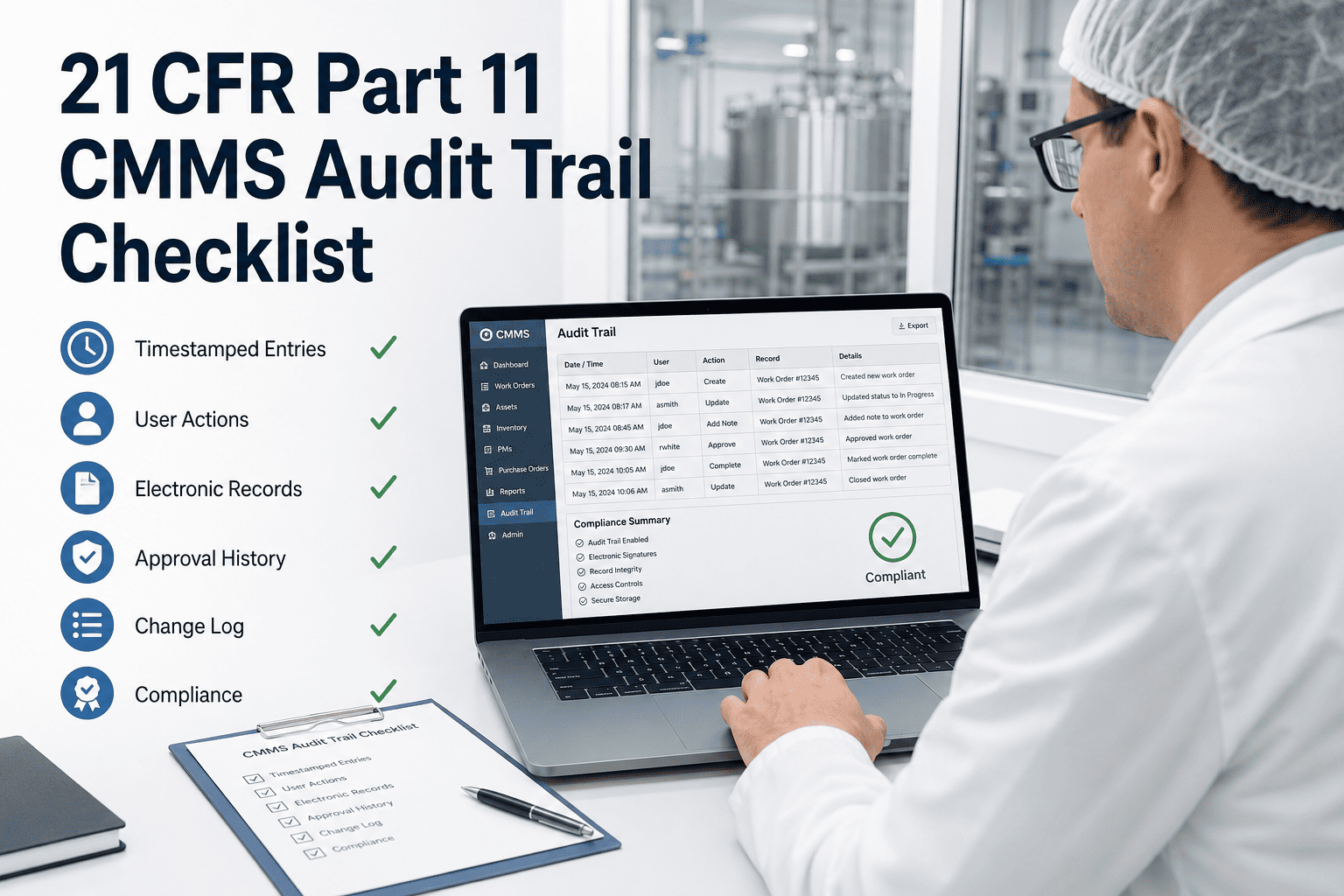
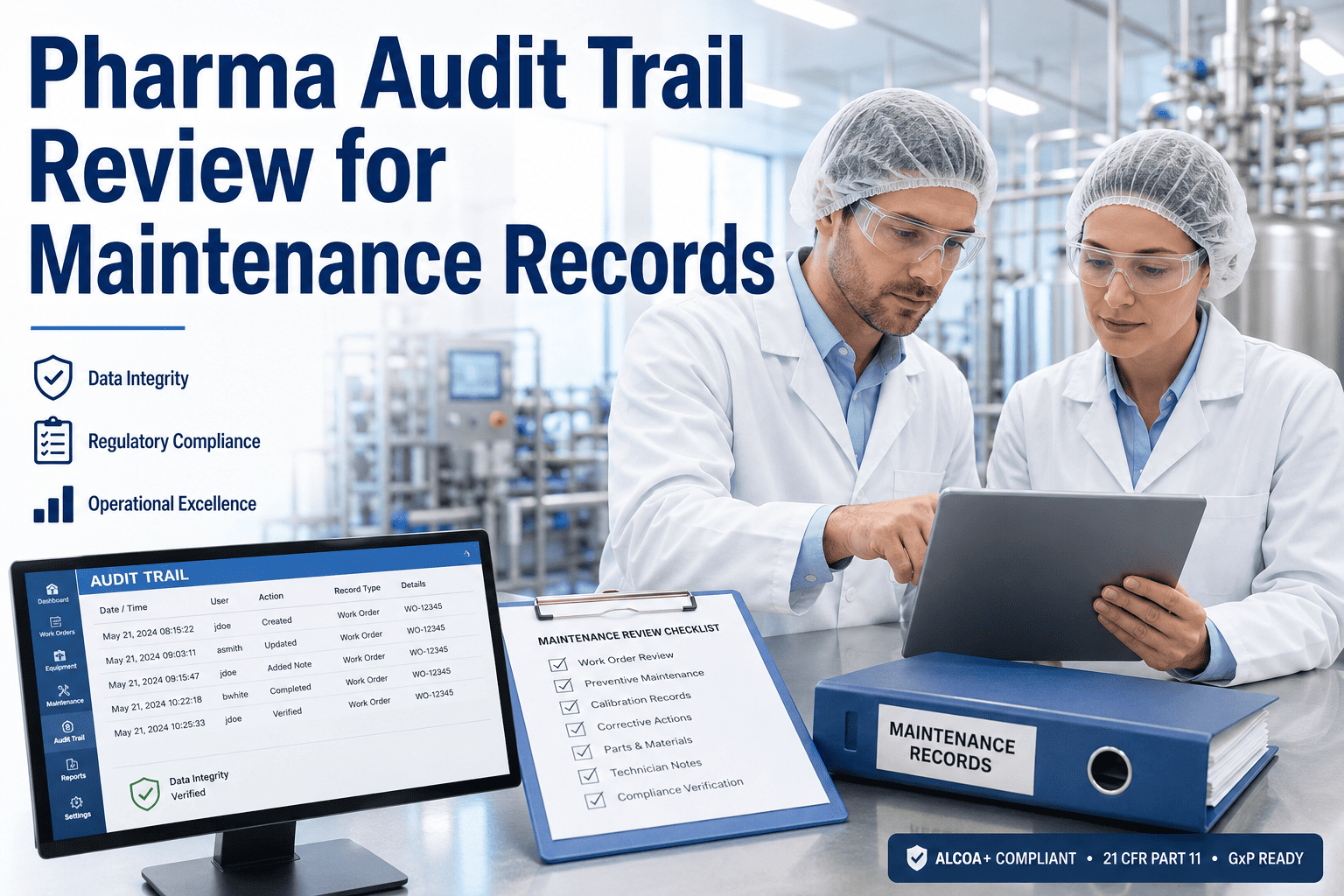
A pharmaceutical maintenance audit trail is not a log of what happened — it is the legal record that proves what happened, who did it, and whether it was altered afterward. Under 21 CFR Part 11, Section 11.10(e), electronic maintenance systems must generate secure, computer-generated, time-stamped audit trails that capture the creation, modification, and deletion of every regulated record. In FY 2023, FDA investigators conducted 18,539 inspections and approximately 31% ended with Voluntary or Official Action Indicated findings — the majority driven by documentation gaps that a properly configured audit trail would have prevented. The 2025 draft revision of EU GMP Annex 11 goes further still, requiring audit trails to be always on and locked, with multi-factor authentication. In this environment, a maintenance CMMS without a compliant audit trail is not a convenience gap — it is a regulatory liability. Book a demo to see OxMaint's audit trail system, or start free today.
Article · Data Integrity · Audit Trails · Part 11
Data Integrity Audit Trails for Pharma Maintenance
Every field change. Every approval. Every attachment. Every e-signature. Tracked, timestamped, and tamper-evident — because an audit trail that can be altered is no audit trail at all.
2025-03-14 · 07:42:11
R. Santos (Maintenance Tech)
Work order created — Scheduled PM due 2025-03-14
2025-03-14 · 09:18:34
R. Santos (Maintenance Tech)
Field updated: Bearing condition → "Abnormal vibration noted at north bearing. Bearing replacement required." Reason: Condition found during inspection
2025-03-14 · 09:21:05
R. Santos (Maintenance Tech)
Attachment added: vibration_reading_CG07_20250314.pdf — Vibration analysis report
2025-03-14 · 11:55:22
R. Santos (Maintenance Tech)
E-signature applied — Meaning: Work completed as documented. Certificate: RSA-2048, Hash: a7f3...
2025-03-14 · 14:30:09
K. Patel (QA Manager)
QA review e-signature — Approved. Deviation investigation triggered: DEV-2025-0218 linked to this WO.
2025-03-14 · 14:31:00
System (OxMaint)
Work order closed. Record locked. Audit trail sealed. All subsequent access logged as view-only.
What a Compliant Pharma Maintenance Audit Trail Must Capture
21 CFR Part 11.10(e) defines the minimum audit trail requirement for electronic records in pharmaceutical systems. The six event categories below are the minimum that every maintenance CMMS must capture — and that FDA investigators will request during an inspection.
01
Record Creation
Who created the record, at what exact time, and from what user account. Creation timestamp must be server-generated — not user-entered or system-clock-dependent on the client device.
21 CFR 11.10(e) — Secure computer-generated time stamps
02
Field Modification
Every change to any regulated field must record: the original value, the new value, the user who changed it, the timestamp, and the reason for the change. Original values must remain visible — they cannot be overwritten.
FDA DI Guidance 2018 — Original data preserved; changes documented
03
Attachment Upload
When documents are attached to a maintenance record — calibration certificates, inspection reports, photographs — the upload event must be logged with file name, uploader identity, timestamp, and a hash value to detect subsequent file substitution.
21 CFR 11.10(a) — Accurate and ready retrieval throughout record retention period
04
E-Signature Application
Each e-signature event must record the signer identity, the meaning of the signature (e.g. "Work completed as described"), the timestamp, and a cryptographic link to the record at the moment of signing. Signatures applied to a version of the record that subsequently changed are invalid.
21 CFR 11.50 — E-signatures linked to records; 11.70 — Non-falsifiable link
05
Approval and Review
Every QA review, supervisor approval, or deviation acknowledgement must generate a separate audit trail entry — distinct from the technician's completion signature. The two-step approval chain proves the record was reviewed by an independent qualified person, not just self-certified by the executor.
21 CFR 211.68 — Qualified person review; ICH Q10 QA oversight
06
Record Access (View-Only)
Even read-only access to a closed GMP record should be logged — who accessed it, when, and from where. This satisfies the Available principle of ALCOA+ and provides the complete picture of who has seen a record during its retention period, which is relevant in litigation and enforcement contexts.
EU GMP Annex 11 (2025 draft) — All access events logged
Audit Trail Violations Most Cited in FDA Inspections
The table below documents the audit trail failure patterns most frequently observed in FDA warning letters and 483 observations from 2021 to 2025. Each violation has a specific root cause and a specific CMMS control that prevents it.
| Violation Pattern |
Root Cause |
Regulatory Citation |
CMMS Control That Prevents It |
| Audit trail disabled or incomplete for specific period |
Audit trail turned off during system maintenance or upgrade; not re-enabled |
21 CFR 11.10(e); EU Annex 11 §9 |
Audit trail cannot be disabled by any user role. 2025 draft Annex 11: "always on and locked." |
| Shared login — multiple users accessing one account |
Technicians share a generic "MAINT" login to avoid personal password management |
21 CFR 11.10(d) — Access limited to authorised individuals |
Individual user accounts mandatory. Shared credentials technically prevented by session management. Each audit trail entry tied to unique user ID. |
| Original value overwritten — no trace of prior entry |
System allows editing of a field without creating a versioned change record |
21 CFR 11.10(e) — Original record preserved |
Field edits create a new audit trail entry with both old and new values. Original entry is immutable and permanently visible in the audit trail. |
| Audit trail not reviewed — present but ignored |
No SOP requires periodic audit trail review; QA team treats it as a technical system, not a quality tool |
FDA DI Guidance 2018 — Meaningful review of audit trails expected |
Scheduled audit trail review task generated monthly as PM work order. Review completion documented with QA e-signature. |
| System time incorrect — timestamps unreliable |
Server clock not synchronised to NTP time source; timestamps reflect local or manual time settings |
21 CFR 11.10(e) — Computer-generated time stamp required |
OxMaint uses server-side NTP-synchronised timestamps. Client device time is irrelevant — the server records the authoritative timestamp at the moment of event. |
| E-signature applied to wrong record version |
Record was edited after e-signature was applied without triggering a re-signing requirement |
21 CFR 11.70 — E-signature must be non-falsifiable link to record |
Any edit to a signed record invalidates the existing signature and requires re-signing by all prior signatories before the record can be closed. |
AUDIT TRAIL · DATA INTEGRITY · OXMAINT
OxMaint's Audit Trail Is Always On, Always Locked, and Always Complete
Server-generated timestamps. Individual e-signatures with cryptographic links. Immutable original values. Scheduled audit trail review as a documented PM task. Every regulatory requirement — satisfied by design.
Expert Review
"The shift in FDA's enforcement posture on audit trails between 2018 and 2025 is not subtle. The 2018 guidance said audit trails must be present and must be reviewed. What the 2024 and 2025 inspection cycle is demonstrating is that 'reviewed' now means reviewed with frequency, documented with a named reviewer signature, and acted upon when anomalies are found. A CMMS that generates an audit trail that no one reviews is not compliant — it is just a more sophisticated way of having incomplete records. The facilities that consistently pass data integrity inspections have made audit trail review a scheduled, named, signed activity — not a background technical capability. The 2025 draft Annex 11 revision, with its requirement that audit trails be 'always on and locked,' simply codifies what inspectors have been applying for three years already. Any maintenance system that allows an administrator to disable the audit trail has a configuration that does not meet the current de facto standard, regardless of what the written regulation still technically permits."
Dr. Jennifer Wu, PhD
Environmental Compliance Director · Former EPA Region 5 Air Quality Specialist · 18 years pharmaceutical GMP data integrity and electronic records compliance · EU GMP Annex 11 revision contributor
Frequently Asked Questions
What is required in a 21 CFR Part 11 compliant audit trail for maintenance records?
Under 21 CFR Part 11.10(e), a compliant audit trail must be
secure (tamper-evident, cannot be altered),
computer-generated (not user-entered),
time-stamped (from an authoritative source — not client-device time), and must capture the date and time of operator entries and actions that create, modify, or delete electronic records. For maintenance records, this means every field change, every attachment upload, every e-signature application, and every approval event must generate a separate audit trail entry that captures who, what, when, and — for modifications — what the original value was.
Book a demo to see OxMaint's Part 11 audit trail in a live maintenance environment.
How often should pharma maintenance audit trails be reviewed?
FDA's 2018 data integrity guidance states that audit trail review is expected to be meaningful and periodic — not merely technically available. Industry best practice and current inspection expectations set monthly review as the minimum for active maintenance systems, with the review documented by a named QA reviewer with an e-signature. The review should focus on anomalies: records modified after e-signature, entries made outside working hours, pattern changes that suggest retrospective documentation, and access events from unexpected user accounts. The review itself must be documented — an undocumented review does not exist in an FDA inspection context.
Can a spreadsheet-based maintenance system satisfy audit trail requirements?
Microsoft Excel and similar spreadsheet applications cannot satisfy 21 CFR Part 11 audit trail requirements for GMP maintenance records unless implemented with additional validated software controls. Standard Excel does not maintain a secure, computer-generated audit trail of cell changes, does not prevent modification of historical entries, does not provide individual user attribution beyond last-save, and does not generate server-timestamped records. FDA inspectors routinely flag Excel-based maintenance records as inadequate for data integrity compliance — particularly for records that require a complete modification history.
What does the 2025 EU GMP Annex 11 revision change for maintenance audit trails?
The 2025 draft Annex 11 revision introduces three significant changes that directly affect maintenance CMMS systems: audit trails must be
always on and locked (no administrator can disable them);
mandatory multi-factor authentication for access to GMP electronic records; and expanded
lifecycle traceability requirements. These changes largely codify inspection practices already applied since 2022 — but they provide a formal regulatory basis for observations that were previously cited under more general data integrity expectations.
Start free to see how OxMaint meets the 2025 Annex 11 requirements.
DATA INTEGRITY · PART 11 · OXMAINT
Your Maintenance Audit Trail Must Be Always On, Always Complete, and Always Reviewable. OxMaint Makes It All Three.
Server-timestamped. Individually attributed. Original values preserved. E-signatures cryptographically linked. Audit trail review scheduled and documented. OxMaint satisfies every Part 11 and ALCOA+ audit trail requirement — before the investigator asks.