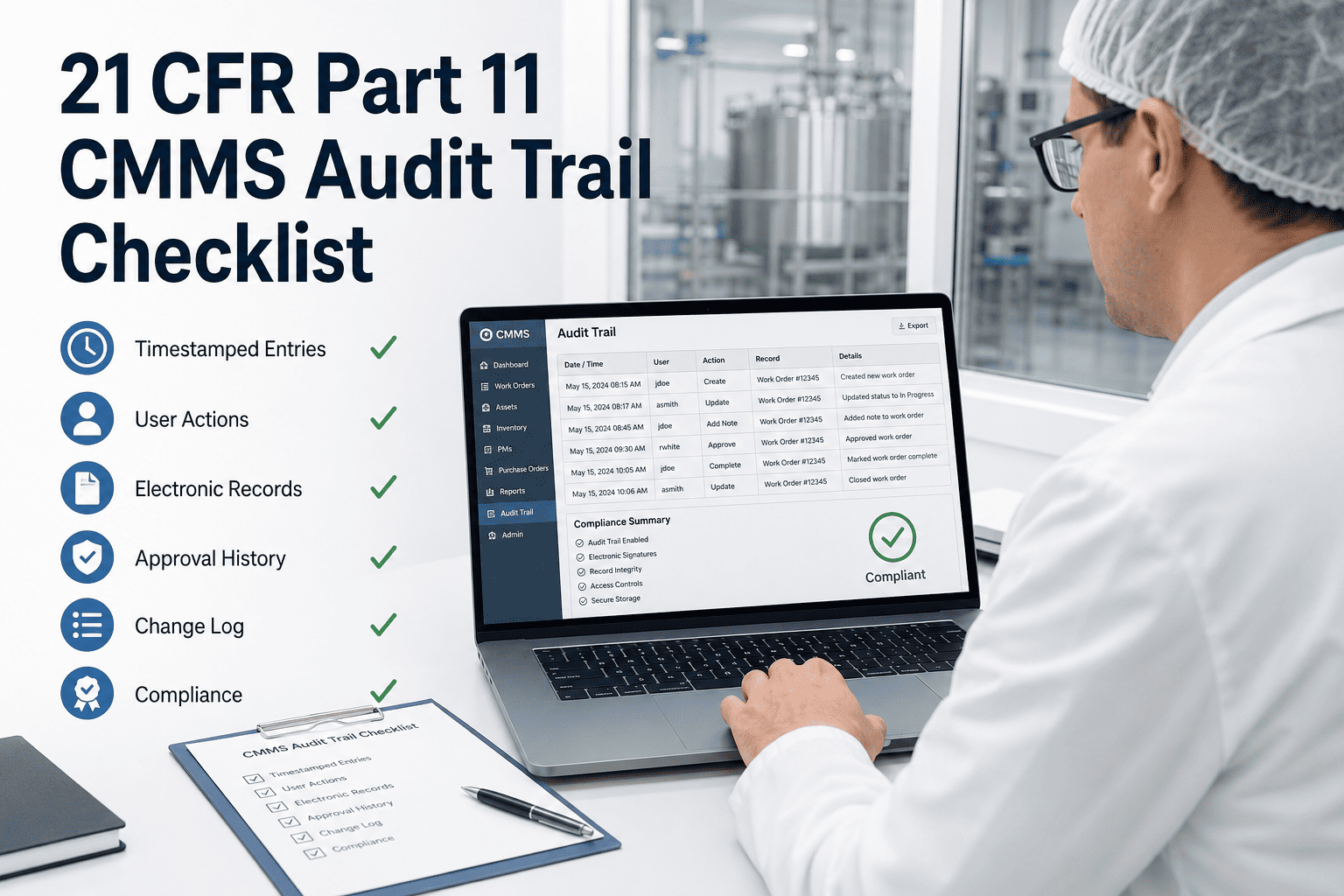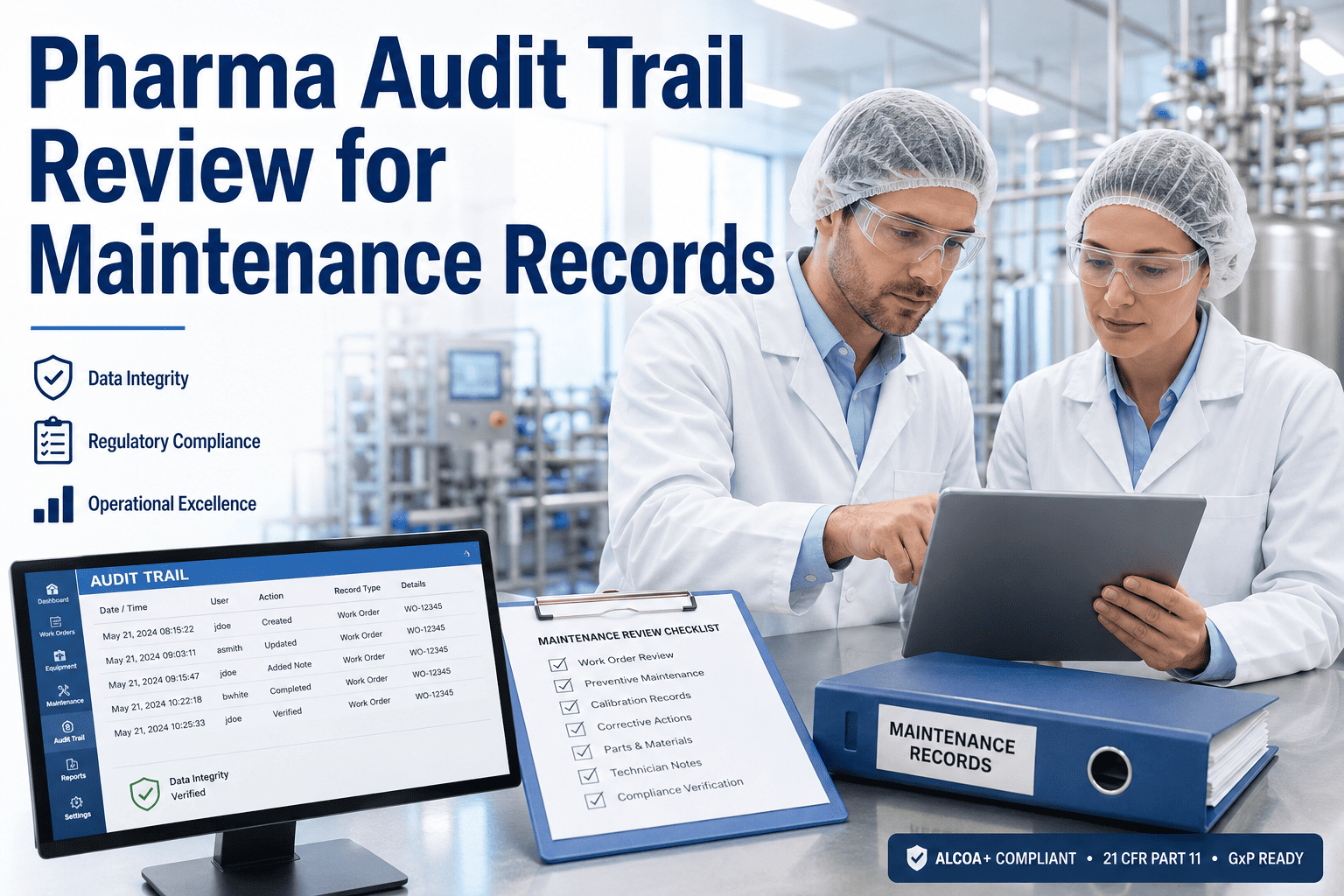
Every GMP maintenance record carries a hidden layer — a timestamped, user-attributed log of every action taken on that record from creation to closure. This is the audit trail, and it is what FDA investigators look at first when they pull your maintenance documentation. Without a structured audit trail review process, pharma quality teams spend hours reconstructing who changed what, when, and why — often under active inspection pressure. OxMaint builds compliant, 21 CFR Part 11-aligned audit trails into every maintenance record automatically, with one-click QA review reports ready for inspection day.
ARTICLE
Pharma Audit Trail Review for Maintenance Records
A practical guide to reviewing maintenance audit trails — what QA needs to check, what FDA looks for, and how to build a defensible review process.
3,600
Monthly searches for pharma audit trail guidance
60%
FDA 483s cite audit trail deficiencies
21 CFR
Part 11 — the federal standard for e-records audit trails
WHAT THE REGULATION REQUIRES
21 CFR Part 11.10(e)
Audit trails must capture the date and time of operator entries and actions that create, modify, or delete electronic records. The audit trail must be computer-generated and protected from modification.
21 CFR 211.68
Input and output to computerized systems must be checked for accuracy. The original record must be available and any alteration must not obscure the original entry, including date, time, and identity of the person making the change.
EU GMP Annex 11
Audit trails should be reviewed as part of periodic system review activities and checked for completeness and accuracy. Any anomalies must be investigated and documented with justification.
THE FIVE AUDIT TRAIL ELEMENTS QA MUST REVIEW
1
User Identity Attribution
Every record creation, edit, and closure must show the authenticated user ID. Shared login credentials invalidate attribution and are a critical Part 11 gap.
2
Timestamp Integrity
Timestamps must be system-generated, synchronized to a controlled clock, and impossible to manually alter. Back-dated entries are a data integrity violation.
3
Change History with Reason
Any modification to a closed or approved record must capture the original value, the new value, and a documented reason for change — not just the final state.
4
Deletion Controls
Records must never be permanently deleted. Voided or cancelled records must remain visible with a deletion reason, user ID, and timestamp in the audit trail.
5
Exception Reports
QA must be able to generate filtered exception reports showing incomplete records, unauthorized access attempts, unusual editing patterns, and records modified after approval.
AUDIT TRAIL REVIEW — WHAT TO CHECK AND HOW OFTEN
| Review Area | Frequency | Key Checks | OxMaint Feature |
|---|---|---|---|
| Work Order Completions | Monthly | Technician e-signature, closure timestamp, no post-approval edits | Completion audit log export |
| PM Schedule Changes | Quarterly | Authorized user change, reason documented, approval chain intact | Change history with reason field |
| Equipment Master Data Edits | Quarterly | Who edited, what changed, before/after values, QA approval if required | Asset record change log |
| Deviation-Linked Records | Per deviation | Maintenance records unaltered after deviation was opened | Deviation linkage audit report |
| User Access and Permissions | Semi-annually | No orphaned accounts, role-appropriate access, no shared credentials | User access review report |
Generate Your QA Audit Trail Review Report in One Click
OxMaint produces exception reports, change histories, and user activity logs formatted for QA review and FDA inspection — without manual data extraction.
COMMON AUDIT TRAIL FAILURES — AND HOW THEY HAPPEN
CRITICAL
Shared login credentials used by maintenance technicians
When multiple users share a single login, individual attribution is lost. This renders the entire audit trail non-compliant under Part 11.10(i) and is cited in approximately 28% of data integrity findings.
HIGH
Audit trail disabled or not configured for maintenance records
Some CMMS platforms require manual activation of audit trail functionality. If the feature is not enabled during validation, years of maintenance records may have no change history — a complete Part 11 gap.
HIGH
Records modified after QA approval without a controlled change
Post-approval edits that are not captured in the audit trail or processed through a change control workflow are considered data integrity violations and suggest record manipulation to investigators.
MEDIUM
QA review not conducted periodically — only reviewed at inspection time
Regulators expect evidence of routine, documented audit trail review. Performing the review only when an inspection is announced does not meet the intent of continuous quality oversight and will be challenged.
EXPERT REVIEW
Vivek Sharma
Validation and Data Integrity Lead — 15 Years Pharmaceutical QA and CMMS Implementation
The audit trail review is not a formality — it is a primary control for data integrity. What I find consistently across sites is that audit trails are enabled, but no one reviews them on a schedule. By the time an inspector pulls the exception report and finds 40 post-approval edits with no documented reason, there is no good answer. The review process needs to be periodic, documented, and attached to a QA procedure with defined acceptance criteria. OxMaint makes this practical by generating purpose-built exception reports that a QA reviewer can actually action in under an hour — rather than exporting raw database logs that require IT support to interpret. That is what regulatory-ready looks like in practice.
FREQUENTLY ASKED QUESTIONS
How long must maintenance audit trail records be retained in a GMP environment?
Under 21 CFR Part 211.180, records must be retained for at least one year after the expiry date of the batch or three years after distribution, whichever is longer. For electronic audit trails specifically, the retention period applies to the audit trail data itself — not just the primary record. OxMaint stores audit trail data with the same retention policy as the associated maintenance record, and the data remains accessible for the full retention period without requiring database administration access. Records are export-ready in multiple formats for archival purposes. Sign up free to review OxMaint's retention configuration options.
Does OxMaint's audit trail meet 21 CFR Part 11 requirements without additional validation work?
OxMaint's audit trail is designed to meet Part 11.10(e) requirements out of the box, capturing user ID, system-generated timestamps, original and new values for all changes, and reason-for-change fields where applicable. However, per FDA guidance, validation is a site responsibility — OxMaint provides the IQ/OQ/PQ documentation templates, risk assessments, and test scripts that your validation team uses to complete the formal validation. Our team can walk you through the full validation package during a demo session. The validation effort is significantly reduced because OxMaint is a SaaS platform with a fixed, documented configuration rather than a custom-built system.
What should a QA exception report for maintenance audit trails include?
A compliant QA exception report should identify records modified after approval, changes made without a documented reason, activity outside business hours that lacks justification, failed login attempts and account lockouts, and any records where the audit trail data is incomplete or missing. OxMaint generates all of these as filterable exception reports with export to PDF or CSV for QA sign-off. The reports are designed to match the format expected by FDA investigators and European QP reviewers, reducing preparation time before inspections to near zero. Each report includes a QA reviewer signature field for documented review completion.