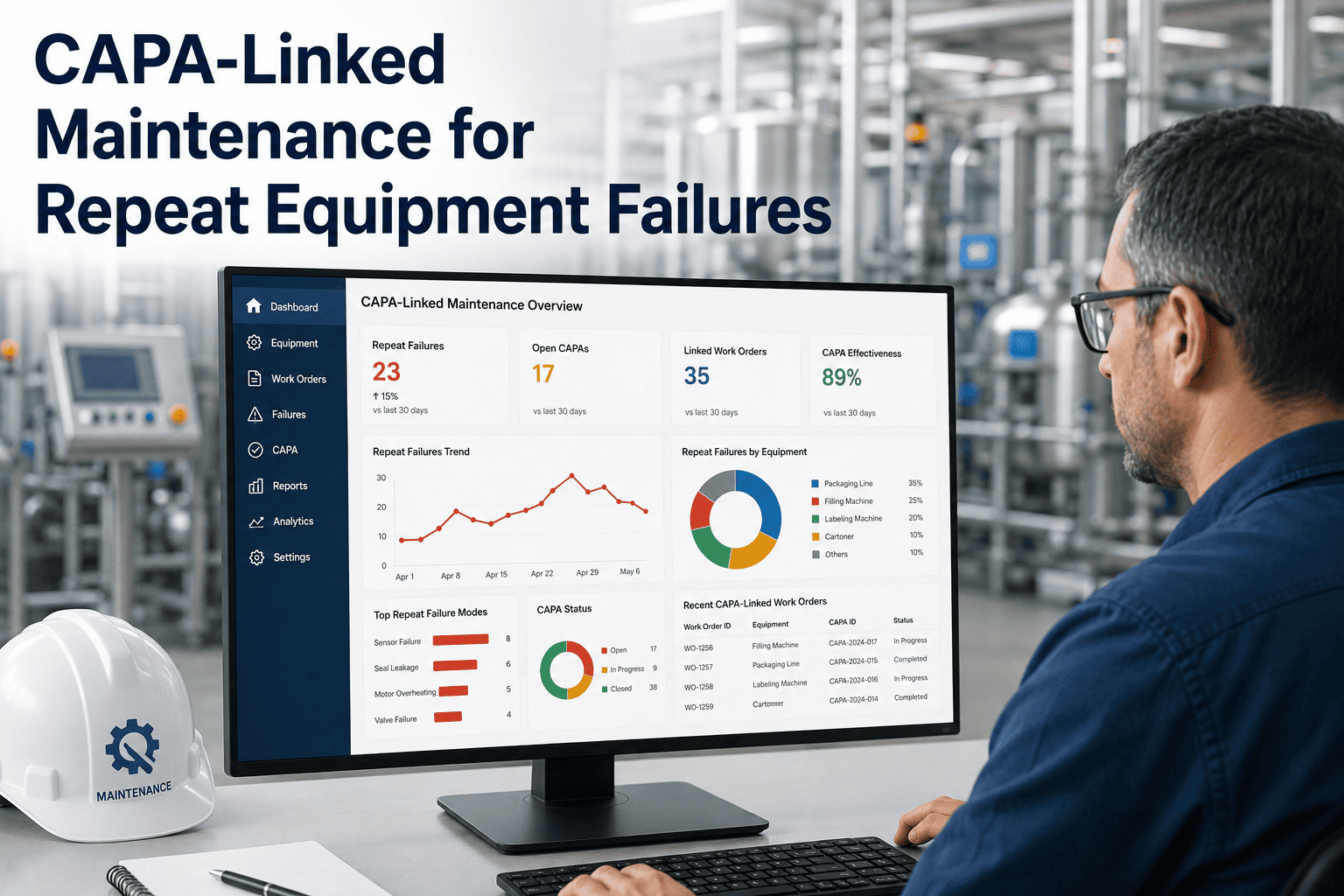
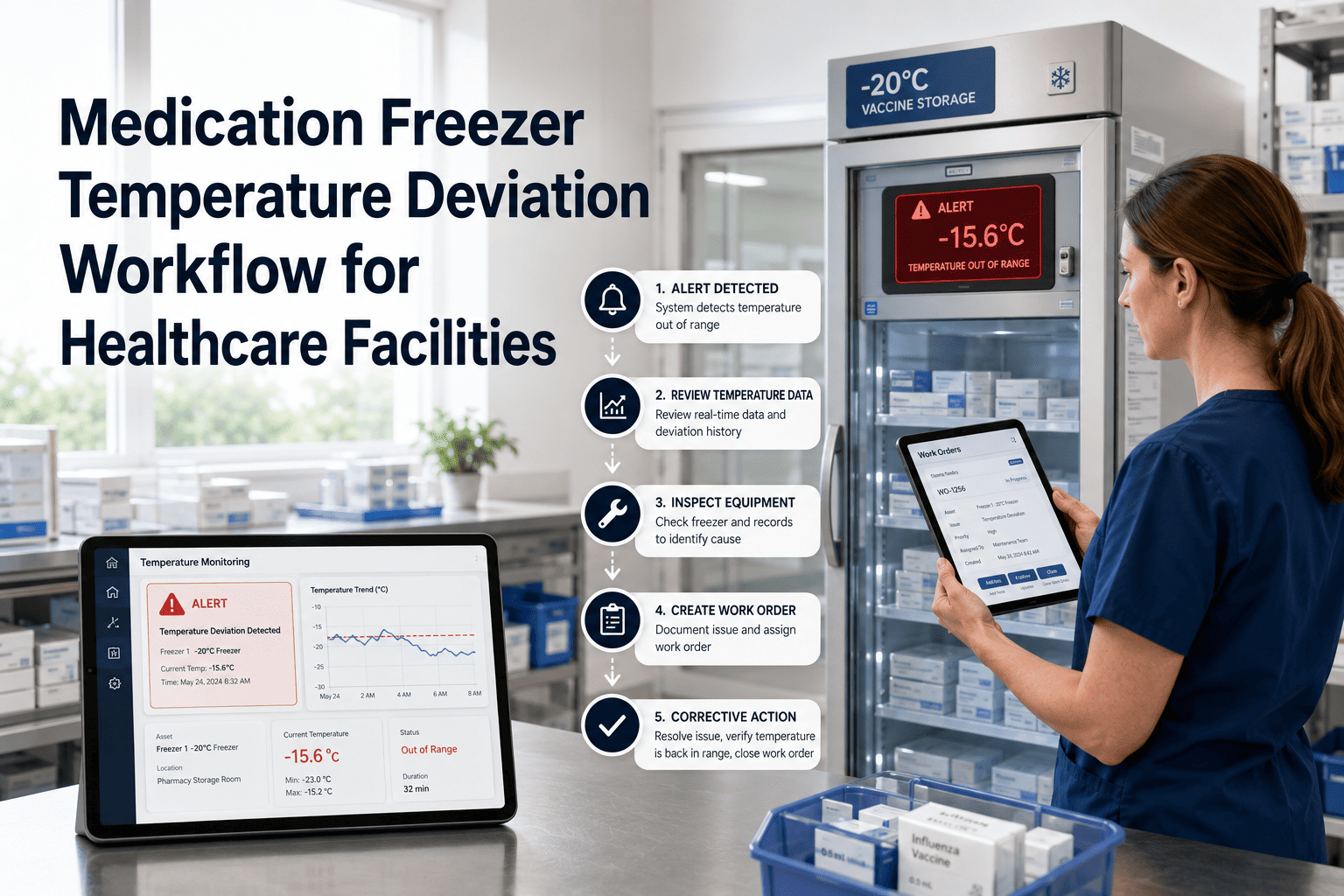
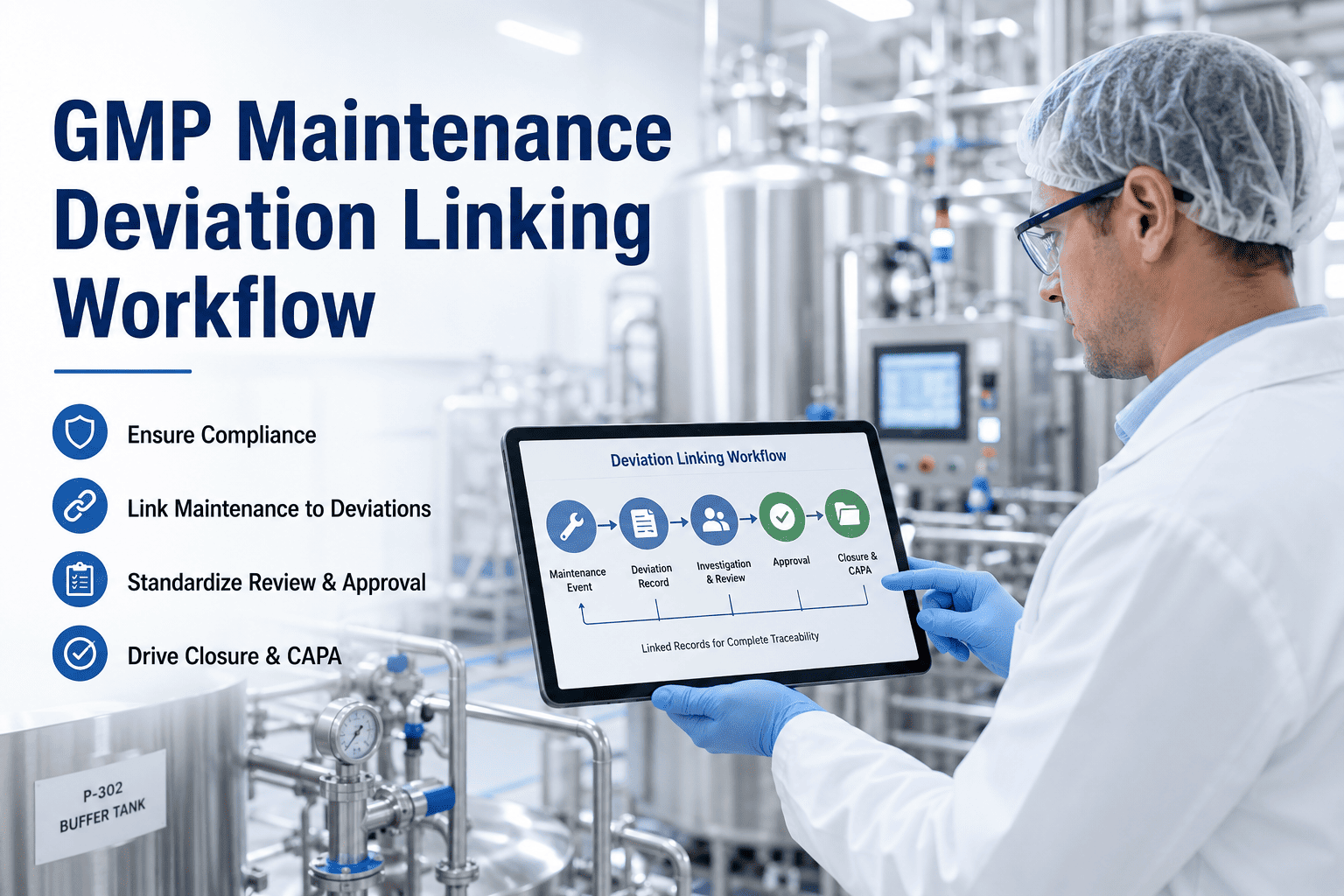
In pharmaceutical manufacturing, an equipment failure does not end at the repair log — it opens a deviation, triggers an investigation, demands root cause analysis, and links to a CAPA that QA must close before the next audit. Most facilities handle these steps across disconnected systems: maintenance records in one place, deviation logs in another, CAPA tracking in a spreadsheet. When FDA or EMA investigators arrive, the gap between what happened on the floor and what the quality record shows is where warning letters originate. The FDA's review of GMP enforcement consistently identifies incomplete investigations and unresolved CAPA linkages as primary citation drivers. A CMMS that connects equipment events directly to deviation workflows, investigation records, and CAPA evidence eliminates that gap — so QA closes events faster, inspections go smoother, and the same fault does not recur on the same asset. OxMaint builds deviation-linked maintenance workflows into the core of how pharma facilities manage equipment, so every work order that matters generates the quality record your QA team needs. Start your free trial or book a demo to see the full deviation-to-CAPA workflow configured for your site.
Deviation-Linked Maintenance Workflows for Pharmaceutical Manufacturing
When equipment issues happen, QA needs evidence — not a paper trail that ends at the work order. OxMaint connects maintenance events to deviations, investigations, CAPA, and closure proof so your quality team closes events faster and stays inspection-ready.
The Disconnect That Drives Inspection Findings
Most pharmaceutical maintenance teams close work orders. Most QA teams log deviations. But when an investigator asks to trace an equipment fault through its investigation to corrective action evidence, two separate systems produce two incomplete records — and the gap between them is precisely what regulators cite. The problem is structural: maintenance and quality operate on different platforms, with no enforced link between an equipment event and the deviation it triggered.
5 Reasons QA Teams Cannot Close Deviation Events on Time
Slow deviation closure is almost never a people problem. It is a system design problem. When the tools that hold maintenance evidence and quality records are separate, every closure step requires manual effort — and every manual step creates an opportunity for delay, omission, or inconsistency.
When a maintenance technician closes a fault work order, nothing automatically notifies QA that a quality-relevant event occurred. QA learns about it from the tech, or from the next batch record review — by which time the investigation window has narrowed.
Five-Why and Ishikawa analysis conducted verbally or in email is not retrievable evidence. Inspectors expect structured investigation documentation attached to the specific equipment asset and deviation record — not a summary written after the fact.
Without assigned owners, due dates, and escalation rules in a system, CAPAs remain open indefinitely. The most common FDA observation in CAPA citations is not poor analysis — it is the absence of documented ownership and effectiveness verification before closure.
Connecting an equipment fault to the batches produced during the affected window requires a manual search across maintenance logs and production records. Every hour that search takes is an hour QA cannot spend on investigation or closure.
Even when a CAPA action is completed, verifying that it actually prevented recurrence requires monitoring the same equipment over subsequent cycles. Without a system that enforces this step, verification is assumed rather than documented — and that assumption is what inspectors find.
Is Every Equipment Fault in Your Facility Linked to Its Deviation Record?
OxMaint creates an automatic, auditable connection from work order to deviation to investigation to CAPA evidence — so your QA team never reconstructs a quality event from memory at inspection time.
How OxMaint Links Maintenance Events to Quality Records
OxMaint does not replace your QMS — it creates the maintenance-side evidence that your QMS needs to function. Every fault that reaches deviation threshold generates a structured quality record within the same platform, eliminating the handoff gap that drives inspection findings.
Deviation Category Matrix — What Triggers Each Level
Not every equipment fault is a deviation. Not every deviation is critical. A structured classification matrix — configured per equipment class and event type in OxMaint — ensures that the right level of quality response is triggered consistently, without relying on individual judgment at the work order level.
| Event Type | Minor Deviation | Major Deviation | Critical Deviation | OxMaint Response |
|---|---|---|---|---|
| Unplanned equipment downtime | Under 2 hours, non-critical equipment | 2–8 hours, production impact | Over 8 hours, batch at risk | Auto-routes to correct investigation template |
| PM overdue | 1–7 days overdue | 8–21 days overdue | Over 21 days, validated equipment | Escalation notification to QA and manager |
| Calibration out-of-tolerance | Within expanded acceptance | Outside specification, product impact assessed | Multiple batches potentially affected | Batch window flag and linked deviation |
| Cleaning validation failure | Procedural gap, no product contact | Product contact surface, single batch | Cross-contamination risk | Immediate QA notification and hold flag |
| Unplanned repair during production | No product exposure | Product line paused for repair | Product integrity compromised | CAPA auto-generated with batch linkage |
What QA Teams Get at Every Stage of the Quality Event
From the moment a technician classifies a deviation-level fault to the moment QA verifies closure, every action generates structured evidence in OxMaint — so investigators never have to ask maintenance to reconstruct what happened.
- Equipment asset ID and location
- Fault description in technician's own words
- Time of detection and work order creation timestamp
- Production batch window during fault period
- Structured root cause analysis (5-Why or Ishikawa)
- Historical maintenance records for same asset
- Prior deviation history on the equipment
- Parts used and technician sign-off with timestamp
- Named CAPA owner and assigned due date
- Corrective action description with completion evidence
- Escalation log if overdue threshold was crossed
- Preventive action plan for recurrence control
- Effectiveness verification record with follow-up dates
- QA sign-off with electronic signature and timestamp
- Complete audit trail from fault to verified closure
- Linked batch record numbers for traceability
Inspection Readiness: What an FDA Investigator Asks — and What OxMaint Provides
FDA inspectors follow a structured investigation pattern during GMP audits. They start with a recent deviation, trace it through investigation, check CAPA completeness, and test whether corrective actions prevented recurrence. Each question below maps to the evidence OxMaint produces automatically.
Frequently Asked Questions
Every Equipment Fault That Matters Should Generate a Quality Record Automatically
OxMaint connects maintenance work orders to deviation records, structured investigation, CAPA ownership, and effectiveness verification — so QA closes events faster, inspectors find complete evidence chains, and the same fault does not recur on the same asset. Deploy in 4 to 6 weeks with no IT project required.