GMP utilities are the infrastructure behind every batch — and they are the most audit-scrutinized assets in a pharmaceutical facility. Purified water systems, WFI loops, compressed air, clean steam, nitrogen, HVAC, and electrical systems each carry independent qualification requirements, continuous monitoring obligations, and a documentation trail that regulators will check before they look at anything else. An FDA 483 for a failed utility qualifies every batch produced during the excursion. Start a free OxMaint trial or book a 30-minute demo to see how pharma utility maintenance runs on one connected, audit-ready platform.
Landing Page · GMP Utilities · CMMS for Pharma
Pharma Utility Maintenance Management
The complete CMMS platform for managing purified water, WFI, compressed air, clean steam, nitrogen, HVAC, and power — with GMP PM schedules, continuous monitoring links, and audit-ready records across every utility system.
6,600
Monthly searches for pharma utility maintenance guidance
#1
Utility failure — top trigger for site-wide FDA holds
7
GMP utility systems requiring independent PM programs
100%
Of utility records must be audit-ready at all times under 21 CFR Part 11
System Coverage
7 GMP Utility Systems — One Maintenance Platform
Each utility system has a different failure profile, qualification status, and documentation requirement. A CMMS that treats them all the same creates record gaps that become 483 findings.
PW
Purified Water
TOC, conductivity, and microbial monitoring must link to maintenance records. Any system intervention during a monitoring excursion requires a concurrent deviation record.
PM Anchor: Weekly sanitization cycle, monthly membrane inspection, quarterly loop flush validation
WFI
Water for Injection
WFI still or multi-effect distillation requires temperature maintenance above 80°C continuously. Feed water quality, still output, and distribution loop temperature are all maintenance-monitored parameters.
PM Anchor: Daily temperature log, monthly still scale inspection, semi-annual vent filter change
CA
Compressed Air
Product-contact compressed air requires oil-free compressors, particulate filtration to ISO Class 1 or 2, and dew point monitoring. Point-of-use filter change intervals are a frequent 483 target.
PM Anchor: Monthly POU filter change, quarterly oil-free compressor check, annual dryer validation
CS
Clean Steam
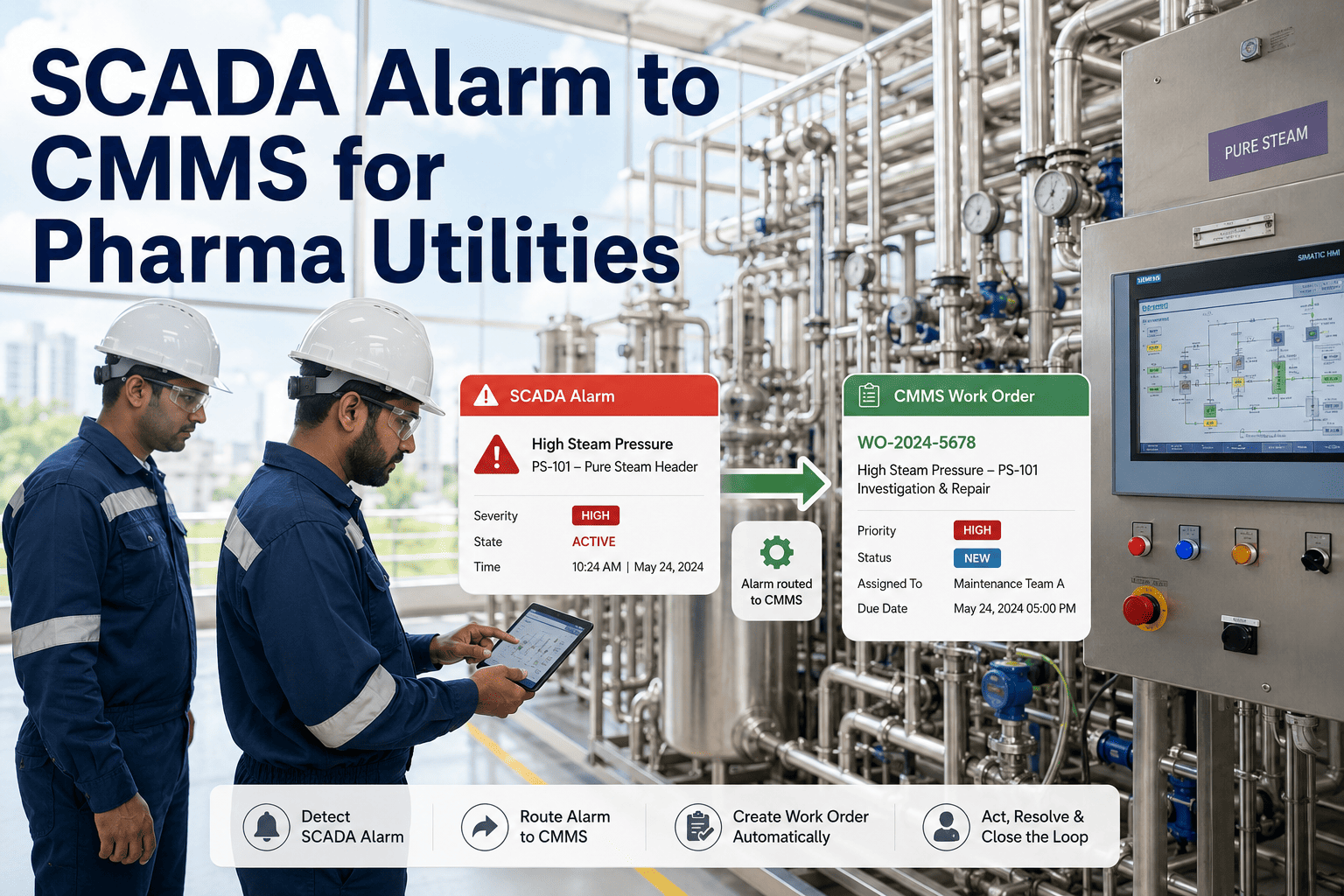
Clean steam for sterilization-in-place requires condensate quality meeting WFI specification. Steam trap condition and superheat control determine whether SIP cycles achieve validated sterilization parameters.
PM Anchor: Monthly steam trap inspection, quarterly non-condensable gas test, semi-annual generator descale
N2
Nitrogen System
Nitrogen used for product blanketing, purging, or transfer must meet purity specifications. Generator membrane condition, purity analyzers, and pressure control valves are the critical maintenance points.
PM Anchor: Monthly purity analyzer calibration, quarterly membrane condition check, annual valve service
HV
HVAC Systems
Classified area HVAC — cleanrooms, airlocks, containment suites — carries the most complex maintenance obligation. Filter integrity, pressure differentials, air change rates, and temperature/RH control are all qualification parameters.
PM Anchor: Monthly HEPA ΔP, quarterly air balance, semi-annual filter integrity test, annual requalification
EP
Electrical & Power
Uninterruptible power supply (UPS) and emergency generator systems protect against production loss and cold-chain failures. Load testing, battery condition, and transfer switch testing require documented PM at defined intervals.
PM Anchor: Monthly UPS battery health, quarterly generator load test, annual full transfer switch verification
Quick Reference
GMP Utility PM Frequency & Record Requirements
| Utility System |
Monitoring Frequency |
Critical PM Interval |
Key GMP Record |
Excursion Trigger |
| Purified Water |
Daily TOC + conductivity |
Weekly sanitization |
Water quality log + deviation link |
TOC >500 ppb or conductivity OOS |
| WFI |
Daily temperature + microbial |
Monthly still inspection |
Still output log + loop temp chart |
Temperature drop below 80°C |
| Compressed Air |
Monthly dew point + particulate |
Monthly POU filter change |
Filter change log + dew point cert |
Dew point above spec or oil detected |
| Clean Steam |
Per SIP cycle — condensate quality |
Monthly steam trap check |
SIP cycle log + condensate test |
Non-condensable gas > limit |
| Nitrogen |
Monthly purity verification |
Quarterly membrane check |
Purity analyzer calibration record |
Purity below grade specification |
| HVAC |
Continuous ΔP monitoring |
Monthly HEPA ΔP log |
Air balance report + requalification |
Pressure differential out of range |
| UPS / Generator |
Monthly battery health check |
Quarterly load test |
Load test report + transfer switch log |
Battery capacity below 80% rated |
One Platform for All 7 GMP Utility Systems
OxMaint pre-configures PM schedules, monitoring integration points, deviation triggers, and audit-ready records for every GMP utility — without custom development or spreadsheet management across departments.
Maturity Levels
Where Most Pharma Sites Stand on Utility Maintenance
25%
Paper-Based
Manual logs, shared drives, no deviation links
45%
Partial Digital
Legacy CMMS — desktop only, no monitoring integration
22%
Connected
Cloud CMMS with monitoring links and mobile closeout
8%
Predictive
AI-triggered PMs, continuous audit readiness
Source: Industry analysis of 200+ pharma site maintenance maturity assessments, 2024
Expert Review
"A utility failure is never just a maintenance event — it is an immediate quality event. The moment purified water conductivity goes out of spec or HVAC pressure differential drops below the limit, every batch in production becomes a potential deviation. Pharma sites that link utility monitoring directly to their CMMS can catch and contain these events in minutes. Those on paper find out on the audit."
Anika Patel
Director of Quality Systems · Sterile Manufacturing · 20 Years Experience
3–5x
Faster deviation closure when utility maintenance records are digitally linked
62%
Of FDA 483 observations in sterile fill sites involve utility documentation gaps
Frequently Asked Questions
Pharma Utility Maintenance — What Compliance and Maintenance Teams Ask
What is the FDA's expectation for purified water system maintenance documentation?
Under 21 CFR Part 211.68 and FDA's Water Quality Guidance, purified water systems must have documented monitoring protocols with defined action and alert limits, a change control process for any system modification, sanitization records with start time, temperature, and completion verification, and maintenance work orders that link to quality deviations when any intervention occurs during a monitoring excursion. The documentation must be retrievable per batch and inspection-ready at all times — not assembled from separate paper binders before each audit.
See how OxMaint structures water system records — free trial available.
How should compressed air PM intervals be set for pharmaceutical manufacturing?
Product-contact compressed air PM intervals should be based on risk classification: ISO Class 1 (direct contact with sterile product) requires monthly POU filter replacement, monthly dew point verification, and quarterly oil-free compressor inspection. ISO Class 2 (indirect contact) typically runs quarterly filter changes with semi-annual dew point verification. Any compressed air system feeding a cleanroom should also have annual microbiological monitoring at each POU point, with results linked to the CMMS as calibrated instrument records.
Discuss your compressed air qualification status in a 30-minute demo.
Can OxMaint handle the HVAC requalification documentation cycle for classified areas?
Yes. OxMaint manages the full HVAC qualification lifecycle for classified pharmaceutical environments — from continuous ΔP monitoring alerts, to semi-annual filter integrity test work orders, to annual air balance requalification scheduling with attachment capability for instrument reports and certificates. When a ΔP excursion occurs, the CMMS automatically generates a corrective work order and flags the event for deviation linkage. All records for classified area HVAC are stored against the equipment asset and retrievable by date range, area, or qualification event for audit preparation.
Try OxMaint free — no credit card, live in under 60 minutes.
What makes utility maintenance documentation different from production equipment maintenance?
Utility maintenance carries a direct batch impact chain that production equipment PM typically does not. When a granulator has a PM, it affects that one asset. When a purified water system has an unresolved PM or monitoring excursion, it can trigger a quality hold on all batches produced using that water during the affected period — sometimes retroactively covering weeks of production. This means utility maintenance records must be linked to batch records, must be time-stamped against monitoring data, and must show continuous compliance rather than episodic documentation.
Free Trial · No Credit Card · Live in Under 60 Minutes
Manage All 7 GMP Utility Systems in One Audit-Ready Platform
Stop running utility maintenance on paper logs, shared drives, and disconnected monitoring systems. OxMaint connects every utility PM, monitoring alert, deviation record, and calibration log into one platform your QA team can retrieve in seconds — not hours.