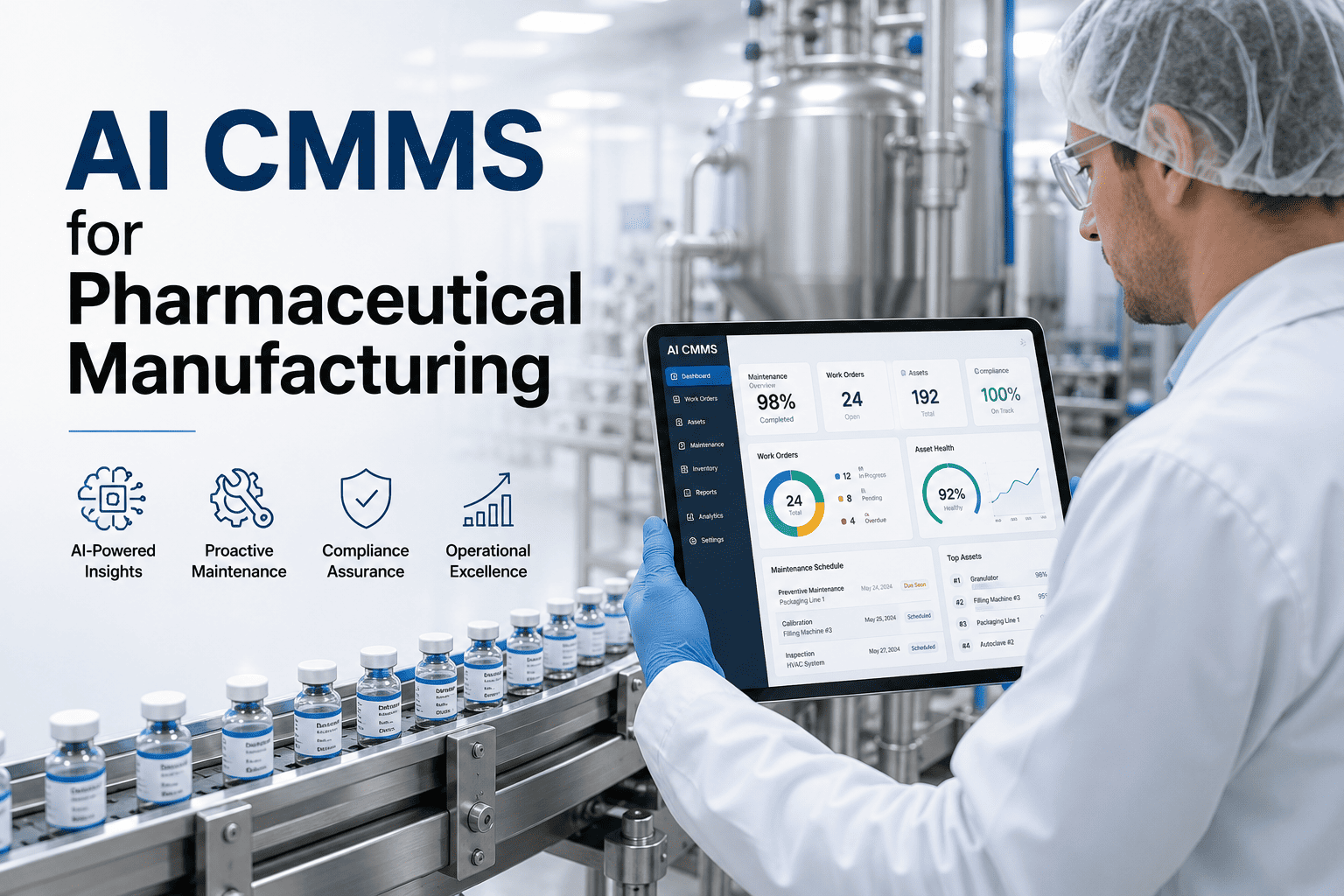
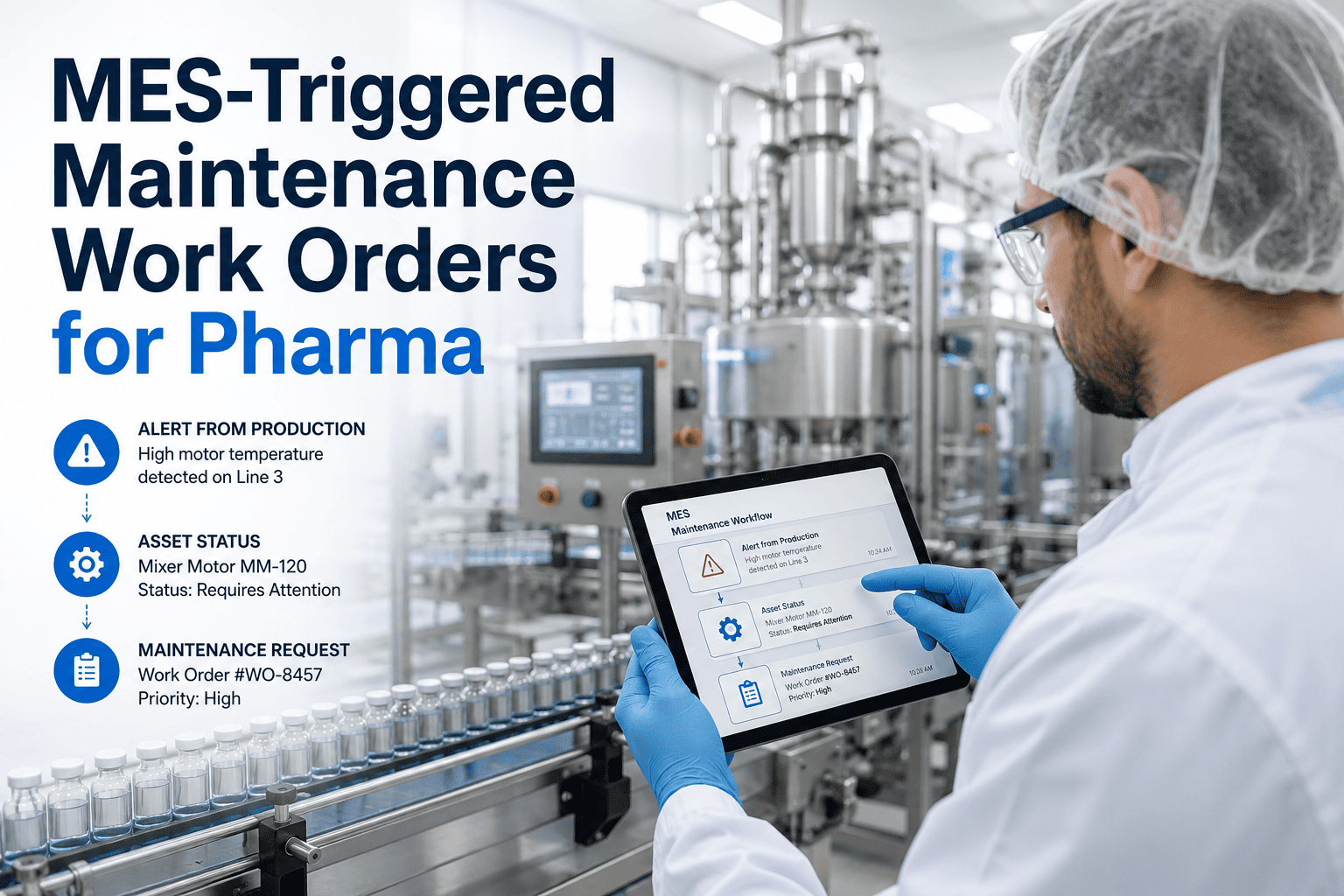
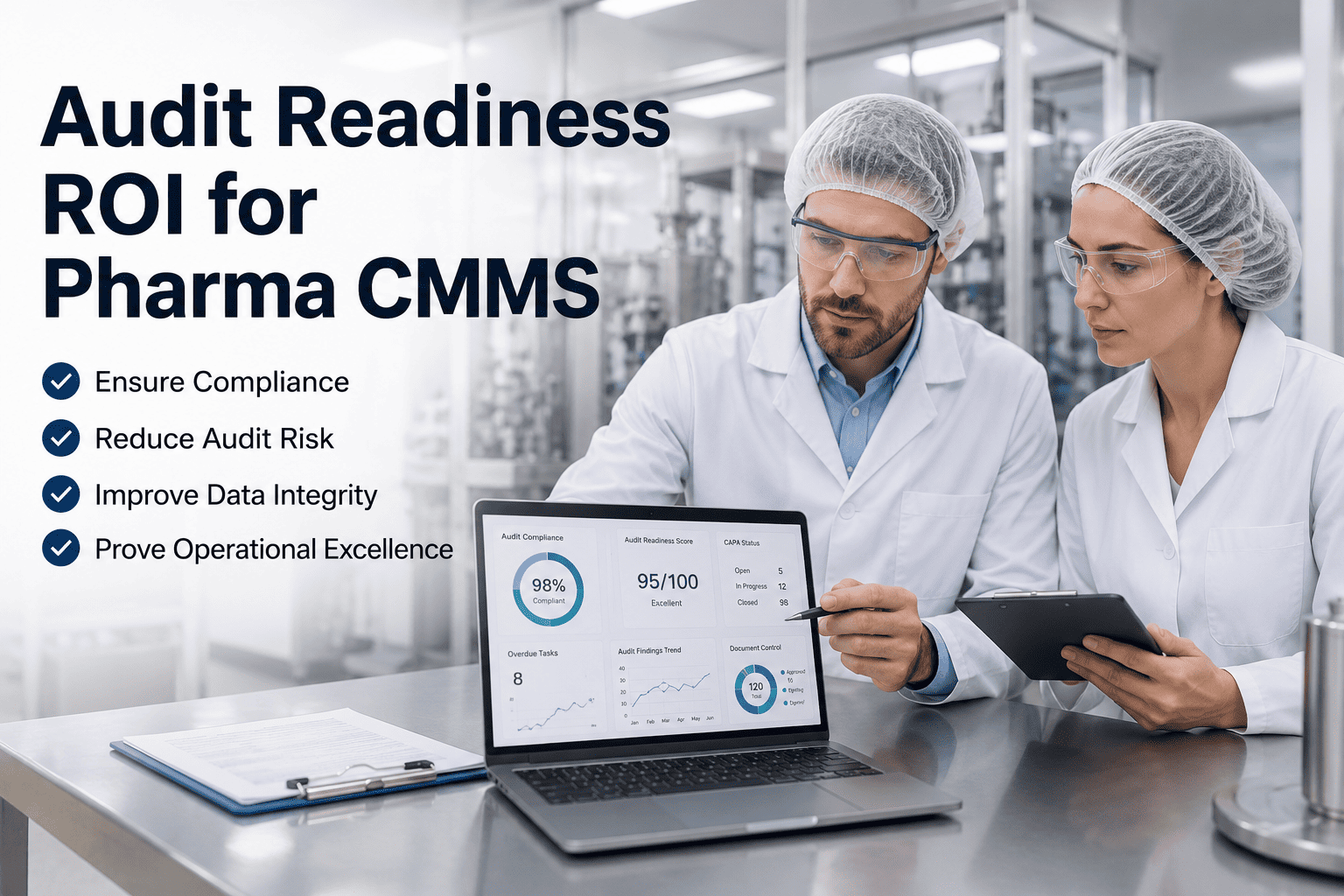
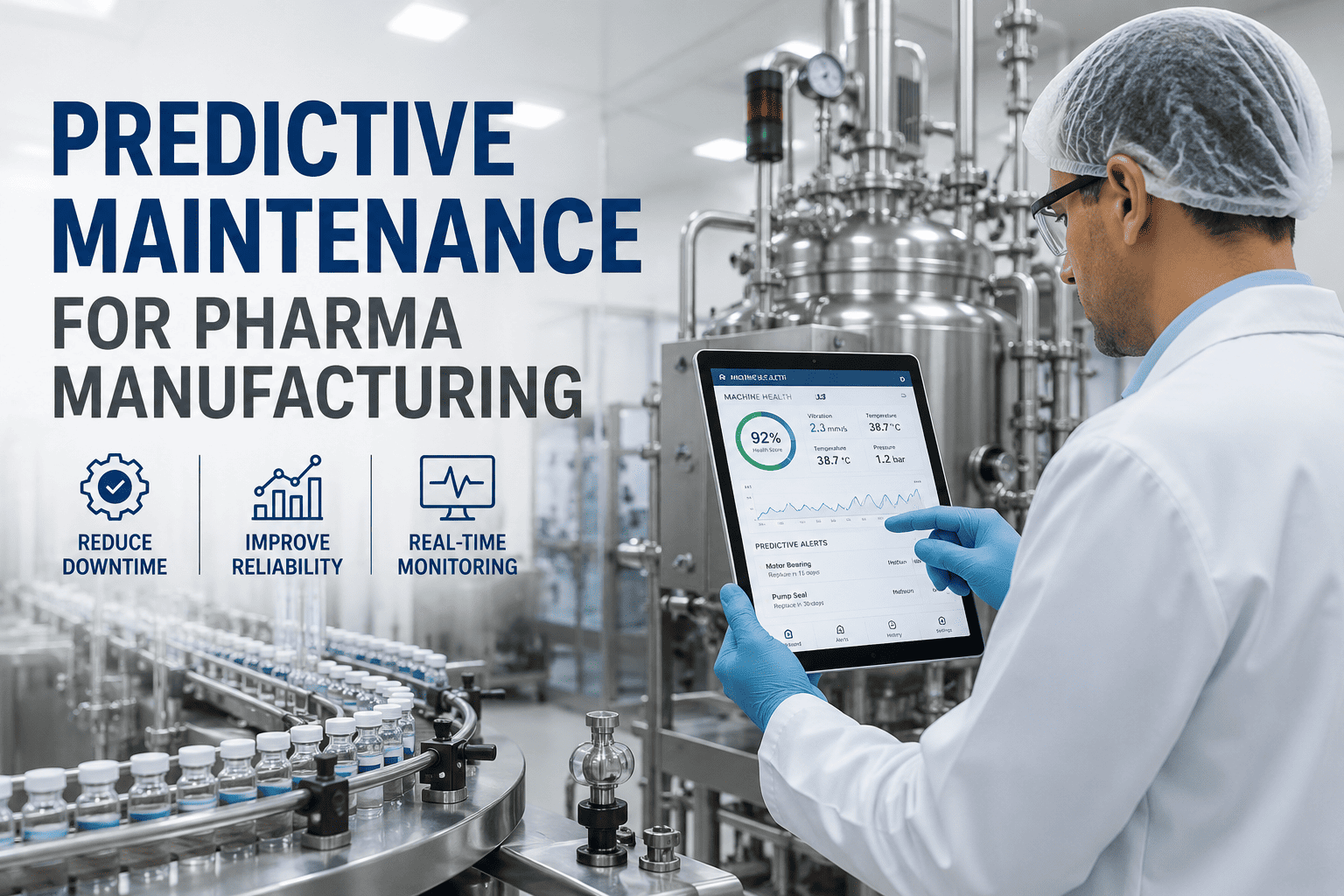
Traditional CMMS platforms were built to record what happened — AI-powered CMMS platforms are built to prevent what's about to happen. In pharmaceutical manufacturing, where unplanned downtime triggers deviation investigations, CAPA obligations, and potential batch losses worth hundreds of thousands of dollars, the difference between reactive and predictive maintenance is the difference between a production interruption and a near-miss. OxMaint's AI CMMS brings predictive failure detection, automated GMP work orders, and intelligent audit readiness to pharma maintenance teams who can't afford to wait for assets to fail.
AI-Powered CMMS for Pharma
Predict Failures. Automate GMP Work Orders. Close Audits Faster.
OxMaint combines machine learning failure prediction with structured GMP workflows — so pharmaceutical maintenance teams spend less time fighting fires and more time building compliance records.
PM Compliance Improvement
62%
Audit Preparation Time Saved
70%
What Makes AI CMMS Different from Standard CMMS in Pharma
Standard CMMS tools tell you a work order is overdue. AI CMMS tells you an asset is trending toward failure before it generates a deviation event. In a GMP environment, that distinction carries enormous regulatory and financial weight — a prevented failure is a prevented investigation.
| Capability |
Standard CMMS |
AI CMMS (OxMaint) |
| Failure Detection |
Records failures after they occur |
Predicts failures from sensor data, maintenance history, and degradation patterns |
| Work Order Trigger |
Manual or calendar-based only |
Condition-based and AI-triggered — work orders generated when risk exceeds threshold |
| GMP Compliance |
Manual documentation; audit trail gaps common |
Automated GMP work order structure with required fields, e-signatures, and audit trail |
| Audit Readiness |
Manual assembly of maintenance records for audit |
One-click audit packages with PM history, completion rates, and deviation linkage |
| CAPA Integration |
Separate QMS system; no automatic linkage |
Failure events auto-link to deviation and CAPA workflows in same platform |
| Continuous Improvement |
No trend analysis across asset fleet |
Fleet-wide pattern detection identifies systemic issues before regulatory observation |
AI Capabilities Inside OxMaint Pharma CMMS
01
Predictive Failure Scoring
OxMaint analyzes maintenance history, failure frequency, and asset age to generate a real-time risk score for each asset — prioritizing work orders before failures occur.
02
Automated GMP Work Order Generation
When risk thresholds are crossed, OxMaint auto-generates work orders pre-populated with GMP-required fields: asset ID, procedure reference, required sign-offs, and documentation fields.
03
Natural Language Search Across Records
Ask "show all PM records for Reactor 3 in the last 6 months" and OxMaint retrieves and summarizes — no manual filtering through spreadsheets during an inspection.
04
Anomaly Detection on Maintenance Patterns
OxMaint flags statistically abnormal patterns — a technician completing work orders 4x faster than average, or a PM completing without all required sign-offs — before audit review finds them.
05
Intelligent PM Interval Optimization
AI analyzes actual asset performance data to recommend PM interval adjustments — reducing over-maintenance waste while maintaining GMP compliance thresholds.
06
Audit Package Auto-Assembly
OxMaint automatically compiles maintenance records, PM completion reports, deviation linkage, and CAPA status into audit-ready packages by asset, date range, or inspection scope.
See AI-Powered GMP Maintenance in Action
A 30-minute OxMaint demo shows predictive failure scoring, automated work order generation, and audit package assembly — purpose-built for pharma manufacturing environments.
Pharma Asset Classes Where AI CMMS Delivers the Highest ROI
| Asset Class |
AI CMMS Benefit |
GMP Impact if Missed |
| Production Equipment |
Predictive PM on tablet presses, filling lines, blenders before product-contact failure |
Batch deviation, OOS investigation, potential recall |
| HVAC/Clean Rooms |
Condition-based filter change, pressure differential monitoring, airflow PM triggers |
Contamination event, environmental monitoring OOS |
| Cold Chain Storage |
Refrigeration unit risk scoring based on compressor age and recent alarm frequency |
Temperature excursion, product loss, deviation record |
| Calibration Assets |
AI-prioritized calibration scheduling based on criticality and out-of-tolerance history |
Instrument OOC, impact assessment on all batches using that instrument |
| Utility Systems |
Water for injection, compressed air, steam system predictive maintenance |
Utility failure triggers facility-wide production halt and regulatory notification |
Expert Review
AI
The pharmaceutical industry is at an inflection point with AI in maintenance. The facilities that will lead on inspection readiness over the next five years are not those with the most documentation — they are those with the most intelligent systems that can predict, prevent, and automatically generate the compliance records that regulators need to see. AI CMMS is not a luxury for large pharma; it is fast becoming table stakes for any facility under modern FDA and EMA scrutiny.
Director of Manufacturing Technology
Global Top-20 Pharmaceutical Manufacturer, 19 years industry experience
Frequently Asked Questions
How does OxMaint's AI predict equipment failures in pharmaceutical manufacturing?
OxMaint's predictive failure scoring analyzes multiple data streams: historical maintenance records, failure frequency by asset, time since last service, open corrective work order count, and (where sensor integration is active) real-time operational parameters. The model generates a risk score per asset that updates continuously — alerting maintenance planners when an asset crosses a configurable risk threshold, well before the failure event that would trigger a GMP deviation.
Start free to explore the risk scoring dashboard.
Is OxMaint's AI CMMS suitable for companies that need 21 CFR Part 11 compliance?
Yes. OxMaint includes the core Part 11 requirements for a compliant CMMS: electronic records with user attribution and timestamps, an immutable audit trail of all record changes, role-based access controls, and e-signature capability for work order approval and closure. For facilities that require formal computer system validation, OxMaint provides IQ/OQ documentation support.
Book a demo to review our validation documentation package.
How does OxMaint reduce audit preparation time for pharma maintenance records?
OxMaint's audit package assembly feature automatically compiles maintenance records, PM completion rates, deviation linkage, CAPA status, and calibration history into structured reports filtered by asset, date range, or regulatory standard. What typically takes a maintenance team 3 to 5 days of manual record-gathering before an inspection is reduced to a single export. The output is formatted for direct submission to FDA investigators or internal QA audit teams, with complete traceability from work order creation through closure.
Can OxMaint integrate with existing pharma production and quality systems?
OxMaint supports integration with major pharma ERP, QMS, and MES platforms via API, enabling bidirectional data flow for asset master data, deviation records, and CAPA status. For facilities with IoT sensor infrastructure, OxMaint can ingest real-time sensor data to enable condition-based PM triggering. Integration requirements vary by system — the OxMaint implementation team conducts a scoping assessment as part of the standard onboarding process for pharma clients.
Move from Reactive to Predictive Pharma Maintenance
OxMaint gives pharmaceutical maintenance teams AI-powered failure prediction, automated GMP documentation, and audit-ready records in one platform.