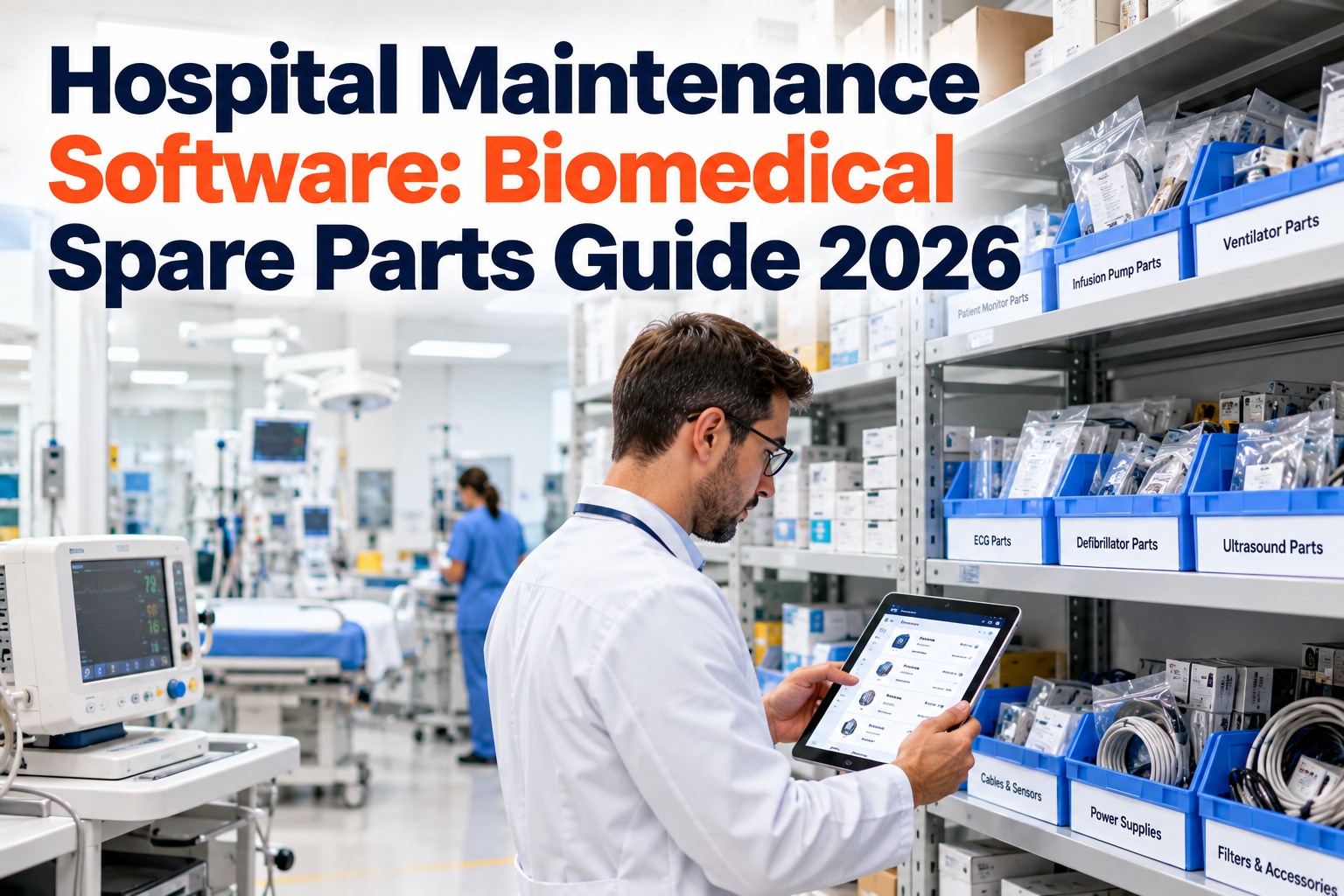
A ventilator failing at 2 AM is a clinical emergency. A ventilator failing at 2 AM with the replacement sensor sitting in a vendor's warehouse three days away is a different problem entirely — one that has nothing to do with the biomedical engineer's skill and everything to do with what was on the shelf. Facilities without spare parts linked to their asset records pay emergency procurement premiums of 22–28% and stretch mean time to repair by roughly 3.2 days per critical failure, simply because nobody knew the part was low until the moment it was needed. AI spare parts planning flips that sequence: it watches consumption patterns, lead times, and asset criticality together, and tells a biomedical team what to reorder before the shelf goes empty, not after.
The Shelf Doesn't Lie — It Just Doesn't Talk to Your Work Orders
Most biomedical stockrooms run on a mix of memory, a spreadsheet, and whoever restocked it last. AI spare parts planning links every part to the assets it serves and the work orders that consume it, so the reorder decision is made from data instead of a shelf glance.
The Parts Criticality Matrix — What Actually Belongs on the Shelf
Not every part deserves the same stocking rule. A biomedical team that stocks everything the same way either ties up capital on low-risk consumables or runs out of the parts that actually stop a ventilator. The matrix below is the logic behind Oxmaint's automated reorder thresholds.
Reorder Point Automation — How the Threshold Gets Calculated
Find Out Which Parts Are One Failure Away From an Emergency Order.
Oxmaint's team will run your current parts list against real consumption history and show you exactly where the stockout risk is hiding — before it turns into a 3-day repair delay.
Manual Parts Tracking vs AI-Planned Inventory
| Dimension | Manual / Spreadsheet Tracking | AI Spare Parts Planning |
|---|---|---|
| Reorder trigger | Someone notices the shelf is low | Automatic threshold based on live consumption |
| Lead time accuracy | Estimated from memory or old invoices | Calculated from actual vendor delivery history |
| Criticality weighting | Same stocking rule for every part | Buffer scaled to linked-asset risk tier |
| Multi-site visibility | Each site's stockroom is its own island | Shared visibility enables cross-site consolidation |
| Audit trail | Manual logs, hard to reconstruct post-incident | Every part tied to the work order that consumed it |
The Cost Math on Getting Parts Planning Right
KPIs a Biomedical Team Should Track Weekly
Stockout Incidents
Number of repairs delayed because a required part was not on the shelf. The single clearest signal that reorder thresholds need adjustment.
Parts-to-Asset Link Rate
Share of inventory items tied to the specific assets they serve. Unlinked parts cannot trigger criticality-weighted reorder points.
Emergency Order Rate
Percentage of purchase orders placed as rush or emergency versus scheduled reorder. A rising rate signals thresholds are set too low.
Days of Excess Stock
Inventory value sitting beyond calculated safety stock. High excess ties up capital that could fund critical-part buffers instead.
Expert Review — A Biomedical Inventory Lead's Perspective
For years our stockroom decisions were based on whoever remembered the last time we ran out of something. That works fine for cable sets. It does not work for a defibrillator capacitor with an eighteen-day lead time. What changed once we linked parts to the assets they serve was not that we suddenly had a bigger budget — it is that the budget stopped going to the wrong shelf. The parts that actually stop a critical device from being repaired are now the ones we never run out of, and the low-risk consumables stopped eating capital they never needed. That reallocation, not a bigger PO, is where the real saving lives.
Frequently Asked Questions
How does the system calculate lead time when a vendor's delivery record is inconsistent?
Oxmaint uses a rolling average weighted toward the most recent deliveries, so a single delayed shipment does not permanently distort the reorder point. Outlier deliveries are flagged, not silently averaged in. Book a demo to see the lead-time calculation on your own vendor history.
Can parts planning work across multiple hospital sites with separate stockrooms?
Yes — the platform gives a shared inventory view across sites, so a low-criticality part can be consolidated into one central order instead of each site placing separate small orders at higher unit cost. This is one of the fastest wins for multi-site health systems in the first quarter of use.
Does the reorder threshold account for seasonal demand, like flu-season ventilator usage spikes?
The consumption model looks at rolling usage windows rather than a flat annual average, so seasonal spikes in high-use assets pull the reorder threshold up ahead of the pattern repeating. See how the same signal logic feeds AI backlog prioritization.
What happens to the draft purchase order once a reorder threshold is triggered?
The draft PO is routed to procurement for approval — it is never auto-submitted to a vendor without a human sign-off. Teams can set approval rules by dollar amount, so routine consumable reorders move fast while larger purchases still get a review step.
How long does it take to link an existing parts inventory to our asset registry?
Most biomedical teams complete the initial parts-to-asset linking within two to three weeks using a bulk import template, with criticality tiers refined over the following month as real consumption data comes in. Start free to begin the import with your current parts list.
The Next Emergency Order Is Preventable. It Just Needs a Threshold Set Today.
Oxmaint links every spare part to the asset it serves and the work order that consumes it — so reorder decisions are made from data, not a glance at the shelf.