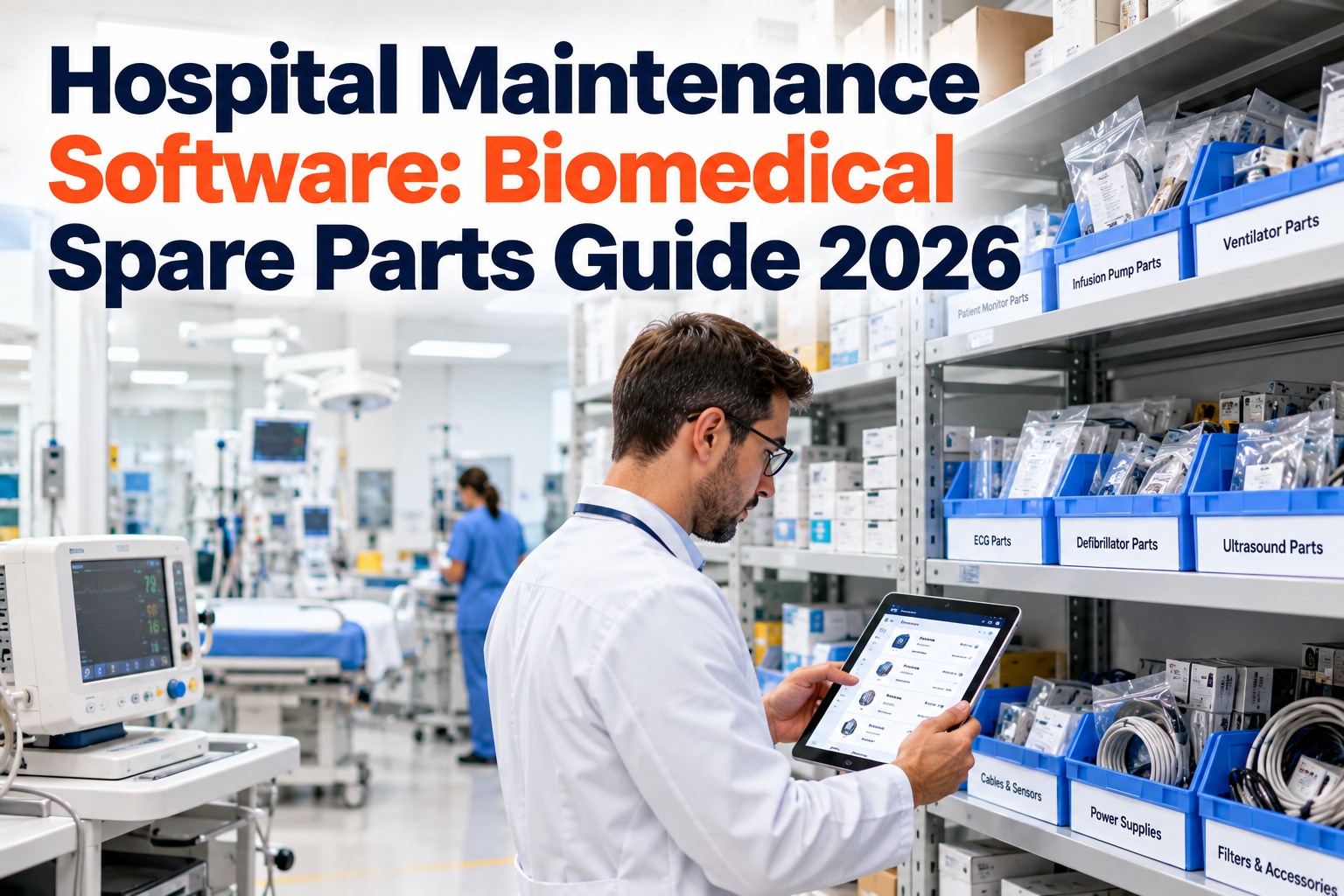
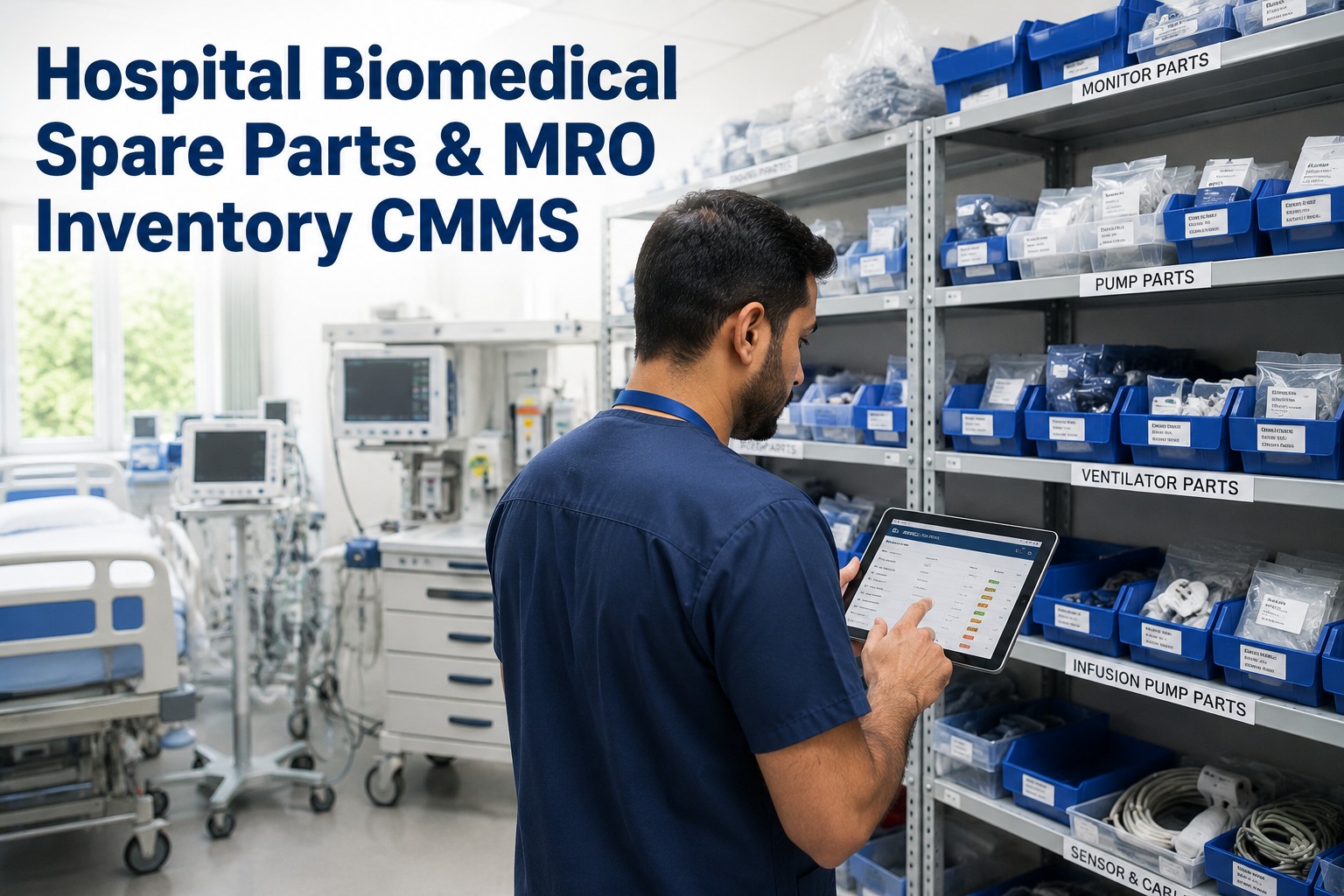
A ventilator is down. The fix is a $40 sensor — but it's not on the shelf, the vendor quotes a five-day lead time, and the rush order costs four times list. Meanwhile a cabinet down the hall holds $12,000 of parts nobody has touched in two years. That's the biomedical spare-parts problem: not too few parts, but the wrong ones, unseen. OXMAINT AI, the AI-powered hospital CMMS, links every part to the equipment it serves and reorders the critical ones before they run out.
Hospital Maintenance Software · Biomedical Spare Parts · CMMS · 2026
Hospital Maintenance Software: Biomedical Spare Parts, Under Control
Stockouts on the part that matters. Cash tied up in parts that don't. OXMAINT AI, the AI-powered CMMS and maintenance management software, runs the whole chain on one platform: a repair request or inspection becomes a logged issue, the issue becomes a work order with its parts attached, and every critical spare stays stocked to a reorder point the software watches — so a fix waits on the tech, never on the part.
1Request / Inspect
→
2Issue
→
3Work Order + Parts
→
4PM / Reorder
PARTS STATUS · BIOMED STORE
Vent O₂ Sensor1 left · REORDER
Pump Battery Pack8 · OK
Monitor Lead Set3 · LOW
Infusion Tubing Kit40 · OK
Legacy X-Ray Board6 · 26mo idle
$8,600/hr
reported average cost of unplanned medical-device failure
3–5×
typical price premium on an emergency spare-parts order
15–25%
annual carrying cost as a share of inventory value
EC.02.04.01
TJC standard behind the equipment-management program you document
Why Biomedical Spares Aren't Like Any Other Storeroom
A hospital biomed store isn't a warehouse of interchangeable bolts. One part is a $40 consumable; the next is a discontinued board for a 15-year-old imaging unit with a six-week lead time and no substitute. Manage them the same way and you either stock out on the critical few or bury cash in the trivial many. OXMAINT AI classifies each part by how badly its absence hurts. Start free and classify your first parts in OXMAINT AI.
Patient-Critical
A missing ventilator part isn't a delay — it's a device out of service on a patient floor.
Long, Uneven Lead Times
OEM-only parts and end-of-life models mean lead times from days to months — safety stock has to reflect that.
Obsolescence Risk
Aging fleets leave shelves full of parts for retired devices — capital frozen in stock that will never move.
Traceable by Mandate
Parts used in a repair are part of the equipment record — and part of what a surveyor expects to see.
Classify First: Vital, Essential, Desirable
Before you set a single stock level, the software sorts every part by criticality — the VED model biomed teams know. Vital parts are always on the shelf and watched daily; desirable ones are ordered on demand. OXMAINT AI applies the tier to each part so its stocking rule, review cadence and reorder priority follow automatically. Book a demo to see VED classification on your parts list in OXMAINT AI.
V · VITAL
~20% of parts · ~80% of value
Failure takes a patient-critical device offline. Always stocked with safety stock; monitored daily; reorder fires first.
Ventilator sensors · pump batteries · defib modules
E · ESSENTIAL
~30% of parts · ~15% of value
Needed soon, workaround exists briefly. Held to min-max levels; reviewed weekly; reordered on trigger.
Monitor leads · imaging consumables · filters
D · DESIRABLE
~50% of parts · ~5% of value
Low impact, readily available. Ordered on demand; reviewed monthly; little or no safety stock.
Common tubing · fasteners · general consumables
Idle stock is its own class: OXMAINT AI flags parts with no movement in 24+ months for obsolescence review, so retired-device inventory stops eating shelf space and capital.
The Reorder Point That Watches Itself
A stockout is rarely a surprise — it's a reorder point nobody was tracking. OXMAINT AI holds a min and max for every stocked part and fires an auto-reorder the moment stock hits the minimum, pre-filled with the vendor and quantity. The trigger is a simple, honest formula the software keeps current from real usage and delivery data. Sign up free and set min-max on your critical spares in OXMAINT AI.
How a Part Moves Between Min and Max
MAX — order stops here
Healthy stock — no action
REORDER POINT — auto-request fires
SAFETY STOCK — buffer for lead-time surprises
Stock is drawn down by work orders, replenished to max on delivery, and never allowed below safety stock without an alert.
STOCKOUT
Too Little of the Vital Few
- Device stays down waiting on a part
- Emergency order at 3–5× list price
- Rush freight and expedite fees on top
- Repair rescheduled, tech time wasted
OVERSTOCK
Too Much of the Trivial Many
- 15–25% of value lost yearly to carrying cost
- Capital frozen in slow-moving stock
- Shelf-life parts expire before use
- Obsolete parts for retired devices pile up
The target sits between them: a service level of 95%+ on availability, stockouts under 2% of requests, and inventory turning 6–12× a year. OXMAINT AI keeps every part in that band.
A Storeroom Full of the Wrong Parts Is Still a Stockout.
Availability isn't about how many parts you own — it's about owning the right ones and seeing them in time. OXMAINT AI links every spare to the equipment it serves, so the reorder that matters fires before the device it protects goes down.
Part, Work Order, PM — One Connected Record
Spare parts only earn their keep when they're tied to the work. In OXMAINT AI a part isn't a line in a separate spreadsheet — it's attached to the asset it fits, drawn down by the work order that uses it, and forecast forward by the PM schedule that will need it. Here's the loop the software runs. Book a demo to walk this loop on your own assets in OXMAINT AI.
01
Part Linked to Asset
Each spare connects to the devices it fits and their bill of materials — so the right part is one click from the work order.
↓
02
Work Order Draws It Down
Closing a repair records the parts used and updates stock automatically — no separate inventory entry, no drift.
↓
03
Reorder Fires at Minimum
Stock hitting the reorder point raises a purchase request pre-filled with vendor and quantity — before the shelf is empty.
↓
04
PM Forecasts Demand Ahead
The software reads scheduled PMs forward and flags the parts they'll consume, so procurement beats the maintenance window.
↓
05
Every Part Traced & Recorded
Part number, lot, cost and the asset it went into are held on the equipment record — audit-ready, recall-ready.
What the CMMS Automates
The point of hospital maintenance software isn't a prettier stock list — it's the manual steps it removes. OXMAINT AI runs five of them on its own, turning parts management from a weekly spreadsheet chase into a background process. Start free and switch these on for your biomed store in OXMAINT AI.
LINK
Asset-to-Part Mapping
Every spare tied to the equipment and BOM it serves, so demand is traceable to real assets.
TRACK
Consumption from Work Orders
Closed work orders update usage history automatically — the numbers stay honest on their own.
REORDER
Auto Purchase Requests
Minimum-level triggers raise pre-filled requests with the right vendor and quantity.
LEARN
Real Lead-Time Intelligence
Actual delivery performance replaces vendor quotes, so safety stock reflects reality.
FORECAST
PM-Driven Demand Planning
Upcoming PMs surface the parts they'll need before the maintenance window arrives.
FLAG
Obsolescence & Recall Review
No-movement parts flagged for disposal; affected lots found fast when a recall lands.
From Stockout Risk to Audit Trail
Every part decision the software makes leaves a record — which is exactly what a Joint Commission equipment-management program under EC.02.04.01 asks you to keep. Parts used, on which asset, at what cost, on what date: it's inventory control and compliance evidence in the same entry. Book a demo to see the parts-and-compliance record in OXMAINT AI.
TRACE
Part number, lot and cost recorded against the asset in every corrective work order.
RECALL
Affected devices and parts found by model or serial in minutes when an FDA recall lands.
EC.02.04.01
Inventory, PM completion and corrective records held together for the equipment-management program.
EXPORT
Filtered, timestamped, signed records exported for a surveyor instead of reconstructed by hand.
“
Our biomed storeroom looked full, but we were still expediting parts every week — and writing off a shelf of boards for machines we'd retired years ago. Once every part was linked to an asset and given a reorder point, two things happened: the emergency orders mostly stopped, and we could finally see the dead stock for what it was. The storeroom got smaller and the equipment stayed up. That's the trade we'd been getting backwards.
Clinical Engineering Manager · Community Hospital
Frequently Asked Questions
What does hospital maintenance software do for spare parts, specifically?
It links every spare to the equipment it fits, tracks usage from closed work orders, and auto-reorders critical parts at their minimum level. OXMAINT AI turns parts management from a manual chase into a background process tied to the actual maintenance work.
Start free and connect your parts to your assets.
How does the software decide which parts to always keep in stock?
By criticality. Parts are classified Vital, Essential or Desirable — vital spares for patient-critical devices are always stocked and watched daily, while desirable ones are ordered on demand. Each tier gets its own stocking rule automatically.
Book a demo to classify your parts.
How is the reorder point calculated?
Average daily usage times lead time, plus safety stock. OXMAINT AI keeps usage and lead time current from real work orders and deliveries, so the trigger stays accurate rather than relying on stale vendor quotes.
Start free and set your reorder points.
Can it help with obsolete parts and recalls?
Does parts tracking help with Joint Commission compliance?
It does — parts used, on which asset, at what cost and date are held on the equipment record, which is exactly the corrective-maintenance evidence an EC.02.04.01 program needs. Inventory control and audit trail come from the same entry.
Start free and build the record automatically.
Stock the Right Part. Keep the Device Up.
Run your biomedical spare parts on the OXMAINT AI maintenance management software — criticality-classified stock, self-watching reorder points, parts linked to every asset and PM, and a traceable record ready for any survey. Stop expediting the vital few and paying to store the trivial many.


.jpeg)
