A brown ring on a ceiling tile is never just a cosmetic issue — it is a signal. Behind that stain is an active or past water intrusion event that may involve a leaking pipe, a failing roof membrane, HVAC condensation, or a slow plumbing drain seeping through the slab above. In hospitals, clinics, and care facilities, that signal carries a second risk: mold growth in a ceiling cavity creates airborne spore load that infection control programs work hard to prevent. The problem is that human inspection rounds cover large buildings inconsistently, and stains that develop between rounds go undetected until they grow large enough to catch someone's eye — or until a Joint Commission surveyor spots them first. OxMaint's AI Vision Camera changes that equation: camera-based visual inspection detects ceiling stains automatically, flags them by location and severity, and routes follow-up inspection work orders to the right technician — before a minor stain becomes a mold remediation project. Sign Up Free to activate visual checks in your facility, or Book a Demo to see OxMaint AI Vision in action.
$10,000+
Cost of a small undetected leak left untreated for months
72 hrs
Time for mold to begin colonizing water-damaged ceiling material
23%
PM budget lost to emergency repairs at hospitals on reactive inspection schedules
Joint Commission
Ceiling stains are a common surveyor finding that triggers formal facility deficiency reports
What a Ceiling Stain Is Actually Telling You
Most facility teams treat ceiling stains as a cosmetic problem. In regulated environments, they are a diagnostic signal — and the right response depends on reading that signal correctly.
Brown Ring Stain
Active or Past Leak
Irregular brown ring pattern indicates water settled and evaporated from a pipe, roof, or plumbing fixture above. If ring is still wet or growing, leak is active. Dry rings can have mold on the unseen face of the tile.
→ Leak source investigation + moisture meter check above tile
Grey / Black Discoloration
Mold Risk
Dark spotting or diffuse grey discoloration — especially with soft or sagging tile — indicates mold colonization. In clinical environments this is an infection control event, not just a maintenance issue.
→ Tile removal, air sampling, infection control notification
White / Chalky Residue
Condensation / Humidity
White mineral deposits or efflorescence suggest condensation from HVAC ductwork or high ambient humidity — often in kitchens, laundry areas, or poorly ventilated corridors. A sign of HVAC balancing issues.
→ HVAC inspection + humidity measurement in affected zone
Yellow / Rust-Toned Stain
Pipe Corrosion Leak
Yellow or rust-colored staining often indicates iron or mineral-laden water from corroding pipes above. Typically slow leaks from aging plumbing — worst in older buildings or those with galvanized steel supply lines.
→ Plumbing inspection above stain location; pipe age assessment
How OxMaint AI Vision Detects Ceiling Stains — Without Extra Staff
Traditional ceiling inspection depends on a technician walking the floor and looking up. OxMaint's AI Vision Camera automates that process — scanning, detecting, and routing without adding headcount or changing inspection rounds.
1
Camera Scan
AI vision camera captures ceiling imagery during routine rounds or via mounted camera network — no dedicated inspection staff required
2
Stain Detection
Computer vision model identifies discoloration patterns — distinguishing water stains, mold indicators, and mineral deposits by color signature and shape
3
Risk Classification
Detected stains are classified by risk level — new vs. growing stains, mold-pattern indicators vs. dry mineral residue — with severity score assigned
4
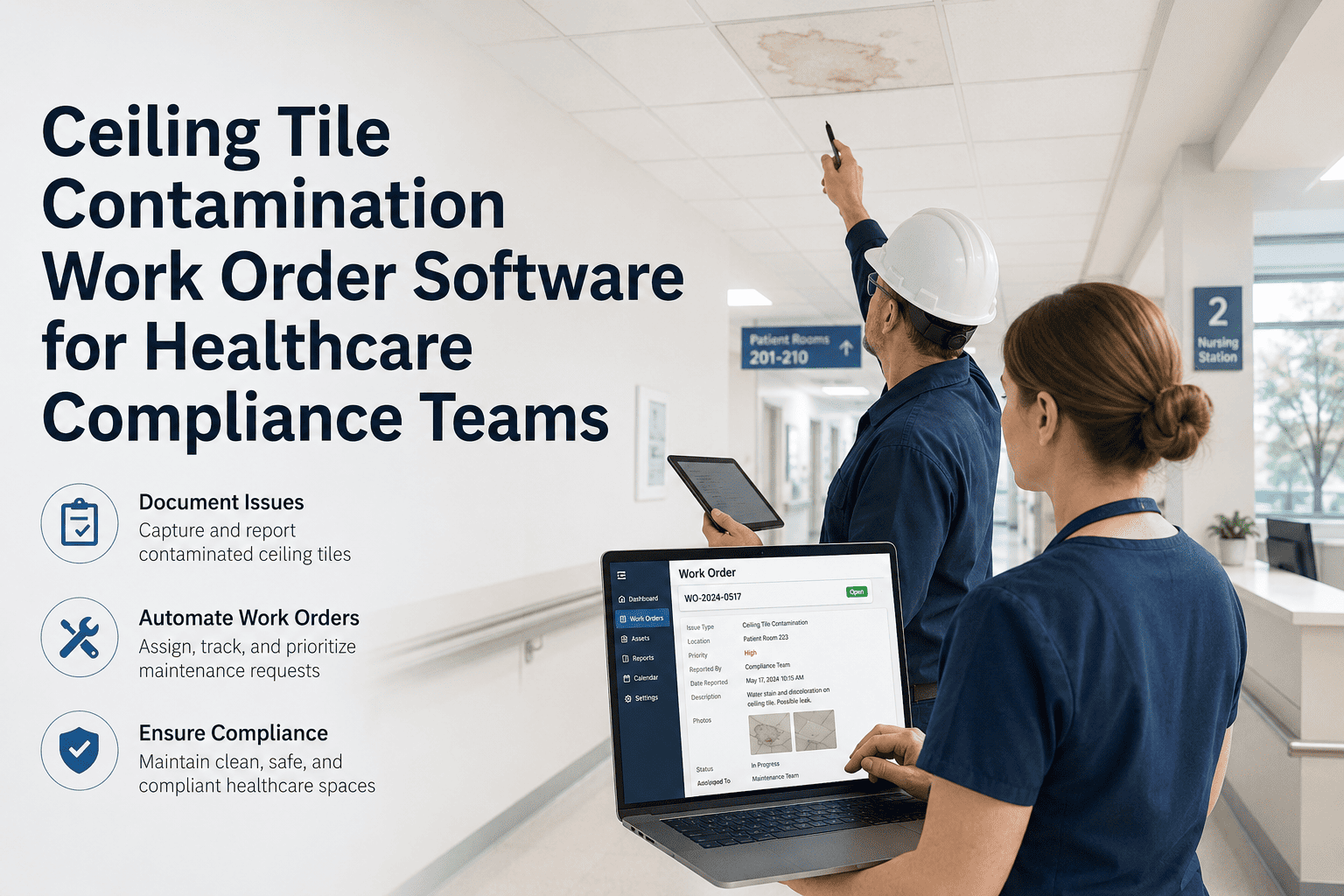
Work Order Created
OxMaint automatically generates a follow-up inspection work order with location, photo evidence, risk classification, and assigned technician
5
Resolved and Logged
Technician confirms root cause, logs corrective action, and closes the work order — building a documented inspection history for compliance and audit purposes
Stop Finding Ceiling Stains the Day Before a Survey
OxMaint AI Vision flags stains when they appear — not when they've grown large enough to notice. Every detection becomes a routed work order, a compliance record, and one less surprise on inspection day.
The Hidden Compliance Risk Facility Managers Miss
Ceiling stains in healthcare facilities sit at the intersection of three separate compliance frameworks — each with its own documentation requirements, inspection standards, and penalty exposure.
EC.02.06.01 / IC.02.01.01
The Environment of Care and Infection Control standards require facilities to maintain clean, damage-free ceiling surfaces and to have documented processes for identifying and responding to infection control risks — including visible water damage and mold indicators.
Common finding: stains present with no work order or investigation record
§482.41 — Physical Environment
Medicare-participating hospitals must maintain a safe and sanitary environment. Unresolved ceiling water damage that creates conditions favorable to mold growth is a deficiency under the physical environment condition — carrying potential reimbursement implications.
Common finding: recurring stains at same location with no root cause documented
Healthcare Facility Design Standards
FGI Guidelines and NFPA 99 require that ceiling materials in clinical areas be cleanable and impermeable in critical care zones. Damaged or stained ceiling tiles that cannot be cleaned to standard must be replaced — and the timeline for replacement must be documented.
Common finding: deteriorated ceiling tile not replaced within required timeframe
Before and After: What AI Vision Changes for Your Facility Team
The difference between reactive and AI-assisted ceiling inspection is not just speed — it is consistency, documentation, and the ability to catch what human rounds miss.
Stains discovered during survey prep — too late for clean documentation
Inspection coverage depends on who walked which corridor that week
No record of when stain first appeared or how it progressed
Mold indicators misread as cosmetic issues — root cause never investigated
Follow-up falls through the cracks between shifts and departments
Infection control team not notified until stain is visible and large
Stains flagged at first appearance — work order created same day
Consistent scan coverage across every zone on every inspection cycle
Photo-timestamped record of stain detection, size, and progression
Mold-pattern stains routed to infection control as a separate priority alert
Work order assigned, tracked, and closed — full audit trail in OxMaint
Infection control notified automatically when mold risk classification triggers
Frequently Asked Questions
How does OxMaint AI Vision distinguish a water stain from normal ceiling discoloration?
OxMaint's computer vision model is trained to identify the irregular ring patterns, color gradients, and surface texture changes characteristic of water damage — distinguishing them from shadow, lighting artifacts, and normal tile aging. Detection confidence scores are included in each alert so facility managers can triage findings by risk level.
Sign Up Free to see detection in your facility.
Do we need to install permanent cameras, or can AI vision work with mobile inspection rounds?
OxMaint AI Vision supports both configurations — mounted camera networks for continuous monitoring in critical areas, and mobile device capture during walkthroughs for broader facility coverage. Most facilities start with mobile-assisted rounds and add fixed cameras in high-risk zones like utility corridors and areas above sterile processing.
Book a Demo to discuss your facility layout.
What happens after a ceiling stain is detected — who gets notified and what action is required?
OxMaint creates a work order with the stain photo, location, and risk classification and routes it to the assigned technician or supervisor. For mold-risk classifications, a parallel notification can be sent to the infection control team. The work order remains open and tracked until root cause is documented and corrective action is confirmed — creating the audit trail compliance surveys require.
Can AI Vision ceiling checks integrate with our existing compliance documentation process?
Yes — all detections, work orders, and resolution records are stored in OxMaint and exportable in formats suitable for Joint Commission Environment of Care binders, CMS survey documentation, and internal quality reports. The detection timestamp and photo evidence make it straightforward to demonstrate that your facility identified and responded to every flagged condition.
What types of facilities benefit most from AI ceiling stain detection?
Hospitals, long-term care facilities, ambulatory surgery centers, and pharmaceutical manufacturing facilities see the highest value — because ceiling condition directly intersects with infection control and regulatory compliance in these environments. Large commercial buildings and educational institutions with extensive ceiling areas that are difficult to inspect consistently also benefit significantly.
Start your free OxMaint account and enable visual checks today.
Every Ceiling Stain Is a Work Order Waiting to Happen — Let AI Find Them First
OxMaint AI Vision Camera detects ceiling stains, classifies mold risk, routes follow-up inspections, and documents every finding — giving facility managers the proactive inspection capability that protects compliance, patient safety, and maintenance budgets.





.jpg)