Every hospital facility has a growing list of deferred repairs, aging assets, and unresolved inspection findings — but most maintenance directors are managing that list in their heads, on whiteboards, or scattered across email threads that disappear the moment a staff member leaves. An open risk log is not an optional administrative exercise. It is the documented proof that your facility has identified every unresolved maintenance risk, assessed its severity, assigned an owner, and put a remediation plan in motion. OxMaint gives maintenance leaders a live risk log that connects directly to open work orders, assigns ownership, and tracks status in real time — so when a Joint Commission surveyor, risk manager, or hospital executive asks what risks are open today, you have an answer in seconds, not days. Book a demo to see how hospital maintenance leaders use OxMaint's risk dashboard to stay ahead of escalations before they happen.
Maintenance Director · Hospital Risk Management · CMMS
If You Cannot Pull Up Your Open Facility Risks in 60 Seconds, You Have a Risk Problem
Hospital maintenance directors who rely on memory, email, or paper to track unresolved facility risks are one unannounced survey away from a corrective action plan. A live, connected risk log changes that equation entirely.
The Stakes
What Happens When Facility Risks Go Untracked
$150K+
Average OSHA exposure per serious violation from incomplete maintenance records
43%
of TJC citations trace to documentation failures, not equipment failures
$340K
Cost of emergency CMMS rollout forced by a single CMS survey deficiency finding
72%
of hospital patient safety incidents are classified as harmful events — many linked to environment failures
Risk Log Structure
What Your Open Risk Log Must Contain — and Why Each Field Matters
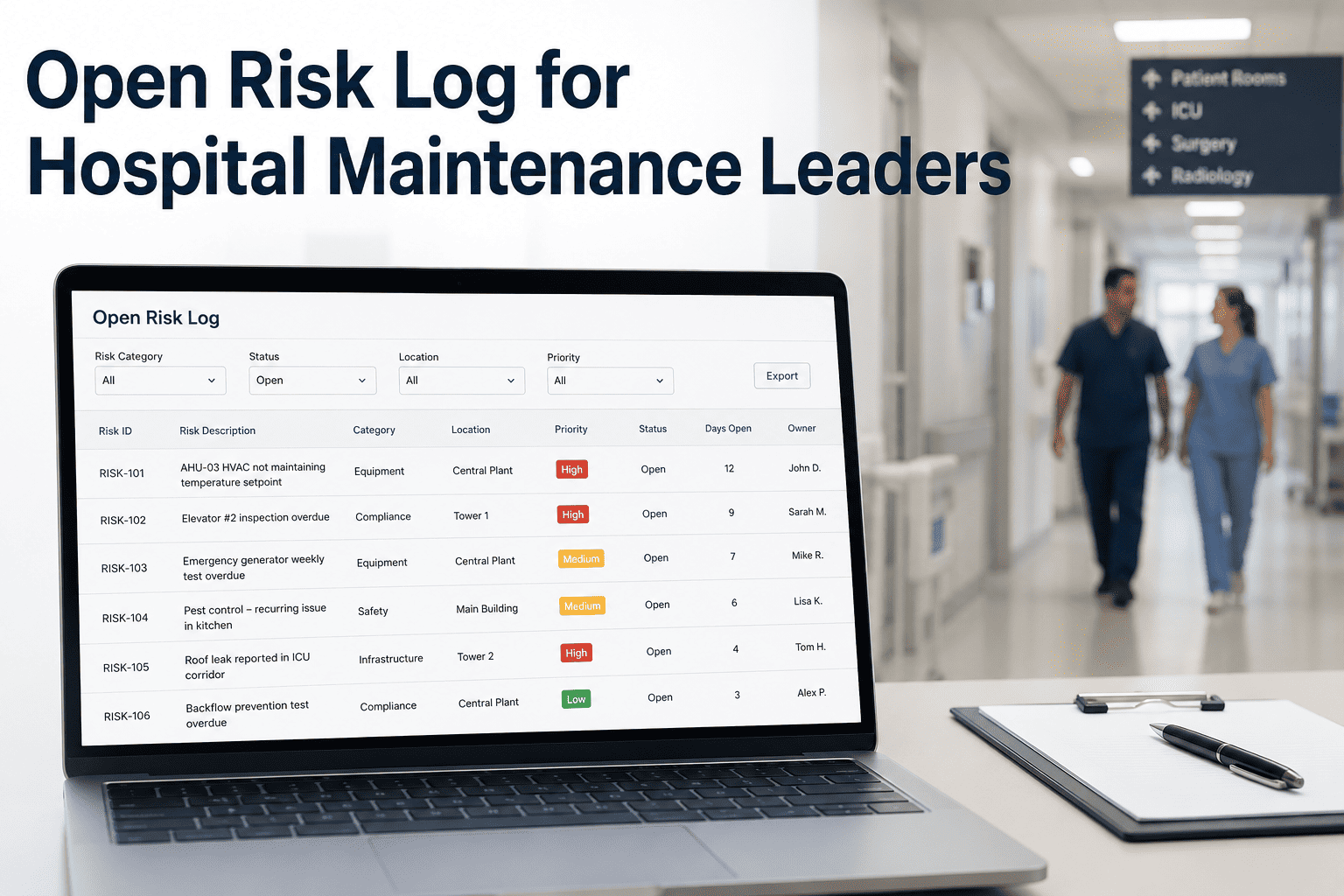
An effective hospital maintenance risk log is not a simple punch list. Each field exists to answer a specific question from a regulator, risk manager, or hospital board member. Here is the complete structure.
Risk ID
Asset / Location
Risk Description
Severity
Owner
Status
R-001
Fire door, 3-North corridor
Self-closer mechanism failed — door does not latch on release
High
J. Torres
Open
R-002
AHU-4, ICU supply
Filter differential pressure 30% above threshold — change overdue 14 days
High
M. Singh
In Progress
R-003
Generator fuel tank, North wing
Fuel level at 61% — below 80% policy minimum, delivery scheduled
Medium
K. Ramirez
In Progress
R-004
Patient room 412
Ceiling water stain consistent with roof leak — origin unconfirmed
Medium
A. Patel
Open
R-005
Stairwell B emergency lighting
Monthly test lamp failure — replacement part on order
Low
D. Chen
Deferred
Every row in OxMaint is linked to a live work order, so status updates in real time as technicians complete repairs — no manual log maintenance required.
Risk Severity Framework
How to Classify Maintenance Risks in a Hospital Setting
Critical — Immediate Action
Fire door latching failure
Emergency generator below 50% fuel
Sprinkler system impairment
Medical gas pressure out of range
Repair or interim mitigation required within 24 hours. Supervisor escalation mandatory.
High — 72-Hour Resolution
HVAC filter change overdue in clinical area
Nurse call system fault in patient unit
Elevator inspection overdue
Isolation room negative pressure drift
Named owner required within 4 hours. Resolution or deferred plan within 72 hours.
Medium / Low — Tracked and Monitored
Cosmetic ceiling stain — origin confirmed resolved
Exterior lighting fault
Non-critical equipment PM overdue 30 days
Door hardware wear — non-fire-rated
Logged with planned resolution date. Reviewed weekly by maintenance director.
Stop Managing Hospital Risk from Memory
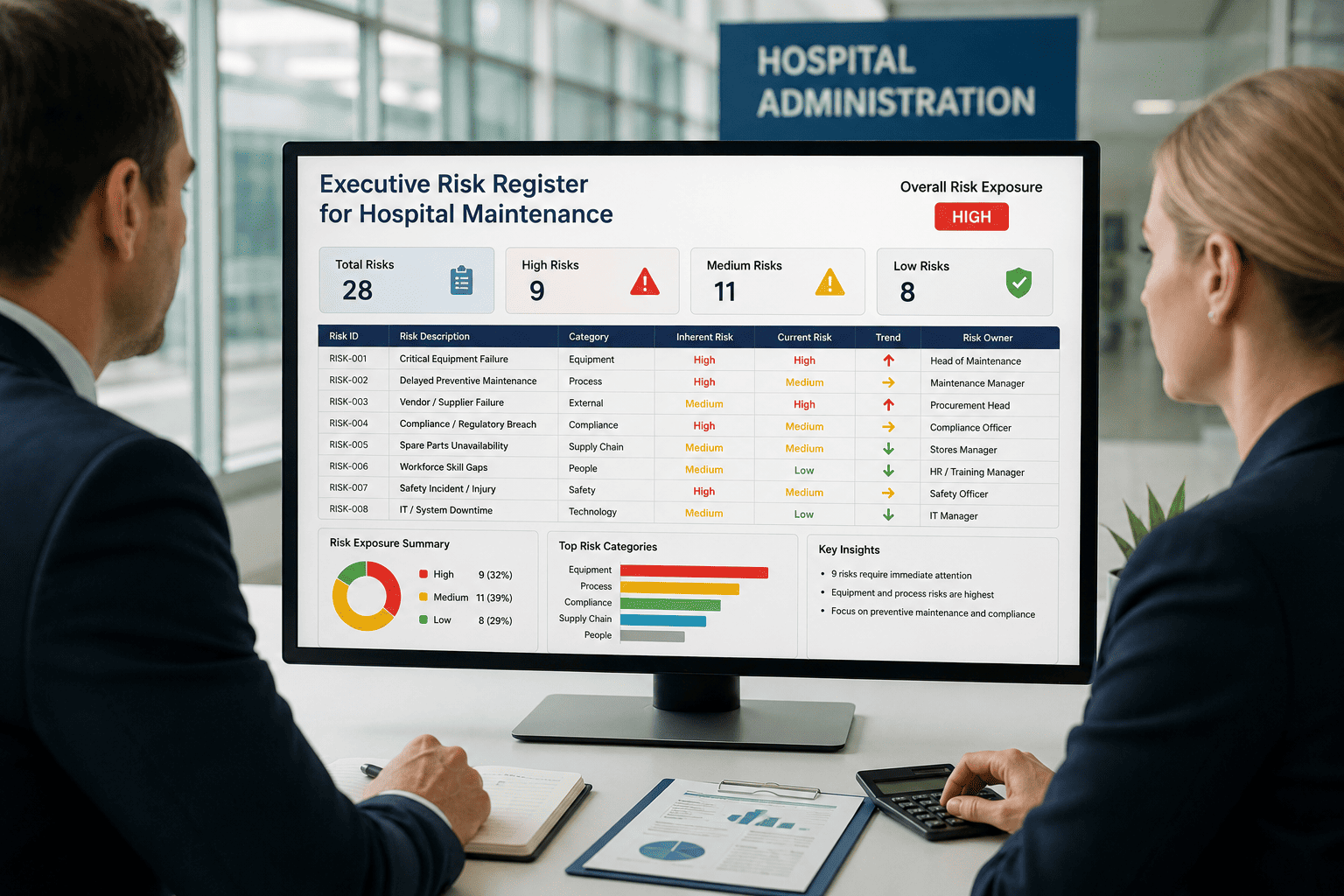
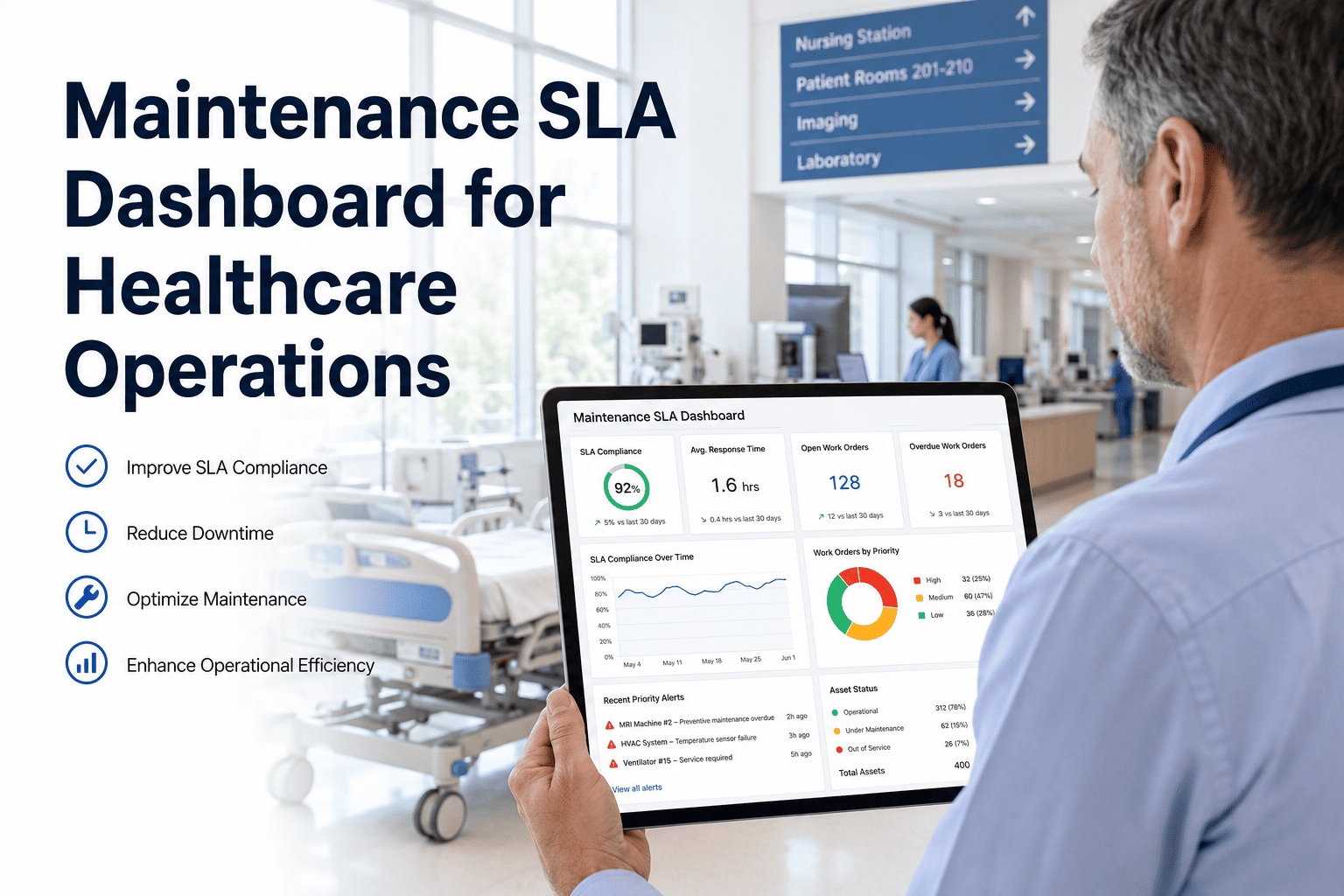
OxMaint gives maintenance directors a live risk dashboard connected to real work orders — with named owners, severity flags, and escalation rules built in. Your entire open risk log, on one screen, from any device.
Expert Review
What Maintenance Directors Say About Facility Risk Tracking
"I used to walk into our weekly ops meeting knowing we had open risks but not being able to quantify them. With a live CMMS risk log, I now present a numbered list with owners and target dates every week. Leadership trusts the process because they can see it."
Director of Plant Operations, 380-bed Community Hospital
Healthcare facility management, 18 years
"Regulators don't expect zero open risks. They expect you to know what they are, who owns them, and what you are doing about them. A live, documented risk log is the difference between a citation and a compliant finding."
CHFM Certified Facility Manager, Multi-Site Health System
TJC and CMS survey preparation lead, 14 years
OxMaint vs. Manual Tracking
Comparing Risk Log Management Approaches
| Capability |
Spreadsheet / Paper |
OxMaint Risk Log |
| Real-time status update |
Manual re-entry required |
Auto-updates from work order progress |
| Named ownership |
Static field, often outdated |
Live technician assignment with contact |
| Escalation on breach |
Relies on director to notice |
Automatic alert when SLA breached |
| Survey export |
Print or email, manual format |
One-click export, timestamped, audit-ready |
| Work order linkage |
Not connected |
Each risk row links to live work order |
| Deferred risk documentation |
Free-text, inconsistent |
Structured fields with approval and date |
| Mobile access |
Office-only in most cases |
Full access from any Android or iOS device |
FAQs
Common Questions About Hospital Maintenance Risk Logs
Does a hospital maintenance risk log satisfy the Joint Commission's requirement for an active deficiency tracking program?
A structured, documented risk log connected to work orders is exactly what the Joint Commission Environment of Care chapter expects under its deficiency tracking requirements. The log must show that risks are identified, assessed, owned, and progressed toward resolution — not just listed. OxMaint's connected risk log satisfies all four requirements with timestamped, exportable records.
Start your free trial and build your compliant risk register from day one.
How does OxMaint prevent a high-severity risk from sitting unowned for too long?
OxMaint allows maintenance directors to configure severity-based escalation rules — for example, any High-severity risk without a named owner after 4 hours triggers an automatic push alert to the facilities supervisor. Any critical risk unacknowledged after 1 hour escalates to the director. The system enforces the response protocol so individual judgment calls never let a critical item fall through the gap.
Book a demo to see escalation rule configuration in action.
Can OxMaint's risk log be used to prepare for unannounced CMS surveys as well as scheduled Joint Commission surveys?
OxMaint's risk log is always current and always exportable — making it equally effective for unannounced CMS surveys as for planned Joint Commission reviews. Because the log updates in real time from work order progress, the view a director sees on Monday morning is the same view available during a Friday afternoon surprise inspection. No compilation, no reconstruction, no delay.
What is the right frequency for a maintenance director to review the open risk log with hospital leadership?
Best practice across accredited hospital systems is a weekly risk log review with the VP of Operations or Patient Safety Officer — covering all High and Critical open items, deferred item rationale, and closure rate trends. Monthly reviews with the EOC committee should cover the full log including Medium and Low items. OxMaint's dashboard makes both cadences practical with filtered, role-specific views for each audience.
Try OxMaint free and share your first risk summary with leadership this week.
Your Leadership Team Deserves a Risk Log They Can Actually Trust
OxMaint connects every open facility risk to a live work order, a named owner, and a documented resolution plan. Stop presenting memory-based risk updates. Start showing a live, timestamped dashboard that proves your program is in control.