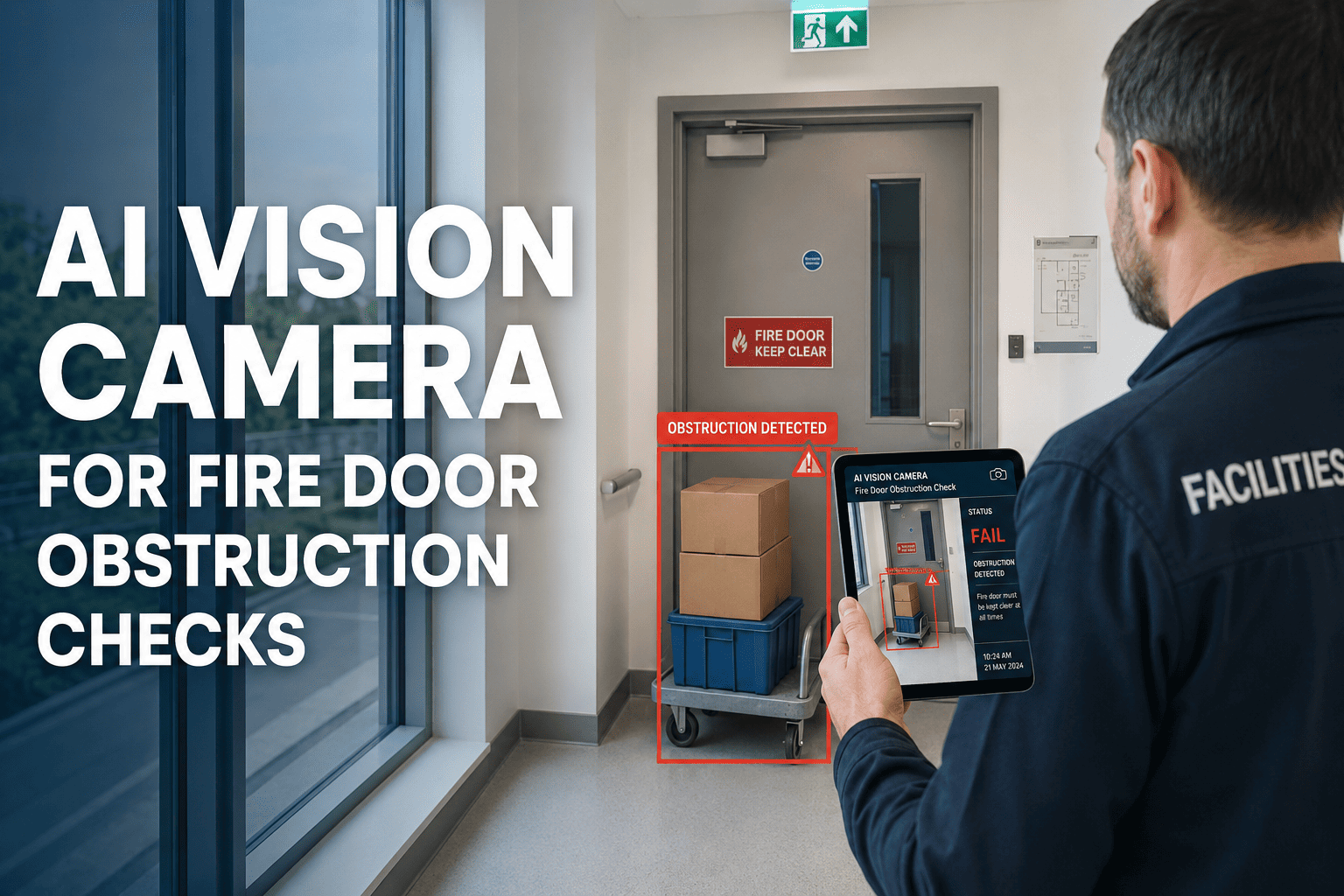
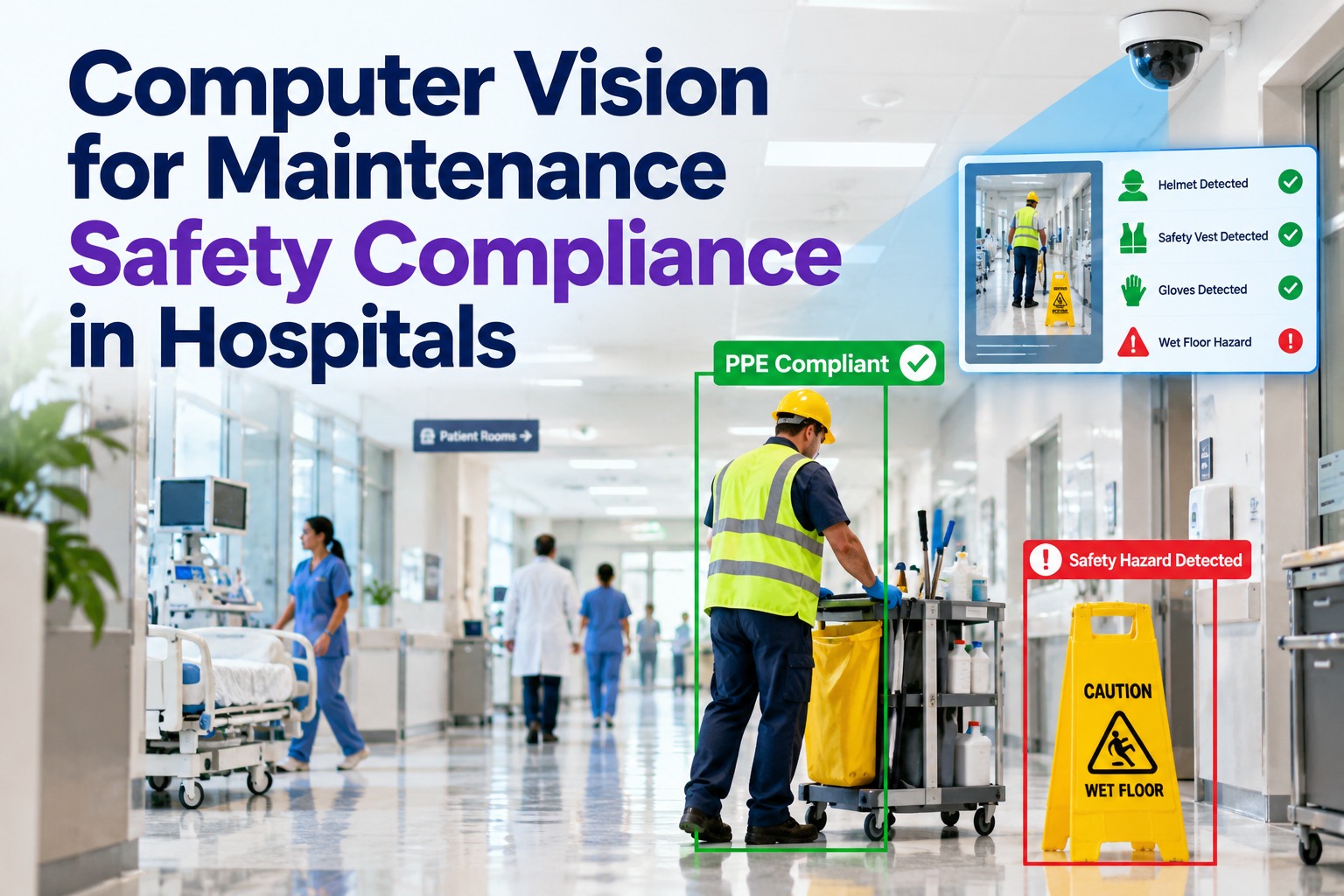
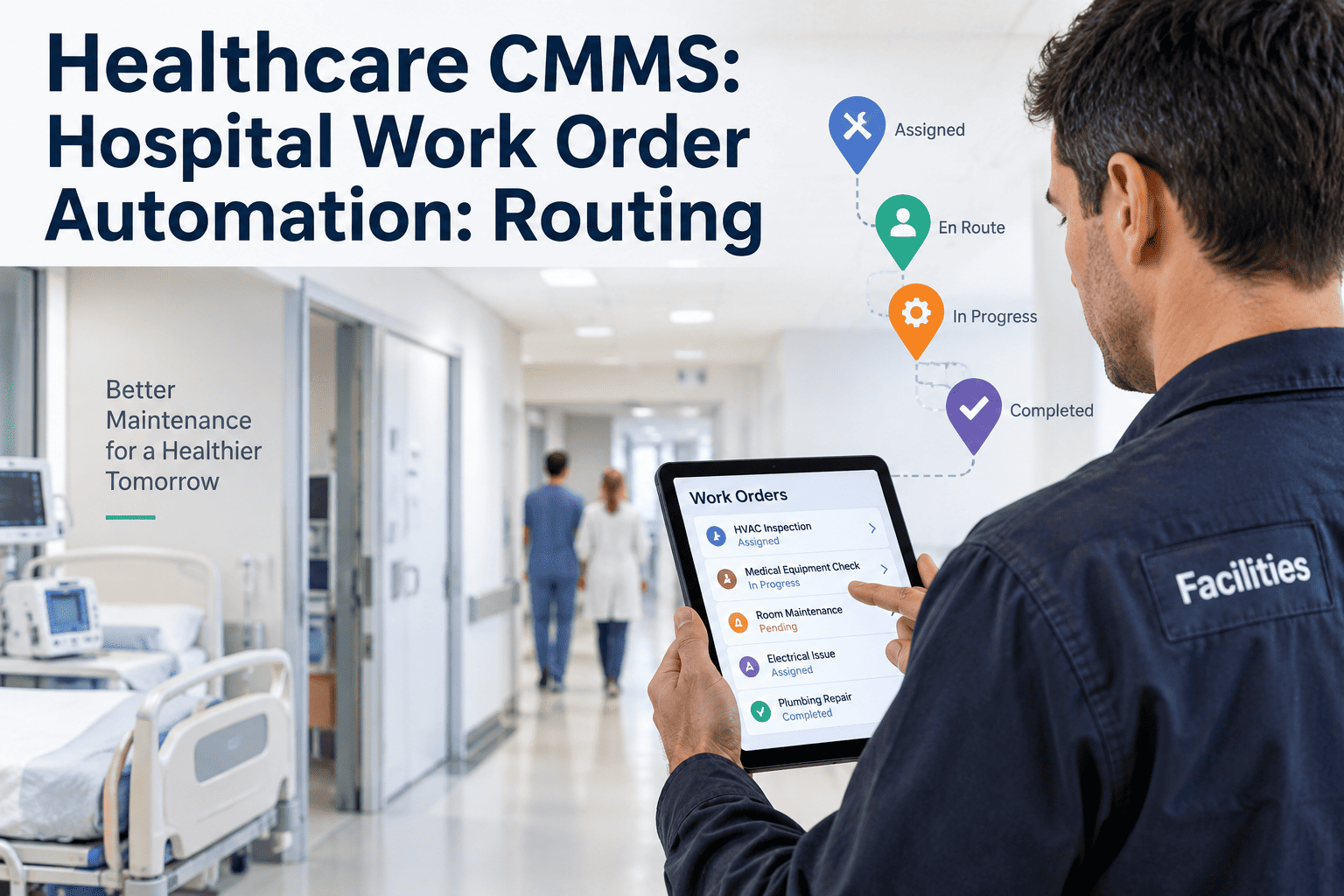
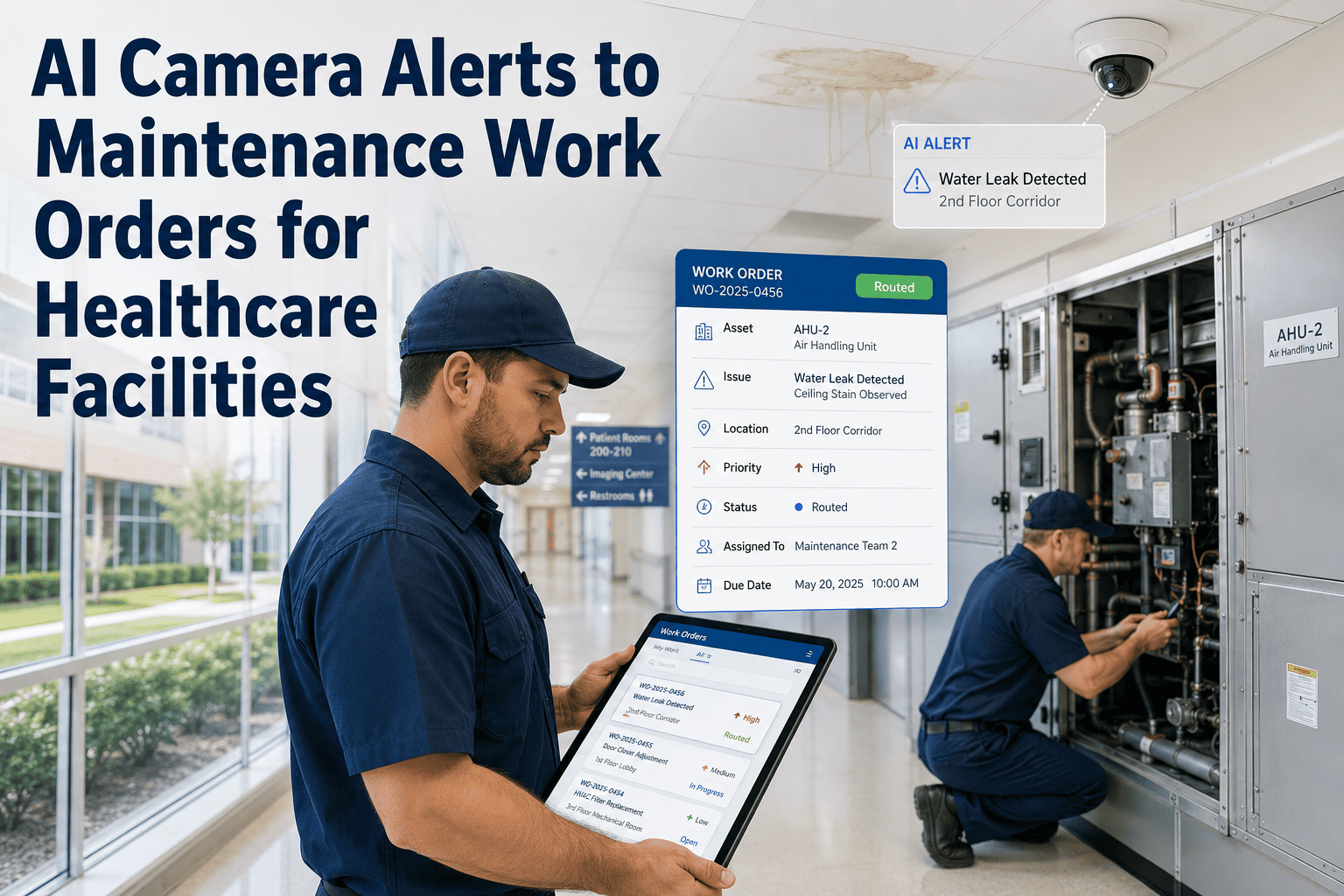
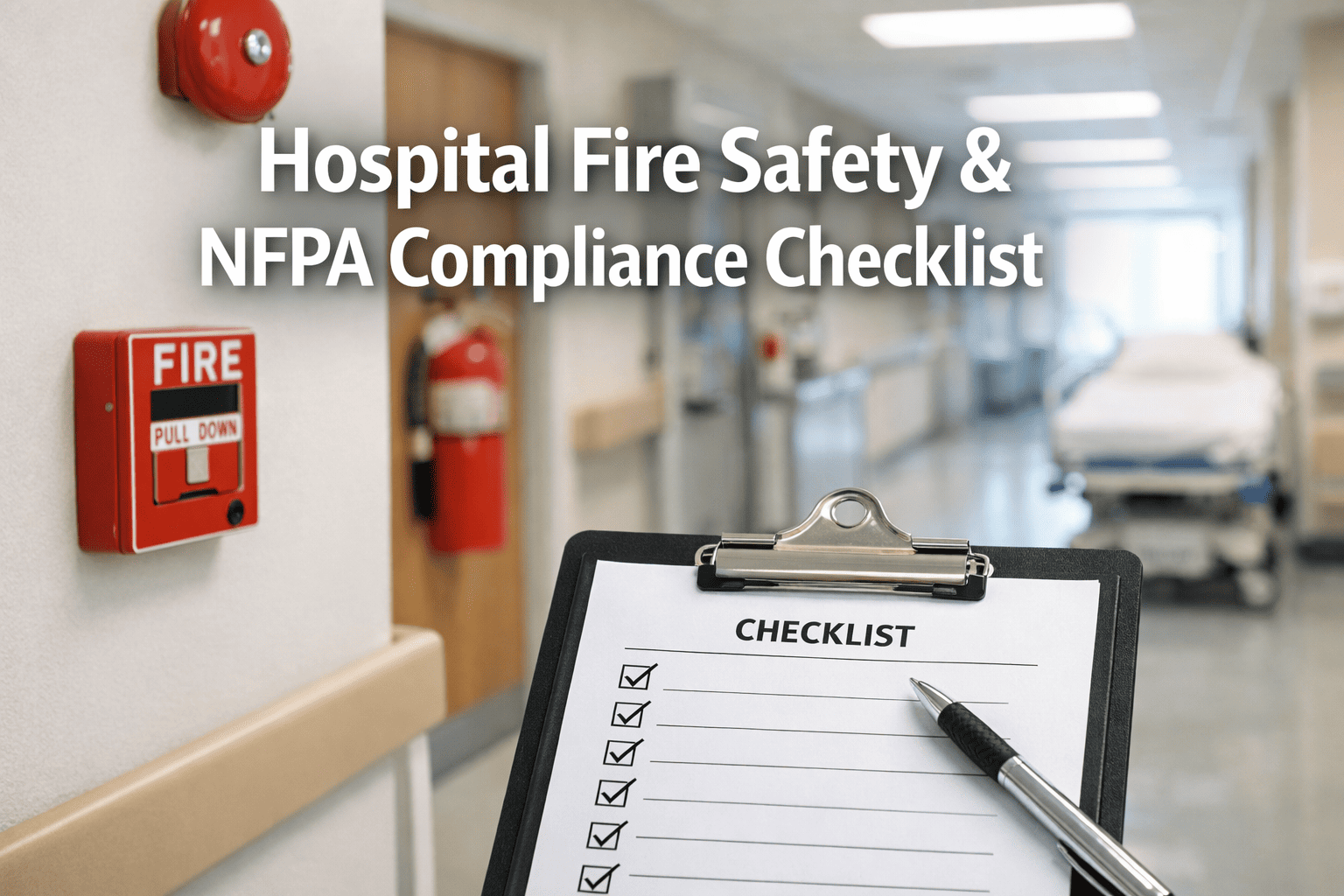
A blocked fire door is not a housekeeping issue — it is a life-safety violation that can cost lives, fail a Joint Commission survey, and expose a facility to immediate regulatory action. In hospitals, care facilities, and large commercial buildings, fire doors and egress paths are checked manually on scheduled rounds. But obstructions happen between rounds: a supply cart parked for twenty minutes, a propped-open door during a busy shift, a corridor blocked by equipment staging. Manual inspection cannot catch what happens in the gaps. OxMaint AI Vision Camera continuously monitors fire doors and egress corridors, detects obstructions the moment they appear, and automatically triggers a corrective work order — so your exits are always clear, and your documentation always proves it. Start a free trial or book a safety demo to see the system live.
AI VISION — LIFE SAFETY
Your Fire Doors Are Only Safe If Someone Is Always Watching
OxMaint AI Vision Camera detects blocked exits and obstructed fire doors in real time — and automatically dispatches a corrective work order before the next inspection round ever begins.
The Gap That Manual Rounds Cannot Close
7:00 AM
Morning round completed — all exits clear
9:20 AM
Supply cart parked against fire door — obstruction begins
11:45 AM
Fire door propped open — egress path compromised
1:00 PM
Afternoon round begins — 4+ hours of undetected risk
With OxMaint AI
Obstruction detected at 9:20 AM — work order raised in 90 seconds
4+ hrs
Average obstruction window between manual rounds
90 sec
OxMaint AI detection-to-work-order dispatch time
24/7
Continuous monitoring — no shift gaps, no missed rounds
How OxMaint AI Vision Works
STEP 1
Camera Deployment
OxMaint AI Vision cameras are installed at fire door locations and egress corridors. Setup is configured to your facility layout — each camera zone is mapped to the relevant asset and location in OxMaint.
STEP 2
Continuous Visual Analysis
The AI model analyzes the camera feed continuously against a baseline clear-path image. Any object, person, cart, or propped door that deviates from the baseline triggers an obstruction flag — day or night, staffed or unstaffed.
STEP 3
Instant Work Order
The moment an obstruction is confirmed, OxMaint automatically creates a corrective work order assigned to the appropriate team. The work order includes a timestamped image of the obstruction — evidence captured at the point of detection.
STEP 4
Resolution & Documentation
The assigned team clears the obstruction and closes the work order with a resolution photo. The complete detection-to-resolution record is stored against the fire door asset — fully audit-ready for life-safety surveys and compliance reviews.
FROM DETECTION TO CORRECTIVE ACTION IN 90 SECONDS
Stop Relying on Rounds to Catch What AI Sees Instantly
OxMaint AI Vision Camera closes the gap between manual inspection rounds — automatically detecting obstructions, raising work orders, and building an unbroken compliance audit trail without adding a single person to your team.
What Gets Detected — And What It Means for Your Survey
Blocked Fire Door
Survey finding, potential immediate jeopardy
Work order raised, team dispatched, resolution documented
Propped-Open Fire Door
NFPA 101 violation, smoke compartment breach
Immediate alert, work order with photo evidence, closure record
Obstructed Egress Corridor
Life-safety survey deficiency, evacuation hazard
Corrective work order, time-stamped detection, audit trail entry
Equipment Staged in Exit Path
Code violation, AHJ citation risk
Detection image captured, work order assigned, resolution verified
Repeated Obstruction Pattern
Systemic compliance failure, behavioural risk
Pattern flagged in reporting, escalation to life safety manager
Built for the Life Safety Manager
Survey Readiness — Always On
Every obstruction event is timestamped, photographed, work-ordered, and resolved — with documentation stored against the fire door asset. When a surveyor asks for compliance evidence, the record is already there. Not assembled the night before.
No Additional Rounding Staff
AI Vision replaces the gaps between manual rounds — not the rounds themselves. You maintain human oversight at the intervals your protocol requires, while the camera closes the hours in between. Same team, tighter coverage.
Pattern Reporting for Root Cause
When the same fire door generates repeated obstruction events, OxMaint flags the pattern. You can address root cause — staff behaviour, workflow routing, storage practices — rather than responding to the same location indefinitely.
Multi-Location Visibility
For health systems and multi-site facilities, OxMaint provides a unified view of obstruction events, open work orders, and compliance status across every location — from a single dashboard, without physical presence at each site.
Compliance Standards OxMaint AI Vision Supports
NFPA 101
Life Safety Code
Requires egress paths to be clear and unobstructed at all times. Continuous AI monitoring provides demonstrable compliance between inspection rounds.
TJC EC.02
Joint Commission Environment of Care
EC.02.06.01 requires fire door inspection and maintenance programs. AI-detected events and corrective work orders satisfy documentation requirements for ongoing compliance evidence.
CMS LSC
CMS Life Safety Code Survey
CMS surveyors assess whether facilities can demonstrate continuous life-safety management. An AI-generated audit trail of every obstruction event and corrective action is stronger evidence than a schedule of rounds.
IBC / IFC
Building & Fire Codes
International Building and Fire Codes require unobstructed means of egress. Timestamped detection records and corrective action documentation support AHJ inspections and insurance reviews.
Frequently Asked Questions
How does the AI distinguish between a temporary obstruction and normal foot traffic?
OxMaint AI Vision uses configurable dwell-time thresholds. A person walking past a fire door does not trigger an alert. A cart parked against the door for more than your defined threshold — typically 60 to 120 seconds — triggers the obstruction flag and work order. Sensitivity and thresholds are set per camera zone during onboarding.
Book a demo to configure thresholds for your facility.
Does OxMaint AI Vision work in low-light or night conditions?
Yes. OxMaint AI Vision cameras support low-light operation for coverage in overnight periods, unstaffed wings, and dimly lit corridors. Detection accuracy is maintained across lighting conditions so compliance monitoring does not have a shift pattern.
How does the corrective work order reach the right person?
Work orders are assigned based on the location and shift schedule configured in OxMaint. The assigned technician or safety officer receives an immediate notification. Escalation rules can be set so that unacknowledged work orders are escalated to the life safety manager within a defined time window.
Set up your escalation workflow in a free trial.
Can AI Vision detection records be used as evidence in a Joint Commission survey?
Yes. Every obstruction event in OxMaint includes a timestamped photo, a linked corrective work order, resolution documentation, and a full audit trail stored against the fire door asset. This constitutes a continuous compliance record that surveyors can review directly — stronger evidence than a round-based log that shows only what was checked, not what was detected and corrected.
How many cameras are needed for a typical hospital floor?
Camera placement is scoped during the facility onboarding process based on your floor plan, fire door locations, and egress path map. Most facilities require one camera per fire door or egress zone. OxMaint's team works with your life safety manager to determine the minimum effective coverage footprint before any hardware is deployed.
OXMAINT AI VISION — FIRE DOOR COMPLIANCE
Every Exit Clear. Every Obstruction Documented. Every Survey Passed.
OxMaint AI Vision Camera continuously monitors fire doors and egress corridors, detects obstructions the moment they appear, and automatically creates corrective work orders — so your facility is compliant every hour of every day, not just during rounds.