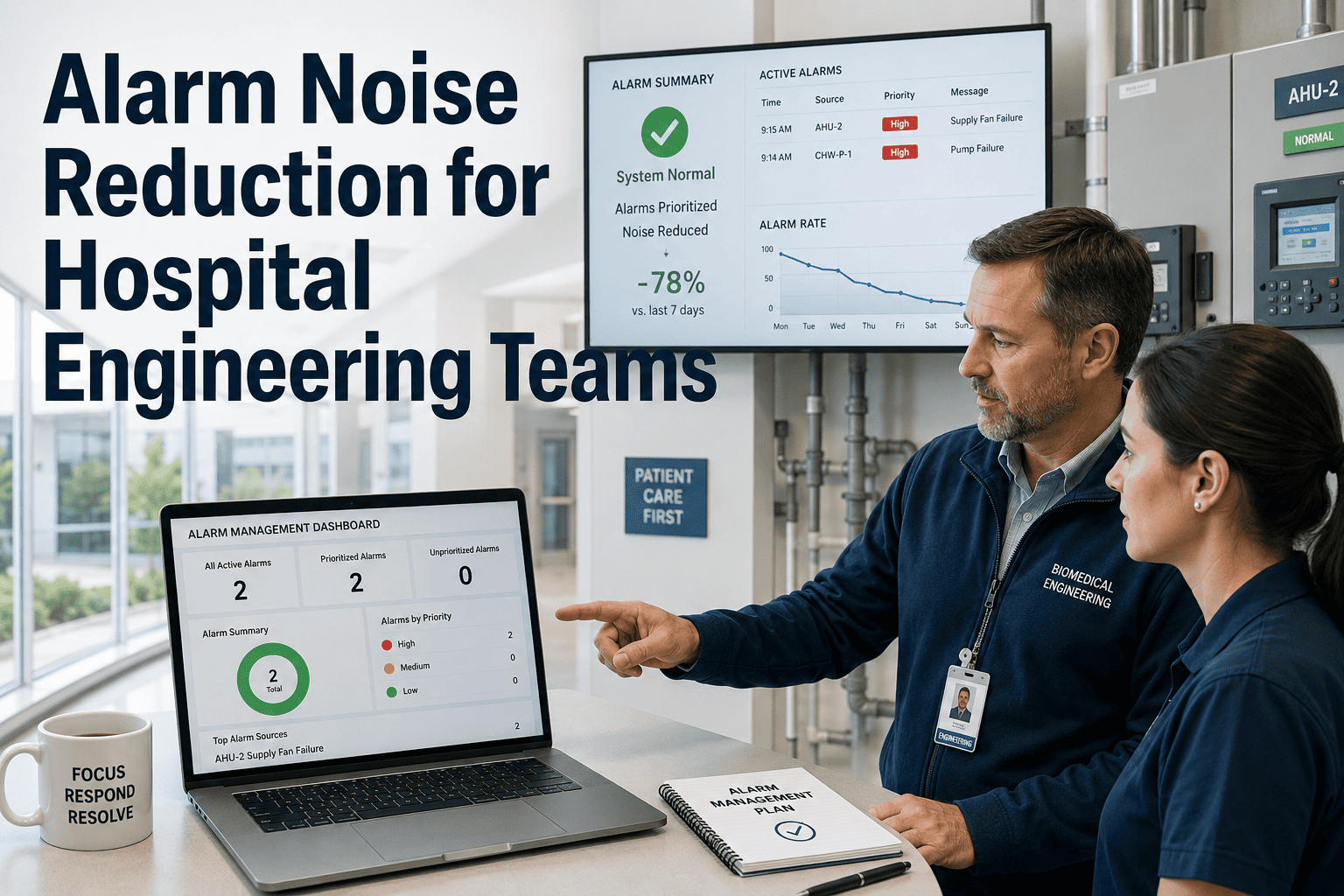
Hospital engineering teams are drowning in alarms — and most of them are noise. Studies consistently show that up to 85–99% of hospital alarms are false or clinically insignificant, and the same pattern plays out in facility systems: BMS alerts, sensor notifications, and equipment warnings stack up faster than any team can triage them. When every alert looks the same urgency, real failures hide in the queue until they become emergencies. Alarm noise reduction is not about ignoring alerts — it is about building a system that surfaces what actually matters, assigns the right response, and creates a traceable record for every action taken. OxMaint gives hospital engineering teams a structured layer between raw alarm feeds and maintenance action — filtering noise, prioritizing real faults, and converting genuine alerts into assigned, evidenced work orders. Book a demo to see how OxMaint reduces alarm fatigue and speeds real response.
Alarm Noise Reduction for Hospital Engineering Teams
From alarm flood to filtered, prioritized, and assigned maintenance action — with asset history, escalation rules, compliance evidence, and healthcare reports built in.
Why Alarm Volume Becomes a Patient and Asset Safety Risk
High alarm volume creates a paradox: the more alerts a team receives, the less attention each one gets. This is alarm fatigue — and in a hospital engineering environment, it has direct consequences on asset uptime, compliance, and ultimately, care delivery.
The Five-Layer Alarm Management Approach
Alarm Management Outcomes: Unmanaged vs. OxMaint
| Factor | Unmanaged Alarm Queue | With OxMaint |
|---|---|---|
| Alert visibility | All alarms mixed — no priority differentiation | Prioritized by asset criticality, instantly |
| Duplicate alerts | Same fault generates repeated alerts across shifts | Deduplicated — one work order per fault |
| Escalation | Manual — supervisor notified by phone or not at all | Automatic — SLA-triggered, timestamped |
| Technician assignment | Manual triage, delayed dispatch | Auto-assigned based on skill and zone |
| Compliance evidence | Inconsistent — depends on individual logging | Automatic — every alarm has a full audit trail |
| Repeat fault visibility | Not tracked — same asset alarms repeatedly | Repeat alarm patterns flagged for root cause |
What Hospital Engineering Leaders Say
We were getting over 400 BMS alerts a day and actioning maybe 30 of them. The rest got lost or ignored. The problem wasn't our team — it was the system. Once we moved to a structured alarm management layer that filtered duplicates and scored by asset criticality, our real fault response time dropped from hours to minutes. Everything that mattered reached someone who could act on it.
Audit findings on alarm response were a recurring problem for us — not because faults weren't fixed, but because there was no consistent record that they had been. Structured alarm-to-work-order management gave us that record automatically. Now every alarm has a response timestamp, a technician signature, and a closure note. The auditors haven't found a gap since.
Frequently Asked Questions
What types of hospital building systems does OxMaint connect to for alarm management?
OxMaint integrates with BMS, HVAC control systems, fire and life safety alarm panels, IoT sensor feeds, and equipment monitoring platforms via standard API and direct connector. Alarm intake is configurable to your specific building system stack without replacing existing infrastructure. Book a demo to review your specific system setup.
How does OxMaint distinguish between a nuisance alarm and a genuine fault that needs a work order?
OxMaint applies asset criticality scoring and configurable threshold rules to each incoming alarm. Alarms from mission-critical assets — sterile HVAC, medical gas, critical power — are always escalated. Patterns of repeated low-level alerts from the same asset trigger a root cause review task rather than a repeat dispatch. Start free to configure your alarm triage rules.
Can OxMaint help us meet Joint Commission alarm management standards?
Yes — OxMaint's alarm-to-work-order workflow produces a timestamped, auditable record for every actionable alarm, including detection time, assignment, response, and closure. This evidence chain meets the documentation requirements of TJC's National Patient Safety Goals on alarm management and supports ongoing survey readiness. Book a demo to see the compliance report view.
How does alarm noise reduction improve engineering team performance over time?
When engineers trust that alerts reaching them are real and prioritized correctly, response engagement improves immediately. Over time, repeat alarm pattern analysis identifies chronic equipment issues — assets that generate recurring alerts are flagged for root cause investigation rather than infinite repeat dispatches, reducing total alarm volume structurally. Start free to build your repeat alarm report.
Replace Alarm Fatigue with Alarm Confidence
OxMaint turns your engineering team's alarm queue from an overwhelming wall of noise into a prioritized, assigned, and evidenced maintenance workflow — so every real fault gets a real response, on record.

.png)
.jpg)
