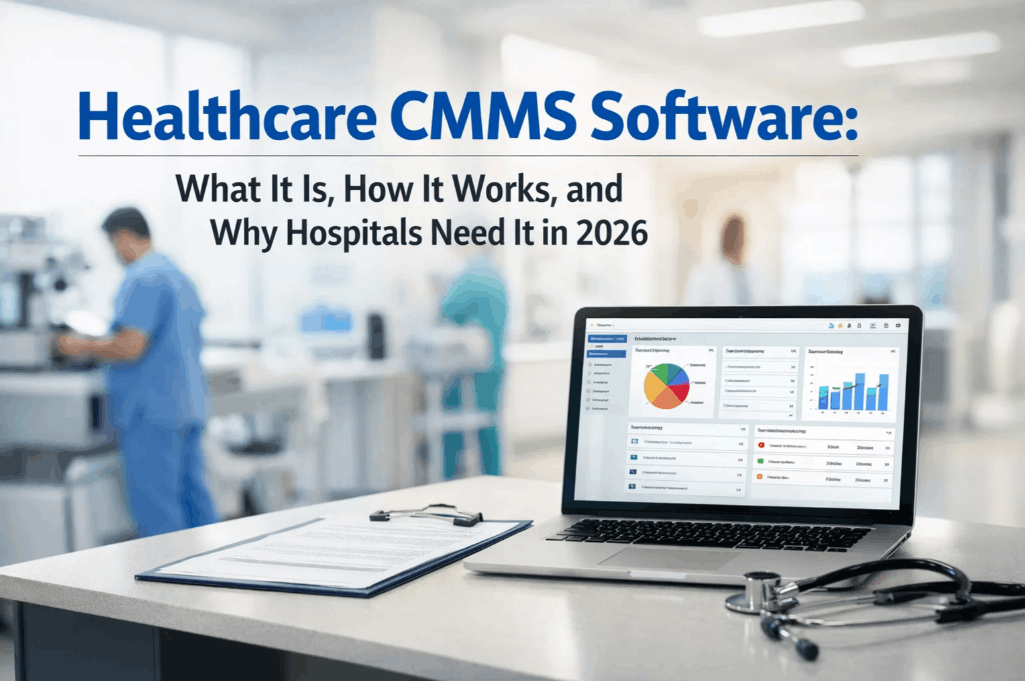
Managing work orders in a hospital or clinic is not a back-office function — it is a direct line to patient safety, regulatory compliance, and operational budget control. When maintenance requests go untracked, technician assignments are made verbally, or PM schedules are managed in spreadsheets, the consequences show up in Joint Commission findings, equipment failures during critical procedures, and budget overruns that cannot be explained. This page is for healthcare facility directors, biomedical engineering leads, and operations managers who are ready to fix the foundation. Want to see how it works in practice — start a free trial for 30 days and book a demo to walk through the healthcare workflow live.
68%
Of hospital maintenance teams still rely on paper or spreadsheet-based work order tracking
4.8x
More expensive to handle emergency repairs than scheduled preventive maintenance
42%
Of Joint Commission findings relate to inadequate equipment maintenance documentation
31%
Faster technician response times reported after adopting automated work order assignment
What Is Healthcare Work Order Management Software?
Healthcare work order management software is a purpose-built digital system that captures, assigns, tracks, and closes every maintenance request across a medical facility — from a broken IV pump in a patient room to a scheduled PM on a CT scanner in radiology. Unlike generic ticketing tools or consumer-grade task apps, healthcare CMMS platforms are built around medical equipment compliance requirements, biomedical technician workflows, and the audit documentation standards set by The Joint Commission and CMS. The result is a closed-loop maintenance operation where nothing gets lost, nothing gets skipped, and every action is timestamped and traceable. If you are evaluating options for your facility, start a free trial to explore the platform with your own asset data, or book a demo and we will walk through a healthcare facility configuration together.
Four Core Functions of a Healthcare Work Order System
Request Capture and Triage
Centralize all maintenance requests from clinical staff, nursing, and facilities in one queue — prioritized by urgency and department
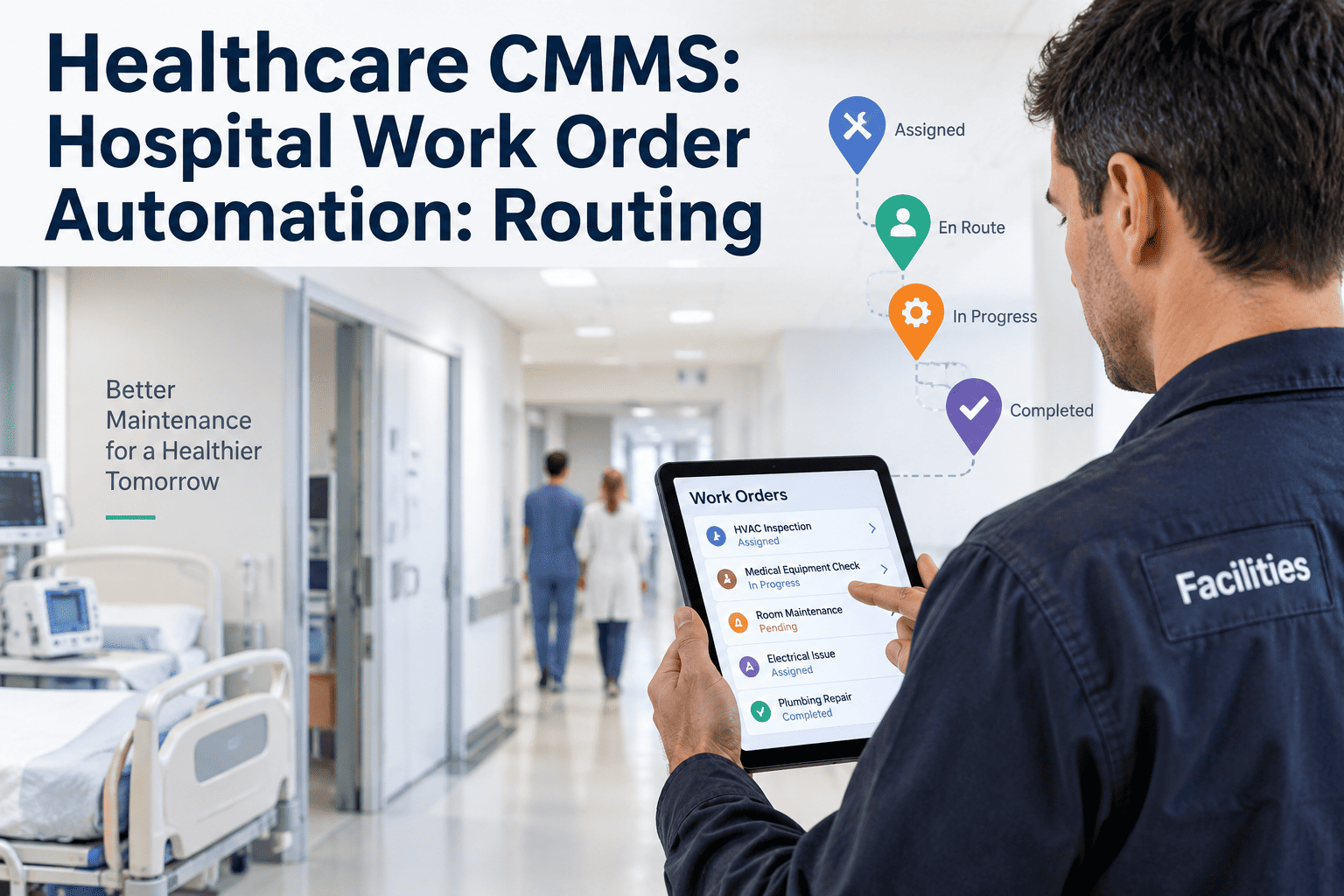
Technician Assignment and Dispatch
Auto-assign work orders to qualified technicians by skill set, location, and availability — no verbal handoffs, no lost requests
Execution Tracking and Documentation
Technicians log parts, time, and resolution notes from mobile — creating an automatic audit trail with timestamps and digital signatures
PM Scheduling and Compliance Reporting
Preventive maintenance schedules are tied to asset records and auto-generate work orders — with compliance dashboards ready for inspections
Key Concepts: The Work Order Lifecycle in a Medical Facility
Understanding how a work order moves from request to resolution — and why each stage matters in a clinical environment — is essential for evaluating any healthcare CMMS platform. Each phase carries compliance weight and operational consequence. Poor handoffs at any stage compound into risk. The lifecycle below reflects best-practice healthcare maintenance operations, and you can see how Oxmaint maps to each stage when you start your free trial or book a demo with our healthcare operations team.
01
Request Submission
Clinical or facilities staff submit a maintenance request via mobile, QR code scan, or web portal. Request is timestamped and queued immediately.
02
Priority Classification
System classifies by urgency: life-safety critical, clinical impact, compliance risk, or routine. Priority drives assignment speed and escalation rules.
03
Technician Assignment
Work order is routed to the right technician by skill set, certification, shift, and proximity. Biomedical vs. facilities split is maintained automatically.
04
On-Site Execution
Technician receives work order on mobile with asset history, PM notes, and parts inventory. Completes checklist steps with photo documentation.
05
Parts and Labor Logging
Parts used are pulled from spare parts inventory in the system. Labor hours logged against the work order. Cost is tracked to the asset record automatically.
06
Closure and Sign-Off
Work order is closed with digital signature. Resolution notes, before/after photos, and compliance checklist confirmation are stored in the asset record.
07
Asset Record Update
Completed work order automatically updates asset condition score, maintenance history, and next PM due date — no manual data entry required.
08
Compliance Reporting
Every closed work order feeds into real-time PM compliance dashboards. Joint Commission or CMS audit reports are available on demand, not scrambled together during a survey.
Why Hospital Work Order Management Breaks Down Without the Right System
Most healthcare facilities do not have a work order management problem — they have an infrastructure problem. The tools being used were never built for the complexity of a medical environment. Understanding where the breakdown happens is the first step toward fixing it. If any of these resonate with your current operation, it is worth taking 30 minutes to start a free trial or book a demo to see what a purpose-built system looks like.
Verbal Handoffs
No Formal Request Record
When clinical staff report equipment issues verbally to the nearest technician, there is no timestamp, no priority classification, and no accountability. Studies show 23% of verbal maintenance requests are never actioned.
Spreadsheet Tracking
Backlogs Hidden in Files
Excel-based work order logs are not visible to clinical staff, do not auto-escalate overdue tasks, and require manual updates that are always running behind — creating an invisible backlog that surfaces only during inspections.
No PM Integration
Preventive and Reactive Are Siloed
When reactive work orders live in a different system than PM schedules, technicians are constantly triaging without full context. Missed PMs are only discovered when equipment fails or a survey is scheduled.
Paper Documentation
Compliance Gaps at Audit Time
Paper maintenance records are lost, incomplete, or illegible. 42% of Joint Commission findings in facilities management relate to documentation gaps — a problem that is entirely preventable with digital work order management.
No Asset Linkage
Work Orders Without Equipment History
When a technician repairs the same HVAC unit for the fourth time in a year without access to prior repair history, they are solving symptoms, not root causes. Repeated failures on aging assets inflate maintenance spend by an estimated 35%.
Zero Visibility for Leadership
Managers Flying Blind on Workload
Without a live dashboard, facilities directors cannot see open work order volume, average closure time, or which departments are generating the highest maintenance load — making resource allocation decisions purely reactive.
No Mobile Capability
Technicians Returning to Desk to Log Work
When technicians must return to a computer terminal to log completed work, documentation lags by hours or days. Details are forgotten, parts are miscoded, and labor hours are estimated — all creating inaccurate cost data.
Multi-Site Fragmentation
Each Facility Operates in Isolation
Health systems managing multiple clinics or campuses often have each site using different tools or processes. There is no portfolio-level view of PM compliance, backlog, or asset risk — making system-wide performance management impossible.
How Oxmaint Automates Healthcare Work Order Management
Oxmaint is built to handle the full complexity of medical facility maintenance — from a single hospital department to a multi-site health system with dozens of properties. The platform connects work orders, asset records, PM schedules, compliance documentation, and CapEx forecasting in one system — so your team is always working from the same source of truth. Start seeing results in weeks, not months — start a free trial for 30 days with no implementation fees, or book a demo to see it configured for a healthcare environment.
Request Management
Centralized Work Order Intake Across All Departments
Clinical staff submit requests via mobile, QR code, or web portal. All requests land in one managed queue — prioritized, timestamped, and never lost. Average response time drops 31% within 60 days.
Smart Assignment
Auto-Routing to Qualified Technicians
Work orders are assigned based on technician skill set, certification, shift availability, and location. Biomedical and facilities work streams stay separated automatically. No more verbal dispatch or missed assignments.
PM Integration
Preventive Maintenance Tied to Every Asset Record
PM schedules are generated from asset data — triggered by runtime hours, cycles, or calendar intervals. Missed PMs auto-escalate with supervisor alerts. Nothing deferred without a documented approval chain.
Mobile Execution
Technicians Work Entirely From Mobile
Field staff receive, action, and close work orders on mobile — with full asset history, compliance checklists, parts logging, and photo capture built in. No paper. No data entry lag. No missing records.
Compliance Documentation
Joint Commission-Ready Records at All Times
Every work order generates a digital audit record with technician signature, timestamp, parts used, and resolution notes — formatted for Joint Commission, CMS, and accreditation body review. Survey-ready every day, not just during announced inspections.
Asset Intelligence
Work Orders Linked to Full Equipment History
Every work order is attached to the asset record — so technicians arrive with full repair history, part numbers, warranty status, and condition score. Repeat failures trigger root-cause flags automatically, not after the fourth incident.
Operations Dashboard
Live Work Order Visibility for Facility Directors
Real-time dashboards show open work order volume, technician workload, average closure time, PM compliance rate, and backlog by department. Directors manage by data, not by walking the floor asking for updates.
Multi-Site Management
Portfolio View Across All Facilities
Health systems managing multiple hospitals, clinics, or campuses get a unified view of work order performance, PM compliance, and asset risk across every site — with the ability to drill into any property in two clicks.
Manual vs. Automated: The Operational Reality Compared
The performance gap between manual work order management and a purpose-built healthcare CMMS is not marginal — it is structural. Teams using automated systems consistently outperform on response time, PM compliance, documentation quality, and cost per work order.
Ready to Replace Your Work Order Process With Something That Actually Works?
Oxmaint is operational in weeks, not months. No specialist consultants, no heavy implementation fees, and no long onboarding cycles. Import your asset list, configure your PM schedules, and your team is submitting and closing work orders from mobile on day one. Take a look —
start a free trial for 30 days or
book a demo to see the full platform configured for a hospital environment.
ROI and Performance Results
Healthcare facilities that implement a structured work order management platform consistently report measurable operational and financial improvements within the first 12 months. These results reflect outcomes from facilities that moved from manual processes to automated, asset-linked work order management.
31%
Faster average work order response time
Driven by auto-assignment and mobile execution — no verbal dispatch delays
96%
PM compliance rate achieved within 90 days
Up from an average of 67% with manual scheduling systems
$280K
Average annual savings on emergency repair spend
Combination of avoided callout fees, premium parts, and overtime recovery
Zero
Documentation gaps at last Joint Commission review
Facilities using digital work order records report survey-ready documentation on demand
Frequently Asked Questions
What makes healthcare work order software different from a generic CMMS?
Healthcare work order management software is designed around the specific compliance, documentation, and equipment classification requirements of medical facilities. Generic CMMS platforms handle work orders but typically lack Joint Commission-aligned documentation templates, biomedical equipment maintenance classifications, GMP-compliant digital signatures, and life-safety system prioritization rules. Healthcare-specific platforms also integrate with clinical equipment hierarchies — differentiating between biomedical devices, building infrastructure, and life-safety systems — and generate compliance reports in the formats expected by accreditation bodies. A generic system can be forced to approximate these functions, but the operational friction and compliance risk are significant.
How does automated work order assignment improve technician productivity in hospitals?
Manual assignment — where a supervisor receives a request, identifies the right technician, and dispatches them — typically introduces 2–8 hours of delay for non-emergency work orders. Automated assignment eliminates this by routing each work order to the correct technician based on predefined rules: skill certification, current workload, shift schedule, and physical proximity to the asset. The result is a 25–35% reduction in average closure time, which compounds across hundreds of work orders per month. Beyond speed, automation removes the burden of dispatch coordination from supervisors, freeing them to focus on workload management and compliance oversight rather than real-time scheduling logistics.
How does work order software help hospitals pass Joint Commission inspections?
The Joint Commission's Environment of Care and Life Safety chapters require documented evidence that equipment maintenance is being performed on schedule, by qualified personnel, with records of what was done and when. Digital work order management platforms create this evidence automatically — every work order generates a timestamped, signed record that includes the technician, parts used, procedure followed, and resolution notes. PM compliance dashboards show completion rates by asset category, department, and date range. When surveyors request documentation, facilities with a CMMS can pull complete maintenance histories for any asset in minutes. Facilities relying on paper or spreadsheets typically spend weeks preparing for surveys and still present documentation with gaps — which is the primary driver of Environment of Care findings.
Can Oxmaint manage work orders across multiple hospital campuses or clinic sites?
Yes. Oxmaint is built for multi-site healthcare operations — health systems managing 3, 10, or 30+ facilities use the same platform with a unified portfolio view. Each site maintains its own asset registry, PM schedule, technician roster, and work order queue, while directors and operations leadership see a consolidated dashboard across all properties. You can compare PM compliance rates, open work order volumes, average response times, and asset risk scores between facilities — identifying underperforming sites before they become compliance or operational problems. The asset hierarchy (Portfolio, Property, System, Asset, Component) maps directly to health system organizational structures, making multi-site configuration straightforward.
Give Your Maintenance Team the Infrastructure They Need to Operate at the Standard Your Patients Expect
Oxmaint gives hospital and clinic operations teams a purpose-built work order management platform — with automated assignment, mobile execution, PM scheduling, compliance documentation, and multi-site visibility all in one place. No spreadsheets. No verbal handoffs. No documentation gaps. Get up and running in weeks, see measurable results in months —
start a free trial for 30 days or
book a demo with our healthcare team today.
Healthcare-specific work order workflows
Auto-assignment by technician skill and shift
Joint Commission-ready documentation
Mobile-first field execution
PM scheduling tied to asset records
Multi-site portfolio dashboard
5–10 year CapEx forecasting
No heavy implementation or onboarding
.jpg)
.png)