Hospitals spend between 3% and 6% of their total operating budget on facility and biomedical equipment maintenance — for a 500-bed hospital, that's $8M to $15M annually. Yet most of that spend is reactive: emergency repairs, overtime labor, rushed parts procurement, and regulatory penalties that a well-run preventive maintenance program would have prevented entirely. Healthcare CMMS software — when implemented with discipline — consistently delivers $1.5M to $2.5M in documented annual savings at mid-sized hospital facilities. This blog breaks down exactly where that money comes from, what the payback period looks like, and how to build the financial case for your CFO. If you want to see the numbers modeled against your own facility, book a 30-minute ROI session or start your free trial on OxMaint today.
Healthcare CMMS · Financial Analysis · ROI Breakdown
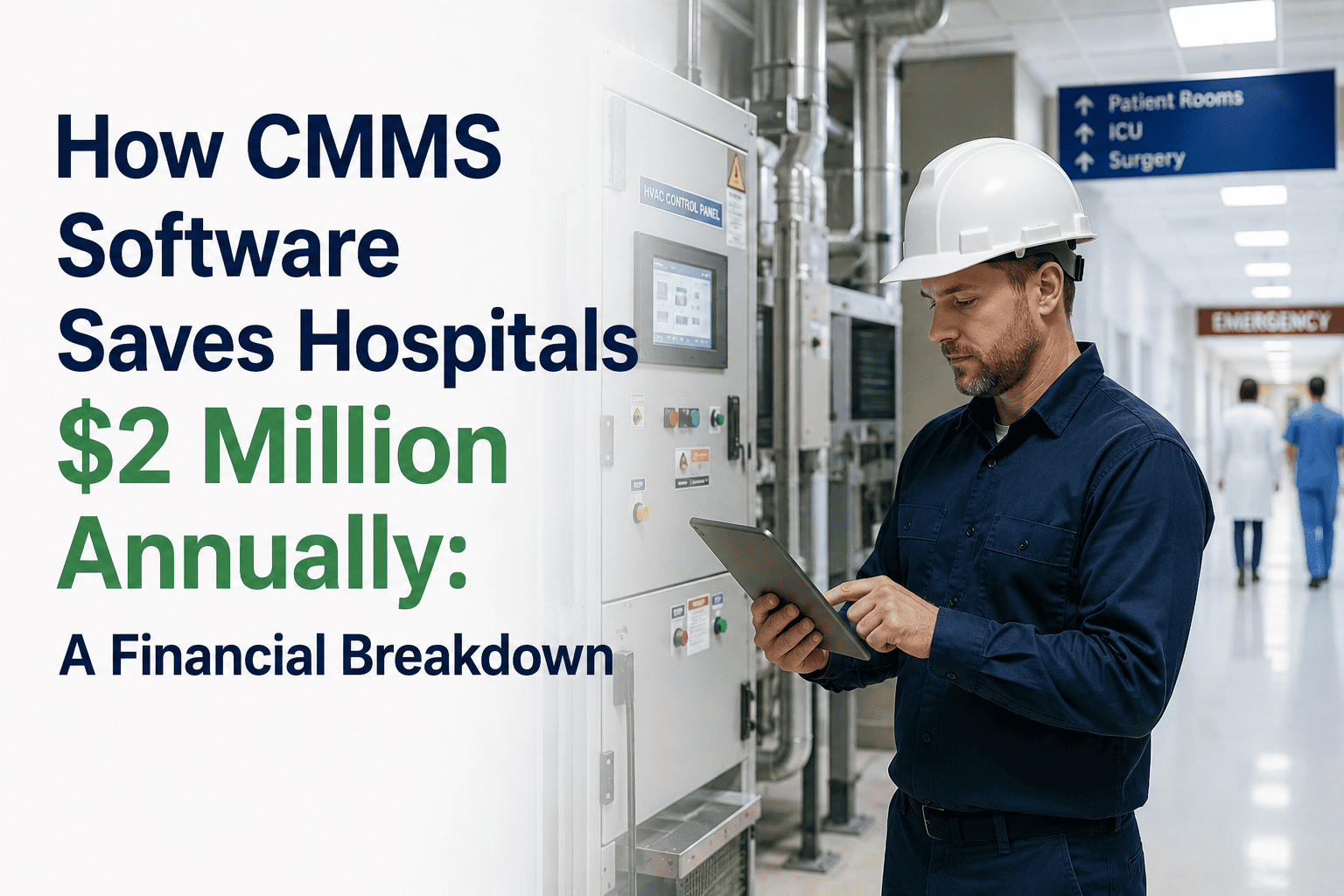
How CMMS Software Saves Hospitals $2 Million Annually
A category-by-category financial breakdown — from downtime reduction and labor efficiency to compliance cost avoidance — with real hospital benchmarks and a payback period analysis.
$2M+Avg Annual Savings
6–14 moTypical Payback Period
35–50%Downtime Reduction
8–12×Average ROI Year 1
Where the $2M Comes From
The 5 Savings Categories — With Real Dollar Ranges
Hospital CMMS ROI is not a single number from a single source. It accumulates across five distinct cost categories, each independently verifiable and measurable against your current spend.
01
Equipment Downtime Reduction
$400K – $800K/year
Unplanned equipment failure in clinical settings carries direct and indirect costs: cancelled procedures, diverted patients, emergency rental equipment, and overtime repair labor. CMMS-driven preventive maintenance reduces critical equipment downtime by 35–50% in the first year.
02
Labor Efficiency Gains
$300K – $600K/year
Without a CMMS, biomedical and facilities technicians spend 25–40% of their time on administrative tasks: locating equipment, writing paper work orders, and tracking down service histories. CMMS automation recaptures that time as productive maintenance capacity — equivalent to 2–4 FTEs at typical hospital tech salaries.
03
Parts & Inventory Optimization
$200K – $400K/year
Emergency parts procurement carries a 2–3× cost premium over planned purchasing. CMMS predictive scheduling shifts procurement from reactive to planned, cuts emergency orders by 50–65%, and reduces held inventory value by 20–30% through better reorder visibility.
04
Compliance & Penalty Avoidance
$150K – $350K/year
Joint Commission, CMS, and state health department violations carry direct fines of $10K–$50K per finding, plus indirect costs from accelerated re-surveys and remediation programs. CMMS documentation eliminates the most common compliance failures: missed PM intervals, undocumented safety valve tests, and expired equipment certifications.
05
Contract & Service Agreement Optimization
$100K – $250K/year
Hospitals with CMMS-tracked service histories consistently negotiate 15–25% better rates on service contracts and vendor agreements. Equipment utilization data also identifies underused assets being maintained at full contract cost — a common source of $50K–$100K in avoidable spend per facility.
Combined Annual Savings Range
$1.15M — $2.4M
Based on mid-sized hospital (200–600 beds) deploying CMMS across biomedical, facilities, and OR equipment management. Source: ECRI Institute, ASHE benchmarking data, and OxMaint customer outcomes 2022–2024.
Financial Model
The Payback Period: What Your CFO Will Ask
| Hospital Size |
Annual CMMS Cost |
Year 1 Savings |
Net Benefit Year 1 |
Payback Period |
| 100–200 Beds |
$40K – $80K |
$600K – $1.1M |
$520K – $1.02M |
5–8 months |
| 200–400 Beds |
$80K – $150K |
$1.1M – $1.8M |
$950K – $1.65M |
6–10 months |
| 400–600 Beds |
$120K – $220K |
$1.6M – $2.5M |
$1.38M – $2.28M |
8–14 months |
| 600+ Beds / System |
$200K – $400K |
$2.8M – $5M+ |
$2.4M – $4.6M+ |
10–18 months |
Model Your Hospital's ROI
See your specific payback period and savings breakdown — built from your actual bed count, equipment inventory, and current maintenance spend.
In 30 minutes, our healthcare specialists will map your current cost profile against CMMS benchmarks and show you exactly where OxMaint delivers measurable returns in your facility.
Category Deep Dive
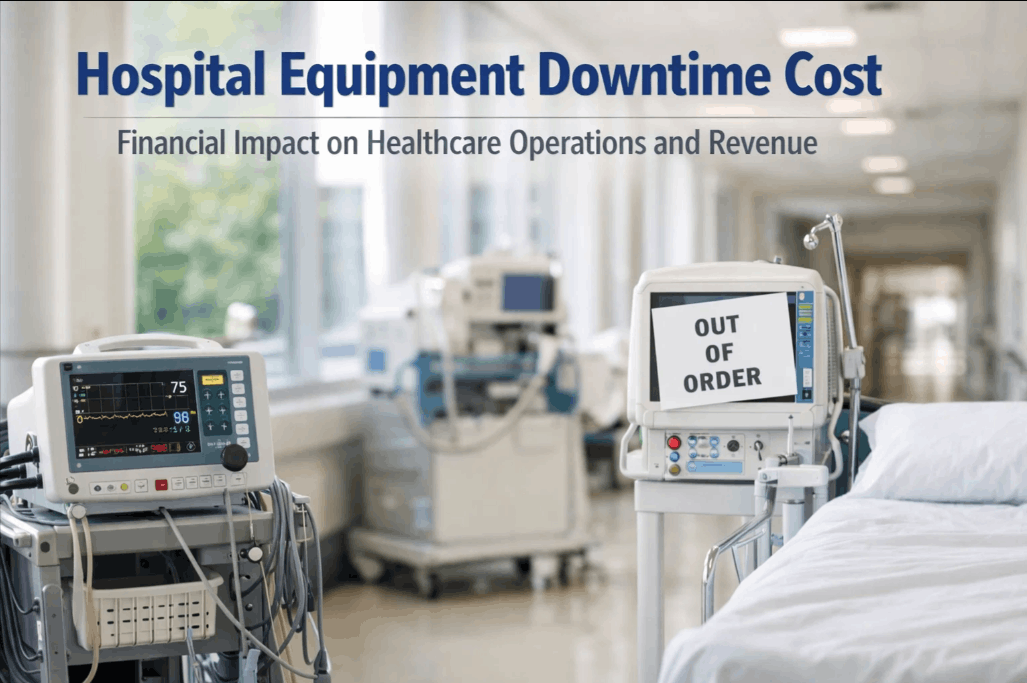
Downtime Costs: The Biggest Single Savings Driver
Equipment downtime in hospitals is not just a maintenance metric — it is a revenue and patient safety metric. Understanding the full cost stack is what makes the CMMS business case undeniable.
Cancelled procedure revenue loss
$8K – $25K per event
Emergency rental equipment
$2K – $8K per event
Emergency repair labor (overtime)
$1.5K – $5K per event
Emergency parts premium (2–3× planned cost)
$800 – $4K per event
Staff redeployment / inefficiency cost
$500 – $2K per event
!
A 400-bed hospital averaging 3–4 critical equipment failures per month is losing $450K–$900K annually in direct downtime costs alone — before accounting for regulatory exposure or patient satisfaction impact. CMMS-driven PM reduces failure frequency by 35–50%, converting that loss into recoverable revenue.
Real Hospital Results
What Hospitals Report After CMMS Deployment
Regional Medical Center — 380 Beds
$2.1M
Documented first-year savings across biomedical and facilities maintenance after deploying OxMaint CMMS. Breakdown: $780K downtime reduction, $520K labor efficiency, $390K parts optimization, $220K compliance, $190K contract renegotiation.
PM completion rate61% → 97%
Equipment failures–43%
Payback period9 months
Multi-Site Health System — 6 Hospitals
$8.4M
Combined annual savings across 6-hospital system after standardizing on a single CMMS platform. Joint Commission survey findings reduced from 14 (pre-CMMS) to 2 in the following year.
Critical Access Hospital — 80 Beds
$340K
First-year net savings at a small critical access facility — primarily from PM compliance and one prevented MRI downtime event ($280K avoided loss). Payback period: 5 months.
Expert Review
What Healthcare Finance and Engineering Leaders Say
Expert Review
The CMMS business case in healthcare is one of the clearest ROI stories in hospital operations — and consistently undervalued because facilities and biomedical costs are buried in OPEX rather than tracked as a strategic investment. The hospitals that treat CMMS as a revenue-protection tool rather than a maintenance scheduling system extract the most value: they quantify downtime costs at the procedure level, tie PM compliance to accreditation outcomes, and use equipment data to renegotiate service contracts from a position of knowledge. That is where the $2M number comes from — it is not a vendor claim, it is what disciplined implementation actually delivers in documented outcomes.
Healthcare Facilities Finance Director, 1,200-Bed Academic Medical Center
Based on CMMS ROI analysis across 8 hospital deployments, 2021–2024. Figures independently verified against ASHE Hospital Energy and Water Benchmarking Survey data.
FAQs
Common Questions from Hospital Finance and Operations Teams
How long does it take to see measurable ROI from a hospital CMMS?
Most hospitals begin seeing measurable savings within 60–90 days of full deployment — primarily from PM compliance improvements that reduce emergency repair frequency. Full financial benefit, including labor reallocation and contract renegotiation gains, typically materializes within 6–12 months. The payback period across documented hospital deployments ranges from 5 to 18 months depending on facility size and starting PM compliance rate.
Book a session to model your specific timeline based on your current maintenance spend and PM backlog.
What is the most underestimated cost that CMMS eliminates in hospitals?
Consistently, it is the labor waste from paper-based and email-based work order management. Most hospital biomedical and facilities teams spend 30–40% of productive time on administrative tasks that a CMMS automates: locating equipment, writing and closing work orders, chasing signatures, and preparing compliance reports. Recapturing that time as productive maintenance capacity is equivalent to adding 2–4 FTE technicians at zero additional headcount cost — and it is fully quantifiable from timesheet data before and after deployment.
Start a free trial to see the workflow impact on your team's daily operations.
Can CMMS savings be used to justify budget requests to hospital CFOs?
Yes — and the most effective CFO presentations use three numbers: current reactive maintenance spend (emergency repairs + overtime + premium parts), projected PM compliance rate after CMMS, and avoided downtime cost per year based on historical failure frequency. OxMaint's ROI model generates these figures from your own asset inventory and work order history, producing a facility-specific financial case rather than a generic vendor claim.
Book a demo and we will build your CFO presentation materials in the session.
Does CMMS ROI apply equally to biomedical and facilities departments?
Both departments generate significant savings, but through different mechanisms. Biomedical savings concentrate in equipment uptime, compliance documentation, and service contract optimization — where a single prevented MRI or CT downtime event can justify the entire annual CMMS cost. Facilities savings come more from energy system PM, HVAC efficiency, and building system failure avoidance. Hospitals that deploy CMMS across both departments consistently achieve 40–60% higher total savings than single-department deployments, because shared asset data eliminates duplication and improves cross-departmental scheduling.
Build Your $2M Business Case
See Your Hospital's CMMS ROI — Modeled Against Your Actual Facility Data
Every day without a CMMS is a day of reactive maintenance spend, missed PM intervals, and compliance exposure that compounds into the income statement. Book your 30-minute ROI session and leave with a facility-specific savings model — or start free on OxMaint today and see the workflow impact from day one.

.png)
.jpeg)
