
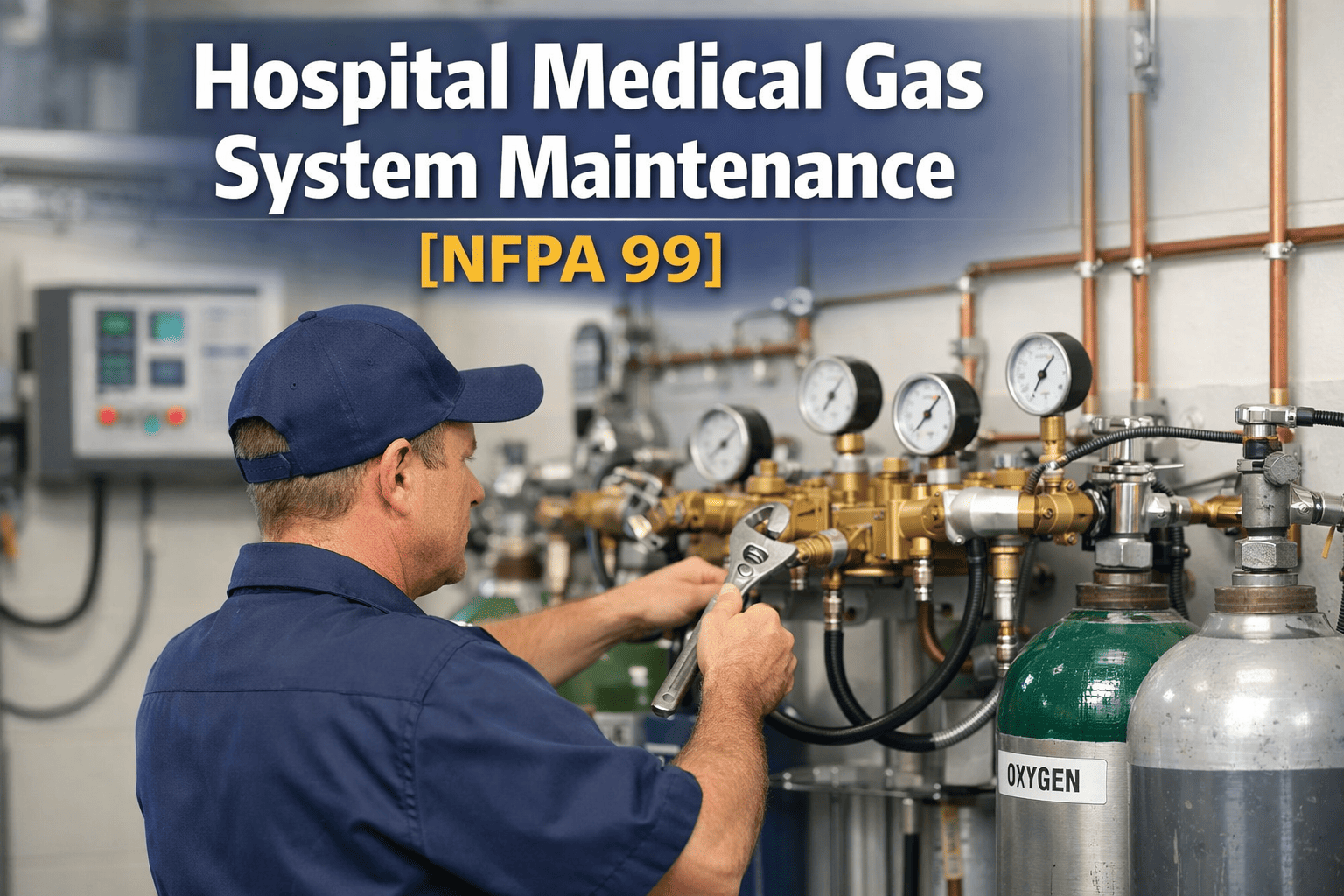
Oxygen systems, medical vacuum, and nitrous oxide delivery are among the most life-critical utilities in any hospital. A single undetected failure in a medical gas system can result in patient harm, immediate NFPA 99 citation, and potential CMS Conditions of Participation suspension. Most incidents are not caused by equipment failure — they are caused by maintenance gaps that were never tracked. OxMaint keeps every PM cycle, deficiency, and compliance log for your medical gas systems in one searchable, audit-ready platform.
Medical Gas System Maintenance Software
Oxygen failures, vacuum outages, and WAGD deficiencies don't announce themselves. Prevent them with scheduled inspections, complete asset history, and automated deficiency tracking built for NFPA 99 Chapter 5.
Every Medical Gas Type. One Maintenance Platform.
Bulk supply, manifolds, zone valves, and alarm panels. Monthly alarm verification, annual zone valve shutoff testing, and pipeline inspection records — all required under NFPA 99 §5.1.
Vacuum pump performance, receiver tank inspection, outlet testing, and exhaust routing. Vacuum system failures are among the most common medical gas deficiencies in Joint Commission surveys.
Compressor maintenance, dew point monitoring, CO monitoring, and purity testing. Medical air for patient breathing is one of the highest-risk systems in the facility — contamination is not visible until harm occurs.
Supply manifold, pressure regulation, and area alarm function testing. N₂O exposure monitoring and ventilation verification in areas of use are required under NFPA 99 and OSHA standards.
WAGD system performance, exhaust flow rate verification, and negative pressure checks at OR pendants and wall outlets. WAGD failures expose staff to anesthetic gas — a serious occupational health risk.
Supply pressure, outlet function, area alarm verification, and storage area ventilation. CO₂ systems in endoscopy and surgical suites have specific NFPA 99 area requirements added in the 2024 edition.
NFPA 99 Medical Gas PM Requirements
NFPA 99 Chapter 5 specifies inspection frequencies for each component of a medical gas system. The table below reflects the minimum requirements from the 2024 edition. OxMaint auto-generates all tasks on the correct schedule from the day your asset is registered.
| Component | Frequency | Key Check Points | NFPA 99 Ref |
|---|---|---|---|
| Master Alarm Panel | Monthly | Alarm activation, signal continuity, indicator lights | §5.1.9 |
| Area Alarm Panels | Monthly | High/low pressure activation, audible/visual function | §5.1.9 |
| Zone Valve Shutoffs | Annual | Shutoff operation, upstream/downstream pressure, labeling | §5.1.11 |
| Bulk Oxygen Supply | Monthly | Tank levels, pressure, manifold integrity, safety relief | §5.1.3 |
| Medical Air Compressors | Quarterly | Dew point, CO levels, oil carryover, filter condition | §5.1.3.5 |
| Vacuum Pumps | Quarterly | Performance curve, receiver pressure, exhaust routing | §5.1.3.6 |
| Pipeline Integrity | Annual | Outlet flow, pressure drop, outlet labeling and color | §5.1.12 |
| WAGD System | Annual | Exhaust flow, disposal interface function, negative pressure | §5.1.3.7 |
Never Miss a Medical Gas PM Again
OxMaint auto-schedules every NFPA 99 required task, routes deficiencies to the right team, and keeps your compliance log survey-ready.
From Finding to Fix — Tracked End to End
Technician marks zone valve non-operational during monthly check via mobile app.
OxMaint opens a corrective action work order with NFPA 99 §5.1.11 reference pre-filled.
Work order routes to the medical gas contractor with due date per your escalation rules.
Completion, repair notes, and technician signature stored in the asset history permanently.
What Facilities Professionals Say
Medical Gas Maintenance Software — FAQ
What are the most commonly cited medical gas deficiencies in hospital surveys?
Joint Commission surveys most frequently cite missing or incomplete alarm panel test records, zone valve shutoff tests that cannot be produced, and medical air purity tests that were conducted but not retained in a retrievable format. In most cases, the underlying maintenance was performed correctly — the citation results from documentation failure, not system failure. A centralized system like OxMaint eliminates documentation gaps by linking every contractor test report to the corresponding asset record automatically.
How does NFPA 99 2024 change medical gas maintenance requirements?
The 2024 edition adds a new requirement for supplementary supply connection capability on essential medical gas systems, directly responding to oxygen supply challenges experienced during COVID-19. It also introduces a new Chapter 15 for dental gas and vacuum piping systems, which was previously inconsistently handled under the general Chapter 5 requirements. Facilities using the 2024 edition should also note expanded requirements for WAGD system verification and more specific CO monitoring thresholds for medical air compressors. Book a demo to see how OxMaint handles 2024 edition compliance.
Can OxMaint track medical gas assets by location — zone, floor, and outlet?
Yes. OxMaint supports a full asset hierarchy: facility → building → floor → zone → individual outlet or component. Each zone valve, alarm panel, compressor, and vacuum pump is registered as a distinct asset with its own PM schedule, inspection history, and deficiency log. When a zone valve inspection is overdue on the third floor surgical suite, that specific gap appears in the compliance dashboard — not just as a generic "zone valve" backlog. This level of granularity is what surveyors look for when reviewing medical gas documentation. Start a free trial to build your asset registry.
Who is responsible for medical gas system maintenance in a hospital?
NFPA 99 requires that certain medical gas maintenance tasks be performed by or under the supervision of a Certified Medical Gas Technician (CMGT). Testing and inspections may be conducted by qualified in-house facilities staff for routine checks, but annual certifications and major system work typically require licensed contractors. OxMaint supports both in-house and contractor workflows — in-house technicians complete mobile checklists, while contractor reports are attached to the relevant asset record by the facilities team. Both appear in the same compliance log for surveyor review.
Medical Gas Maintenance That Closes Every Loop
Scheduled PMs, deficiency tracking, contractor report storage, and compliance logs — everything NFPA 99 Chapter 5 requires, managed in one mobile-first platform built for healthcare facilities teams.



.jpg)