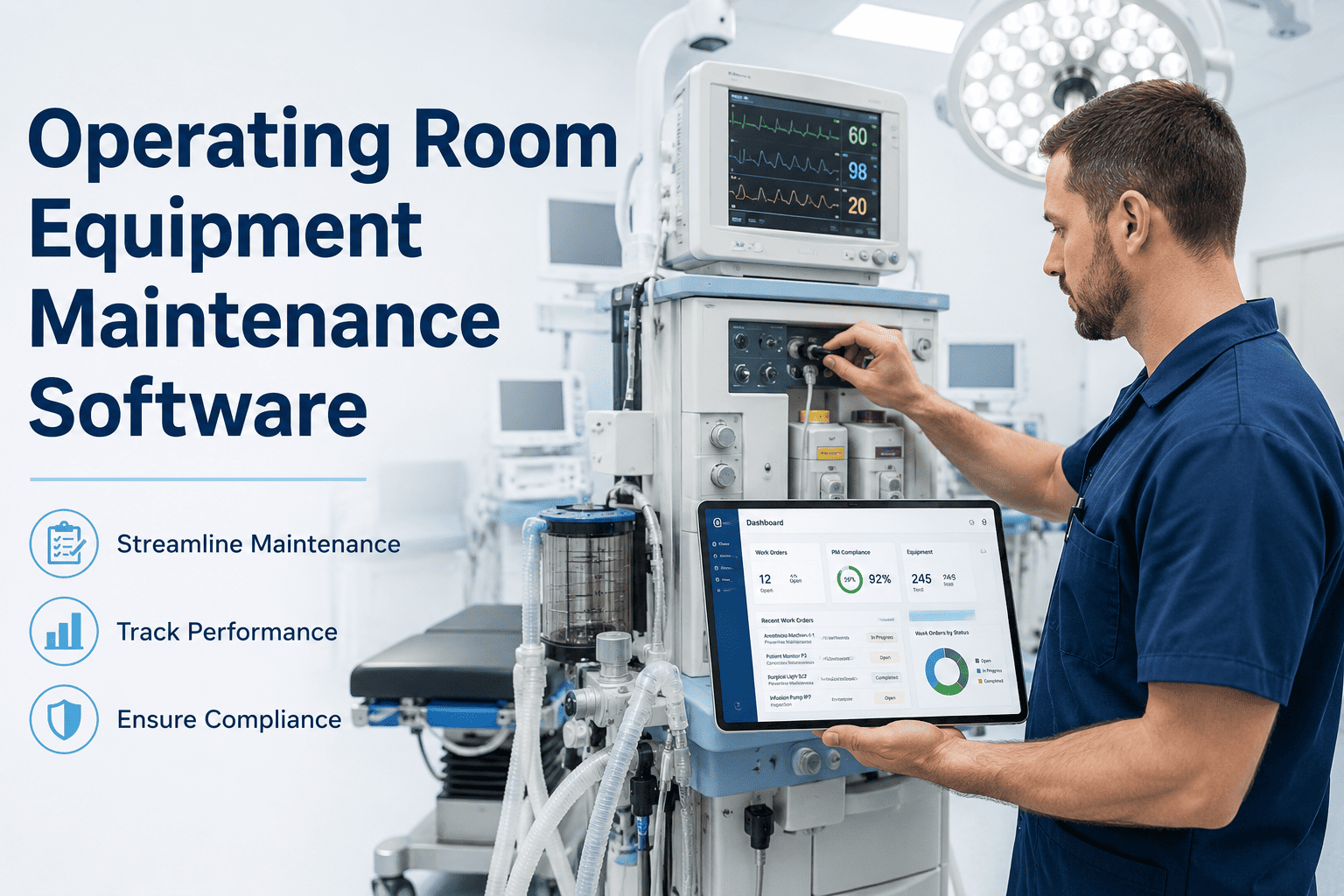
Operating room delays cost hospitals an average of $36–$100 per minute in lost revenue and resource costs. The leading preventable cause of unplanned OR delays is equipment that was not ready — a surgical table that malfunctioned at setup, a surgical light that failed during a procedure, or a boom system with an unresolved work order that no one tracked to completion. OxMaint tracks surgical lights, tables, booms, HVAC, and sterilization assets with PM schedules and real-time downtime alerts — so every OR starts on time, every day.
Operating Room Equipment Maintenance Software
Unplanned OR downtime is the most expensive maintenance failure in a hospital. Prevent it with PM tracking, downtime alerts, and complete asset history for every piece of surgical equipment in your operating suites.
Every Critical OR Asset. One Maintenance Record.
LED surgical lights require monthly intensity and color rendering verification, annual articulation checks on mounting arms, and sterile handle inspection. OxMaint tracks every light by room with a complete PM history and failure log.
Hydraulic system inspection, lateral tilt and Trendelenburg testing, mattress condition, pad integrity, and battery backup verification. Table malfunctions during a procedure are a patient safety incident — not just a delay.
Ceiling-mounted equipment booms require arm load testing, electrical outlet and gas outlet function checks, gas supply pressure verification, and structural connection inspection. Boom failures disconnect life-critical supplies during surgery.
Positive pressure validation, HEPA filter status, temperature and humidity recording for each OR suite. Pressure excursions require immediate corrective action and documentation before the room can be cleared for surgical use.
Steam sterilizers, washer-disinfectors, and ultrasonic cleaners supporting OR instrument reprocessing — cycle log review, door seal inspection, temperature and pressure validation, and biological indicator documentation.
Ventilator mechanism inspection, gas delivery system leak check, vaporizer calibration, scavenging system function, and electrical safety testing. Coordinate with biomedical team — tracked in the same platform, same asset hierarchy.
Know the Status of Every OR Asset Before Surgical Scheduling Begins
OxMaint gives perioperative and facilities teams a shared view of OR asset status — PM compliance, open work orders, and downtime history — so equipment issues are resolved before they cancel a case.
OR Equipment PM Frequency Summary
| Equipment | Daily Pre-Op Check | Monthly | Quarterly | Annual |
|---|---|---|---|---|
| Surgical Lights | Function test | Intensity / color | — | Full arm + mount |
| OR Table | Movement test | Hydraulic + tilt | — | Full mechanical |
| Equipment Booms | — | Outlet function | Load + gas test | Structural |
| OR HVAC / AHU | — | Pressure check | Full validation | Certification |
| Steam Sterilizer | Bowie-Dick test | Cycle review | — | Full service |
| Anesthesia Workstation | Leak check | — | PM inspection | Full biomedical |
What Perioperative Leaders Say
OR Equipment Maintenance Software — FAQ
Who is responsible for OR equipment maintenance — biomedical or facilities?
Responsibility is typically split based on equipment type. Biomedical engineering handles anesthesia workstations, surgical monitors, infusion pumps, and electrosurgical units — devices classified as medical equipment under FDA and Joint Commission standards. Facilities management handles surgical tables, lighting systems, booms, HVAC, and sterilization equipment — classified as facility systems or capital equipment. The problem is that both teams need a complete picture of OR asset status, and in most hospitals they use separate work order systems. OxMaint supports both teams in one platform, so the pre-operative equipment status check reflects both biomedical and facilities work orders. See how it works in a free trial.
How does OxMaint alert the team when OR equipment is at risk of downtime?
OxMaint sends configurable alerts when OR equipment PM tasks are overdue, when an inspection generates a finding, or when a work order for OR-critical equipment is open beyond a defined threshold. For assets flagged as OR-critical, the alert routing escalates faster than standard equipment — going to the OR charge nurse, the biomedical lead, or the facilities supervisor depending on the asset type. This means an OR table with an open hydraulic work order does not sit quietly in a backlog while surgical cases are scheduled against that room. See the alert routing in a live demo.
Can OxMaint integrate OR equipment downtime history with scheduling data?
OxMaint provides a complete downtime history per OR asset — including the dates, durations, and causes of every unplanned equipment unavailability event. This data can be exported and correlated with your surgical scheduling system to identify patterns: which OR suites have the highest equipment-related delay rates, which equipment types are driving the most downtime, and which PM cycles have the highest impact on reliability. This level of asset intelligence is what enables perioperative leadership to make evidence-based decisions about equipment replacement versus repair budgets.
What documentation do Joint Commission surveyors look for in OR equipment records?
Surveyors reviewing OR equipment typically look for evidence of scheduled PM completion at the frequencies specified by the manufacturer or the facility's maintenance management plan, documentation of any findings from those PMs with associated corrective actions and completion dates, and records of any unplanned failures with the response taken. For OR HVAC specifically, they cross-reference pressure validation records with any surgical site infection data. For sterilization equipment, they look for cycle logs, biological indicator records, and a clear record of any failed cycles and how affected instruments were managed. OxMaint produces all of these record categories in exportable format for surveyor review.
Every OR Asset. Every PM. Every Downtime Alert.
Surgical lights, tables, booms, HVAC, and sterilization systems — tracked together in one mobile-first platform that keeps perioperative and facilities teams aligned before cases start.