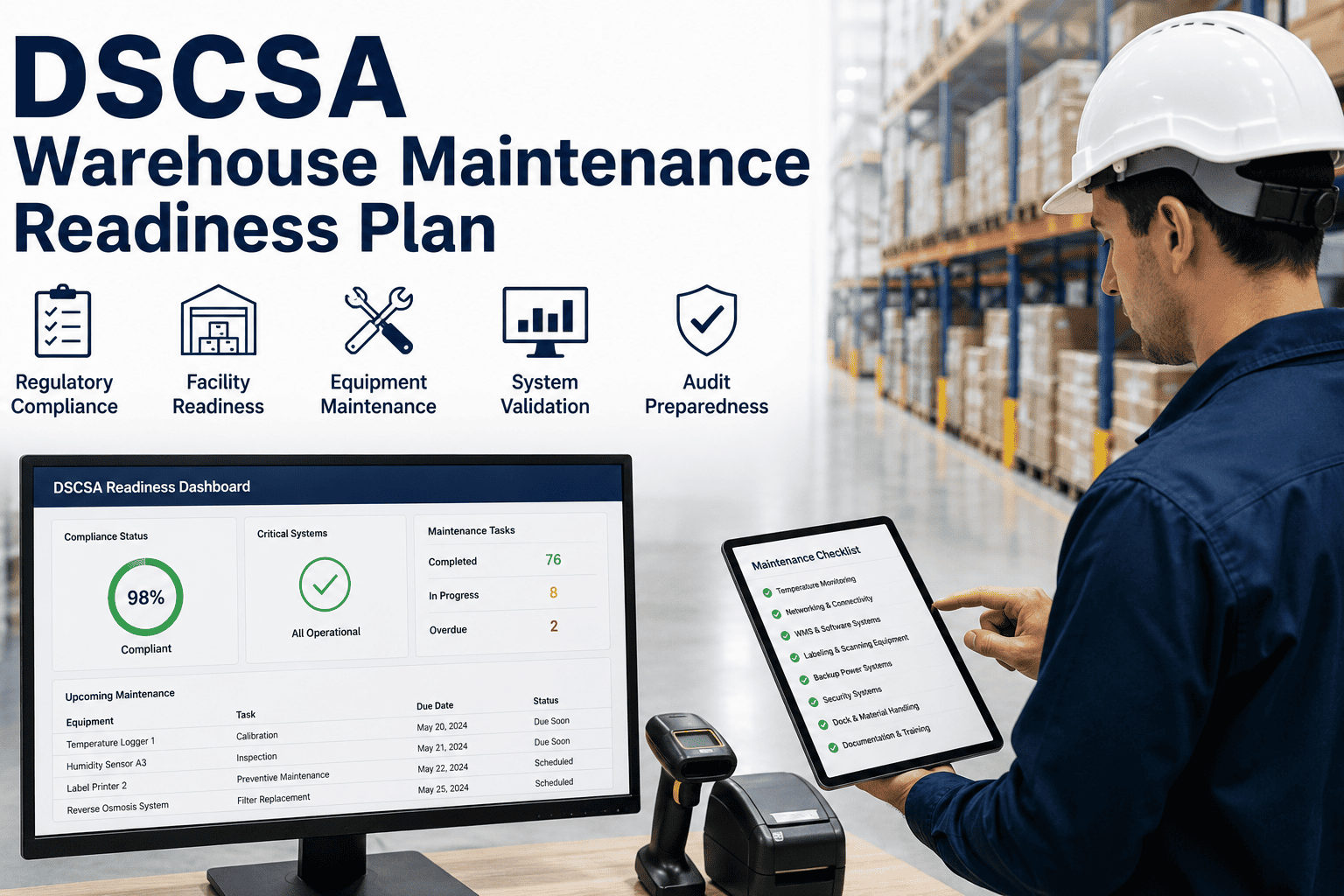
The Drug Supply Chain Security Act requires every pharmaceutical warehouse handling prescription drugs to maintain interoperable, electronic product tracing at the package level — and the entire traceability chain collapses the moment a barcode scanner fails to read a serialized label, a conveyor diversion gate malfunctions, or a climate-controlled dock door loses its seal during a product handoff. DSCSA compliance is not just a software problem; it is a maintenance problem, because the physical equipment that captures, verifies, and transmits traceability data must operate at near-zero failure rates during every receiving, putaway, picking, and shipping transaction. A single scanner downtime event on a high-volume shipping dock can leave hundreds of serialized packages unverified and untraceable, creating a compliance gap that must be investigated, documented, and reported. If your warehouse maintenance program treats serialization scanners and traceability conveyors the same as general facility equipment, start a free Oxmaint account to classify and track DSCSA-critical assets with dedicated uptime SLAs, or book a 30-minute demo to see a warehouse maintenance readiness plan built for pharma distribution compliance.
Pharma Distribution · DSCSA Compliance
DSCSA Warehouse Maintenance Readiness Plan
Your serialization equipment is the backbone of drug traceability. One scanner failure creates a compliance gap. This plan ensures every traceability-critical asset stays operational.
34%
Of pharma warehouses lack dedicated PM for serialization scanners
4.2 hrs
Avg. time to replace a failed fixed-mount scanner on a line
280 pkgs
Avg. packages affected per hour of scanner downtime
Why DSCSA Turns Warehouse Maintenance into a Compliance Function
Before DSCSA, a broken scanner was an operational inconvenience. Under final requirements, the same failure creates a traceability gap triggering FDA investigation, quarantines, and supply chain notifications.
Operational Maintenance (Pre-DSCSA)
- Equipment failure = throughput delay
- PM based on vendor recommendations
- Work orders prioritized by output impact
- Spares managed by cost and lead time
- Downtime measured in lost hours
Compliance Maintenance (DSCSA)
- Equipment failure = traceability gap
- PM based on uptime SLA for traceability
- Work orders prioritized by traceability tier
- Spares stocked as compliance reserves
- Downtime measured in untraced packages
DSCSA Equipment Criticality Matrix
Not every asset carries the same risk. The matrix classifies equipment by impact on the DSCSA chain and failure frequency to determine the correct maintenance strategy.
Low Traceability Impact
High Traceability Impact
High Failure Freq
Q2 — High Freq / Low Impact
Lighting, HVAC filters, standard rollers
Strategy: Standard PM, batch repairs
Q1 — High Freq / High Impact
Scanners, divert gates, RFID readers
Strategy: Predictive PM, on-site spares
Low Failure Freq
Q3 — Low Freq / Low Impact
Office equipment, non-critical racks
Strategy: Run-to-failure, reactive
Q4 — Low Freq / High Impact
WMS servers, network switches, cold chain
Strategy: Reliability-centered, redundant
4-Phase DSCSA Maintenance Readiness Plan
Implementing a DSCSA-ready program requires four sequential phases. Each phase builds on the previous one with a defined compliance deliverable.
Phase 1
Asset Classification
Inventory every asset and classify as traceability-critical, adjacent, or non-critical. Register Q1 and Q4 assets in Oxmaint.
Deliverable: DSCSA asset register
›
Phase 2
SLA-Driven PM Setup
Define uptime SLAs for critical assets. Configure scanner calibration weekly, conveyor checks bi-weekly. Set overdue escalations.
Deliverable: SLA-bound PM schedules
›
Phase 3
Spares & Redundancy
Stock critical spares on-site — scanner cables, triggers, printheads. Establish swap-out procedures for under 30-minute replacement.
Deliverable: On-site compliance spares
›
Phase 4
Monitoring & Reporting
Activate real-time uptime dashboards for DSCSA assets. Track PM compliance, MTTR, and traceability gap events for QA.
Deliverable: Live compliance dashboard
Warehouse Zone Maintenance Requirements
Each zone has distinct DSCSA-critical equipment with different failure modes. This zone-based approach ensures full coverage.
Receiving Dock
Critical assets: Incoming scan stations, dimensioners, label printers, dock levelers
DSCSA risk: Product received but not verified — creates orphan inventory
PM focus: Scanner calibration, printhead cycles, dock seal checks
Putaway & Storage
Critical assets: Mobile RF scanners, location labels, climate monitors
DSCSA risk: Product in wrong location — traceability breaks at storage
PM focus: Mobile battery cycles, cradle contacts, sensor calibration
Pick & Pack
Critical assets: Pick-to-light modules, handheld scanners, verification scales
DSCSA risk: Wrong serial applied — ships non-compliant package downstream
PM focus: Sensor cleaning, decode accuracy testing, scale calibration
Shipping Dock
Critical assets: Outbound scan tunnels, divert gates, RFID readers
DSCSA risk: Product leaves without scan — no T3 transaction generated
PM focus: Tunnel alignment, gate actuator testing, antenna checks
Expert Review
"The most overlooked DSCSA gap is never the serialization software — it is the physical equipment. A WMS can be perfectly configured, but if the fixed-mount scanner on dock 4 has a degraded decode rate nobody tracks because it falls under facility maintenance, you have a silent traceability gap. Classifying traceability equipment as compliance-critical with SLA-driven PM is the minimum standard."
Tom Hargrove — Pharma Supply Chain Consultant, former VP of Distribution at a top-3 US wholesaler, 16+ years in DSCSA
Classify warehouse assets by traceability impact. Set SLA-driven PM for every DSCSA-critical piece of equipment. Oxmaint flags critical assets, enforces uptime SLAs, tracks spares, and generates monthly compliance readiness reports.
Scanner & Reader PM Schedule: Highest-Risk Asset
Scanners and RFID readers are the highest-frequency, highest-impact assets. A degraded scanner creates a gap undetected for days. This schedule keeps decode accuracy above 99.8%.
| PM Task |
Fixed-Mount |
Handheld |
RFID Tunnel |
Failure Prevented |
| Decode accuracy test |
Weekly |
Weekly |
Weekly |
Degraded read rate, missed scans |
| Lens cleaning |
Weekly |
Per shift |
Bi-weekly |
Contamination causing read failures |
| Cable inspection |
Bi-weekly |
Bi-weekly |
Monthly |
Intermittent connection, dropped scans |
| Alignment check |
Monthly |
N/A |
Monthly |
Inconsistent read zone coverage |
| Firmware verification |
Monthly |
Monthly |
Monthly |
Label format compatibility issues |
| Full spare swap-out |
Quarterly |
Quarterly |
Semi-annual |
End-of-life component degradation |
Traceability Gap Event: Response Protocol
When a DSCSA-critical asset fails, the response protocol must initiate immediately. Oxmaint automates the first three steps to minimize compliance exposure.
01
Automatic Gap Detection
System detects downtime or scan-rate drop and logs a traceability gap event with timestamp and estimated package count.
02
Emergency Work Order
Auto-created with DSCSA-critical priority. Technician assigned with spare unit pull instruction if swap-out exists.
03
Package Impact Quant
Cross-references WMS log against downtime window to produce a list of affected serial numbers for investigation.
04
QA Investigation
QA receives gap event report with affected serial numbers. Determines if packages can be retroactively verified or quarantined.
Frequently Asked Questions
What qualifies as a DSCSA-critical asset in a pharma warehouse?
Any equipment directly capturing, verifying, or transmitting product traceability data — barcode scanners, RFID readers, label printers, verification scales, and divert gates.
Book a demo to see the classification template.
How is a DSCSA maintenance plan different from a standard warehouse PM program?
Standard PM optimizes for equipment lifespan. DSCSA readiness optimizes for traceability continuity using SLA-driven schedules and compliance-critical spare parts stocking.
Sign up free to configure DSCSA profiles.
What happens if a scanner fails during an active shipping shift?
Every unscanned package creates a traceability gap triggering an immediate work order, package impact quantification, and QA investigation for quarantine or retroactive verification.
Book a 30-minute session to see the workflow.
How many spare scanners should we keep on-site for DSCSA compliance?
Best practice is one spare per high-volume scan point plus one floating spare. Oxmaint tracks spare inventory with automated min/max alerts for compliance thresholds.
Start a free account to set up tracking.
Does DSCSA require documented maintenance records for traceability equipment?
While not explicitly mandated, FDA expects proof that systems maintain traceability. Missing PM records during a gap investigation significantly increases regulatory risk exposure.
Book a demo to see audit-ready records.
Build Your DSCSA Warehouse Maintenance Readiness Plan
Classify traceability-critical assets, set SLA-driven PM schedules, stock compliance spares, and monitor equipment uptime with real-time dashboards.