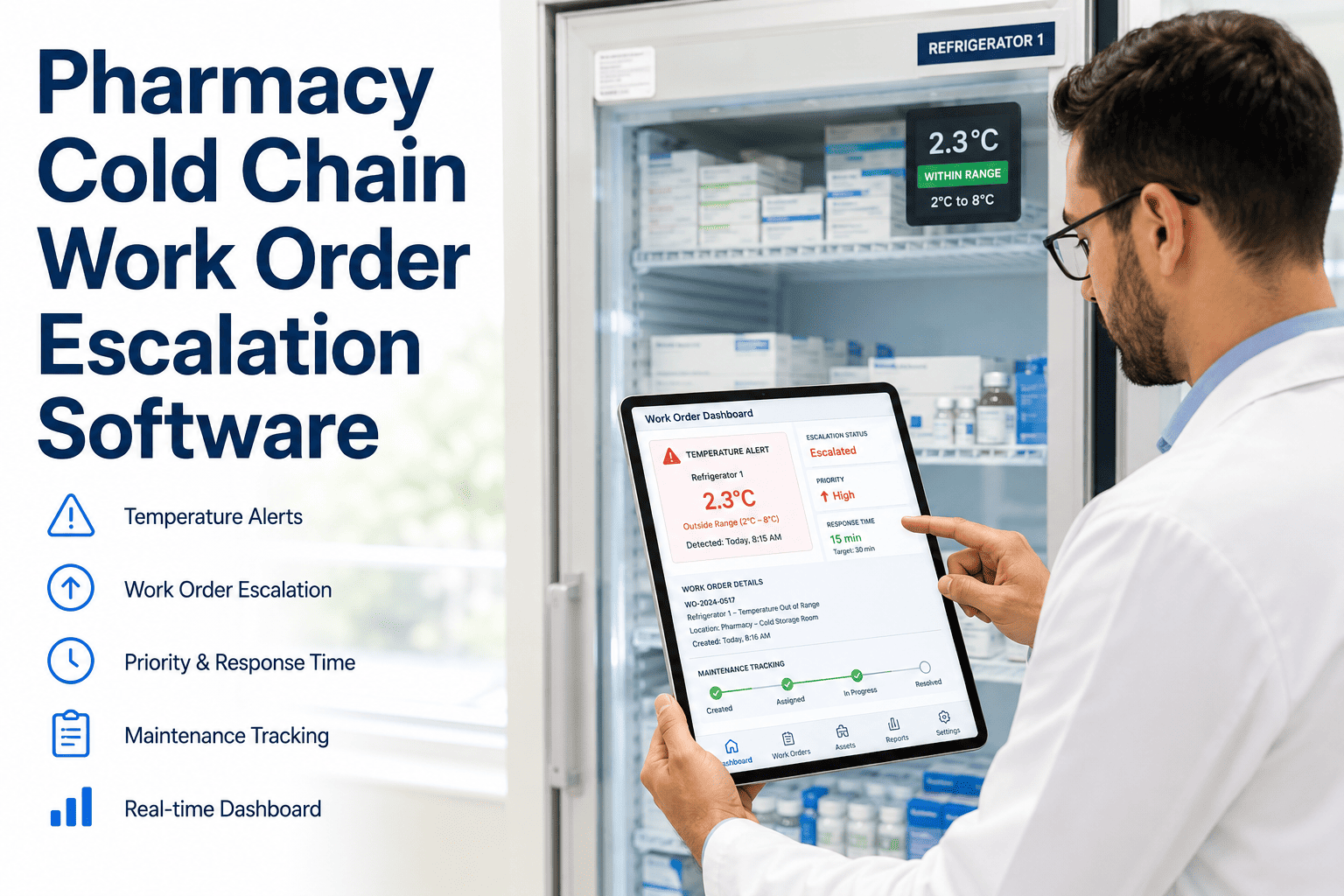
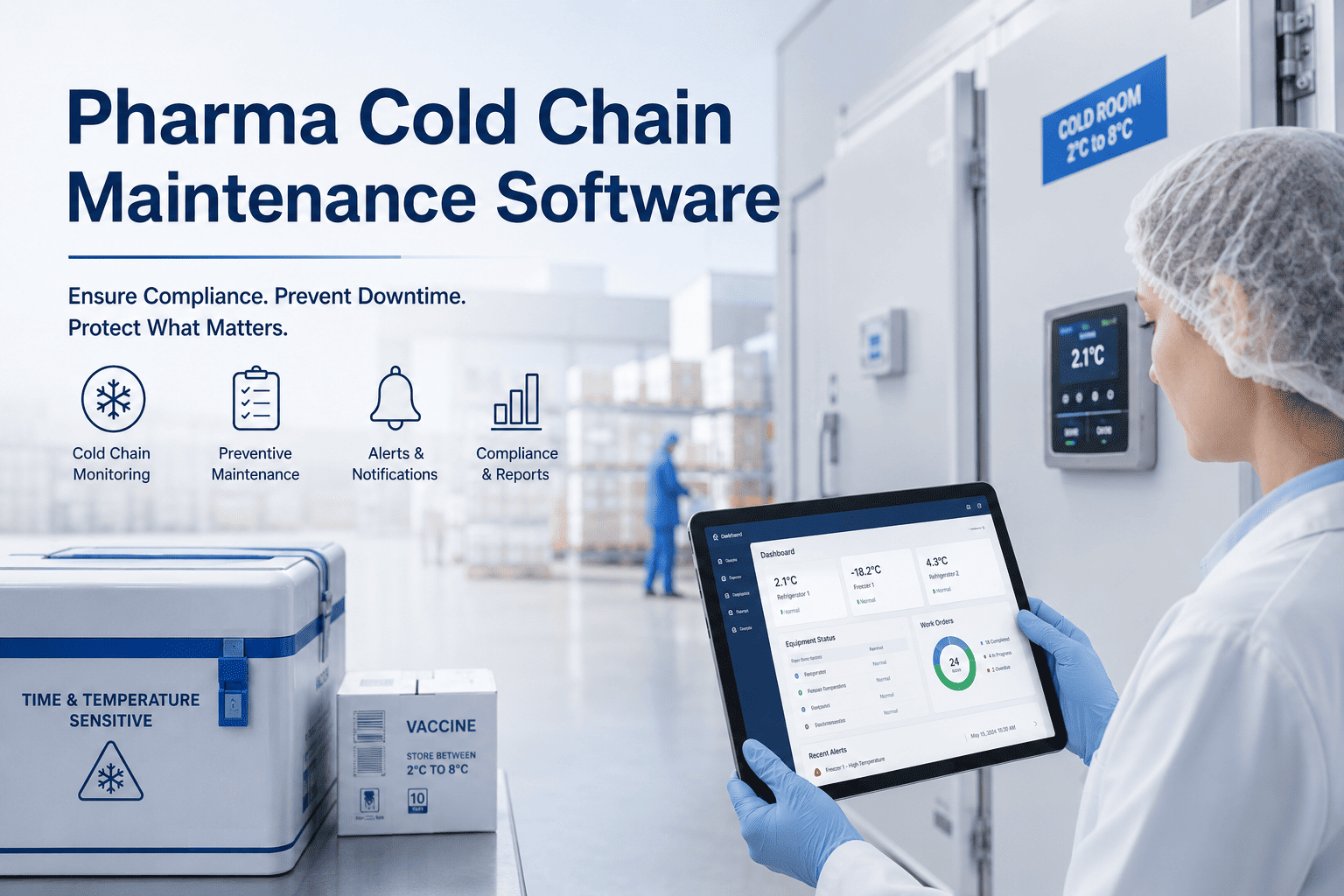
A single temperature excursion in a pharmaceutical cold room averages $100,000 to $500,000 in product losses — before adding the investigation labour, GDP non-conformance documentation, regulatory reporting obligations, and potential product recall costs. Biologics now account for 46% of US drug spending, and the cold chain segment of pharmaceutical warehousing has grown to represent 38% of total market volume. Every refrigerated vial, frozen biologic, and controlled temperature product moving through that market requires continuous, documented temperature monitoring with a calibrated sensor network, a qualified storage area, an annual temperature mapping programme, and a documented excursion response process. What most North American pharma warehouses are missing is not the monitoring equipment — it is the maintenance infrastructure that keeps that equipment operating correctly, and the CMMS that turns sensor alarms into documented, investigation-closed work orders before a GDP auditor arrives. OxMaint's cold chain CMMS schedules every refrigeration PM, door seal inspection, sensor calibration, and temperature mapping event as a recurring work order — and converts every alarm into a documented, batch-linked, audit-ready response record automatically.
Refrigeration PM. Sensor calibration. Door seal inspection. Temperature mapping. Excursion investigation. CAPA closure. Everything the GDP-qualified warehouse needs to maintain cold chain integrity — structured, scheduled, and documented in one platform.
GDP mandates a documented maintenance programme for all cold chain warehouse equipment — but most pharma warehouses have the monitoring technology without the maintenance infrastructure that keeps it reliable. The table below maps every GDP-required maintenance activity to its regulatory basis, required frequency, and the OxMaint work order that executes it.
| Maintenance Activity | Regulatory Basis | Required Frequency | GDP Documentation Required | OxMaint Work Order Type |
|---|---|---|---|---|
| Refrigeration unit PM — compressor, condenser, controls | FDA GDP / WHO TRS 1025 | Semi-annual minimum; quarterly for units >10 years old | PM record with technician credentials, findings, and next service date | Recurring semi-annual PM WO — asset-linked to each refrigeration unit by serial number |
| Temperature sensor calibration | FDA 21 CFR 211.68 / WHO GDP / EU GDP §3.2.1 | Annual minimum — traceable to national standard (NIST or NRC) | Calibration certificate with sensor ID, standard used, result, next due date | Annual calibration WO per sensor — certificate attached, due-date alert automatic |
| Temperature mapping study | WHO TRS 1025 / EU GDP Annex §3.2.1 | Annual + after any modification or significant maintenance | Full mapping report: sensor placement, 72-hr data set, hot spot/cold spot analysis, set-point validation | Annual project WO — links to commissioned third-party report; change-triggered variant WO |
| Door seal and gasket inspection | GDP best practice — equipment qualification maintenance | Monthly visual + annual physical measurement | Inspection log: door ID, seal condition, gap measurement where applicable | Monthly checklist WO + annual physical inspection WO — replacement triggered on finding |
| Backup power and UPS test | FDA GDP / WHO TRS 1025 §15.1 — power failure contingency | Semi-annual load test; monthly battery check | Test record: load applied, duration, result, battery condition, next test date | Semi-annual UPS load test WO — battery replacement triggered on capacity below 80% |
| Alarm system function test | EU GDP §3.2.2 — alarm must trigger at validated alert levels | Quarterly — each alert threshold tested for each zone | Test record: zone, threshold triggered, alarm fired Y/N, response time, corrective action | Quarterly alarm test WO — checklist item per zone; failed tests trigger immediate corrective WO |
| Out-of-hours alarm response verification | GDP §3.2.2 — out-of-hours excursion must be detected and responded to | Documented on-call roster and response procedure — tested quarterly | Roster record + simulated out-of-hours alarm test record | Quarterly simulated alarm WO — response time logged, escalation path verified |
| Refrigerant leak check | EPA Section 608 (North America) + equipment maintenance | Annual minimum; more frequently for units with prior leak history | Leak check record per unit; refrigerant log per EPA requirements | Annual refrigerant check WO — EPA leak rate calculated, refrigerant log updated |
| Condenser coil cleaning | Manufacturer PM schedule — critical for refrigeration efficiency | Semi-annual; quarterly in dusty environments | Cleaning record with before/after visual or pressure differential reading | Semi-annual PM WO — before/after photo documentation required for completion |
| Loading bay and transition zone inspection | GDP — product must not be exposed to temperature excursion during transfer | Monthly inspection + pre-receipt check for each incoming shipment | Inspection log: bay temperature, door seal condition, staging time controls | Monthly inspection WO + pre-receipt checklist work order per shipment |
GDP does not just require that you detect temperature excursions — it requires a documented response chain from initial detection through stock quarantine, root cause investigation, manufacturer stability assessment, and disposition decision. Most warehouses have the alarm. Few have the documented workflow that turns that alarm into a GDP-compliant event record.
In every GDP audit I have conducted across pharmaceutical warehousing operations in North America and Europe, the most common finding is not temperature excursions — it is unmanaged temperature excursions. The storage facility had a monitoring system. The sensors were functional. The alarms fired. But when I asked for the investigation records, the root cause documentation, the manufacturer notifications, and the disposition decisions, the team could produce partial records at best. Often, the alarm was silenced, the product was held briefly, and then released without a completed investigation because the warehouse team did not have a structured workflow that enforced the GDP-required response steps. A CMMS that enforces the response chain — requiring every alarm to generate a work order, every work order to include root cause documentation, every excursion affecting product to include a QA disposition decision before closure — is not regulatory overhead. It is the difference between a GDP-qualified warehouse and a GDP-certified facility that cannot demonstrate compliance when inspected.
How does OxMaint integrate with warehouse temperature monitoring systems to receive real-time alerts?
OxMaint connects to pharmaceutical warehouse monitoring systems via REST API, MQTT, or BACnet/IP — the protocols supported by the major pharmaceutical cold chain monitoring platforms including Sensitech, Rees Scientific, Monnit, and most integrated EMS platforms. Each sensor point is mapped to a specific asset record in OxMaint (refrigeration unit, cold room zone, or temperature-controlled area) with configurable alert and action level thresholds. When a reading crosses a threshold, OxMaint creates the work order automatically — no manual transfer, no alarm silencing without documentation. Start your free trial to configure the monitoring integration for your specific sensor network.
Can OxMaint schedule annual temperature mapping as a project-level work order with all sub-tasks included?
Yes. OxMaint creates annual temperature mapping as a project-level work order with sub-tasks covering sensor placement verification, 72-hour monitoring period initiation, data collection review, hot-spot and cold-spot analysis, report commissioning, and final approval by QA. The work order is assigned to the Qualified Person responsible for the temperature mapping programme, with intermediate completion milestones and automatic escalation if any milestone is missed. The completed mapping report is attached to the work order record — and the change-triggered mapping variant fires automatically when a refrigeration modification or significant maintenance event is logged against that zone's asset record. Book a demo to see the temperature mapping project work order configured for your warehouse type.
How does OxMaint support multi-site pharmaceutical warehouse portfolios with different temperature zone configurations?
OxMaint supports multi-site, multi-zone configurations where each warehouse has its own asset register, PM schedule, and alarm threshold settings — while the portfolio QA director sees a unified compliance dashboard across all sites simultaneously. Each site configures its own temperature zones (refrigerated, frozen, controlled room temperature) with site-specific alarm thresholds and response SLAs. The portfolio view shows PM compliance rates, open excursion work orders, overdue calibrations, and CAPA status per site — in the same dashboard, updated in real time. Start your free trial to configure the multi-site warehouse dashboard for your portfolio.
What documentation does OxMaint produce for an FDA or Health Canada GDP inspection of warehouse operations?
OxMaint generates a GDP inspection documentation package covering: all refrigeration PM records for the inspection period (by equipment, with technician credentials and findings); temperature sensor calibration certificates (by sensor ID, with NIST/NRC traceability documentation); temperature mapping reports (current and prior year); alarm test records (quarterly, per zone); excursion event records (alarm, work order, MKT calculation, manufacturer notification, disposition decision, CAPA) for any event in the inspection window; and a PM compliance rate report showing percentage of scheduled maintenance completed on time per zone. All records are date-filtered and exportable as PDF within 60 seconds. Book a demo to see the GDP inspection package format for your warehouse type.
OxMaint schedules every refrigeration PM, sensor calibration, temperature mapping event, door inspection, and alarm test as a recurring work order — and converts every excursion alarm into a GDP-compliant, audit-ready response record complete with MKT calculation, disposition decision, and CAPA closure.