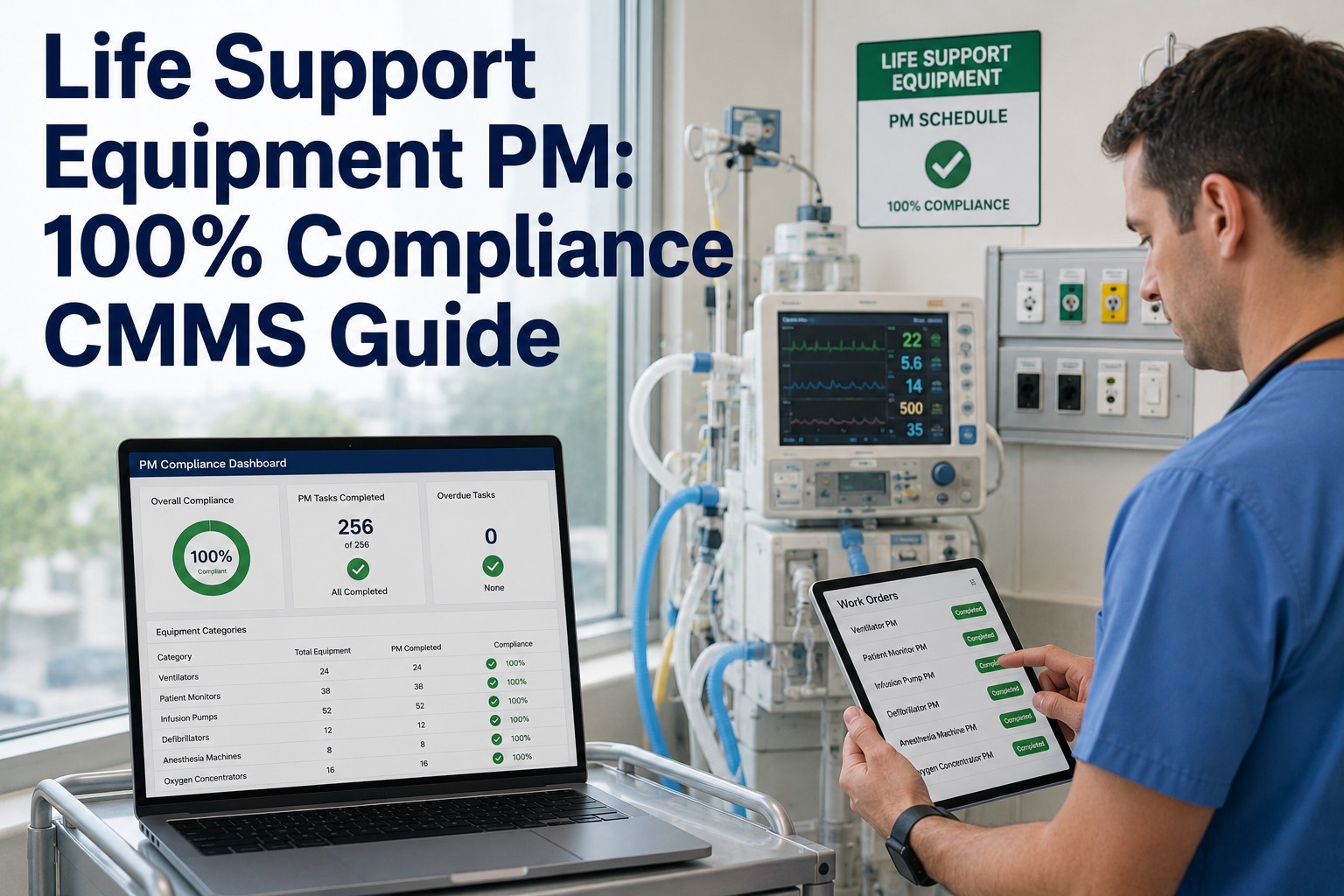
Life support equipment preventive maintenance demands zero-tolerance, 100 percent PM compliance — every ventilator, defibrillator, and cardiac monitor either has a current PM record or it does not belong near a patient. This life support CMMS guide explains how maintenance and reliability teams in healthcare facilities use CMMS-based priority, escalation workflows, and out-of-service discipline to keep life support equipment PM at 100 percent every day of the year. If your biomed or facilities team is still tracking PMs on spreadsheets, the gap between 95 percent and 100 percent is where adverse events live — you can close it today when you Start Free Trial with OxMaint and automate the compliance chain end to end.
Can your team prove 100% PM compliance on every life support device — right now?
When a ventilator misses PM by one day, the risk is not theoretical. OxMaint enforces zero-tolerance PM discipline across ventilators, defibrillators, cardiac monitors, and infusion pumps so no life support equipment ever falls through the cracks. See it on your assets in 30 minutes.
Why 99% PM compliance is not good enough for life support equipment
In a 500-bed hospital running approximately 1,200 life support devices, 99 percent PM compliance means 12 devices are overdue at any given moment. If even one of those is a ventilator attached to an ICU patient, the organization is exposed to sentinel-event risk, Joint Commission findings, and CMS deficiencies. Life support equipment PM operates on a binary standard: the device is compliant, or it is pulled from service.
How to design a zero-tolerance PM library for life support equipment
A defensible PM library is the foundation of 100 percent compliance. Every life support device category needs a manufacturer-aligned PM template, a defined interval, a required-parts list, and an assigned technician tier — all stored centrally in a CMMS so the schedule generates itself.
Ventilator PM Template
- Flow sensor calibration — every 6 months or 1,000 hours
- Leak test on patient circuit — quarterly
- Battery load test and replacement — annual
- Firmware version check and security patch — semi-annual
- HEPA filter inspection and replacement — every 3 months
Defibrillator PM Template
- Energy output test at 50J, 150J, 200J, 360J — monthly
- ECG waveform and lead integrity check — monthly
- Battery capacity and cycle count — quarterly
- Paddle and cable insulation resistance — semi-annual
- Self-test log review and anomaly flag — weekly
Cardiac Monitor PM Template
- Alarm limit verification and audit — monthly
- SpO2 and NIBP calibration against reference — quarterly
- Lead wire continuity and connector wear — monthly
- Display and backlight functionality — semi-annual
- Network connectivity and alarm escalation test — monthly
Infusion Pump PM Template
- Flow rate accuracy at 5 ml/h and 300 ml/h — quarterly
- Occlusion and air-in-line alarm test — quarterly
- Battery run-time to 80% capacity — semi-annual
- Drug library version verification — monthly
- Free-flow protection and clamp inspection — quarterly
CMMS escalation on missed PMs: the 3-tier out-of-service workflow
When a life support PM is missed, the CMMS must not simply log it as overdue — it must trigger an automated escalation that removes the device from clinical use. OxMaint enforces a three-tier escalation ladder that moves from notification to lockdown within 72 hours.
PM Due — Automated Notification
Work order auto-generates 7 days before due date. Assigned biomed technician receives push notification and email. Supervisor CC'd. Device status in CMMS shows yellow — PM Approaching.
PM Overdue — Escalation to Manager
If PM is not closed by due date, CMMS escalates to the clinical engineering manager and the unit charge nurse. Device tagged red — PM Overdue. Spare unit dispatched from ready pool to replace it.
Out-of-Service Lockout
At 72 hours overdue, OxMaint marks the device Out-of-Service and removes it from the available asset pool. Director of Facilities and Risk Management notified. Device physically tagged and quarantined until PM is closed and signed off.
The daily compliance discipline that keeps life support PM at 100%
Compliance is not an annual audit sprint — it is a daily discipline. A 180-bed regional hospital running 420 life support devices was spending $42,000 annually on manual PM tracking, audit prep, and post-finding remediation. After implementing OxMaint CMMS, they cut audit prep time by 70 percent and held 100 percent PM compliance for 14 consecutive months. Here is the weekly rhythm that got them there.
| Cadence | Compliance Action | Owner | Outcome |
|---|---|---|---|
| Daily | Review OxMaint PM-due-today dashboard; close completed work orders with e-signature | Biomed tech on shift | Zero devices age past 24 hours overdue |
| Weekly | Run PM compliance report by device category and unit; flag any Tier 2 escalations | Clinical engineering manager | Trend visibility; 100% closure before Tier 3 |
| Monthly | Audit ready-pool spare inventory; verify loaner PM status before deployment | Facilities director | No non-compliant spare enters patient care |
| Quarterly | Reconcile CMMS asset registry against physical inventory and ERP capital list | Biomed + Finance | Zero ghost assets; zero untracked devices |
| Annually | Generate full PM compliance audit trail for Joint Commission and CMS review | Risk management | One-click audit export; zero findings on PM |
How OxMaint enforces 100% PM compliance on life support equipment
OxMaint is an AI-powered CMMS and EAM platform purpose-built for maintenance and reliability teams that cannot afford a single missed PM. Four capabilities map directly to the life support compliance chain:
Automated PM Scheduling
OxMaint auto-generates work orders based on manufacturer intervals, usage hours, or calendar triggers — eliminating manual scheduling errors. Outcome: eliminate missed PM due dates and cut scheduling time by 80%.
Tiered Escalation Engine
When a life support PM ages past its due date, OxMaint fires Tier 1 to Tier 3 escalations automatically — notifying techs, managers, and directors, then locking the device out of service. Outcome: zero devices slip past 72 hours without action.
One-Click Audit Trail
Every PM action — who, what, when, parts used, e-signature — is logged immutably. Generate a Joint Commission-ready compliance report in seconds, not weeks. Outcome: audit prep time cut 70% with zero PM findings.
Predictive Failure Alerts
OxMaint AI analyzes usage patterns, battery cycles, and error logs to predict component failure before the next scheduled PM — surfacing at-risk devices for early intervention. Outcome: cut unplanned downtime 30–50% on critical life support assets.
See OxMaint enforce 100% PM compliance on your life support fleet
Book a 30-minute demo and we will load your ventilator, defibrillator, and cardiac monitor inventory into a live sandbox so you can see the escalation engine, audit trail, and PM dashboard in action.
Life support equipment PM compliance — your questions answered
What is life support equipment PM and why does it require 100% compliance?
Life support equipment PM is the scheduled preventive maintenance performed on ventilators, defibrillators, cardiac monitors, infusion pumps, and other devices that sustain patient life. It requires 100 percent compliance because any device with an overdue PM may have undetected calibration drift, battery degradation, or sensor failure — meaning it cannot be trusted on a patient and must be pulled from service immediately. OxMaint enforces this standard by auto-locking any device that ages past its PM window.
How does a CMMS improve ventilator maintenance and defibrillator maintenance?
A CMMS like OxMaint eliminates manual spreadsheet tracking by auto-generating PM work orders on the correct interval, assigning them to the right technician tier, tracking parts and e-signatures, and escalating automatically when a PM is missed. For ventilator maintenance and defibrillator maintenance specifically, this means no device ever sits overdue without the team knowing — and the audit trail is built in real time, not reconstructed weeks before a survey. You can see it live when you Book a Demo.
What happens when a life support PM is missed or overdue?
In a zero-tolerance model, the device is immediately flagged as non-compliant and removed from clinical use. OxMaint triggers a three-tier escalation: Day 0 notifies the assigned technician, Day +1 escalates to the clinical engineering manager and charge nurse with a spare-unit dispatch, and Day +3 locks the device out of service and notifies risk management. The device stays quarantined until the PM is completed, signed off, and verified.
How long does it take to implement a CMMS for life support equipment?
Most healthcare facilities can import their life support asset registry, configure PM templates, and go live in OxMaint within 2 to 4 weeks. The platform supports CSV import of existing asset data, and the PM library can be templated from manufacturer specifications for common device categories. Training for biomed technicians typically takes one session because the mobile work-order interface is designed for point-of-care use.
Can OxMaint help with Joint Commission and CMS PM compliance audits?
Yes. OxMaint logs every PM action — technician identity, timestamp, parts consumed, test results, and electronic signature — in an immutable audit trail. When Joint Commission or CMS surveyors request compliance evidence, you generate a filtered report by device category, unit, or date range in seconds. Facilities using OxMaint report cutting audit preparation time by up to 70 percent and receiving zero PM-related findings.
Stop gambling with 95%. Get to 100% PM compliance this quarter.
Every day life support PMs run on spreadsheets is a day your team cannot prove compliance. OxMaint closes the gap with automated scheduling, tiered escalation, and a real-time audit trail your surveyors will respect.
Free 14-day trial · No credit card