An unverified crash cart at a resuscitation bay — missing a signed daily check, an expired defibrillator pad, or an undocumented ventilator calibration record — exposes a US health system to an average TJC citation finding of $84,000 per equipment documentation failure, plus the clinical consequence no compliance officer can reverse. In 2024, 68 percent of Joint Commission surveys at Level I and Level II emergency departments identified at least one equipment maintenance documentation gap. The PMs were scheduled. The checks were performed. The failure was in the connection — between what technicians did at the bedside and what appeared in an auditable, retrievable record. That gap is exactly what Oxmaint closes. Book a demo to see how Oxmaint digitizes ED equipment maintenance, crash cart verification, and compliance records across your full emergency operation.
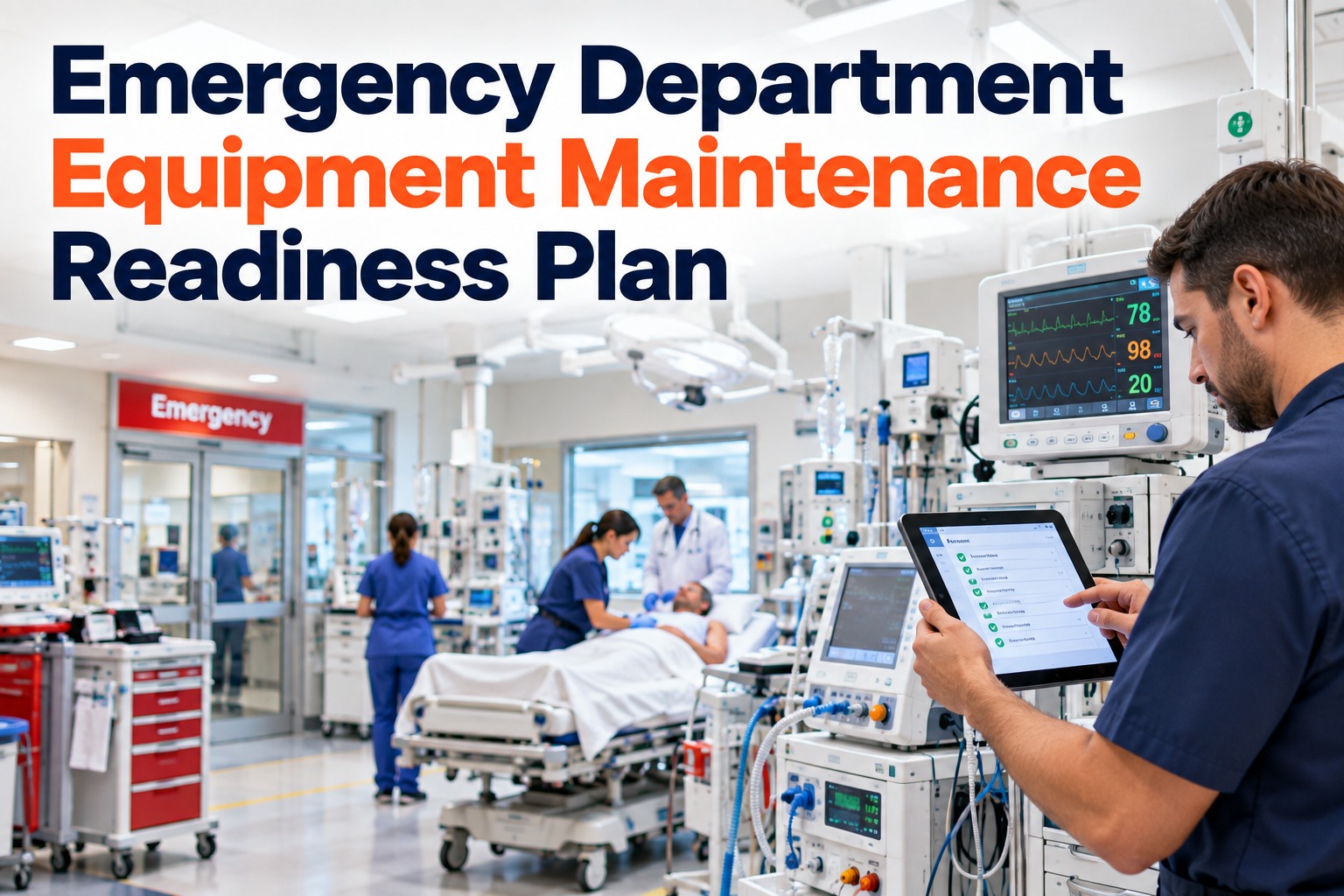
Emergency department equipment maintenance requires documented control of four high-consequence categories: crash cart and resuscitation equipment verification (daily checks, defibrillator pad expiry, AED readiness), patient monitoring system calibration (ECG monitors, vital signs equipment, pulse oximetry), airway and respiratory equipment PM (ventilators, suction units, laryngoscopes), and trauma and infusion device inspection (IV pumps, imaging equipment, surgical instruments). Oxmaint digitizes every checklist, calibration record, and work order — connecting field execution to auditable compliance documentation automatically, without paper and without manual transcription.
The Four Equipment Categories Where Emergency Departments Carry the Highest Maintenance Risk
Each category carries its own regulatory obligation, its own documentation requirement, and its own failure mode when that documentation is managed on paper. Book a demo to see how Oxmaint structures all four into a unified digital maintenance program for your ED.
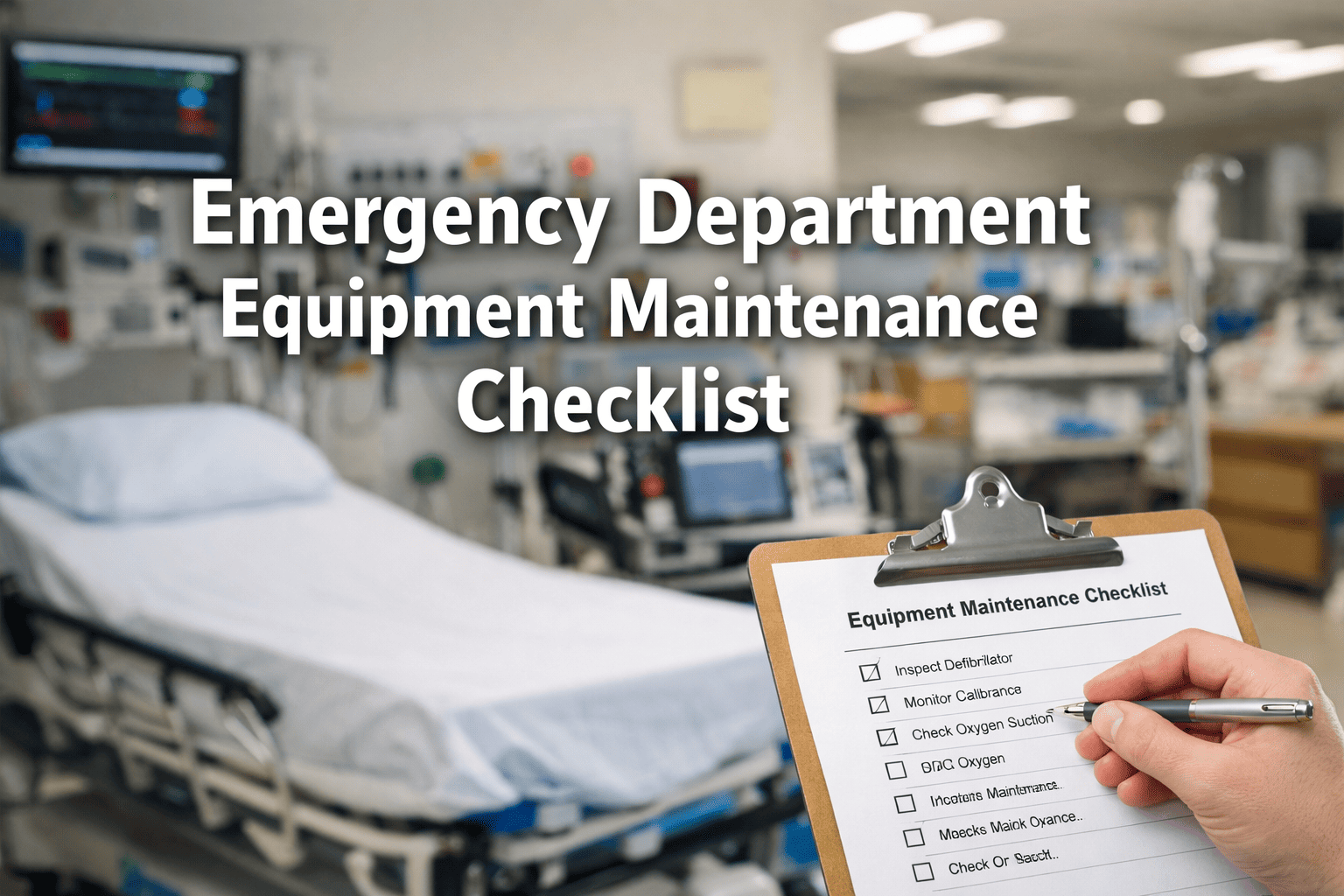
Crash carts, defibrillators, AEDs, external pacemakers, and bag-valve masks require daily verification checks with documented sign-off, defibrillator energy delivery testing, and expiry date review for all medications and consumables. A single undocumented daily check is a TJC Environment of Care finding. Oxmaint generates daily crash cart verification checklists on mobile, captures technician sign-off with timestamp at the unit, and archives completed records against each cart asset automatically — with alerts when any check is overdue by even one shift.
Bedside cardiac monitors, 12-lead ECG systems, pulse oximeters, non-invasive blood pressure modules, and end-tidal CO₂ monitors require documented PM intervals, alarm function verification, and calibration records traceable to each device serial number. FDA-regulated devices require documented incoming inspection and periodic performance validation. Oxmaint manages PM schedules per device with equipment-specific test protocols, captures calibration readings with technician identity, and prevents work orders from closing until all performance checkpoints are confirmed.
Transport ventilators, suction units, laryngoscopes, video laryngoscopy systems, and CPAP/BiPAP equipment require inspection frequency tied to patient census and acuity — not calendar interval alone. Laryngoscope blade function, suction unit vacuum pressure verification, and ventilator alarm testing must be documented per unit before clinical use. Oxmaint links respiratory equipment inspection records to each ED bay assignment — ensuring device readiness is confirmed and archived before any intubation or ventilator initiation occurs.
Smart infusion pumps, portable X-ray units, point-of-care ultrasound systems, and trauma procedure equipment require device-specific PM protocols, software version control records, and dose calibration documentation. Infusion pump drug library updates must be version-controlled and audit-trailed. Oxmaint manages the PM schedule per device ID, captures software and firmware version at each service event, and triggers automated alerts when calibration intervals approach expiry — eliminating the manual tracking that causes documentation gaps before TJC survey.
Every Crash Cart Check. Every Defibrillator Test. Every PM Record. Captured at the Point of Care — Not Reconstructed After the Shift.
Oxmaint generates crash cart checklists, ventilator PM records, and infusion device calibration logs on mobile — completing documentation at the bedside, not from memory at the nursing station. Book a demo to see the maintenance workflow configured for your ED equipment inventory.
Oxmaint ED Equipment Maintenance — Implementation Roadmap
A structured deployment moves your emergency department from paper-based maintenance logs to a fully operational digital equipment management system — without disrupting clinical operations or existing biomedical workflows.
Every crash cart, monitor, ventilator, infusion pump, and imaging device registered in Oxmaint's asset hierarchy with device class, regulatory code reference, PM interval, and inspection type. Device-specific checklists built from existing biomedical PM protocols and OEM service requirements. TJC EC.02.04 equipment risk categories validated and assigned per asset. FDA-regulated device identifiers and software versions captured at registration.
Crash cart daily verification, defibrillator energy test protocols, ventilator PM checklists, and infusion pump calibration forms configured as mobile-first digital workflows in Oxmaint. Biomedical technicians and nursing staff access checklists via QR-tagged equipment — no paper retrieval, no missing signatures, no end-of-shift transcription. Performance readings entered at the device, time-stamped, and archived against the asset record instantly. Book a demo to see mobile crash cart verification for your ED configuration.
Oxmaint compliance dashboard activated showing PM completion rates by device category, overdue inspection alerts, open corrective work orders, defibrillator check currency, and TJC Environment of Care readiness status. Biomedical director, CNO, and facility management views configured with role-appropriate data scope. Automated escalation to department heads when daily crash cart checks are missed or when PM intervals are breached by more than 24 hours.
All equipment maintenance records, PM logs, corrective action evidence, and defibrillator test histories exportable in formats required for TJC Environment of Care surveys, CMS Conditions of Participation reviews, DNV GL audits, and insurance carrier risk assessments. TJC EC.02.04 compliance documentation assembled automatically from Oxmaint records — no manual collation before the surveyor arrives at your department door.
Regulatory Compliance Coverage by Region
Emergency departments operating across multiple jurisdictions face distinct accreditation and equipment compliance obligations per market. Oxmaint's maintenance templates are pre-configured for each primary regulatory framework.
| Region | Primary Regulatory Frameworks | Key ED Equipment Requirements | Oxmaint Coverage |
|---|---|---|---|
| USA / Canada | TJC EC.02.04 Equipment Management, CMS CoP 482.41, FDA 21 CFR 803 MDR, NFPA 99 Healthcare Facilities, Accreditation Canada QMENTUM, DNV GL hospital standards | TJC-required PM interval documentation, CMS equipment maintenance plans, FDA MDR-linked device records, NFPA 99 life-safety equipment inspection logs, Accreditation Canada QMENTUM equipment standards | TJC EC.02.04-aligned PM templates, CMS equipment maintenance plan documentation, FDA device record management with MDR flag triggers, NFPA 99 inspection scheduling, 10-year device history retention |
| UK / NHS | CQC Regulation 15 Premises & Equipment, NHS England MECC Standards, MHRA Medical Device Alerts, HTM 08-01 Defibrillators, NHSE Patient Safety Incident Framework | CQC Regulation 15 equipment fitness documentation, MHRA device alert tracking and response records, HTM 08-01 defibrillator inspection registers, NHSE PSIF adverse event corrective actions | CQC Regulation 15 inspection templates, MHRA alert integration for affected device identification, HTM 08-01 defibrillator PM scheduling, NHSE PSIF corrective action management and closure tracking |
| Germany / EU | MPDG (Medical Devices Implementation Act), EU MDR 2017/745, DIN EN ISO 13485, DGSV sterilisation standards, BfArM device safety alerts, Ärztekammer regional accreditation | MPDG metrological inspection records for measuring devices, EU MDR UDI-linked maintenance documentation, ISO 13485 device history records, BfArM safety alert response and corrective action logs | MPDG inspection scheduling and certificate management, EU MDR UDI device registry in Oxmaint, ISO 13485-aligned device history records, BfArM alert tracking with affected device flagging and resolution documentation |
| Australia | NSQHS Standard 1.27 Equipment, TGA Medical Device Regulations, AS/NZS 3551 Medical Equipment Management, ACHS EQuIP accreditation, State health department equipment policies | NSQHS Standard 1.27 equipment maintenance plan documentation, TGA recall and hazard alert response records, AS/NZS 3551 management program evidence, ACHS EQuIP criterion evidence for accreditation surveys | NSQHS 1.27-aligned maintenance templates, TGA alert integration and response documentation, AS/NZS 3551 program management records, ACHS EQuIP audit package export, state-specific equipment policy templates |
| Saudi Arabia / UAE | CBAHI Hospital Standards (Kingdom of Saudi Arabia), HAAD / DOH Abu Dhabi Healthcare Standards, JCI International accreditation, MOHAP UAE medical device regulations, GCC medical device technical regulations | CBAHI FMS equipment maintenance documentation, HAAD/DOH equipment management standard evidence, JCI FMS.8 and FMS.9 equipment inspection records, MOHAP device registration and maintenance compliance | CBAHI and HAAD-aligned PM templates, JCI FMS chapter documentation export, MOHAP device registry management, multilingual mobile forms for diverse clinical and biomedical workforces across KSA and UAE facilities |
TJC, CMS, CQC, and CBAHI — One Digital Maintenance System for Every Jurisdiction
Whether your emergency department operates under TJC in North America, CQC in the UK, or CBAHI in Saudi Arabia — Oxmaint pre-configures the correct PM templates, inspection schedules, and audit exports for your accreditation framework. Book a demo to see multi-region ED equipment compliance configuration for your health system.
Oxmaint vs Competing CMMS Platforms — ED Equipment Maintenance
Most general-purpose CMMS platforms manage work orders — they do not manage crash cart verification protocols, TJC EC.02.04 PM documentation, or FDA MDR-linked device records configured for emergency department operations.
| Maintenance Capability | Oxmaint | TruAsset | UpKeep | Fiix | Limble | IBM Maximo | Hippo CMMS | Infor EAM |
|---|---|---|---|---|---|---|---|---|
| Crash cart daily verification workflows | Yes | Generic | No | No | No | Custom | No | Custom |
| TJC EC.02.04 PM interval documentation | Yes | Yes | Partial | Partial | Generic | Yes | Generic | Yes |
| Defibrillator test records per serial number | Yes | Partial | No | No | No | Custom | No | Custom |
| FDA MDR-linked device history records | Yes | Partial | No | No | No | Yes | No | Partial |
| Calibration readings captured at device | Yes | Partial | No | Generic | No | Custom | No | Custom |
| TJC survey export — ready in under 2 hours | Yes | Yes | Partial | Partial | Partial | Yes | Partial | Yes |
| Infusion pump drug library version control | Yes | Partial | No | No | No | Yes | No | Partial |
| Recall and safety alert tracking per device | Yes | Yes | No | Partial | No | Yes | No | Yes |
| Deployment in weeks without IT project | Yes | Varies | Yes | Varies | Yes | No | Yes | No |
| Shift-to-shift equipment handoff verification | Yes | Generic | No | No | No | Custom | No | Partial |
Equipment Maintenance KPI Benchmarks — Emergency Department Industry
Client Outcomes — Emergency Departments Using Oxmaint
These outcomes are drawn from emergency department and hospital biomedical deployments where Oxmaint's digital equipment maintenance system replaced paper-based PM logs and manual crash cart verification programs.
From 61% to 99.6% Crash Cart Compliance — in 60 Days
Emergency departments that move from paper PM logs to Oxmaint's digital maintenance system close the documentation gap before the next TJC survey — not during it. Book a demo to identify your current equipment compliance gap in the first deployment session.
Oxmaint Platform Capabilities for Emergency Department Equipment
Daily and shift-based crash cart checklists generated and signed on mobile — defibrillator test results, medication expiry checks, and supply counts captured at the cart with timestamp and technician identity, archived against the asset automatically.
Equipment-specific PM protocols per device class — ventilator, monitor, infusion pump, and imaging system intervals managed independently with OEM-aligned checklists. Work orders cannot close until all PM checkpoints are documented by the assigned biomedical technician.
FDA MedWatch, MHRA, and TGA recall alerts matched against your Oxmaint device inventory — affected assets flagged automatically, response actions assigned to biomedical staff, and resolution documentation archived for regulatory review within the required response window.
EC.02.04 equipment maintenance evidence, corrective action closure records, and device history logs exportable in the format TJC surveyors and CMS reviewers require — assembled in under two hours from Oxmaint, not across two weeks of manual retrieval.
Every infusion pump registered with drug library version, last update date, and assigned nursing unit — software version changes documented at each service event, version audit trail available for CMS medication management standard compliance and ISMP review.
Equipment readiness status visible in real time to charge nurses, biomedical directors, and facility management — shift handoff reports generated automatically showing any outstanding equipment checks, open corrective work orders, or devices removed from service pending repair.
ED Equipment Documentation: Paper Systems vs Oxmaint
| Documentation Area | Paper-Based Systems | Oxmaint Digital System |
|---|---|---|
| Crash cart record retrieval for TJC survey | 2 to 4 days searching physical binders across units | Under 5 minutes from Oxmaint asset search by cart ID |
| Defibrillator test documentation | Handwritten paper logs — incomplete entries and illegible timestamps | Digital record per test, per device, per technician, with energy output reading |
| Ventilator PM interval tracking | Spreadsheet per device — no centralized overdue alert system | Automated alerts 7 days and 24 hours before PM interval expiry per device |
| TJC survey preparation time | 18 days of manual record assembly across biomedical and nursing | 90-minute automated export from Oxmaint, formatted for surveyor review |
| Recall response documentation | Not systematically matched to inventory — response delays averaging 14 days | Affected devices flagged in Oxmaint within hours of alert receipt — response documented automatically |
| Corrective work order closure tracking | Average 39 days to close — no escalation visibility for overdue items | Average 11 days to close with automated escalation at day 14 to biomedical director |
| Infusion pump version control audit trail | No version history per device — drug library update dates unknown | Complete software version history per pump serial number, exportable for CMS review |
Frequently Asked Questions
Close the Equipment Documentation Gap Before the Next TJC Survey
Digital crash cart verification, defibrillator PM records, infusion pump calibration tracking, and corrective action management — all live in Oxmaint within 4 to 6 weeks, no IT project required. Book a demo with your biomedical director and see the full maintenance workflow configured for your ED equipment inventory.