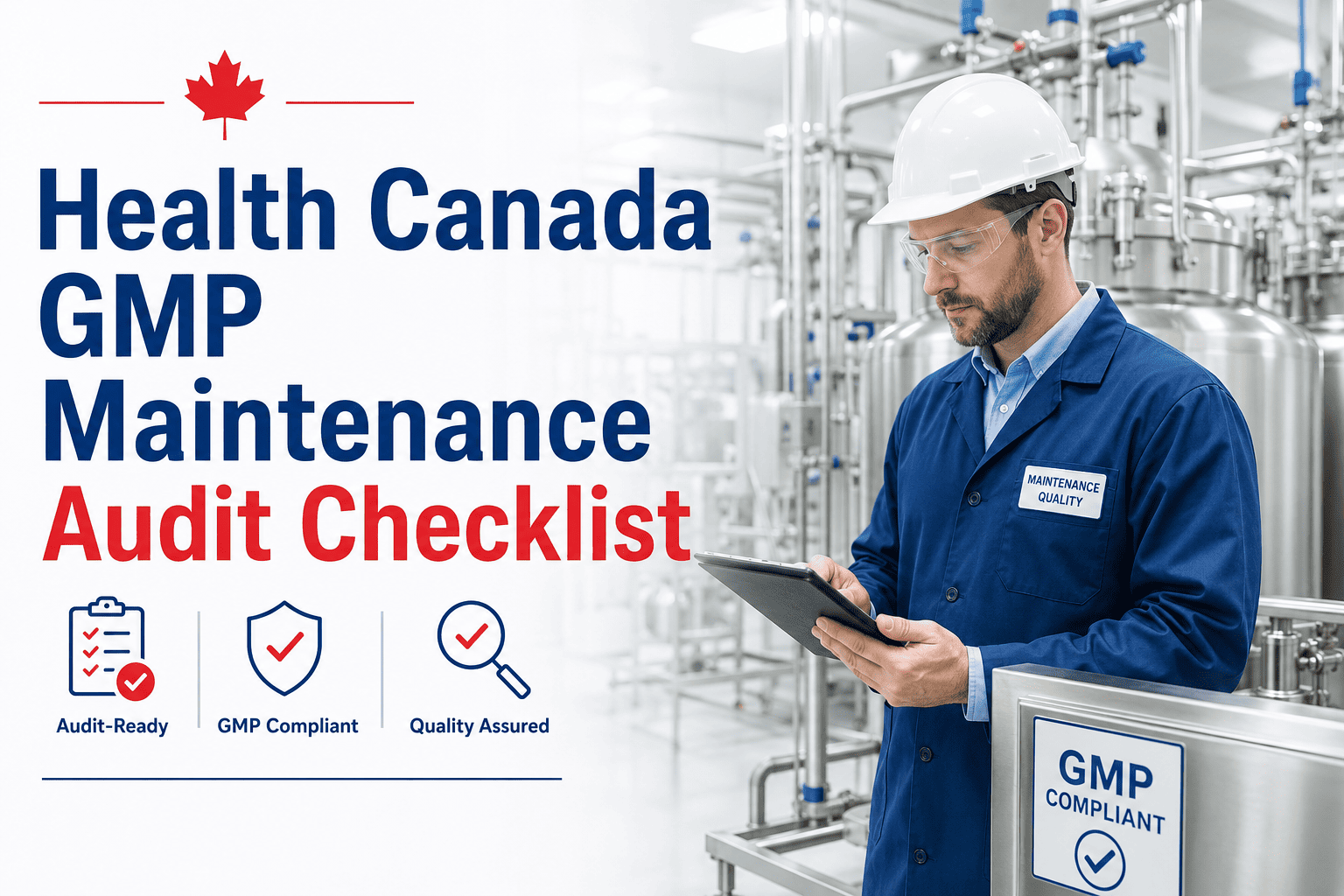
Canadian pharmaceutical manufacturers regulated under the Food and Drug Regulations (C.02.004–C.02.029) and Health Canada's Good Manufacturing Practices Guidelines face inspection readiness requirements that are closely aligned with — but distinct from — FDA and EU standards. A Health Canada GMP audit covers equipment maintenance, calibration status, deviation linkage, and controlled documentation with the same depth as any international authority inspection. Start with OxMaint free and give your Canadian pharma site an audit-ready maintenance record system built for Health Canada requirements.
Governing Regulation
C.02.004 – C.02.029
Aligned With
ICH Q10 / PIC/S
Inspection Program
Compliance Monitoring
Health Canada GMP Maintenance Audit Checklist
HEALTH CANADA AUDIT READY
Every Asset Log, Calibration Status, and Deviation Link — Ready When the Inspector Walks In
OxMaint connects asset maintenance history, calibration records, and CAPA linkage in one platform so your Canadian pharma site can pull audit evidence in under 60 seconds.
Key Differences: Health Canada vs. FDA GMP Maintenance Expectations
| GMP Requirement |
Health Canada (GUI-0001) |
FDA (21 CFR 211) |
Alignment |
| Equipment maintenance program |
Written program, defined frequencies |
Written program, equipment-specific |
Aligned |
| Calibration traceability |
NRC or equivalent national body |
NIST or equivalent |
Aligned |
| Electronic records standard |
Part C, Division 2 / PIC/S guidance |
21 CFR Part 11 |
Partially Aligned |
| Deviation and CAPA |
ICH Q10-aligned requirements |
21 CFR 211.192 investigations |
Aligned |
| Record retention |
1 year post-expiry or 2 years minimum |
Longer of 1 year post-expiry or 3 years |
Note Difference |
Expert Review
Nadia Bergeron, P.Eng.
GMP Quality Systems Consultant — Canadian Biologics and Sterile Manufacturing, 17 Years
"Health Canada inspectors under the Compliance Monitoring Program are specifically trained to follow the evidence trail from a maintenance work order through to the quality system. They will ask: is this deviation linked to a CAPA? Is the CAPA closed? Is the equipment back in qualification? If any link in that chain is broken — if a work order is closed with no quality notification, or a deviation has no CAPA — that is an observation. Canadian sites that manage this linkage in a digital platform rather than across disconnected paper systems audit significantly better."
Frequently Asked Questions
How does Health Canada's GMP inspection program work for drug manufacturers?
Health Canada's Health Products and Food Branch (HPFB) conducts GMP inspections under the Compliance Monitoring Program for establishments licensed to fabricate, package, label, test, import, or distribute drugs for human use. Routine inspections occur on a risk-based frequency, typically every two to three years for standard manufacturing sites and more frequently for sterile or biologics facilities. Inspectors assess compliance with the Food and Drug Regulations (Part C, Division 2) and the associated GMP guidelines in GUI-0001. Non-compliance findings are classified by severity and may result in voluntary undertakings, establishment licence suspension, or product recalls for critical findings.
See how OxMaint supports Health Canada compliance.
What calibration traceability does Health Canada require for GMP instruments?
Health Canada's GMP guidelines require that measuring equipment used in pharmaceutical manufacturing be calibrated against reference standards traceable to a recognized national metrology body. In Canada, this means traceability to the National Research Council of Canada (NRC) or, for imported standards, to an equivalent body such as NIST in the United States or PTB in Germany. Calibration certificates must explicitly state the traceability chain. Instruments calibrated using reference standards with expired or undocumented traceability do not meet GMP requirements, and all measurements taken with those instruments since the last verified calibration are potentially invalid.
Book a demo to see calibration management in OxMaint.
Does Health Canada accept electronic maintenance records and e-signatures?
Yes. Health Canada's GMP guidelines and the supporting PIC/S guidance documents accept electronic records as equivalent to paper records provided the electronic system meets defined data integrity requirements. These requirements align closely with ICH Q10 data integrity principles and include unique user identification, audit trails capturing all record creation and modification events, access controls preventing unauthorized changes, and system validation demonstrating the software performs its intended functions. Facilities transitioning from paper to electronic maintenance records should ensure their CMMS vendor can provide validation documentation and that internal computer system validation (CSV) procedures cover the CMMS deployment.
What is the difference between a Health Canada Form GMP/MIR and an FDA Form 483?
Both documents communicate inspection observations to the inspected facility but operate under different regulatory frameworks. Health Canada issues a GMP Inspection Report following a Compliance Monitoring inspection, which documents observations using a classification system of critical, major, and other deficiencies. The FDA Form 483 is issued at the close of an inspection and lists observations that may constitute violations of the Food, Drug, and Cosmetic Act but does not itself constitute a formal violation finding — that determination comes later through the Warning Letter process. Health Canada's critical findings can directly trigger licence suspension more quickly than the FDA's multi-step escalation process, making prompt response to Health Canada observations particularly important for Canadian manufacturers.