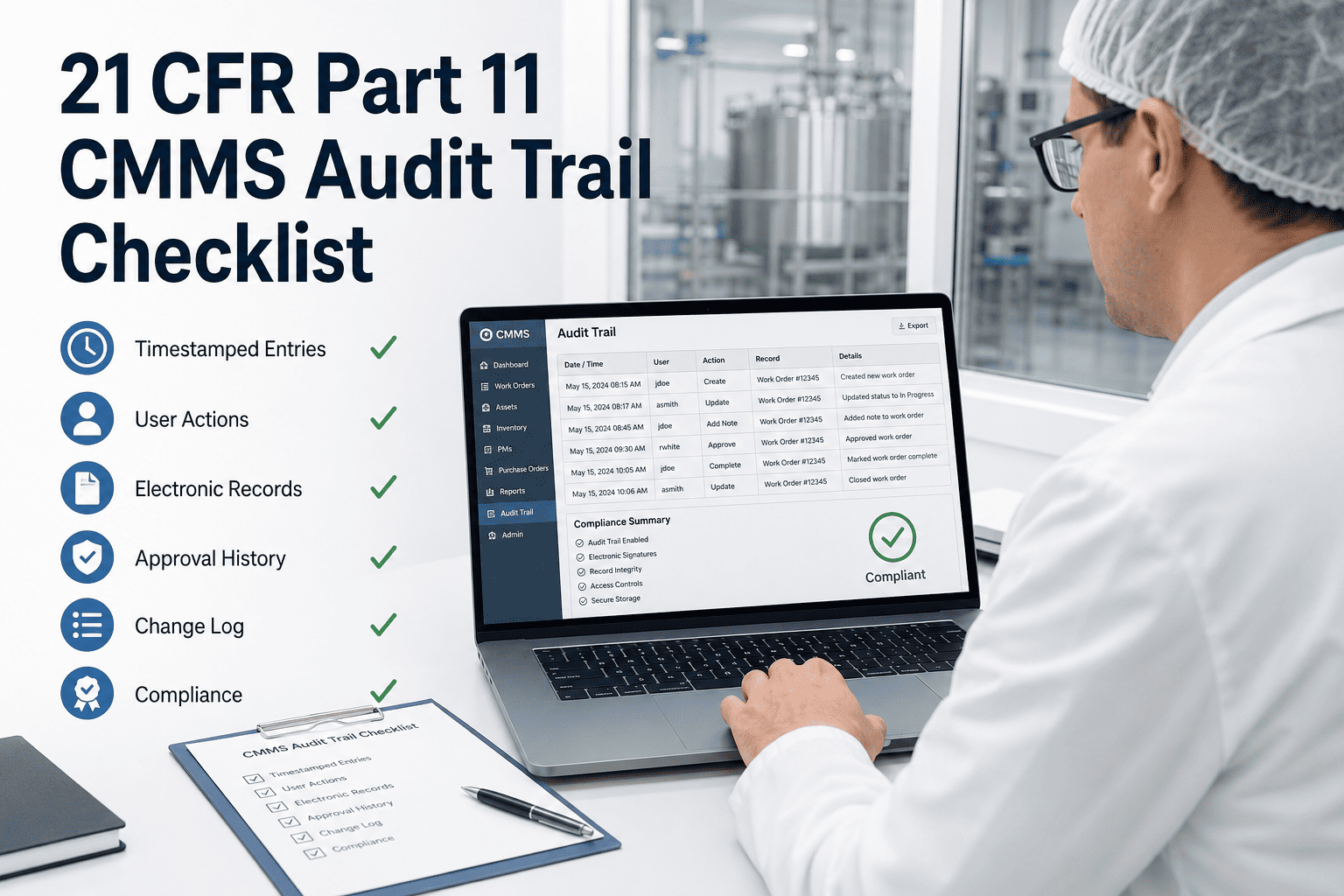
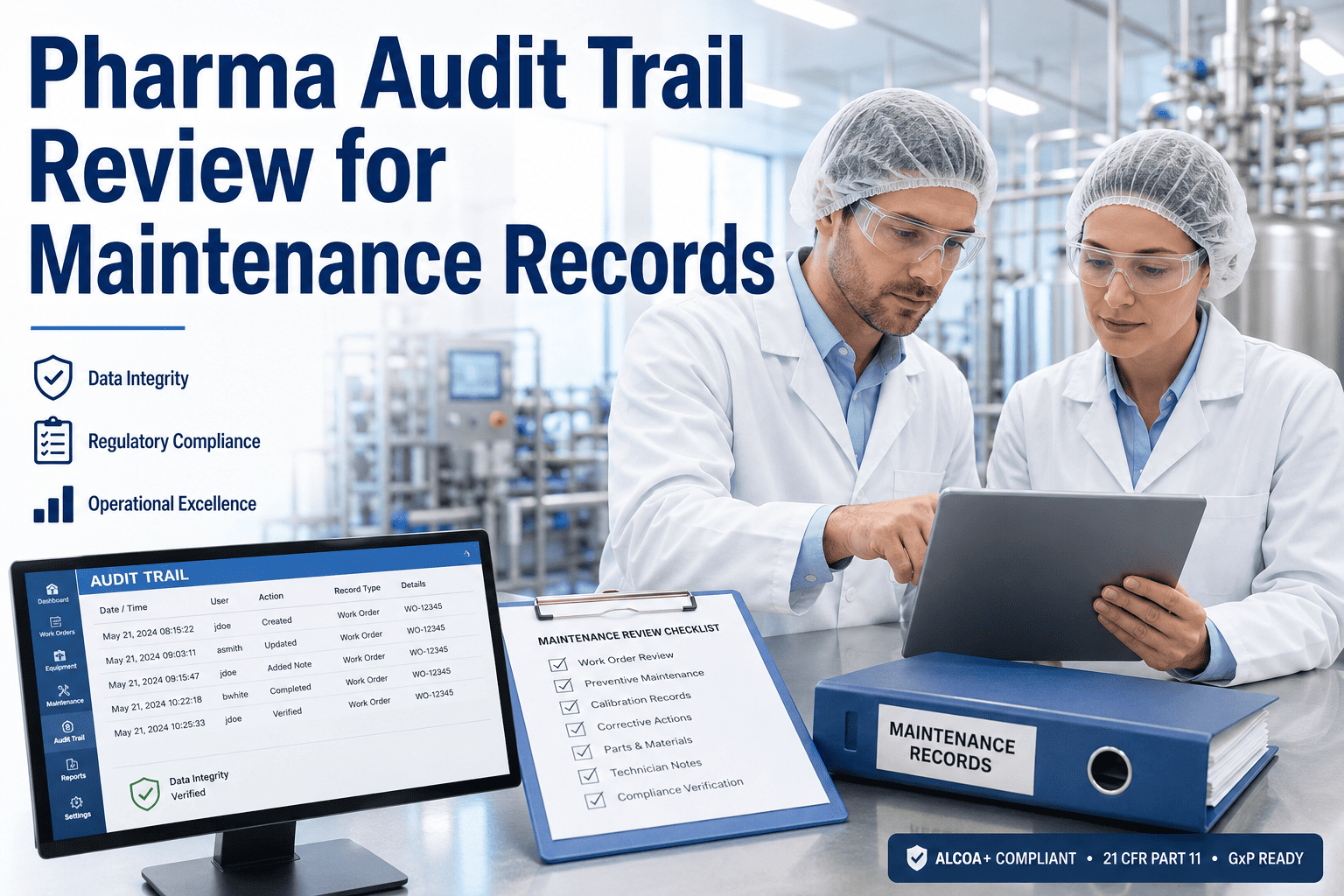
U.S. pharmaceutical manufacturers operating under 21 CFR Parts 210 and 211 are required to maintain complete, accurate, and retrievable maintenance records for every piece of GMP-critical equipment. Building a documentation system that satisfies FDA investigators while supporting day-to-day maintenance operations requires more than a paper logbook — it demands digital work orders, enforced e-signatures, immutable timestamps, and a full asset maintenance history accessible within minutes. Sign up for OxMaint free and build a compliant GMP maintenance record system from day one.
21 CFR
Parts 210 & 211 Coverage
Part 11
Electronic Records Standard
100%
Audit Trail Required
10 yr
Typical Record Retention
What GMP Maintenance Records Must Include
21 CFR 211.68 requires that equipment used in drug product manufacturing be maintained in a clean and orderly manner and that records of maintenance, cleaning, sanitizing, and inspection be maintained and available for review. The specific content required in a GMP-compliant maintenance record goes well beyond a technician's name and a completion date — each record is a piece of regulatory evidence that must stand on its own during an inspection.
01
Asset Identification
Equipment ID, tag number, description, and location clearly identified on every work order.
02
Date and Time of Performance
System-generated timestamps capturing when work started and when it was completed and signed.
03
Performing and Verifying Personnel
Full name, signature, and qualification status of both the technician who performed and the supervisor who verified the work.
04
Procedure Reference
SOP or maintenance procedure number and version used, confirming work was performed per approved instructions.
05
Parts and Materials Used
Description, lot number, and quantity of any replacement parts or cleaning agents used during the maintenance activity.
06
Findings and Observations
As-found equipment condition, any defects or anomalies observed, and corrective actions taken or initiated.
GMP DOCUMENTATION
Build GMP-Compliant Maintenance Records That Satisfy FDA on Day One
OxMaint enforces every required documentation field — asset ID, e-signatures, timestamps, procedure reference — so every work order is inspection-ready before it is closed.
Paper vs. Digital GMP Maintenance Records
| Documentation Element |
Paper-Based System |
Digital CMMS (OxMaint) |
| Signature verification |
Manual — difficult to verify identity |
User-authenticated e-signature with 21 CFR Part 11 controls |
| Timestamp integrity |
Handwritten — can be backdated |
System-generated, tamper-evident timestamp |
| Overdue PM visibility |
Manual calendar review required |
Automated alert at 80% and 100% of PM interval |
| Record retrieval during audit |
Hours to locate physical records |
Full asset history retrieved in under 60 seconds |
| Audit trail for amendments |
Cross-out and initial — often illegible |
Immutable change log with reason-for-change field |
| CAPA linkage |
Manual cross-reference, easily missed |
Auto-linked on corrective work order creation |
Asset History: The Foundation of GMP Maintenance Documentation
A complete asset maintenance history is the single most important document you can present to an FDA investigator. It demonstrates that your facility has consistently monitored, maintained, and documented the condition of GMP-critical equipment over time. An asset history should be retrievable by equipment ID within minutes and should show the full chronological record of every PM, calibration, corrective maintenance event, and deviation linked to that asset.
What a Complete Asset History Contains
Installation Qualification
IQ/OQ/PQ validation records establishing baseline asset status
Scheduled PM Records
All preventive maintenance completions with dates, technicians, and findings
Calibration History
As-found and as-left values, standards used, and out-of-tolerance findings
Corrective Maintenance Events
Failure descriptions, root cause, parts replaced, and linked CAPA numbers
Modifications and Change Controls
Engineering change notices, impact assessments, and post-change verification records
Expert Review
Dr. Michael Torres, PhD
GMP Compliance Director — Large Molecule Biologics Manufacturing, 22 Years
"The facilities that perform best during FDA inspections have one thing in common: their maintenance records are self-explanatory. An investigator should be able to pick up any work order, read it without context, and understand exactly what was done, by whom, when, why, and what the outcome was. Building that clarity into your documentation system — through required fields, structured forms, and enforced signatures — is a quality system decision, not just a software choice."
Frequently Asked Questions
Which equipment at a U.S. pharma site requires GMP maintenance records?
Any equipment that contacts or could affect drug product quality requires GMP maintenance records under 21 CFR 211.67. This includes manufacturing equipment such as reactors, mixers, and tablet presses; packaging equipment; clean utilities such as WFI systems and clean steam generators; HVAC and cleanroom systems affecting environmental classification; and laboratory instruments used for in-process or release testing. Facilities should maintain a GMP equipment list that identifies all assets requiring maintenance records, the applicable maintenance frequency, and the record retention period.
See how OxMaint manages GMP asset lists.
What are the 21 CFR Part 11 requirements for electronic maintenance records?
21 CFR Part 11 requires that electronic records used in lieu of paper records be created with controlled access through unique user IDs and passwords, include audit trails that capture the date, time, and identity of the person who created, modified, or deleted a record, use electronic signatures that are linked to their respective records such that the signature cannot be excised or transferred, and be generated by validated systems with documented procedures. A CMMS used for GMP maintenance records must be validated to demonstrate it consistently produces accurate, complete records and that its audit trail functions correctly.
Book a demo to review OxMaint's Part 11 features.
How should pharma maintenance teams handle retroactive record corrections?
Retroactive corrections to GMP maintenance records must follow a documented procedure that prohibits deleting or overwriting the original entry. The correct approach is to draw a single line through the error, add the corrected information next to it, initial and date the correction, and add a brief note explaining why the correction was made. In an electronic system, corrections must be captured in an audit trail that preserves the original data entry alongside the corrected value. FDA investigators specifically look for systems where original data can be deleted without a trace — this is a serious data integrity finding regardless of whether any records were actually altered.
How does a digital CMMS reduce GMP documentation risk compared to spreadsheets?
Spreadsheets lack the access controls, audit trails, and electronic signature binding required by 21 CFR Part 11 for records used to satisfy GMP requirements. A cell in a spreadsheet can be modified by any user with file access without any record of the change — this creates a data integrity vulnerability that FDA investigators will cite if discovered. A validated CMMS provides role-based access controls so only authorized users can close or modify records, generates system timestamps that cannot be manually altered, and creates an immutable audit trail of every change. Moving maintenance records from spreadsheets to a validated CMMS is one of the most high-impact GMP documentation improvements a pharma facility can make.
BUILD YOUR GMP RECORD SYSTEM
Complete Asset History. Enforced Signatures. Instant Audit Retrieval.
OxMaint gives U.S. pharma teams the digital maintenance record infrastructure FDA expects — without the complexity of legacy CMMS platforms.