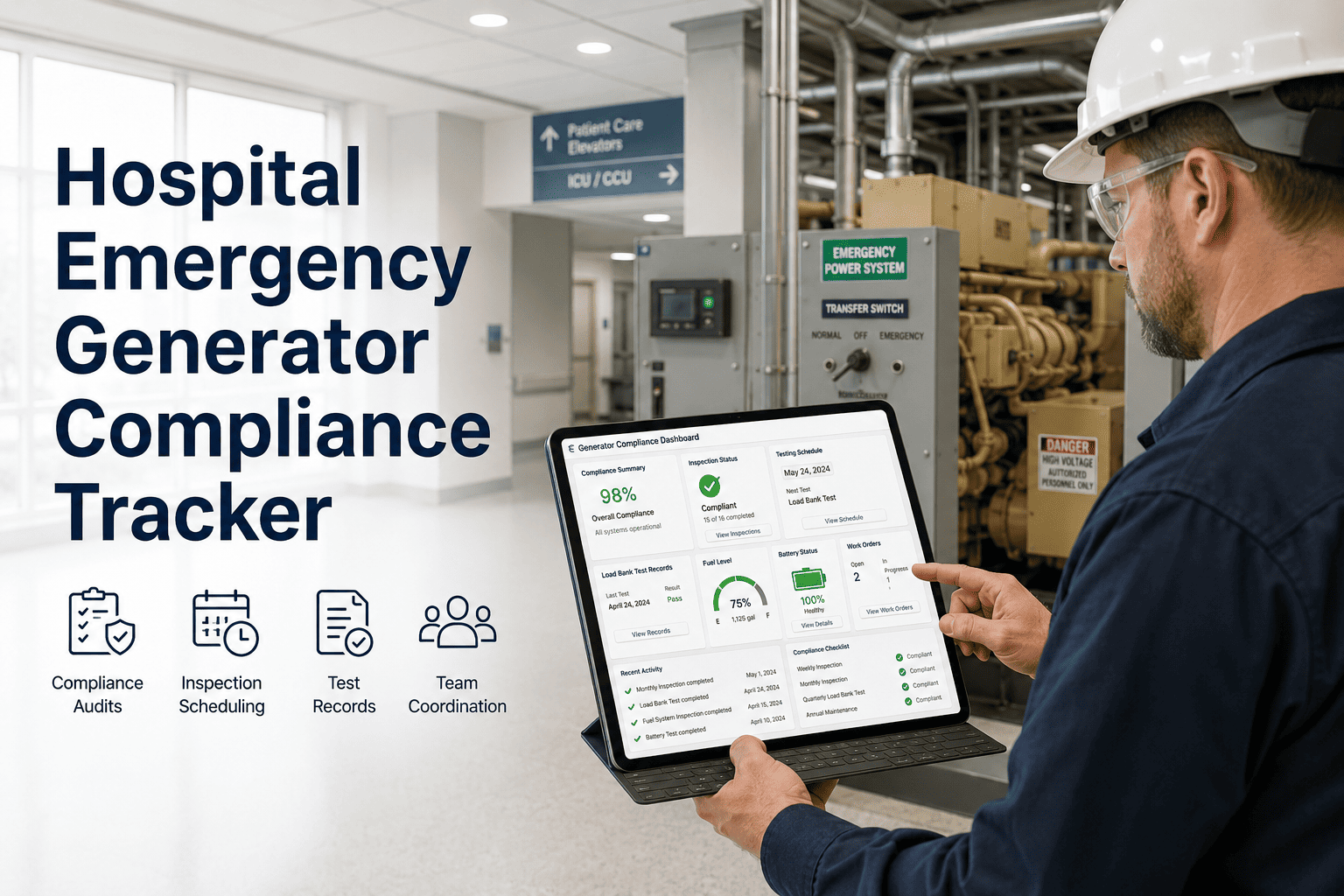
When utility power drops, a hospital has about ten seconds before the gap between the grid and the generator becomes a clinical event — ventilators, ORs, imaging, and life-safety lighting all waiting on a machine that has to start, accept load, and carry it without hesitation. The cruel pattern behind most failures is that the generator which dies at 2 a.m. usually failed quietly a month earlier, on a light-load test nobody flagged, or sat behind an automatic transfer switch that had not been exercised in years. Emergency-generator PM is not one annual service; it is a layered schedule of weekly, monthly, annual, and triennial tests, each with its own NFPA load and documentation rules. This checklist lays out every interval, and shows how OxMaint Preventive Maintenance auto-schedules each test and captures audit-ready records. Book a demo to load it onto your generator inventory.
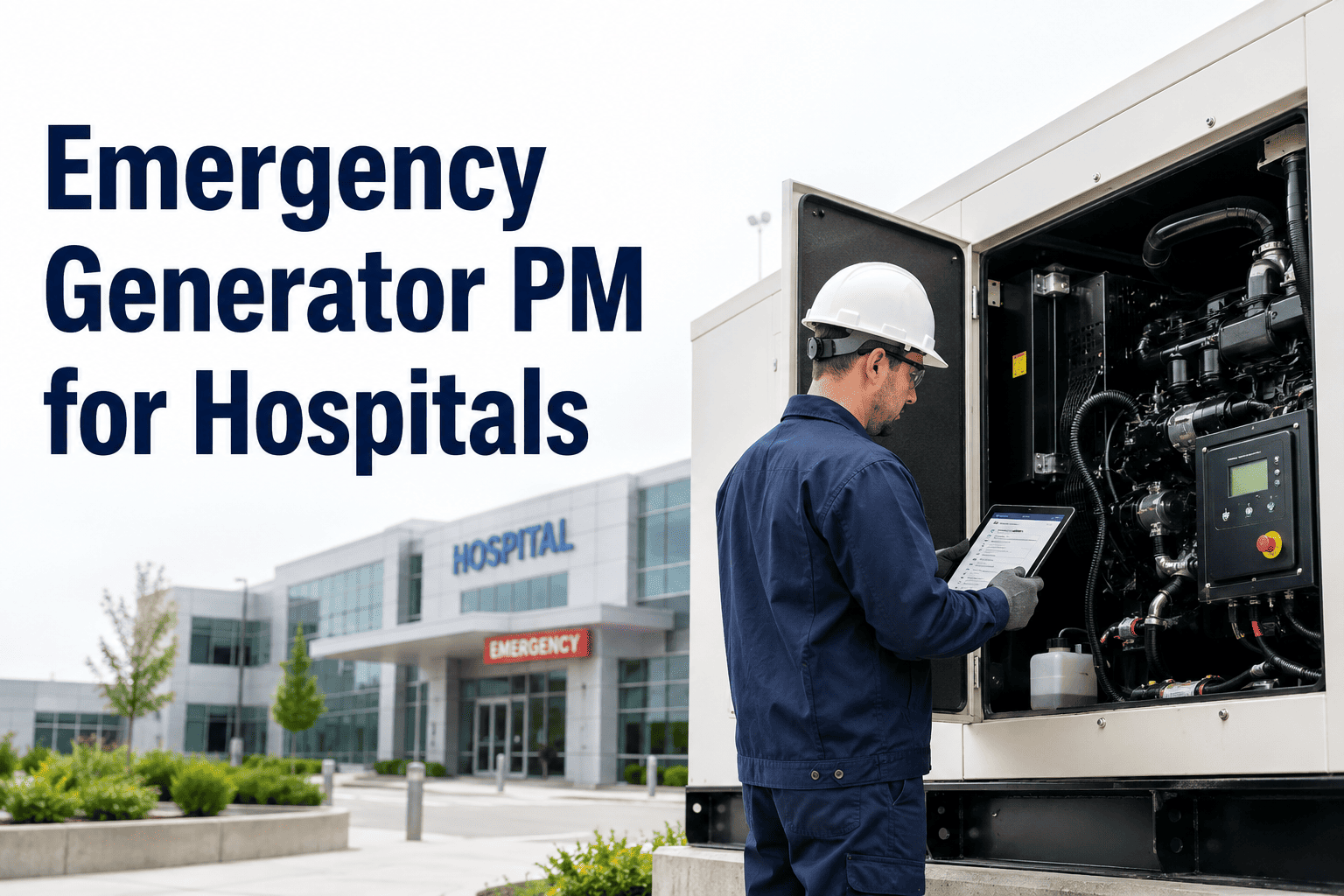
Emergency Generator PM for Hospitals
Automate NFPA 110 and NFPA 99 generator testing, transfer-switch checks, and compliance documentation — so backup power starts on the first try and proves itself to the surveyor.
The Outage Is a Test You Don't Get to Reschedule
A hospital's essential electrical system — life-safety, critical, and equipment branches — depends entirely on the emergency power supply system performing on demand. The two components that quietly cause most failures are chronic light loading, which leaves unburned fuel deposits that wreck an engine over time, and the transfer switch, which can fail with no alarm at all. A layered test schedule exists precisely to catch both before the grid does.
Every Interval, Tier by Tier
Work each cadence on its own clock. Check every task, capture the readings the standard expects, and never let a heavily used generator drift past an interval because the calendar was the only thing watching.
The Transfer Switch Fails Silently
The automatic transfer switch is the single most failure-prone part of the whole system — and it can fail with no panel alarm, so the only way to know it works is to exercise it. Skip that, and its failure rate roughly triples within five years.
The Survey Is Won in the Records
An unannounced surveyor expects immediate access to twelve to twenty-four months of test records, and paper-based programs show roughly a quarter of monthly-exercise documentation out of compliance. Every test should capture its evidence at the point of work, not reconstruct it later from a filing cabinet.
What Facilities Leaders Say
An outage is the worst possible moment to learn you missed a test. The generator that dies at 2 a.m. almost always failed a month earlier on a light-load run that nobody escalated. Automated intervals and a transfer that actually fires on real loss of power — not a warm-up — are what let me stop worrying about the one night the grid goes down.
Facilities Director · 22 Years Hospital EngineeringThe survey is decided in the documentation, not the engine room. I have watched a team spend six hours digging through filing cabinets and still hand the surveyor incomplete logs — and that is a conditional accreditation finding, on a generator that ran perfectly. Timestamped capture on every single test is the entire difference.
Environment of Care & Compliance Manager · 18 Years HealthcareFrequently Asked Questions
How often must a hospital generator be tested?
Diesel generators run at least twelve times a year, at intervals of no less than 20 and no more than 40 days, each test a minimum of 30 continuous minutes at 30% of nameplate rating or the manufacturer's minimum exhaust temperature. On top of that monthly cycle, Level 1 systems require a four-hour endurance test at least every 36 months. Book a demo to auto-schedule every interval.
What is the 30% load rule, and what is wet stacking?
A diesel generator must run under enough load to reach 30% of nameplate kW or its minimum exhaust temperature. Run chronically lighter than that and unburned fuel deposits build up in the exhaust — wet stacking — which damages the engine and can make it fail when full output is finally needed. The annual load bank test at higher load burns those deposits off and verifies performance. Start free to track load-test results.
Why is the transfer switch the highest-risk component?
Because it can fail silently — no alarm on the panel — so a switch that has not been exercised may simply not transfer when the grid drops, and its failure rate roughly triples within five years without regular exercising and contact inspection. That is why every automatic and manual transfer switch is tested monthly under simulated power loss, confirming the 10-second transfer. Book a demo to schedule ATS exercising.
What exactly is the 36-month test?
A four-continuous-hour run at no less than 30% of nameplate, performed as a full utility-interruption test of the entire emergency power supply system rather than a load-bank simulation. It can be combined with the annual load bank test, in which case the first three hours run at 30% and the final hour at 75%. Where a live interruption is unsafe, the substitution needs documented AHJ approval. Start free to log the triennial test.
What documentation will a surveyor actually ask for?
Records of every inspection, test, exercise, repair, and modification — surveyors arrive unannounced and expect immediate access to twelve to twenty-four months of logs. Paper systems fail here often, with roughly a quarter of monthly-exercise records out of compliance during surveys, and most facilities retain EPSS records for at least three years. Capturing each test digitally turns days of assembly into a minutes-long export. Book a demo to see the audit package.
Can all these intervals be scheduled automatically?
Yes — pre-built NFPA 110 templates for weekly, monthly, annual, and three-year intervals auto-assign to each generator and ATS, technicians get mobile notifications before each one with the full checklist, and every completed test produces a signed, timestamped record. The overlapping codes stop being a manual calendar exercise and become one automated program. Start free to load your generator inventory.
Make Sure It Starts the One Time It Has To
OxMaint schedules every weekly, monthly, annual, and triennial generator and ATS test, captures the readings and signatures each standard demands, and keeps a clean audit trail on hand — so backup power is both reliable and provable when the grid goes down.