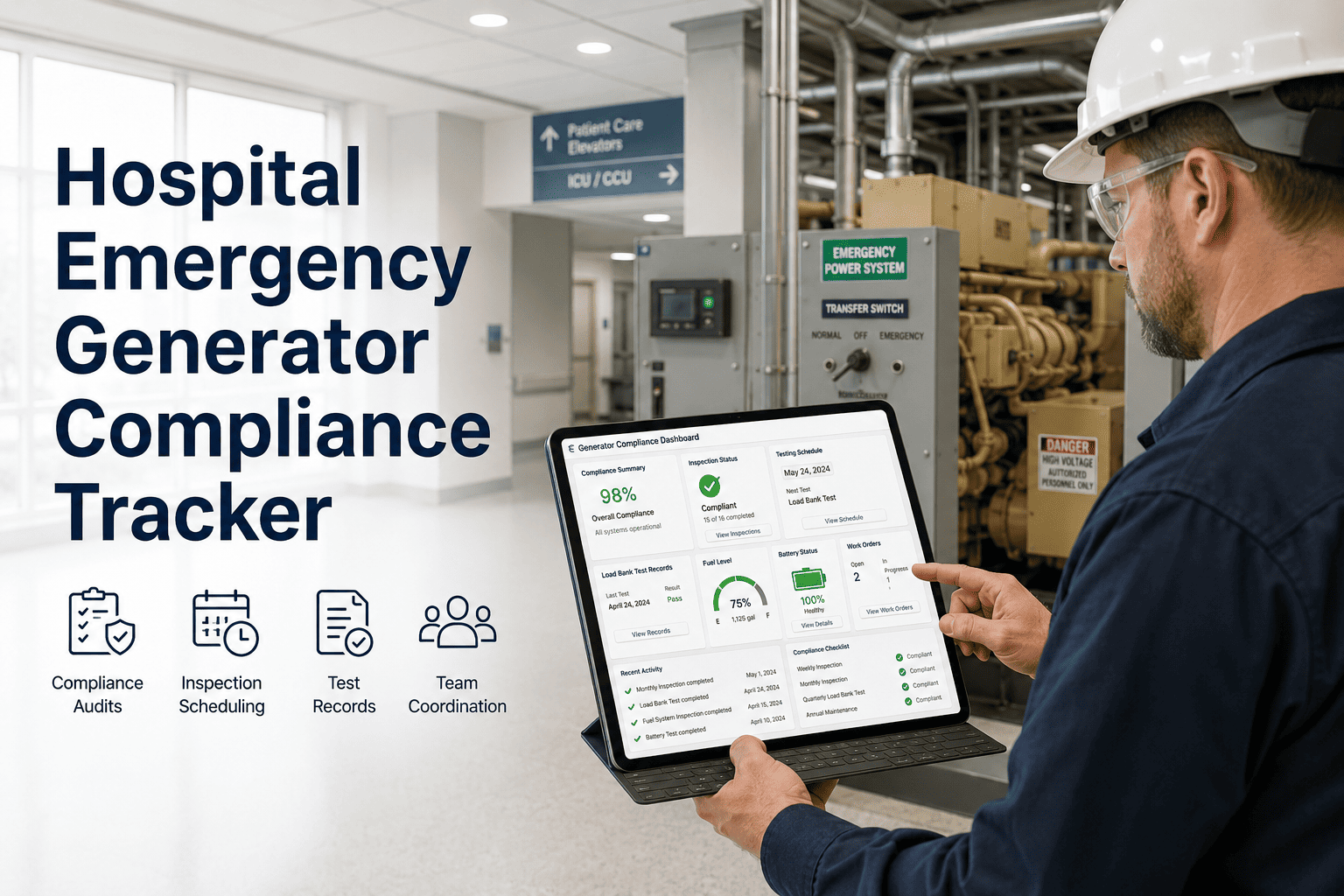
A hospital generator that fails to start during a grid outage does not produce a maintenance work order. It produces a mass casualty event. Ventilator-dependent ICU patients, patients mid-surgery under general anaesthesia, neonates in incubators — all of them depend on power transfer within 10 seconds of utility failure. NFPA 110 Type 10 Level 1 systems exist because that number is the line between a managed emergency and an unrecoverable patient harm event. The most common cause of EPSS failure is not electrical failure — it is maintenance failure: missed monthly exercise intervals, undetected wet stacking from chronic light loading, starting batteries left in service past their service life, and fuel degradation never caught because annual quality testing was not performed. Sign in to OxMaint to structure your hospital generator maintenance programme to NFPA 110 Chapter 8 requirements — or book a demo to see EPSS maintenance tracking configured for your facility's generator fleet.
Hospital Backup Generator Maintenance: NFPA 110 Compliance, Testing & PM Schedules
Complete maintenance framework for hospital emergency power supply systems — weekly inspections, monthly load tests, annual qualification, ATS maintenance, fuel management, and Joint Commission documentation.
Why Hospital Generator Maintenance Is a Life Safety Programme, Not Just PM
Hospital emergency power supply systems operate under a compliance framework that has no parallel in commercial or industrial facilities. NFPA 110, NFPA 99, NFPA 101, Joint Commission EC.02.05.07, and CMS Conditions of Participation collectively mandate a structured, documented maintenance programme with specific testing intervals, minimum load requirements, fuel management standards, and record retention requirements — all enforceable during unannounced surveys where non-compliance risks Medicare and Medicaid participation.
The maintenance failures that cause EPSS failures during actual grid outages follow a predictable pattern. Generators run at chronic light loads fail annual load bank tests because wet stacking has deposited unburned fuel on pistons and injectors. Starting batteries left in service past their 3–5 year service life fail to crank the engine when the ATS signals start. Fuel tanks last polished more than 24 months contain microbial contamination that blocks injectors under full load. Transfer switches exercised infrequently develop contact oxidation that prevents reliable transfer. Every one of these failures is detected and prevented by a compliant NFPA 110 Chapter 8 maintenance programme. Sign in to OxMaint to build your generator maintenance programme on NFPA 110 Chapter 8 requirements.
Automate Your NFPA 110 Maintenance Schedule
OxMaint pre-configures weekly, monthly, annual, and 3-year NFPA 110 maintenance intervals at the asset level — so intervals auto-trigger without manual calendar management and every test record is audit-ready for Joint Commission review.
Critical Monitoring Parameters for Hospital Generator Systems
Effective EPSS maintenance requires systematic monitoring of key operational and fuel system parameters at each inspection interval. Each monitoring area maps to a specific NFPA 110 Chapter 8 requirement with mandatory documentation. Sign in to OxMaint to configure monitoring templates per interval with mandatory sign-off fields.
NFPA 110 §8.3.6 requires weekly battery inspection and monthly specific gravity testing. Starting batteries are the most common cause of generator failure to start — a battery that tests marginally acceptable monthly may fail catastrophically at -15°C during a winter grid outage.
NFPA 110 §8.3.7 requires annual fuel quality testing per ASTM D975. Diesel fuel degrades in storage — oxidation products, water ingress, and microbial contamination (ULSD is particularly susceptible) can block injectors within 12–24 months of production. Tank-to-generator delivery systems require periodic inspection for water, sediment, and microbial growth.
Weekly visual inspection covers coolant level, oil level, and condition, exhaust system integrity, and air intake condition. Monthly 30-minute exercise under load captures operating voltage, frequency, oil pressure, coolant temperature, and exhaust characteristics that confirm the engine is performing within specification at the loads delivered.
The ATS is the highest-risk single component in any EPSS — it can fail silently without triggering a control panel alarm. Without regular exercising and contact inspection, ATS failure rates increase 3× within 5 years. Monthly testing verifies transfer time and sensing relay function. Annual inspection of contact condition is mandatory for Life Safety Branch ATS units.
EPSS control panels include local and remote annunciation for generator status, low fuel, low coolant, high temperature, battery failure, and failure-to-start conditions. All alarm points must be tested at defined intervals — a control panel that shows all-green but has a failed low-fuel sensor will not alert staff when the day tank empties during a prolonged grid outage.
NFPA 110 §8.5.1 requires written records of all EPSS inspections, operational tests, exercising, repairs, and modifications — retained on premises and available to the AHJ on request. The records must include: date, name of service person(s), identification of unsatisfactory conditions and corrective actions taken. Paper-based systems show 23% non-compliance rates during Joint Commission surveys. Sign in to OxMaint to generate audit-ready NFPA 110 test records automatically at each inspection close.
NFPA 110 Chapter 8 Maintenance Schedule — Required Intervals
The following PM schedule reflects NFPA 110 Chapter 8 minimum requirements for Level 1 EPSS in hospital applications. These are minimums — manufacturer recommendations and AHJ requirements may specify shorter intervals for specific components. OxMaint configures all intervals at asset level and auto-generates work orders before each interval falls due. Book a demo to see NFPA 110 PM templates pre-built in OxMaint.
Every Missed Interval Is a Compliance Finding. Every Missing Record Is a Liability.
OxMaint eliminates missed test intervals, incomplete documentation, and manual record assembly — the three most common NFPA 110 failure points during Joint Commission and CMS surveys.
Wet Stacking, Load Bank Testing, and the 30% Rule
The most widespread generator reliability problem in hospital EPSSs is wet stacking — unburned fuel accumulation in the exhaust system from chronic light loading. A generator that runs at 15–20% of nameplate kW during monthly tests cannot reach the exhaust gas temperatures needed for complete combustion. Fuel deposits build on pistons, injectors, and the exhaust system over months. The engine still starts, still runs, and still passes monthly tests at light load — then fails to deliver rated output during a prolonged grid outage when full load is demanded for the first time in years.
In twelve years of NFPA 110 compliance consulting for hospital systems, I have seen every possible variant of generator maintenance failure — but the pattern is almost always the same: the generator is mechanically sound, the maintenance team is competent, and the failure is administrative. A monthly exercise that was performed but not documented. An annual load bank test conducted by a contractor whose certificate was filed in a binder no one can locate during a survey. A starting battery replaced three years ago with the replacement date recorded nowhere in the asset history. The surveyor asks for records, the records are not retrievable, and a functioning EPSS becomes a compliance finding. OxMaint solves exactly this problem — every test result, every meter reading, every certificate is linked to the specific generator asset record and retrievable in seconds. That is the difference between an EPSS that is compliant and one that cannot prove it is compliant.