Multi-site hospital networks are among the most operationally complex environments in existence — thousands of assets, dozens of clinical areas, and regulatory scrutiny that never stops. When maintenance fails across even one facility, the consequences cascade: deferred procedures, compliance findings, and emergency capital spend that was never budgeted. This guide breaks down exactly how enterprise maintenance management software transforms hospital network operations at scale — and what the numbers look like when it works. If you manage maintenance across multiple hospital sites, start a free trial for 30 days and see your entire portfolio in one platform, or book a demo with our healthcare enterprise team today.
4.8x
Higher cost of emergency repairs vs scheduled maintenance across hospital networks
62%
Of critical equipment failures are detectable 24–72 hours before clinical impact
$2.4M
Average annual emergency repair spend in reactive hospital maintenance programs
35%
Asset lifespan lost annually to undetected degradation in multi-site health systems
Definition
What Is Enterprise Maintenance Management for Hospital Networks?
Enterprise maintenance management for hospital networks is the practice of centralising asset lifecycle data, preventive maintenance scheduling, work order management, and CapEx forecasting across every facility in a health system portfolio — into a single, unified platform. It replaces siloed spreadsheets, disconnected CMMS tools, and manual compliance reporting with one source of truth for every site. The result is a maintenance program that scales with your network, not against it. Want to centralise your hospital network today? start a free trial or book a demo with our enterprise specialists.
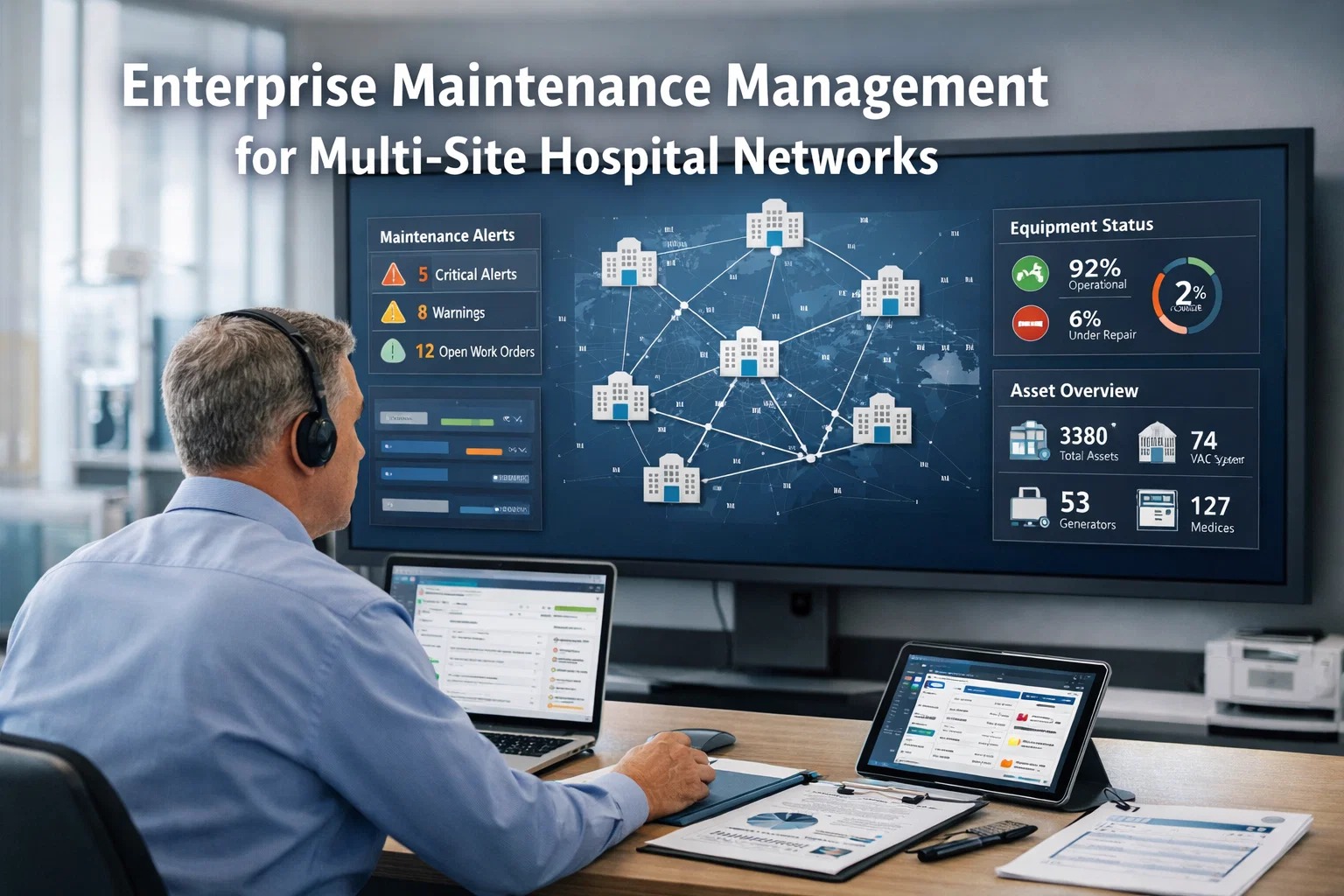
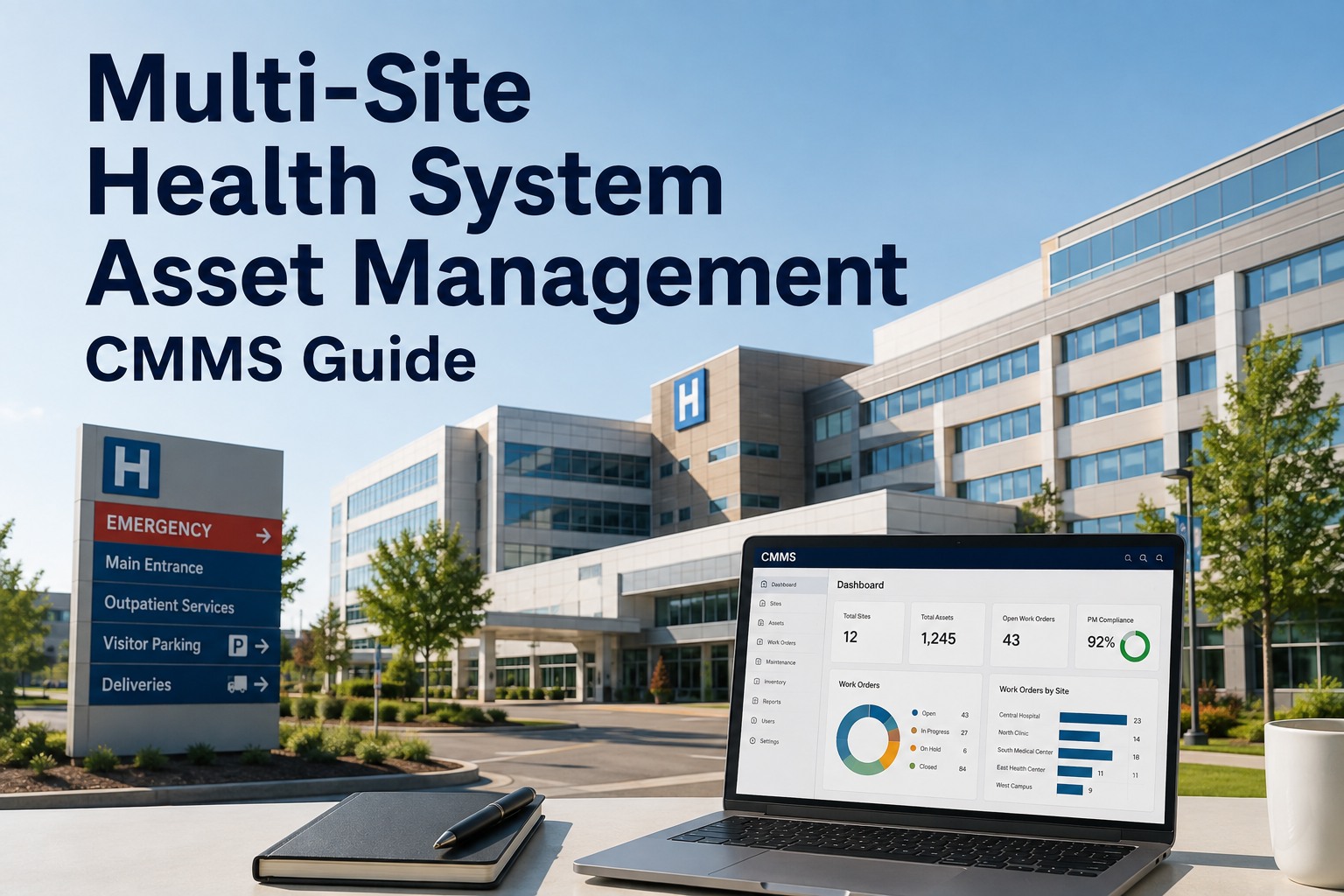
A single dashboard surfaces asset health, PM compliance, and open work orders across every hospital site — no site-by-site log-in required.
Centralised PM Scheduling
Preventive maintenance schedules for all sites, all asset classes, all technicians — managed from one enterprise interface with site-level delegation.
Compliance Documentation at Scale
Joint Commission, CMS, and local regulatory records generated automatically across every site — no manual compilation before surveys.
Asset Hierarchy Management
Full asset registry structured as Portfolio > Property > System > Asset > Component — giving every level of management the view they need.
Multi-Year CapEx Forecasting
Rolling 5–10 year capital replacement models driven by live asset condition data across your entire hospital network — not vendor estimates.
Multi-Site Technician Management
Work order routing, technician assignment, and performance reporting across all facilities — with mobile-first tools for field teams at every site.
Condition-Based Asset Scoring
Every asset carries a live condition score updated by inspections, sensor data, and work history — surfacing the highest-risk equipment before failure.
Investor-Grade Reporting
Portfolio performance reports structured for ownership groups, boards, and capital committees — not just facility managers. Ready to share in minutes, not hours.
The Problem
Why Multi-Site Hospital Networks Break Under Reactive Maintenance
A single hospital running a reactive maintenance program is a costly problem. A network of 5, 10, or 20 hospitals running reactive programs simultaneously is a structural crisis. Every disconnected site multiplies compliance risk, inflates emergency spend, and blinds leadership to the portfolio-wide picture they need to make defensible capital decisions. Oxmaint was built for exactly this scale — start a free trial or book a demo to see how multi-site health systems close the gap.
01
No Cross-Site Visibility for Operations Leadership
VPs of Operations and Directors of Facilities cannot see asset health, PM compliance rates, or open work order backlogs across sites simultaneously. Decisions are made on stale reports or anecdote — not live data. 78% of multi-site facility leaders report that cross-site reporting takes more than 4 hours to compile manually.
78% spend 4+ hrs compiling cross-site reports
02
Siloed Asset Records Across Disconnected CMMS Platforms
Hospital networks that grew through acquisition often run 3–6 different CMMS platforms across their sites — each with its own data structure, compliance workflow, and reporting format. Consolidating asset records for a single accreditation survey can take weeks. Benchmarking maintenance performance across sites is practically impossible.
3–6 disconnected CMMS platforms in typical networks
03
PM Compliance Gaps Multiplied Across Every Facility
Joint Commission Environment of Care standards require documented PM for all medical equipment. In networks running paper-based or disconnected digital programs, PM compliance below 85% at any single site creates accreditation exposure — and CMS penalty risk that can reach $1M+ per survey cycle. Missed windows at one site are invisible to network leadership until a survey finding surfaces them.
PM below 85% = automatic JC survey finding
04
CapEx Surprises That Derail Annual Budget Cycles
Without condition-based asset data, capital replacement decisions are made on intuition and vendor warranty schedules — not actual asset health. Hospital networks regularly face unexpected equipment replacements outside budget cycles at $150K–$2.5M per major asset. Across a 10-site network, this can mean $8M–$15M in unbudgeted capital spend annually. Leadership has no early warning and no data to defend deferral or acceleration decisions.
$8M–$15M unbudgeted CapEx in 10-site networks
Built for Enterprise Scale
One platform for every hospital in your network — from a single dashboard.
Oxmaint gives multi-site health systems the unified asset registry, centralised PM scheduling, and portfolio-level reporting they need to run maintenance at enterprise scale — without long implementation timelines or heavy consulting fees.
The Solution
How Oxmaint Powers Enterprise Maintenance Across Hospital Networks
Oxmaint is structured around the reality of multi-site healthcare operations. The platform's asset hierarchy — Portfolio, Property, System, Asset, Component — maps directly to how health system portfolios are organised. Every feature is built for scale: centralised scheduling with site-level execution, portfolio dashboards with individual-site drilldown, and compliance documentation that flows automatically at every level of the hierarchy. See how Oxmaint works for your network — start a free trial for 30 days or book a demo with our enterprise implementation team.
Asset Intelligence
Unified Asset Registry Across Every Hospital Site
Oxmaint consolidates asset records from all facilities into a single structured registry. Every asset — from MRI suites to elevator banks to HVAC chillers — carries a full history: condition score, maintenance record, failure history, and remaining useful life estimate. For networks migrating from multiple legacy CMMS platforms, Oxmaint's onboarding team handles data migration without disruption to ongoing maintenance operations. Most networks are fully operational across all sites within 2–4 weeks.
2–4 weeks to full network deployment
PM Management
Centralised PM Scheduling with Site-Level Execution
Enterprise maintenance managers set PM schedules, frequencies, and compliance thresholds centrally. Site-level teams receive auto-generated work orders, mobile checklists, and escalation alerts — without needing to manage the scheduling logic themselves. Compliance rates are tracked in real time at both site and portfolio level. Networks using Oxmaint consistently reach 95%+ PM compliance across all facilities within 90 days of deployment.
95%+ PM compliance within 90 days
Work Order Management
Network-Wide Work Order Visibility and Routing
Every work order — planned PM, corrective, and emergency — flows through Oxmaint's unified system. Enterprise managers see the full work order backlog across all sites. Individual site managers see their own queue. Technicians receive mobile-first assignments with full asset context: prior repair history, parts availability, and manufacturer documentation. Average MTTR drops by 67% within the first 6 months as mobile work order management eliminates the administrative bottleneck that inflates repair timelines.
67% reduction in average MTTR within 6 months
Compliance Automation
Audit-Ready Documentation Generated Automatically at Every Site
Every PM completion, inspection result, and corrective action generates a timestamped, digitally-signed record in Oxmaint's compliance module. Joint Commission Environment of Care documentation, CMS evidence packages, and local regulatory records are always current and always retrievable — for every site, simultaneously. No manual compilation before surveys. Network compliance officers can pull audit packages for any facility in under 10 minutes.
Audit packages retrievable in under 10 minutes
CapEx Forecasting
5–10 Year Capital Plans Across the Full Portfolio
Remaining useful life estimates and MTBF trends from every asset in the network feed into rolling CapEx replacement models. CFOs, Directors of Finance, and Capital Committee members receive multi-year forecasts at both portfolio and site level — grounded in actual asset condition data, not vendor estimates or rule-of-thumb depreciation. Surprise CapEx requests drop by over 70%. Budget cycles become defensible conversations backed by data, not negotiations over gut feel.
70% fewer surprise CapEx requests
Portfolio Reporting
Investor-Grade Reporting for Boards and Ownership Groups
Oxmaint's portfolio-level reporting module produces structured performance summaries designed for ownership groups, health system boards, and capital committees — not just operations teams. Asset condition index, PM compliance rate, emergency spend trend, and CapEx runway are all surfaced in board-ready formats. What previously required 20+ hours of analyst time to compile across sites is now available in real time from a single dashboard.
20+ hours of manual reporting eliminated per cycle
Before vs After
Siloed vs. Centralised: The Performance Gap in Hospital Networks
Multi-site hospital networks running disconnected maintenance programs face a performance deficit on every critical dimension — not just cost. This comparison shows what changes when enterprise maintenance is centralised on a single platform. Want to model what centralisation means for your specific network? Start a free trial or book a demo and let our team run the numbers for your portfolio.
4+ hours of manual compilation per reporting cycle
Real-time portfolio dashboard — zero manual effort
58–72% across disconnected sites, no network view
95%+ across all sites, tracked in real time
12–18 hours average across the network
Under 2 hours with mobile work order routing
3–6 systems, inconsistent records, no condition scores
One registry, live condition scoring, full history
Guesswork; $8M–$15M annual unbudgeted surprises
Data-driven 5–10 year model; 70% fewer surprises
Weeks of manual prep per site per survey cycle
Audit packages in under 10 minutes, always current
$1.2M–$2.4M annually per facility
Under $180K per facility with predictive PM
20+ hours analyst time; no standardised format
Board-ready reports generated in real time
Reduction in unplanned failures
Within 12 months of structured enterprise PM deployment
Drop in average MTTR
Mobile work orders with integrated parts lookup across all sites
PM compliance across all sites
Centralised scheduling with automated escalation
Fewer surprise CapEx requests
Rolling 5–10 year forecasts driven by live asset data
FAQ
Common Questions on Enterprise Hospital Network Maintenance
What is enterprise maintenance management software and how is it different from a standard CMMS?
A standard CMMS manages work orders and PM schedules at a single-site level. Enterprise maintenance management software is purpose-built for multi-site portfolios — it adds a portfolio layer above the site layer, enabling centralised asset registry management, cross-site PM scheduling, network-level compliance reporting, and portfolio-level CapEx forecasting. The key difference is that enterprise platforms give operations leadership a unified view of all facilities simultaneously, while site teams retain their individual work queue views and mobile tools. Oxmaint's asset hierarchy — Portfolio, Property, System, Asset, Component — maps directly to how hospital network portfolios are structured, making it a natural fit for health systems managing 3 or 30 facilities.
How long does it take to deploy Oxmaint across a multi-site hospital network?
Most hospital networks are fully operational on Oxmaint across all sites within 2–4 weeks. The onboarding process covers asset data migration from existing CMMS platforms, PM schedule import, technician onboarding on the mobile app, and compliance template configuration for Joint Commission and CMS documentation requirements. Oxmaint does not require long implementation projects, specialist consultants, or IT infrastructure changes. The platform is cloud-native and mobile-first — there is no server infrastructure to install. Networks migrating from 3–6 legacy CMMS systems typically find the consolidation itself delivers immediate operational value before any features are fully utilised.
How does Oxmaint handle Joint Commission and CMS compliance documentation across multiple sites?
Every maintenance action recorded in Oxmaint — PM completion, corrective repair, inspection, and emergency response — automatically generates a timestamped, digitally-signed record that satisfies Joint Commission Environment of Care documentation requirements. CMS evidence packages and local regulatory records are always current and retrievable at both the site and portfolio level. Network compliance officers can pull audit documentation for any facility in under 10 minutes. For accreditation cycles involving multiple sites, Oxmaint eliminates the multi-week manual preparation process that typically precedes Joint Commission surveys. PM compliance rates are tracked in real time, with automated escalation alerts when any site falls below configured thresholds.
How does Oxmaint's CapEx forecasting work for hospital network capital planning?
Oxmaint generates rolling 5–10 year CapEx replacement forecasts from live asset condition data. Every asset in the registry carries a condition score, MTBF trend, and remaining useful life estimate — updated continuously from inspection results, work order history, and sensor data where available. These inputs feed into replacement timeline models at both the individual asset and portfolio level. CFOs and capital committee members receive multi-year forecasts showing projected replacement spend by facility, by asset class, and by year — with data-driven confidence intervals rather than rule-of-thumb estimates. Networks consistently report a 70% reduction in unbudgeted CapEx requests within 12 months of Oxmaint deployment, because replacement timelines are visible well in advance of failure or budget cycle deadlines.
Get Started with Oxmaint
Give Your Hospital Network the Enterprise Maintenance Platform It Needs
Oxmaint delivers centralised asset management, automated PM scheduling, portfolio-level compliance reporting, and investor-grade CapEx forecasting — built specifically for multi-site healthcare operations. No heavy implementation. No specialist consultants. Unified portfolio dashboards from week one.
Unified portfolio asset registry
Cross-site PM scheduling
Joint Commission documentation
5–10 year CapEx models
Portfolio-level dashboards
Mobile-first technician tools
IoT and SCADA integration
Investor-grade reporting
.png)
.jpg)

