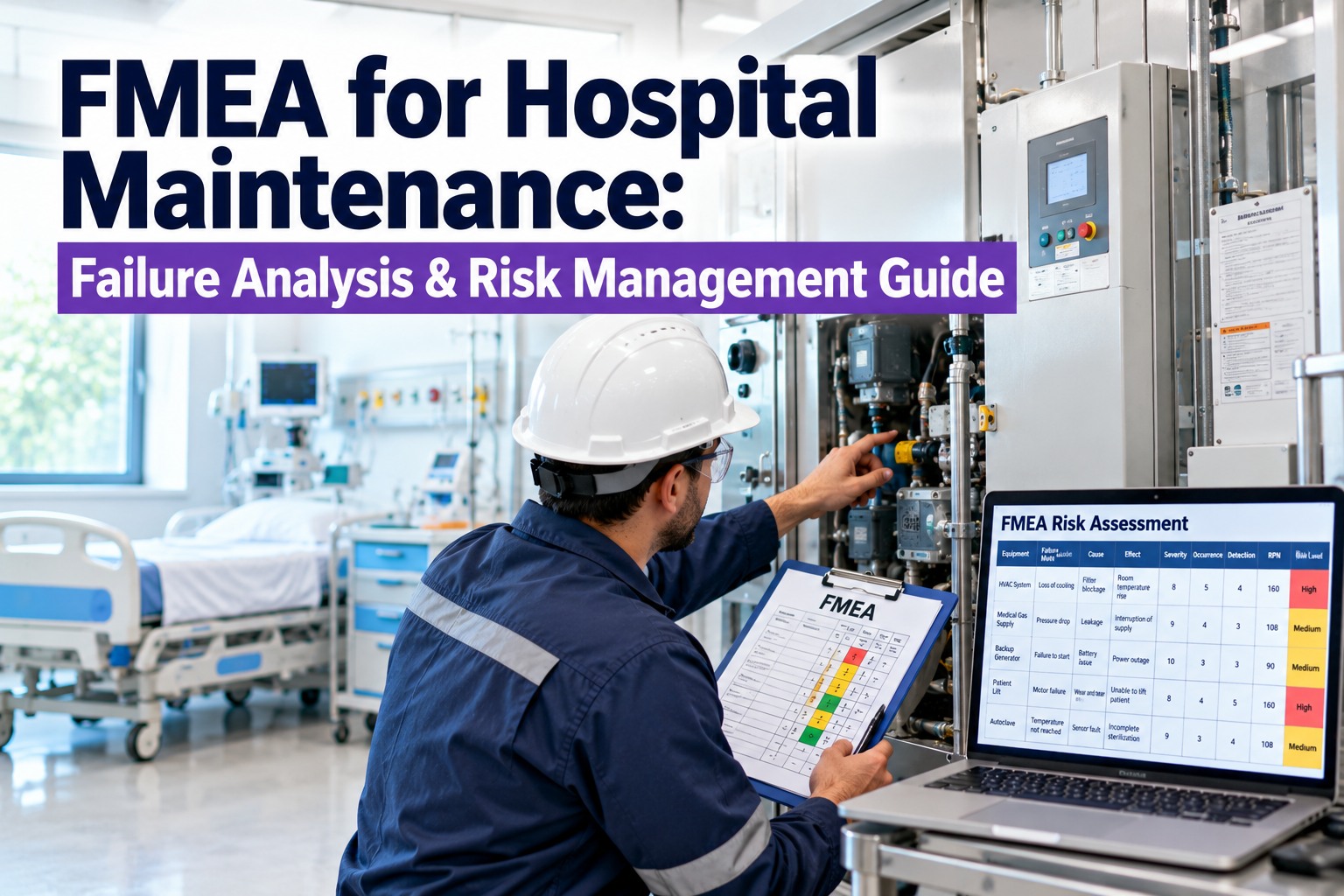
In a hospital, not every asset deserves the same maintenance attention — a failed ventilator is a patient-safety event, a failed waiting-room TV is an inconvenience, and spreading limited biomedical staff evenly across both is how the dangerous failures slip through. FMEA — Failure Mode and Effects Analysis — is the method that ranks what to watch by real risk, scoring each failure mode on how severe, how likely and how hard to catch it is. This guide shows how to run FMEA on hospital equipment and turn the numbers into a prioritized PM program, and how OXMAINT AI, the AI-powered healthcare CMMS, captures the failure history that makes the scoring real.
FMEA for Hospital Maintenance: Failure Analysis & Risk Management
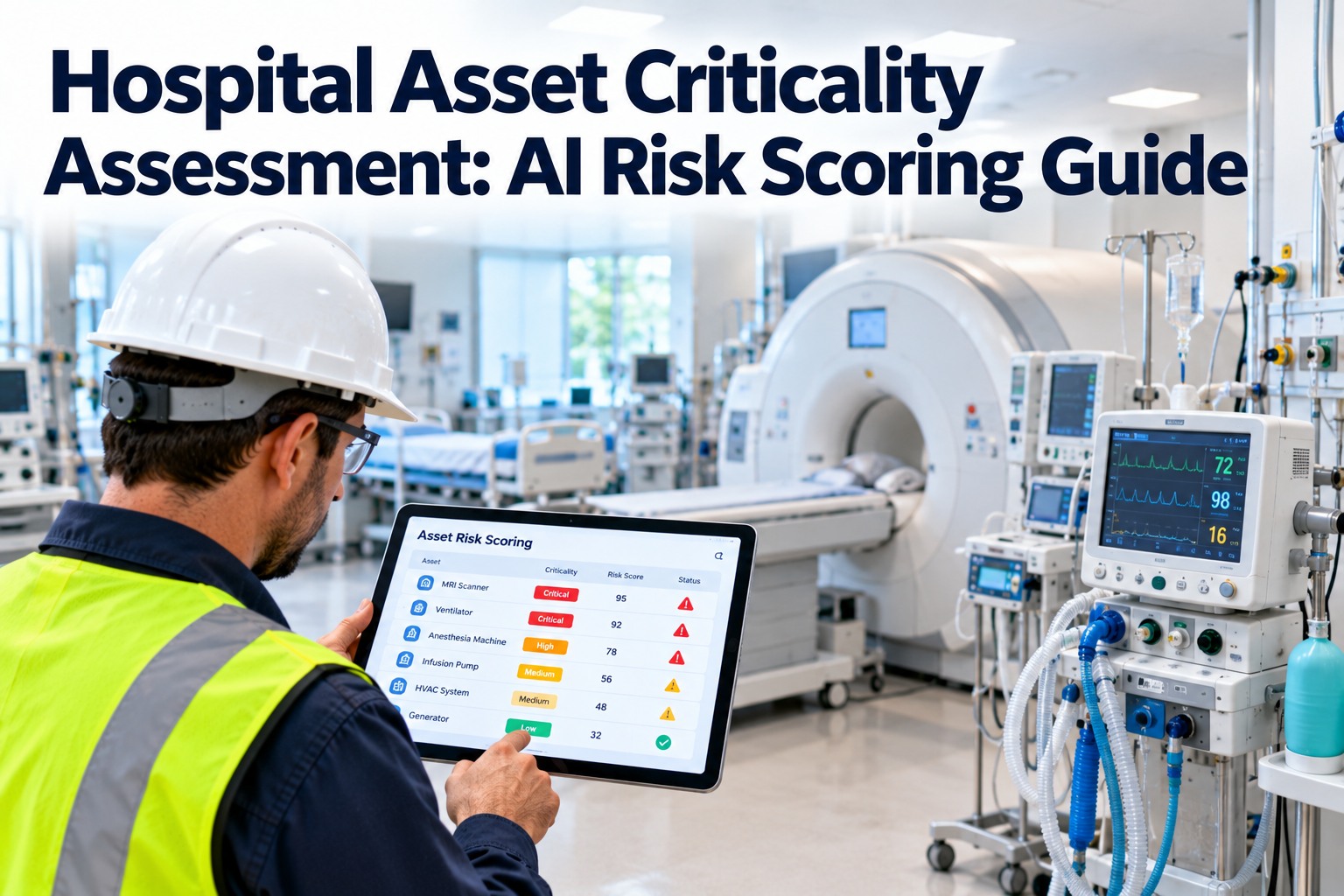
Biomedical staff stretched thin, PM schedules set by habit instead of risk, a critical-care device that fails with no warning anyone acted on — that's maintenance without a risk lens. OXMAINT AI, the AI-powered CMMS and maintenance management software, builds FMEA into the workflow: score each failure mode on severity, occurrence and detection, rank by Risk Priority Number, and convert the highest-risk items into PM and inspection tasks — with the failure history behind every score.
The Three Questions Behind Every Score
FMEA reduces a messy question — "which failure should we worry about?" — to three you can actually score. How bad is it if this happens, how often does it happen, and how likely are we to catch it first? Each is rated 1 to 10, and OXMAINT AI anchors the occurrence score in real failure history rather than a guess. Book a demo to see FMEA scoring in OXMAINT AI.
A Worked FMEA on Hospital Equipment
The method becomes concrete when you run it on real assets. Here is an FMEA worksheet across a few representative hospital devices — each failure mode scored, the RPN calculated, and the maintenance action that score justifies. OXMAINT AI stores this worksheet against the asset, with the RPN as the documented reason for every task. Start free and build your FMEA worksheet in OXMAINT AI.
| Asset & failure mode | S | O | D | RPN | Maintenance action |
|---|---|---|---|---|---|
| Ventilator — blower motor degradation | 9 | 3 | 6 | 162 | Condition-based runtime monitoring + scheduled motor service |
| Infusion pump — flow-rate drift | 8 | 4 | 5 | 160 | Scheduled calibration verification each PM cycle |
| Defibrillator — battery charge loss | 10 | 2 | 4 | 80 | Routine battery test + automated readiness check |
| Sterilizer — chamber seal leak | 7 | 3 | 5 | 105 | Quarterly seal inspection + pressure-hold test |
| Imaging chiller — coolant flow loss | 6 | 4 | 4 | 96 | Flow trend monitoring; service at defined threshold |
Note the defibrillator: an RPN of 80 sits below the usual action line, but severity alone is 10 — a safety-critical failure — so it is treated as high priority regardless. RPN ranks the many; severity still overrides for the few that can harm a patient.
What the RPN Tells You to Do
The Risk Priority Number isn't a grade — it's a routing rule. Where a failure mode lands in the RPN bands decides whether it becomes a proactive task, a scheduled one, or stays on watch. OXMAINT AI applies these bands as it ranks the worksheet. Book a demo to see RPN-driven prioritization in OXMAINT AI.
Score the Risk Once, and the PM Schedule Writes Itself.
FMEA turns a subjective argument about what to maintain into a ranked list backed by failure history. The highest-risk modes become PM tasks with the RPN as their justification — so limited biomedical hours go where patient risk is highest, not where habit sends them.
Turning a Score Into the Right Task
A high RPN tells you to act; which of the three factors is driving it tells you how. The remedy targets the worst-scoring component of the score, not the number as a whole. OXMAINT AI uses that logic to suggest the task type. Start free and convert scores into tasks in OXMAINT AI.
The Eight-Step FMEA Loop
Run as a repeatable loop, FMEA stays current as equipment and failure history change. OXMAINT AI structures each step and keeps the worksheet live against the asset record. Book a demo to run the full loop in OXMAINT AI.
Reliability the Numbers Can Prove
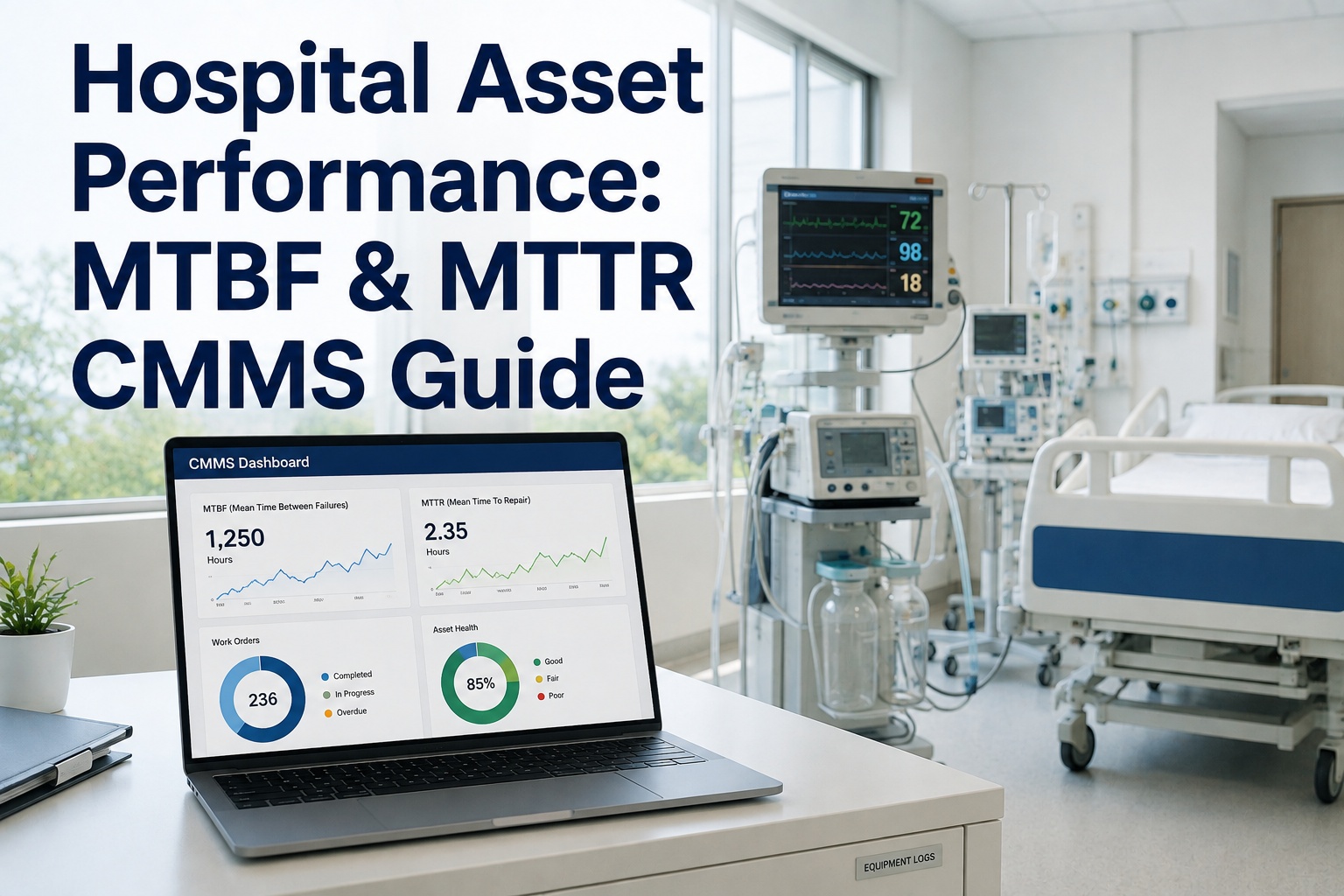
FMEA sets the priorities; reliability KPIs show whether the resulting program is working. Two numbers matter most, and OXMAINT AI tracks both from the same work-order history that feeds the occurrence scores. Start free and track reliability KPIs in OXMAINT AI.
How OXMAINT AI Makes FMEA Stick
FMEA fails when it lives in a spreadsheet nobody updates. Built into the CMMS, it stays tied to the assets, the history and the tasks it generates. Book a demo to see FMEA inside the CMMS in OXMAINT AI.
Our PM program had grown by accretion — everything got a quarterly check whether it needed one or not, and the genuinely critical devices got the same slot as the trivial ones. Scoring the fleet with FMEA forced the honest conversation: the ventilators and infusion pumps rose to the top on severity and detectability, and a lot of routine checks on low-risk assets came off the calendar. The best part is that every task now has an RPN behind it, so when a surveyor or a department head asks why we maintain something the way we do, the answer is a number, not an opinion.
Frequently Asked Questions
Maintain by Risk, Not by Habit.
Run FMEA on your hospital equipment with the OXMAINT AI maintenance management software — severity, occurrence and detection scored against real failure history, every mode ranked by Risk Priority Number, safety-critical overrides flagged, and the highest-risk items turned into PM tasks with the RPN as justification. Put biomedical hours where patient risk actually is.